Katie Couric Inspired Me to Finally Embrace My Reading Glasses Era at the Age of 44
The 'aging cliff' of 44 came for my eyes first—and a certain beloved book club host made the landing a whole lot cuter

Key Takeaways
- Presbyopia in your 40s: Age-related near vision decline commonly starts around age 44.
- Presbyopia signs: Blurry close-up vision, strain and needing more light signal readers.
- Katie Couric x Caddis: Miklos readers offer a stylish solution for first-time users and all.
They say we age in bursts, and one of those bursts hits at 44.
The articles had made the rounds in my group texts enough times that when I turned 44 earlier this year, I braced myself. What would this “cliff” feel like? How would it manifest?
Once I actually hit 44, it was hard to put my finger on. Were my disrupted sleep patterns perimenopause? Maybe, maybe not. Was it brain fog I was feeling, or just exhaustion from hitting a peak in my life that felt like being at the top of my career and parenting in hard mode with my 10-year-old preteen all at once?
I was already familiar with all the anti-aging beauty treatments and retinoids. I thought I had the landscape mapped.
Then the cliff hit me in one very specific way: my vision.

The moment I realized I needed readers
My inability to read tiny text while I had my nearsighted contacts in hit me like a ton of bricks. Even though I knew the need for reading glasses comes for everyone eventually, I still wasn’t expecting it when I found myself rubbing my eyes to read the directions on a bottle of over-the-counter painkillers. Let’s face it. I needed reading glasses.
When it’s not something you’ve even considered before, it’s hard to know where to turn. Do I go to Warby Parker? Will a CVS pair of glasses do? Do I need a prescription? What strength do I need? And—because I want to bring my best self to midlife—how do I find a pair that actually looks cute?
What’s actually happening to your eyes
If you’ve found yourself holding your phone at arm’s length, you may have presbyopia—which is a legit condition… It’s just that everybody gets it with age.
“Presbyopia is the age-related decline in the eye’s ability to focus on near objects,” Meenal Agarwal, OD, a board-certified optometrist and leading authority on the eye-brain connection at Dr. Meenal Agarwal & Associates, told Woman’s World. “Most adults will experience some degree of presbyopia; it typically begins in our 40s and those who do more near work tend to progress faster.”
So, basically, me. (Hello, I’m an editor who reads for work!) And probably you. (Who doesn’t hunch over a computer for something these days?) Dr. Agarwal says the signs to look for include:
- Blurred vision when looking at something up close
- The need to hold near things farther away to see clearly
- Headaches or eye strain when doing work up close
- Issues changing your focus from distance to near and vice versa
- Relying on more light to see things up close
Check, check, check, check and check.
When presbyopia begins, Dr. Agarwal says, treatment usually involves “reading glasses, progressive glasses, multifocal contact lenses or surgical interventions like lens implants.” The good news for the needle-phobic among us: new research supports another strategy— eye drops—though for now, most of us will start where generations before us started: with a pair of readers.
A bookish solution
One of the great joys of being an editor at Woman’s World is that I get to read a lot of books. And one of our beloved reading gurus is Katie Couric, whose book club is a favorite among readers who love a smart, feel-good pick.
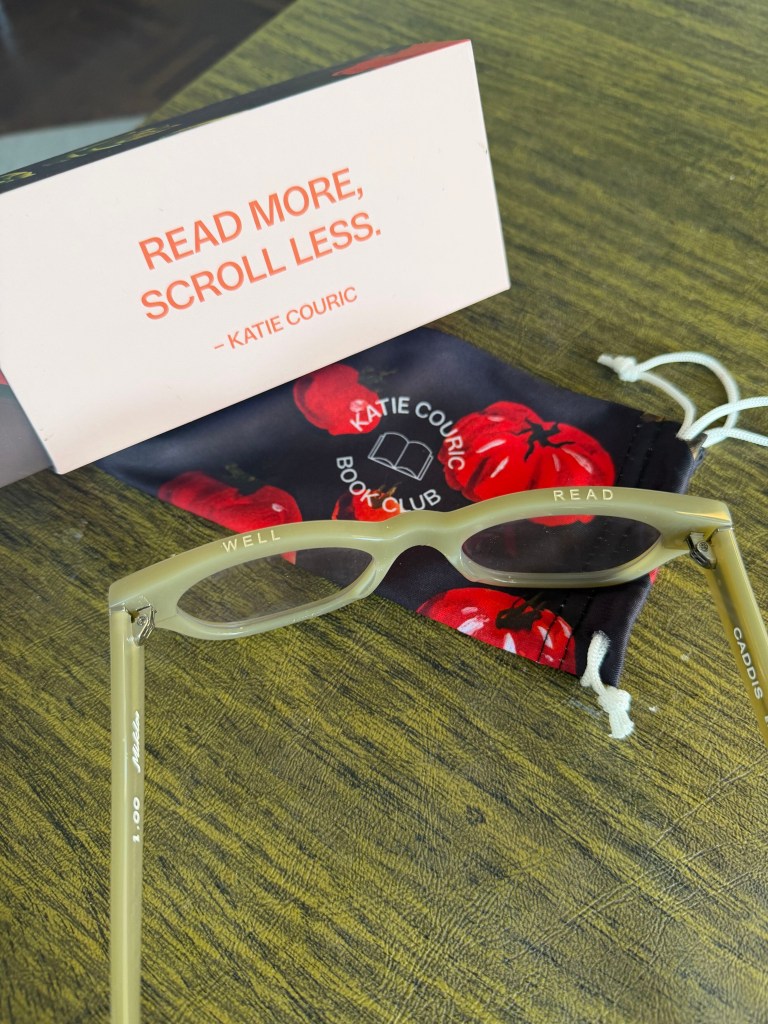
So when I heard she’d released a line of reading glasses in collaboration with Caddis, I knew this was my chance to dive headlong off the cliff of 44—and look chic doing it.
The limited-edition style presents Caddis’ bestselling Miklos frame in a custom color called Heirloom (like the tomato), with the phrase “WELL READ” etched along the top of the lenses—as a gentle reminder as to why you’re wearing them. It’s a love letter to the bookish among us, and it comes from a brand whose whole philosophy is about flipping the narrative around aging—the idea that now is what we’ve got, and now is pretty great.
Couric put it best on her Substack: “I have loved living out my 2026 goal—to read more and scroll less—with all of you in the Katie Couric Book Club. The books keep getting better, but the type, unfortunately, isn’t getting any bigger! So I teamed up with one of my favorite brands to create something special for our bookish community: a gorgeous, limited-edition pair of glasses.”
I felt seen—right at the moment I could see just that little bit better thanks to my new glasses.

My honest take on the glasses
I’ve been wearing the Caddis x Katie Couric Miklos readers in Heirloom for a few weeks now, and I can confirm: they do the job. The frame is substantial without being heavy, the color is a warm, flattering muted green and the “WELL READ” etching is subtle enough to feel like an inside joke rather than a slogan. They’re the kind of readers I’m happy to leave on my face instead of shoving on top of my head between the kitchen and the couch.
The readers are $130 and the progressives are $180. Not drugstore cheap—but as a first “real” pair, they feel like something I’ll actually keep track of, which, for a baby +1 like me, is maybe the most important feature of all.
What to look for in your first pair of readers
If you’re newly in the market, here are the questions I wish someone had answered for me before I started:
Do I need a prescription? For simple presbyopia, over-the-counter readers can work. But if you have other vision issues (I wear contacts for nearsightedness), talk to your eye doctor first. You may be a better candidate for progressives, multifocal contacts or a prescription pair.
What strength? Readers are sold in strengths—typically starting around +1.00 and climbing in quarter-point increments. If you don’t know your strength, your optometrist can tell you in about 30 seconds, or many drugstores have test cards right next to the display.
How many pairs? If you’re anything like my mom, the answer is: more than you think. One for the nightstand, one for the kitchen, one for your bag. Losing them is a near-religious experience. Plus, what I’m discovering is you can pair them with all your outfits.

Style matters. You’re going to wear these on your face. A frame you actually like—in a color that complements your coloring and a shape that flatters your face—makes the whole transition feel less like a surrender and more like an upgrade.
The real reset of 44
The cliff is real. But it’s also, I’m finding, less of a cliff and more of a doorway. On one side: pretending none of this is happening. On the other: embracing the readers, the conversations about perimenopause with my girlfriends, the glass of water on the nightstand, the willingness to say I need help seeing the tiny print on the painkiller bottle.
Katie Couric didn’t invent reading glasses. But she—and the brand she teamed up with—made it a little easier to walk through that doorway with a smile. And honestly? That’s worth more than 20/20.
Conversation
All comments are subject to our Community Guidelines. Woman's World does not endorse the opinions and views shared by our readers in our comment sections. Our comments section is a place where readers can engage in healthy, productive, lively, and respectful discussions. Offensive language, hate speech, personal attacks, and/or defamatory statements are not permitted. Advertising or spam is also prohibited.