Ann Patchett Reveals 3 Surprising Ways Her New Novel ‘Whistler’ Mirrors Her Real Life Story
Patchett opens up about the personal experiences that inspired her most talked-about novel yet

Key Takeaways
- Ann Patchett's ‘Whistler‘ includes autobiographical elements like a childhood car accident.
- Patchett has found freedom in letting go of controlling what readers think about the new story.
- Patchett’s novels feel real because she’s a pro at capturing true human emotions in scenes.
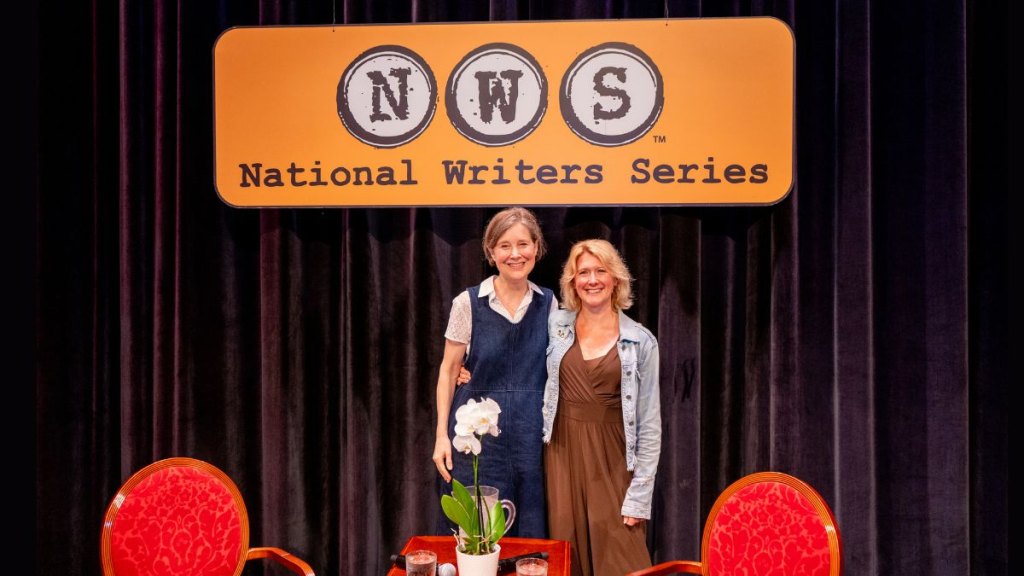
Novelist Ann Patchett has captivated millions as a storyteller, whipping up works of fiction from her imagination. But how much of her real life gets woven into her tales, like her newest novel, Whistler? “Everywhere I go, people say this novel is so autobiographical,” Patchett recently shared on the National Writers Series stage. And while she was hesitant to fully embrace that label, she admitted there are some undeniable common threads between her life and this book. And she’s finally ready to explain which parts of the story came straight from her own life. Keep reading for Patchett’s candid explanations for all her personal inspiration that she’s sharing with readers.
What is ‘Whistler’ about? A quick overview of Patchett’s new novel
Without giving any spoilers, here’s a little overview of the story, in case you haven’t read it yet. And once you hear Patchett’s insider details, you’ll want to grab a copy right away. The book is set in New York City, when 53-year-old Daphne experiences a surprise reunion in the Metropolitan Museum of Art with her former stepfather, Eddie, whom she hasn’t seen in 44 years. The story traces their bond over all that time and explores the connections we can share with people from our past despite time and distance. Here are three powerful ways this artful novel was colored by Patchett’s real life.
Ann Patchett survived a childhood car accident—just like her main character
In Whistler, young Daphne experiences a devastating car crash—and Patchett bravely revealed that she survived a similar trauma as a child, though she was quick to clarify that the two incidents are “completely different.” She explained, “Yes, I was in a car accident when I was 9 with my stepfather and my sister. But we were hit on a Sunday morning by a drunk driver.”
Patchett went on to share, “It was an explosive accident. My sister, who was in the front seat, nearly died—and nearly died for a year after the accident.” She went on to explain just how devastating the crash had been. “I was in the back seat and I broke my face and I was unconscious for many, many hours.” She stressed, “I don’t remember the accident… I woke up in the hospital.”
Thankfully Patchett made a full recovery. But that experience gave her a dramatic, authentic turning point to add to her story. She explained, “It was so pivotal when I was a kid. And I believed as a child that everyone would be in a terrible car accident sooner or later. I saw it as a rite of passage.” She added, “You draw from something you’ve experienced that is not the way you’ve experienced it, and yet emotionally you could say this thing happened and it was really life-changing.”
Patchett has been surrounded by plenty of real and fictional stepfathers
In Whistler, Daphne’s mother has been married three times—and here’s the interesting parallel: Patchett’s own mother walked down the aisle three times too. Patchett explained, “So my mother was married three times and that has been the entrance to everybody saying this is autobiographical.” She explained the logic people use with a knowing smile: “Okay, Daphne has three fathers. You had three fathers. Ergo it must be [autobiographical.]”
Patchett even wrestled with this similarity when writing the book. “I thought, ‘Oh, I don’t want to do this because if she has three fathers, everybody is going to think it’s about me’ And then I thought, ‘What the hell difference does it make?’ It doesn’t!”
The author also confirmed this book is not about her stepfather Mike.
So how has Patchett found freedom from worrying about the constant questions about similarities? “This is the answer, which is at some point you let go. At some point, you stop worrying or trying to control what anybody thinks.”
Patchett’s dear friend inspired the character of Eddie
Much like in the book, Patchett has known the bonds of deep friendship. When she lost a beloved friend to pancreatic cancer, she found herself working through her grief by writing an essay about their beautiful friendship. Patchett shared, “When I was writing about my friend Jim Fox, who died on his 85th birthday, what I realized was that I could write Jim’s voice. And it made me incredibly happy because he was the loveliest, brightest, funniest, most beloved person.”
That realization gave Patchett the joy of purpose. “I thought, I want to write a book about Jim that’s not about Jim, and it’s not about me, but it’s about the love that we have for each other.” That voice took shape and came alive in the fictional character of Eddie, the long-lost stepfather in Whistler.
Why readers are convinced ‘Whistler’ is Ann Patchett’s most personal novel yet
Why do readers want this novel to be autobiographical so badly? Patchett, 62, has a theory. The staff at Parnassus Books, the beloved bookstore she owns in Nashville, helped her understand it. “The kids who work at Parnassus say it’s ‘parasocial.’” That’s the special connection fans feel with celebrities or public figures, often through social media. Fans feel they know them, even though they’ve never met.

Patchett joked, “They all say it’s Taylor Swift’s fault.” Here’s what she means: “You listen to a Taylor Swift song and you know that it’s about Jake Gyllenhaal or whatever. If you know that, then you enjoy it more because you know that this is actually her story.” So Patchett suspects readers might experience books the same way and feel a bond to the book because they sense its connection to the author’s real life.
How Ann Patchett transforms real life into unforgettable fiction
For every book Patchett has written, she’s stitched together outside research and real-life observations. She offered a great analogy: comparing writing a novel to cooking a meal. “There is very much a sense in which I cooked from my own pantry when I was making this book.” She added, “There is the dinner that you go to four grocery stores to buy the ingredients. It calls for lemongrass. You don’t have any. And then there is like pasta and sauce and beans, and you have everything dried right there. And that’s what this book is.”
Bottom line: Whether you believe that Whistler is partly autobiographical or not, enjoy it for the powerful, heartfelt story that it is. Patchett does what the best writers do: She crafts stories that touch us because they capture real human emotions.
Conversation
All comments are subject to our Community Guidelines. Woman's World does not endorse the opinions and views shared by our readers in our comment sections. Our comments section is a place where readers can engage in healthy, productive, lively, and respectful discussions. Offensive language, hate speech, personal attacks, and/or defamatory statements are not permitted. Advertising or spam is also prohibited.