Julia Whelan Talks Audiobook Stardom, Writing ‘My Oxford Year’—And Its Upcoming Movie (EXCLUSIVE)
The author of ‘Thank You for Listening’ shares career insights, favorite titles and more

Julia Whelan, award-winning audiobook narrator and bestselling author, has become one of the most recognizable voices in modern fiction—literally. Known for her work narrating hundreds of books, including fan favorites by Taylor Jenkins Reid, Kristin Hannah and Emily Henry, she’s mastered the art of bringing a story to life. Many listeners even seek out audiobooks specifically because she’s the one reading them.
And Whelan isn’t just the voice behind best-selling novels—she’s written a few herself. Her debut, My Oxford Year, captivated readers with its dreamy London setting, coming-of-age plotline and sweet romance, and now, the story is headed to the big screen.
The story behind My Oxford Year has had a long and winding path to becoming a film—starting not as a novel, but as a screenplay Whelan was initially hired to write. “It’s been 13 years since I first started working on the screenplay, and it’s been seven years since the book came out, so I am so happy and fulfilled to see this finally coming to fruition as originally intended,” she tells Woman’s World. After spending time developing the script, Whelan realized the story needed more—something she felt could be better explored in novel form. That decision ultimately led to her debut as an author, with the project coming full circle.
Here, Woman’s World sat down with Whelan to discuss her audiobook career, what it means to see her novel being adapted into a film, her favorite titles and more. Keep scrolling to find out all the details.

Woman’s World: You have had a very successful acting career from a young age. How has your acting training and experience supported and distinguished your audiobook work?
Julia Whelan: I’ve been acting since I was 9, and I was a very trained young actor. I wasn’t someone who just got away with being cute; I treated it like an athletic pursuit. So I was very into being as good at it as possible, and all of the skill set that that gave me allowed me to learn how to translate those skills into just voice. One of the biggest learning curves about doing audio performance is you lose the ability to use your body and face, so you learn very quickly what works in audio and what doesn’t.
For instance, if I’m doing something intentionally dry or sly, I might, as an actor on camera, roll my eyes, or just be able to give a look, and it will be conveyed to the audience what I mean. When I tried that in audio, when first starting, I would listen back and think that did not come through at all. So, learning how to translate all of those skills into just channeling through your voice was a challenge
WW: Besides narration, you’ve also authored two very successful novels. What are some differences between writing a book and narrating/performing one?
JW: I came out of college with a writing degree, so I was intending to write. The audiobooks were the job that came along to pay the bills when I needed it, and then it became a career, accidentally. In the meantime, I was always writing and always working on my own stuff. But an interesting thing happened: I wasn’t good enough at either thing yet to do them simultaneously.
As a writer, especially a young writer, you always try to find your voice and take. And when I would be in a first-draft scenario where I would be writing, writing, writing, and then I would have to go into the booth and dive into someone else’s voice and world, the lines would get crossed. I couldn’t do either one effectively, so I put down my pen for about four years while doing audiobooks, until I felt competent and secure enough to interpret someone else’s work without it infecting my own. But recording audiobooks has taught me so much about how books are made, and I learned a lot about pacing and construction, which has been very helpful.
WW: You often narrate multiple books by the same author. What’s that collaborative process like between author and narrator?
JW: The collaboration with authors is one of this job’s unexpected joys. Unlike on-camera work, this is such an isolated, solitary performance experience. I’m in my booth alone most of the time. I’m self-directing. I’m self-engineering; no one is listening to me as I record, so I don’t have the immediate feedback I would typically have as an actor in any other medium. So the collaboration, as opposed to being with different actors and a director or production crew, is really with the author. And one of the things that I have loved experiencing over the last 15 years of doing this is partnering with the authors whose voices I just get.
We are very aligned. I understand what they’re trying to convey with their books, and my job is to help adapt them for the listener so that the listener gets the same feeling that someone reading with their eyeballs will get. Watching their success and development over the years has been incredibly gratifying and makes me feel like we’re in a partnership.
WW: What parts of audiobook narration do you think most people don’t realize or underestimate?
JW: The number one thing that always surprises people when I talk about it is how much work goes into the pre-recording process. It is a job that is highly dependent on prep work. I obviously read the book ahead of time. It would be a dereliction of duty not to, but it’s also a very close reading where I’m keeping a list of characters as well as a list of words I need to learn how to pronounce. For the character list, I’m keeping not only vocal information that the author has given me in the text, but also any biographical information, so that I can start building them out.
I also research whether there are any accents that I need to brush up on, and there is a lot of back-and-forth with the producer and the author. By the time I sit down to record, it’s about a two-to-one ratio in the booth of recording time to finished hour. So all told, it’s about four hours of work for every hour of finished audio.
Another thing I don’t think people realize is that I read the book straight through. I’m not going and doing one character’s lines of dialogue and then stopping. Lastly, the narrators don’t get royalties. It boggles my mind that we are such a big part of an audiobook’s success, and we do not benefit from that success.
WW: You’ve narrated hundreds of audiobooks. Do you have a favorite book or character you’ve voiced?
JW: I can’t say I have a favorite book because I don’t have favorite children. I do have books that have meant something to me personally when I’ve recorded them, either because they were turning points in my career, or they just resonated with me as a reader at a moment that I needed them. It’s sort of like asking me what my favorite music is, but it depends on the mood.
Certain characters stand out to me. Alicia from the last Cormac McCarthy book, Stella Maris, which was done in duet with Edoardo Ballerini, was very interesting because she was A: so different from me, and B: the way it was recorded was like a transcript, so I was fully inhabiting a character. There was no narrative. It was just performing a character again. And that was really fun.

WW: Shifting gears to congratulate you on the ‘My Oxford Year’ film adaptation. How does it feel to see that come to the screen?
JW: This book has a very interesting and unique origin story. It started as a screenplay that I was hired to work on because it had gone through a few different drafts, but no one who had touched it yet knew how Oxford worked or had been. So a friend and I, she went to Oxford as well, and she’s a screenwriter. We were hired to polish the screenplay, bringing a lot to the story and developing it further.
At a certain point in that process, the producers got to know my very strong opinions about the story and asked me, ‘Do you think there’s a book here?’ And I said, ‘Nothing has ever wanted to be a book more.’ They wanted to find a writer, and I went ‘I live in books. That’s my day job. I know exactly where this book would fit on the shelf. I know exactly the story I want to tell. Please let me do it.’ And they gave me a shot.
We were in pre-production previously, and there was another cast attached. So I was writing as fast as possible to beat the movie. And then Hollywood being Hollywood, things fell apart, and they would come back together and they would have another draft of the screenplay happening. And then COVID happened, and the strikes happened, and it just kept getting delayed. It’s been 13 years since I started working on the screenplay, and it’s been seven years since the book came out, so I am so happy and fulfilled to see this finally coming to fruition as it was originally intended. But it’s been a journey.
WW: After writing ‘My Oxford Year,’ you followed up with ‘Thank You for Listening,’ a novel set in the world of audiobook narration. How much of that story is drawn from your real-life experience behind the mic?

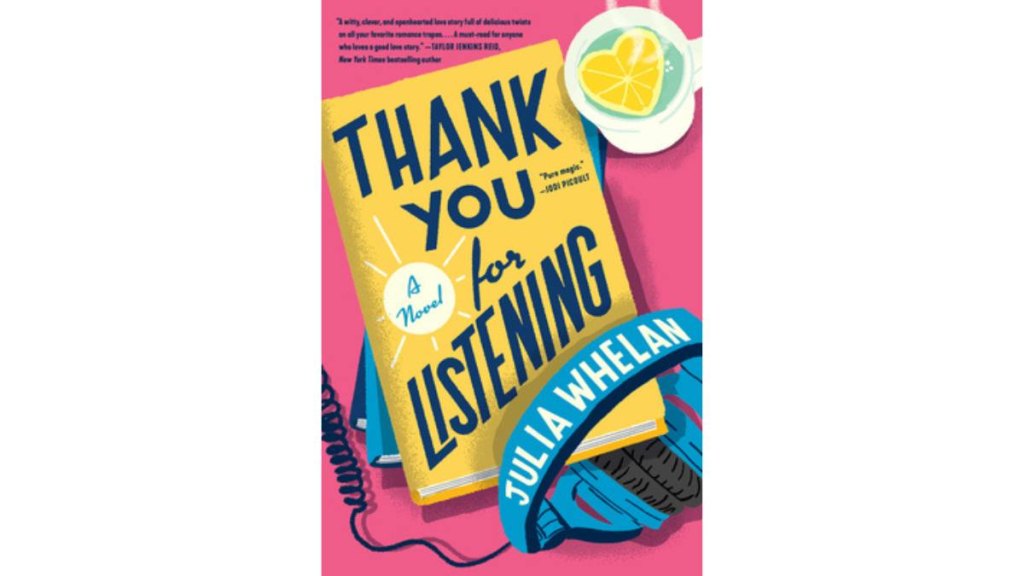
JW: Like My Oxford Year, people assume TYFL is a memoir, and it’s absolutely not. It’s not even a really light autobiography. It’s truly fictional. I definitely brought myself to the writing, but I was not writing about myself. I wanted to write about this job and this world and what it means to do art anonymously or invisibly in a certain way, which is what an audiobook narration is. And a lot of the job and day-to-day stuff is very much my personal experience, but it’s not autobiographical. Most people assume the part of the audiobook is autobiographical, but it’s actually the storyline with the grandmother because the setup of the book is similar to something that I was dealing with in my life.
WW: We have to know, do you listen to audiobooks, and if so do you have a favorite narrator?
JW: Unfortunately, I don’t have a commute, and I walk from my bedroom to my office. I have so much narrative in my head at any given moment that I can’t take on more between writing, performing and also reading slush pile stuff. There are just too many books! That said, I had the experience of listening to Beautiful Ruins, which came out like 12 years ago. But it’s a Jess Walter book, and it was one of Edoardo Ballerini’s first books, and I was listening to it, realizing that this is why people listen to audiobooks, because the performance is this transformative. I wish I had more time to listen, because it was such a moving, incredible experience.
WW: Finally, we love knowing what our favorite authors are reading. What are some books you always recommend?
JW: I’ll stick with books that fly under the radar, because it feels ridiculous at this point to recommend bigger titles. Some of my favorites include:
- Bluff by Michael Kardos
- Painted Horses by Malcolm Brooks
- Follow Me by Elizabeth Rose Quinn
Conversation
All comments are subject to our Community Guidelines. Woman's World does not endorse the opinions and views shared by our readers in our comment sections. Our comments section is a place where readers can engage in healthy, productive, lively, and respectful discussions. Offensive language, hate speech, personal attacks, and/or defamatory statements are not permitted. Advertising or spam is also prohibited.