The Beatles’ Rooftop Concert: How One Cold London Afternoon Became Their Final Live Performance
Inside the day that allowed John, Paul, George and Ringo to perform one last time

By January 1969, The Beatles were a band at a crossroads. Just three years earlier, they had walked away from touring after their final concert at Candlestick Park in August 1966. Exhausted by the chaos of Beatlemania and frustrated by the limitations of live sound systems, the group had turned its attention inward, creating increasingly ambitious studio work on albums like Sgt. Pepper’s Lonely Hearts Club Band and The Beatles (aka The White Album). Yet by the end of 1968, one member of the band was beginning to feel the absence of the stage more acutely than the others.
Insofar as three-quarters of The Beatles were concerned, touring would remain a thing of the past, but for Paul McCartney, there was a growing belief that the longer the group distanced themselves from their fans, the more difficult it would be for them to remain strongly bonded as a band.
“Paul increasingly regretted The Beatles’ decision to stop touring,” said Peter Brown, confidant of the group and author of The Love You Make. “The Beatles had lost contact with their audiences, and he felt that was a mistake. His creativity was nurtured by the immediate feedback of a live audience. That public adulation was half the fun of being a musician, he felt, and his need for the sound of applause was so strong that one day, high on LSD, he stopped at a roadside pub in Bedfordshire and played the piano for the delighted patrons. Paul had decided that it was important for The Beatles to ‘get back to their roots,’ and that was what Get Back was supposed to be.
“However,” he adds, “the idea of a huge tour was greeted with great reluctance by the others, and it was whittled down to having a documentary filmed of them making the album, capped by a single live performance. Paul wanted to justify the idea of one show by holding it in some grandiose location. A Tunisian amphitheater was considered but dismissed as impractical, as was holding the concert on an ocean liner in the middle of the Atlantic. John’s personal suggestion was that they hold the concert in a ‘lunatic asylum,’ and perhaps he was right. The Beatles needed their heads examined to embark on such a project.”
The ‘Get Back’ Project
The idea that McCartney was pushing eventually evolved into what became known as the Get Back project—an attempt to strip away studio experimentation and document the band writing and rehearsing new material before performing it live.
The project would ultimately be filmed by director Michael Lindsay-Hogg and eventually released as the 1970 documentary Let It Be. Decades later, the same footage would be revisited and dramatically expanded by Peter Jackson for the 2021 documentary series The Beatles: Get Back, which revealed a far more nuanced portrait of the band’s creative process than audiences had originally seen.
In the earliest stages of the project, one fan of the idea was producer George Martin, who explained, “They wanted to write a complete album and rehearse it and then perform it in front of a large audience. A live album of new material. Most people who did a live album would be rehashing old stuff, but they thought, ‘Let’s have a completely new album that nobody has ever heard, and put it in front of an audience.’ It was a great idea, except that you couldn’t have an open-air concert in England in February and there was no venue available that would take The Beatles and their crowds. So we then started thinking about staging it abroad, we thought about doing it in California, but that would have been too expensive. We thought of going to Marrakech and importing people—but that fell through. In the end, because there was so much vacillation, there was nowhere left at all. So they started rehearsing down in Twickenham Film Studios.”
The rehearsals at Twickenham Film Studios were famously tense. Cameras rolled as the band worked through new material, sometimes arguing, sometimes rediscovering their musical chemistry. Those sessions would later move to the newly constructed basement studio inside the Beatles’ headquarters at Apple Corps.
‘We need an ending!’
But director Lindsay-Hogg had a growing concern: his film had no ending. “I didn’t want to make a straight documentary,” he said of his intent for the film. “I figured if we just showed them working, we’d learn quite a bit about them. But I did want an ending. We had all of these rehearsals and all this footage and it wasn’t going anywhere. One day we had lunch and I said to them, ‘Listen, we’ve got to do something to have an ending because this is the project.’ I was told, ‘There is no special. It’s just going to be what this is,’ but I said, ‘We just don’t want to put it in a drawer when it’s over. We need some kind of climax here. We need some kind of resolution.’ I didn’t want to let Let It Be get put in the closet, because the momentum was gone. So the only way I knew to fix it was to have some sort of climax. I said, ‘Why don’t we just do some sort of concert on the roof?'”
McCartney immediately responded to the idea, though he was the only one initially enthusiastic. Noted Lindsay-Hogg, “George didn’t [want to do it], which was the usual breakdown of the personalities. And then John, who was the leader of the democracy, if he chose to be, said, ‘Oh, f**k it, come on, let’s do it.’ And so we all walked up that little staircase and kind of into history.”
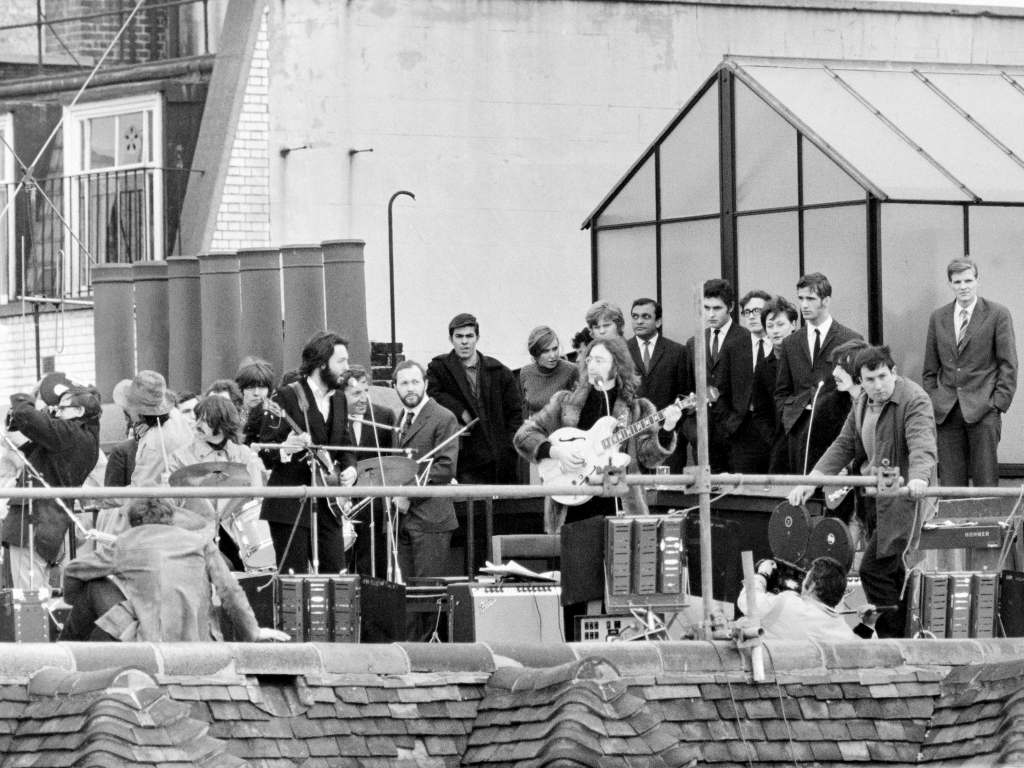
And so, on January 30, 1969, The Beatles stepped onto the rooftop of Apple’s headquarters at 3 Savile Row in London.
“We went on the roof in order to resolve the live concert idea,” said George Harrison, “because it was much simpler than going anywhere else. Also, nobody had ever done that, so it would be interesting to see what happened when we started playing up there. It was a nice little social study.”
Reflected Ringo Starr, “I remember it was cold and windy and damp, but all the people looking out from offices were really enjoying it.”
“It was good fun, actually,” enthused McCartney. “We had to set the mics up and get a show together. It was really good fun, because it was outdoors, which was unusual for us. We hadn’t played outdoors for a long time.”
Mojo magazine summed up the “concert” pretty succinctly: “The Beatles, with Billy Preston in tow [he played keyboard], took to the roof of 3 Savile Row for what was to be their last public performance, played to an audience of Apple staff, reporters, local office workers, businessmen and passers-by. And, for three-quarters of an hour, The Beatles actually gelled as they blasted their phenomenally loud, rockier numbers into the icy London air. McCartney was proven right; the four musicians enjoyed themselves as they ran through several takes of ‘Get Back,’ ‘Don’t Let Me Down,’ ‘Dig A Pony,’ ‘I’ve Got A Feeling’ and ‘One After 909.’

“The impromptu concert was brought to a premature end by local police after the manager of a nearby bank complained about the breach of the peace,” the article continued. “Although no arrests were made, it was as dramatic as they could manage. Afterwards, The Beatles felt the elation of the live performance. ‘The whole scene is fantastic,’ beamed Lennon.”
For one brief moment, the band looked and sounded like the Beatles of old — four musicians enjoying the simple thrill of playing together.
Sadly, but for that one moment in time, there was no escaping one fact: it was all coming to an end. Which it did in 1970.
Conversation
All comments are subject to our Community Guidelines. Woman's World does not endorse the opinions and views shared by our readers in our comment sections. Our comments section is a place where readers can engage in healthy, productive, lively, and respectful discussions. Offensive language, hate speech, personal attacks, and/or defamatory statements are not permitted. Advertising or spam is also prohibited.