Thinning Hair After 50? These Expert-Backed Fixes Can Help Your Strands Look Fuller and Healthier
Hair thinning is common as we age, but these affordable options can help regrow and strengthen locks

Key Takeaways
- Hair thinning becomes increasingly common for women in their 40s and 50s.
- Biotin supplements may not help unless you have a proven deficiency.
- Coconut oil, gentle hair care and healthy nutrition can support stronger-looking hair.
If your part looks a little wider lately or your ponytail doesn’t feel as full as it once did, take heart: You’re far from alone. Hair can change as we age, and while seeing more strands in the brush can be discouraging, a little extra TLC can go a long way, and there are gentle, affordable ways to care for your scalp, minimize breakage and give your hair the support it needs to look and feel fuller, healthier and stronger.
What’s really happening to your hair after 40
Your hair naturally cycles through growth, rest and shedding, and losing about 100 strands a day is completely normal. What’s not normal is a sudden uptick—and that’s often a signal worth paying attention to.
“By the time women are in their 40s, there’s about a 40 percent chance that they can start to notice thinning,” says Christina Han, MD, dermatologist and medical director at XYON Health Inc. “And by the time they’re in their 50s, about 50 percent will notice increased thinning.”
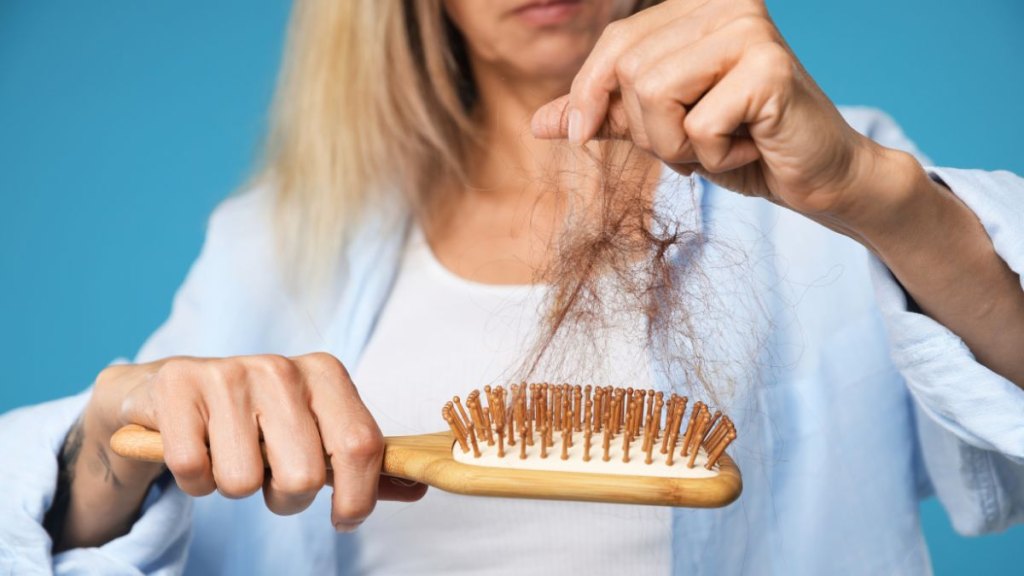
Thyroid imbalances, PMOS and nutritional deficiencies can all disrupt the hair cycle and lead to excessive shedding, known as telogen effluvium. Han advises talking to your doctor if you spot a sudden change, because treating the underlying issue often turns things around.
Age plays a role, too—female pattern hair loss (androgenetic alopecia) is the most common form of hair loss in women, according to the American Academy of Dermatology, and it affects roughly two-thirds of women after menopause.
An Annals of Dermatology study also found that hair loss can seriously sap women’s self-esteem and lower quality of life, so if you’ve been feeling down about it, that reaction is valid—and worth addressing.

Does biotin really help?
Biotin shows up in nearly every hair supplement on the shelf, but the vitamin isn’t the magic bullet many women hope for.
“Biotin is a B vitamin—vitamin B7—that plays a role in energy metabolism and helps support healthy hair, skin and nails,” says Ross Kopelman, DO, a hair restoration surgeon in New York City. It’s naturally present in eggs, salmon, sweet potatoes, nuts, seeds and leafy greens, which is why most people already get what they need.
“Most people are already getting enough without even thinking about it,” Kopelman says. “That’s actually why I don’t typically recommend biotin supplements unless there’s a proven deficiency.” He also cautions that high doses can interfere with thyroid and cardiac lab tests and may trigger breakouts in some patients.
If you suspect a deficiency, trichologist Kerry Yates, founder of Colour Collective, points out that biotin does feed the follicle. “It’s known to improve the overall appearance and resilience of the hair, making it shinier, less prone to breakage and generally healthier over time,” she says. For most readers, a comprehensive hair supplement that pairs biotin with other nutrients—Kopelman mentions Nutrafol or Viviscal—tends to be more useful than biotin alone.
The kitchen staple that works wonders
For a hair treatment under $10, it’s hard to beat coconut oil. Dana Ionato, a colorist at Sally Hershberger NoMad Salon in New York City who’s worked with Jennifer Lopez and Scarlett Johansson, calls it a “miracle product” for hair. “Not only does it make your hair healthier, it prevents protein loss and penetrates deep into your hair cortex,” she says.
Stephanie Angelone, a hairstylist at RPZL Salon in New York City, agrees. “It has natural fatty acids that nourish strands, which make it a versatile product that I recommend to every client.” Coconut oil also brings antifungal and antimicrobial benefits that can ease dandruff, tames frizz by smoothing the cuticle and adds shine thanks to lauric acid.
To use it as a weekly mask, Angelone suggests scooping solid coconut oil and massaging it in—or warming it until melted and combing it through. Ionato recommends starting at the ends and working up toward the roots, letting it sit 15 to 20 minutes, then rinsing with shampoo. For a lighter mist, melt a tablespoon, combine with ¼ cup water in a spray bottle and spritz onto hair.

Smart drugstore buys for thinning hair
Price isn’t always a reliable guide to quality. “The idea that all drugstore products are bad for your hair is a misconception,” celebrity hairstylist Laura Polko, founder of Laura Polko Los Angeles, says in her rundown of drugstore dos and don’ts. “However, there are a few ingredients you should watch out for.”


Watch labels for sulfates (sodium lauryl sulfate), silicones (dimethicone), heavy alcohols, parabens and phthalates. “Drugstore hair brands aren’t inherently bad but often use cheaper ingredients like sulfates or silicones, which may cause buildup or dryness,” says Jennifer Korab, celebrity hairstylist and founder of Renaissance Salon and Spa.
She recommends Pantene Pro-V Repair and Protect Shampoo for its balance of moisture and repair, along with L’Oréal Elvive Hyaluron Plump Hydrating Conditioner.
The bottom line
Healthier hair after 50 is less about one miracle product and more about the small, steady choices—protein on your plate, a few minutes of scalp massage, a weekly oil treatment and a careful eye on labels. If shedding doesn’t ease up, your dermatologist can walk you through options like prescription medications, laser therapy or platelet-rich plasma (PRP) therapy. You have more tools—and more time—than you think.
Ready for more? Subscribe to our YouTube channel for video podcasts, health tips and uplifting stories designed for women 40, 50, 60 and beyond.
Conversation
All comments are subject to our Community Guidelines. Woman's World does not endorse the opinions and views shared by our readers in our comment sections. Our comments section is a place where readers can engage in healthy, productive, lively, and respectful discussions. Offensive language, hate speech, personal attacks, and/or defamatory statements are not permitted. Advertising or spam is also prohibited.