At IFA, ARBREST Rethinks the Ergonomic Chair Around Women’s Needs

At IFA Berlin, the conversation around office furniture is usually led by screens, materials and increasingly elaborate mechanisms. At Arbrest’s stand in Hall 2.2, Stand 141, the point of interest was more physical. Visitors could sit in COVE, move through its forward tilt and recline positions and notice what happens when the chair responds to the body rather than asking the body to settle for the chair.
ARBREST presented COVE at IFA from September 4 to 8, 2026, as its first product and the public expression of the new brand. COVE made its world debut at the show and has received the IFA Best of Design award. The chair is designed around women’s proportions and everyday working postures. Office furniture has become more adjustable, but adjustability does not automatically solve a poor starting point.
That problem is where ARBREST says its development began. The brand describes itself as a smart lifestyle technology company interested in overlooked details of everyday comfort. Its technology is intended to remain quiet, appearing when needed. With COVE, that philosophy takes a specific form: redesign the reference points first, then build movement around them.
The chair’s 7-Point Fit Calibration covers seat height, seat width, seat depth, lumbar support position, armrests, headrest and footrest. COVE is engineered for users between 150 and 175 centimeters in height. Seat height adjusts from 46 to 54 centimeters, and seat depth from 43 to 49 centimeters. These figures may look modest on a specification sheet, but they shape the first few minutes of use. If the seat is too deep, a user may slide forward. If the lumbar support sits too high, the lower back loses contact. If the feet do not reach the floor comfortably, the legs begin searching for support elsewhere.
COVE treats the seat as a set of different jobs rather than one uniform cushion. A firmer zone supports the sit bones, while the pelvic area is gently contoured. The flexible front edge is intended to reduce pressure beneath the thighs. It is not a dramatic visual feature. It is a small design detail intended to make the front edge less noticeable during longer periods of sitting.
The same practical thinking appears above the shoulders. The 3D Winged Headrest leaves room for ponytails and updos, so reclining does not press a hairstyle against the support. Wide-surface touch controls are designed for fingertip or knuckle use, including for people with longer nails. The 5D armrests follow changing elbow positions while typing, reading, browsing or turning to speak.
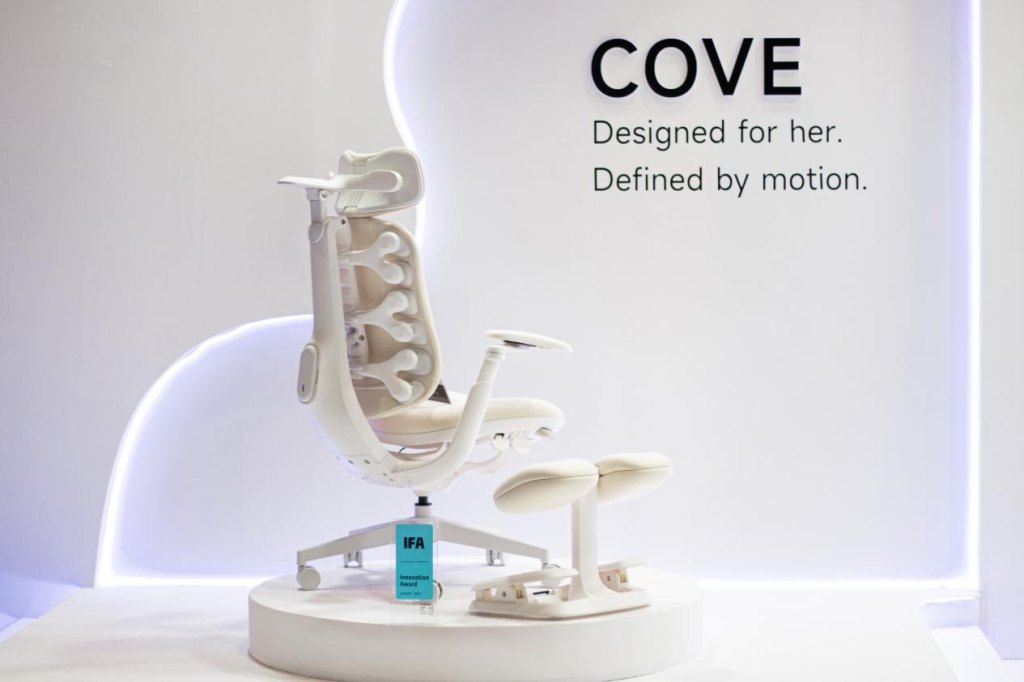
Fit is the first part of the COVE proposition. ARBREST began with how women sit, then developed movement around that starting point. A working day rarely stays in one posture. Its multi-axis chassis provides up to 16 degrees of forward tilt for concentrated work. The user can move toward the desk while the seat, backrest and dual-tier active footrest are designed to maintain support. The point is not movement for its own sake, but support that follows the body.
Behind that movement is a 12-Zone Micro-Motion Backrest. Twelve independent support units are arranged along a flexible spine plate, designed to accommodate movement across the shoulders, back and lumbar area. The intention is not to freeze the user in a corrected pose. It is to maintain contact through small shifts, turns and changes in weight.
Five points—the headrest, armrests, backrest, seat and footrest—are coordinated as one support system. When fatigue sets in, a motorized lumbar support extends forward as the backrest reclines, while the footrest supports the lower body. The feature is intended to offer a brief seated stretch and reset without requiring additional manual adjustment.
COVE’s market significance lies in the question it brings to a familiar category. Ergonomic chairs have traditionally treated differences in body size as problems to be solved after the main design is complete. ARBREST is placing women’s proportions at the beginning of the process and combining that fit with movement, hairstyle-aware details and a seated reset function. It does not make a medical promise, and it does not claim that one chair suits everyone. Its proposition is narrower, suggesting that ergonomic design can begin accounting for differences in body proportions.
At IFA, COVE presented ARBREST’s approach to ergonomic design through fit, movement and details developed around women’s proportions.


