Using a Yoga Ball During Pregnancy: What Expectant Mothers Should Know
From choosing the right size to understanding common uses, here’s what expectant mothers should know about yoga balls.

The second trimester of a pregnancy can be an uncomfortable time for expectant mothers. The couch may sag under them, and desk chairs start to pinch. Finding an alternative can become a priority to alleviate discomfort. This is when some mothers start considering using a yoga ball as an alternative.
A yoga ball is a large inflatable exercise ball that is sometimes called a stability ball, exercise ball or birthing ball. These balls come in a variety of sizes and can be used for sitting, gentle movement and comfort. Depending on her health and how her pregnancy is progressing, a woman may also use a yoga ball during labor.
Using yoga balls during pregnancy
If a pregnant woman is given the green light by her medical provider, she can add a yoga ball for pregnant women to her daily routine. She should check the sizing charts on the box before making her selection, and choose one that fits her needs.
An anti-burst yoga ball is a firm tool that many women use for comfort and can also support:
- Upright posture while seated for work, reading, watching television and more
- Gentle hip and lower-back movement through slow pelvic rocks and circles
- Gentle mobility on days when a mother feels stiff, but not up to other forms of exercise
- Practicing familiar positions that may be used in early labor, such as leaning forward while kneeling
Not everyone who uses a yoga ball will have the same benefits. It’s not a cure-all for every ache and pain. It is also not a replacement for regular checkups with a clinician. The yoga ball provides comfort and movement.
Some family members may wonder if using a yoga ball is the same fad they remember from the past. Upright positions and gentle hip movement have been used for a long time in labor rooms and predate social media trends.
Choosing the right size with a quick sit test
When selecting a yoga ball to use during pregnancy, a mother should look at the sizing. The common picks in yoga ball sizes depend on the mother’s height. If the mother is shorter, she should choose 55 cm; average-height moms should opt for 65 cm, while 75 cm is a good choice for taller women.
To see if a yoga ball is the right size, the yoga ball should be inflated until it feels firm, but not rock-hard. A mother should stand the ball in a clear area of the floor and have her partner seated within arm’s reach. When the pregnant mother sits down, her feet should be flat on the floor with her knees bent at about 90 degrees. Her hips should be level with or slightly above her knees. If her knees are higher than her hips, the ball is too small. If the mother feels unstable or her body stretched, she should opt for a different size.
A yoga ball should be stored away when not being used, kept away from radiators, pets or sharp objects. The pump should be put in a place where it is easy to find, since slow leaks can happen.
When should a pregnant woman start using a yoga ball?
There isn’t a set time when a mother should start using a yoga ball. Many women begin in the second trimester. It’s during this time that their bump is showing and sitting on a flat surface becomes uncomfortable for many moms-to-be. This is also when morning sickness may start to go away, and movement may make a nauseated mother feel worse. Other mothers might start earlier if their medical provider approves light activity.
Before a mother starts to use a yoga ball, she should:
- Discuss using one with her obstetric provider, especially if she has concerns about exercise or balance
- Check that the ball is the right size, with her hips level with her knees or slightly above when her feet are flat
- Make sure she has a clear floor space and something sturdy to use to stabilize herself if her balance shifts in her third trimester.
If a woman has a high-risk pregnancy, placenta previa, preterm labor history or experiences unexplained pain, she should ask for medical guidance, not just copy someone else’s routine.
Safety considerations
Many expectant moms use yoga balls for sitting during pregnancy. If a mom has the approval of her medical provider to use a yoga ball, she should still take precautions.
Some safety tips are:
- Inflate the yoga ball so it’s firm, but with a slight give
- Check the air every week or two
- Prevent slipping by having bare feet or socks with grip
- Avoid sitting for long periods of time since it can strain the back and hips
- Place the ball in a clear area, but be able to reach out to stabilize her balance
- Stop using the ball if dizziness or other symptoms occur. A medical provider should be contacted immediately if bleeding, fluid leakage or painful contractions occur.
Some women use a stability ring or base for their yoga ball, which may be useful during their third trimester.
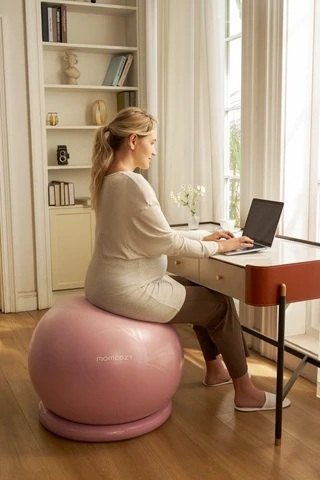
Is it okay to bounce on a yoga ball while pregnant?
Aggressive bouncing is not recommended for pregnant mothers. This is especially true for mothers who have been told to limit activity, have preterm labor risk or cervical issues.
Small rhythmic movements may ease pain in the lower back, but if bouncing causes pain, breathlessness or triggers contractions that don’t cease, a mother should call her doctor.
Mothers often pair their ball time with something they already do, like watching half of an episode, talking on the phone, reading or other tasks.
Understanding the different types of exercise balls
A yoga ball is not the same thing as a small Pilates ball or a weighted medicine ball from the gym. A yoga ball is usually between 55 and 75 cm in diameter and is used for sitting, leaning and gentle movements.
The terms yoga ball, exercise ball and birthing ball are often used to describe the same product. The package should be read to check the ball size, whether it is anti-burst, and how stable it is when inflated.
A yoga ball is not a medical treatment. It’s home equipment used for comfort and labor practice. If cleared by a doctor, some mothers use the same ball for postpartum seated stretching.
Yoga ball pregnancy use should be approved by a doctor who understands the mother’s medical history and her pregnancy risk.
This article is for informational purposes only and does not substitute for professional medical advice. If you are seeking medical advice, diagnosis or treatment, please consult a medical professional or healthcare provider.


