Superman Creators Jerry Siegel and Joe Shuster Sold the Rights for $130—Then Fought To Get Them Back
'The Superman Wars' looks back at the lifelong battle waged by the Man of Steel's creators

Key Takeaways
- Superman’s rise began in 1938—and sparked decades of creator legal battles.
- The creators lost control of Superman just as he conquered the world.
- Superman’s success exposed the business side of comic book creation.
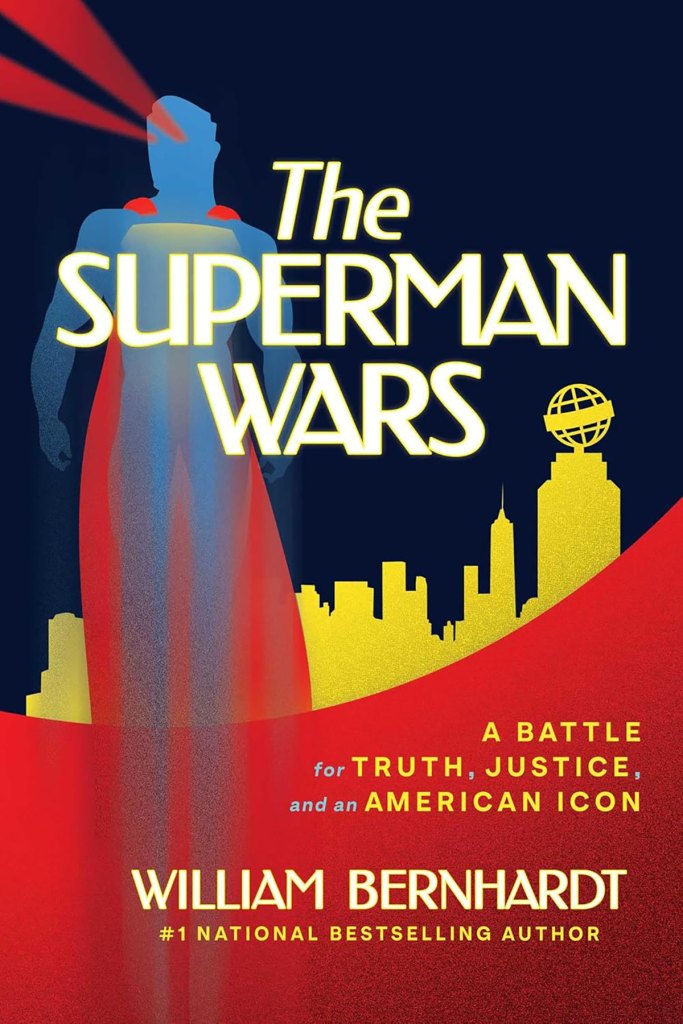
Superman has always been presented as something larger than life—a symbol of hope, strength and moral clarity. But behind that symbol lies a very different story, one defined not by triumph, but by decades of struggle over who truly owned the Man of Steel. That’s the story author William Bernhardt set out to tell in The Superman Wars, a deep dive into Jerry Siegel’s long, painful battle over the character he created—and ultimately lost control of.
“I’m a longtime comic book and probably every other brand of nerd person that there is,” says Bernhardt, author of numerous courtroom dramas, with a laugh. “I was doing my last courtroom thriller and I wanted to get into the idea of art versus commerce conflict. My first take was, ‘Let’s do it about movies.’ Then I thought, ‘No—comic books. That’ll be more fun.’” It was a decision that led him straight into one of the most complicated and emotionally charged stories in pop culture history.
At first glance, the saga of Siegel (and artist Joe Shuster, though the focus of The Superman Wars is squarely on the former) and DC Comics can seem like a dense legal maze—contracts, appeals and settlements stretching from the 1940s into the 21st century. But Bernhardt quickly realized that wasn’t the real story.
“I didn’t want the book to just be lawsuits. That would be so boring,” he explains. “You don’t care about the lawsuits unless you care about the people. So, I started thinking about writing a book about Jerry Siegel… I’m a writer, so I love writers and I can get into the head of writers. And so much about who Jerry Siegel is I could relate to—how precocious he is. He knows he wants to be a writer at a very early age. He’s sending things off. He’s getting published when he’s a one-digit age.”
Like many writers, Siegel faced rejection early and often. “I got my first rejection letter when I was 11,” Bernhardt reflects, in essence sharing the experience. “Which I can prove because I’ve still got it… but you just keep pushing at it. Eventually, something breaks for you.” For Siegel, something did break—but not in the way anyone would expect.
The price of success
Superman’s success is one of the great stories of American pop culture—but for Siegel, it came at a devastating cost. “As you know very well, when something finally broke for Jerry Siegel, the problem was he didn’t own the character anymore.”
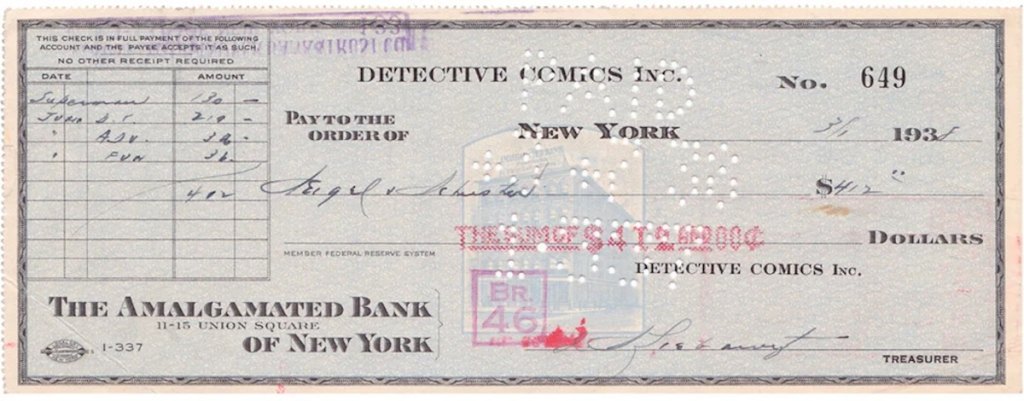
In 1938, Siegel and Shuster—young, ambitious and without guidance—signed away the rights to Superman for $130. It was a foothold, nothing more. There was no way to predict that the character would become a cultural phenomenon. “Jerry lost his father when he was 17. He had nobody to advise him,” notes Bernhardt. “They didn’t have agents, they didn’t have lawyers and they made mistakes.”
And yet, the implications of that deal would ripple across the entire comics industry. “If they could screw over Jerry and Joe, they can do that to anybody—and often did. That’s why people call it the original sin of comics because it started at the very beginning.”
That contradiction—success paired with loss—sits at the heart of The Superman Wars. “Jerry Siegel created the character and wrote the scripts… He should have had a better life instead of the decades of trauma that he did have,” opines Bernhardt. “Yes, he made some mistakes, but at the end of the day, ethically and morally, things should have worked out better for him.”
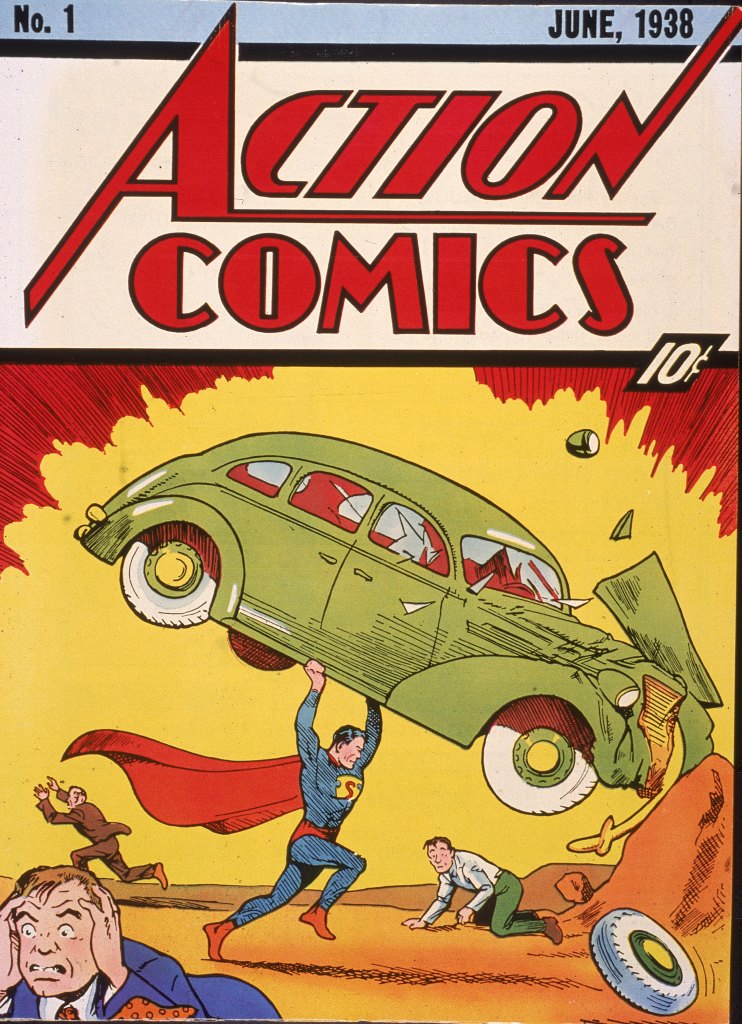
From his debut in Action Comics #1 in 1938, Superman didn’t just succeed—he exploded into a full-blown cultural phenomenon. The character quickly moved beyond the pages of comic books, headlining his own title by 1939 and becoming the centerpiece of DC’s rapidly expanding line. Within a few short years, Superman was everywhere: a nationally broadcast radio show beginning in 1940, a series of Max Fleischer animated shorts that brought cinematic scope to the character, newspaper comic strips reaching millions of daily readers and a flood of licensed merchandise that made him one of the first true multimedia superheroes. By the time the 15-part Superman serial starring Kirk Alyn hit theaters in 1948 (reflecting production efforts underway just before 1947), the Man of Steel had become more than a comic book character—he was a defining American icon, even as behind the scenes, the seeds of a long and painful battle over ownership and credit were already being sown.
Losing everything
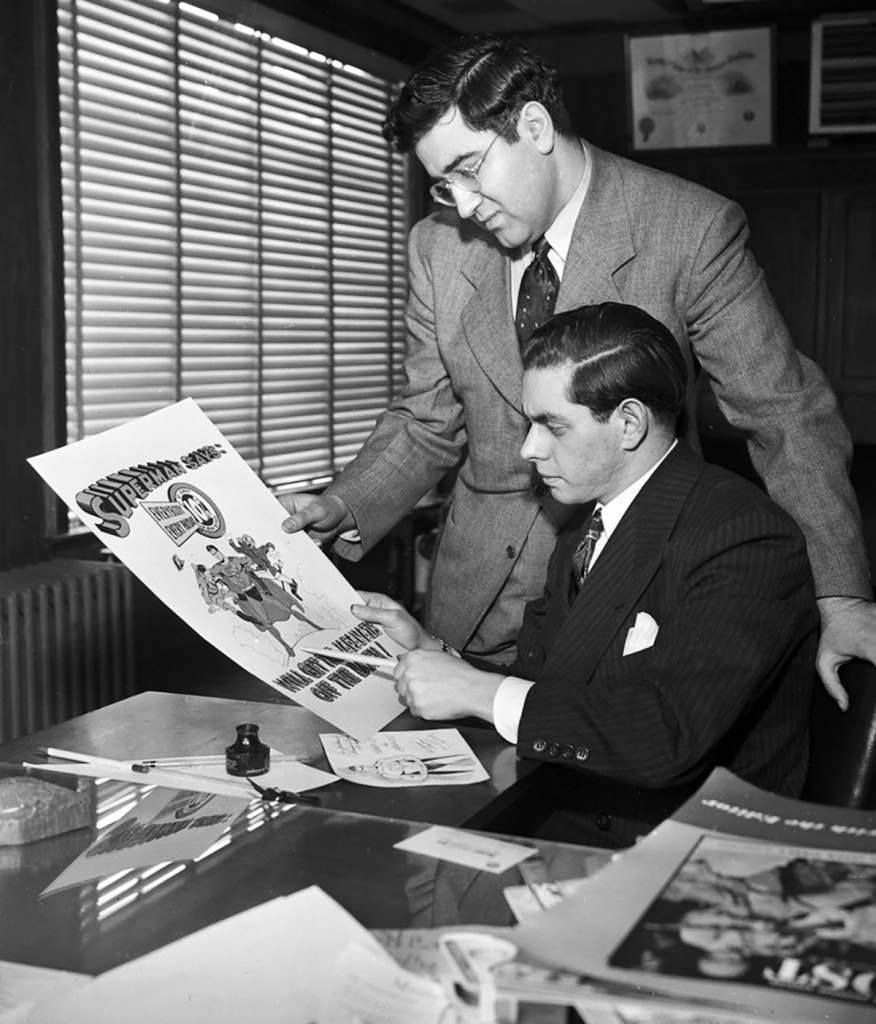
By 1947, Siegel and Shuster attempted to reclaim their creation through legal action. Instead, the court ruled that DC owned Superman outright. The consequences were devastating in that both men were fired and their names were immediately removed from their work. For Bernhardt, that loss of credit remains the most painful part of the story. “Removing someone’s credit from their work is absolutely immoral,” he says. “We can argue about the money and the ownership and all that, but stripping someone’s name off their own work—that is just fundamentally wrong.”
At the same time, he emphasizes that Siegel was anything but passive. “Whatever else you want to say about Jerry, by gosh, he pushed. He was not satisfied.” And that persistence came at a cost. “I think today we would probably say he had a nervous breakdown… This is a person who’s hurting, clearly.”
And yet, he kept going. “This guy was constantly hustling throughout the ’50s and ’60s. He was constantly trying to work and earn money for his wife and daughter. As the daddy of daughters myself, I can tell you, daddies love their daughters. Daddies want to do anything they can for their daughters… and he just couldn’t make enough.”
A second chance—and another loss
In 1959, Siegel was brought back to DC, due in part to outside pressure and behind-the-scenes efforts, including those of his wife Joanne and a campaign of her own. But the experience was far from a redemption story.
“Editor Mort Weisinger was just merciless to Jerry, just cruel,” Bernhardt says. And yet, even in that environment, Siegel produced some of his most powerful work. “Some of the stories he did are some of the best classic stories anybody’s ever read. Comic books that’ll make you cry. How often does that happen?”
And there was one truth that even Mort Weisinger had to acknowledge: He may have been the editor of Superman, but Jerry created him and would always be the creator of Superman, whether the public knew it any longer or not.
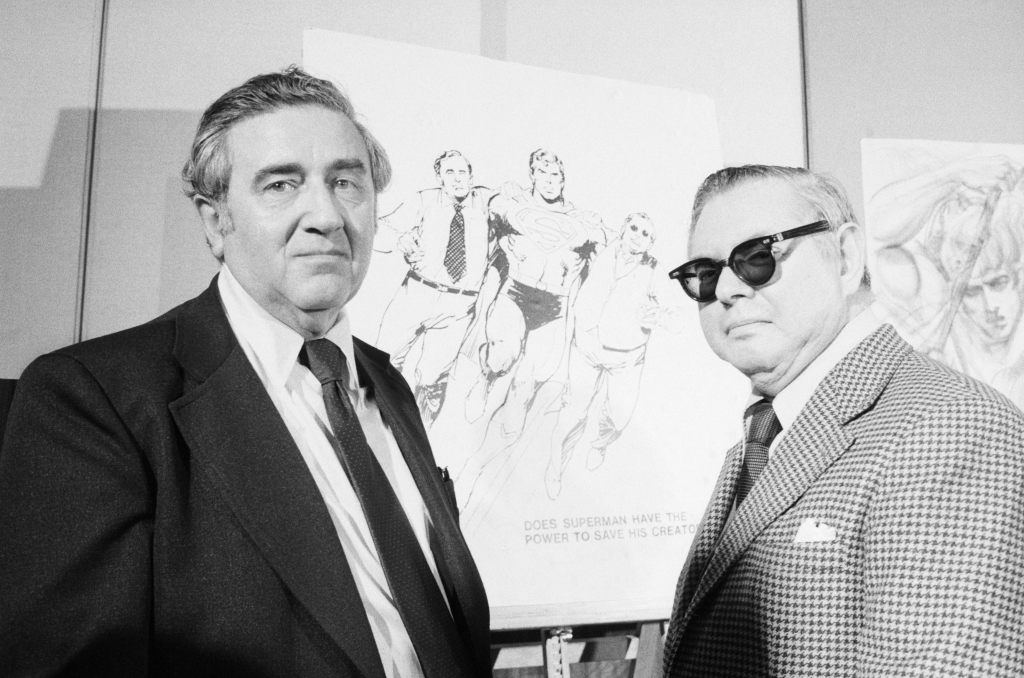
But history repeated itself. A second legal effort in 1965 failed and Siegel was fired again. Yet the breaking point came years later, sparked by a moment that underscored just how far removed he was from the success of his own creation. When Siegel learned that Mario Puzo had been paid $300,000 to write the screenplay for Superman: The Movie, it became a catalyst. Frustrated and determined, he wrote a nine-page letter detailing his situation, everything he and Shuster had endured and putting a curse on the new film. “Here’s this over nine-page letter… basically just an extended rant,” Bernhardt says. “And yet check out the citations in that letter—they’re dead on… it’s all accurate.”

At first, nothing happened—“Crickets… Nobody’s interested”—but then something unexpected changed the course of the story. “It wasn’t the mass media… it was fans,” Bernhardt explains. “Fan publications started picking up the story.”
Momentum built. Figures like artists Neal Adams and Jerry Robinson helped bring wider attention to the cause. Eventually, the pressure became impossible to ignore—even for Warner Bros., the new owner of DC Comics. The result, in an effort to prevent Superman: The Movie from having a cloud of negative publicity over it, was a pension, healthcare and, most importantly, restored credit for both Siegel and Shuster.
Created by…

One of the most powerful moments in the story came at the premiere of Superman in December 1978, 40 years after Siegel and Shuster had introduced the character. Bernhardt recounts a memory shared by Siegel’s daughter, Laura: “She’s sitting in the theater between both parents… and here it is, four minutes and 16 seconds into the movie when ‘Superman created by Jerry Siegel and Joe Shuster’ [appears]. She felt both parents squeeze her hand. The audience cheers and she looks over at her dad. He’s just got tears streaming down his eyes. This is what he’s wanted for decades.”

Despite being told in various forms over the years, Bernhardt believes the story of Siegel and Superman is still widely misunderstood. “Some people said, ‘Everybody knows this story.’ No, they don’t. This is so not true.”
And maybe that’s why it continues to resonate—not just as a cautionary tale about contracts and corporations, but as something more personal. At its core, The Superman Wars is the story of a man who refused to let go of what he created and a fight that stretched across decades. “This is a family that stuck together and fought for their rights,” Bernhardt says.
And in the end, that fight reshaped the industry itself. Because today, every time those words appear—“Superman created by Jerry Siegel and Joe Shuster”—they stand as a reminder not just of who created the Man of Steel, but of how hard it was to make sure the world would never forget them again.
‘The Superman Wars’ quick facts
- Superman made his historic debut in Action Comics #1 (1938), published by National Allied Publications, the company that would evolve into DC Comics.
- The character was created by Jerry Siegel and Joe Shuster—known formally as Jerome “Jerry” Siegel—while the two were attending Glenville High School in Cleveland.
- Before Superman became a hero, Siegel first explored the concept in a 1933 short story titled “The Reign of the Superman,” reflecting his early interest in science fiction the advance guard of future civilization.
- Early Superman adventures expanded beyond comic books into comic strips and a daily newspaper strip, helping cement the character’s place in pop culture.
- Publisher Malcolm Wheeler-Nicholson, founder of National Allied Publications, played a key role in launching the early line of fun comics that led to Superman’s breakthrough.
- The success of Superman helped define the superhero genre and paved the way for competitors like Marvel Comics, where characters like the Human Torch would emerge.
- Siegel and Shuster were heavily influenced by science fiction heroes like Buck Rogers, whose futuristic adventures helped shape early superhero storytelling.
- Artist Joe Shuster was later honored in the Jack Kirby Hall of Fame, while both creators have been recognized in the Kirby Hall of Fame for their lasting contributions.
- The original Superman story quickly expanded into radio, animation and film, turning the character into one of the first true multimedia icons.
- Despite that success, the creators’ early deal for the rights to Superman—signed around the time of the first issue of Action Comics—would lead to decades of legal battles explored in The Superman Wars.
Conversation
All comments are subject to our Community Guidelines. Woman's World does not endorse the opinions and views shared by our readers in our comment sections. Our comments section is a place where readers can engage in healthy, productive, lively, and respectful discussions. Offensive language, hate speech, personal attacks, and/or defamatory statements are not permitted. Advertising or spam is also prohibited.