Erin Gray On Why She Fought to Play Captain Janeway on ‘Star Trek’ After ‘Buck Rogers’ Frustrations
The actress reflects on Wilma Deering's surprising impact on women and the role that got away

Key Takeaways
- Erin Gray fought for the chance to audition for Captain Janeway on 'Star Trek: Voyager.'
- 'Buck Rogers' left Gray wanting roles where women drove the story.
- Gray says losing 'Voyager' was a blessing: 'But, damn, I wanted to be in charge!”
Nearly 15 years after Buck Rogers in the 25th Century ended its run, Erin Gray saw an opportunity she desperately wanted: the chance to command a starship. Having played Colonel Wilma Deering opposite Gil Gerard’s Buck Rogers from 1979 to 1981, she was among the actresses considered for Captain Kathryn Janeway on Star Trek: Voyager. The role would eventually go to Kate Mulgrew after original star Geneviève Bujold departed shortly after filming began, but Gray remembers fighting just for the opportunity to audition.
For her, it wasn’t simply about joining Star Trek, a franchise she admits she was never that familiar with. Instead, it stemmed from the years of playing women who frequently existed in support of a male leading character—including Wilma, despite her military rank. In Janeway, Gray saw the kind of role actresses were rarely offered at the time: the person in charge and the character around whom the story revolved.
ERIN GRAY: “I knew it was an opportunity of a lifetime. I really wanted to be in charge. It just came at a time in my life where I went, ‘I want this.’ But I had a hard time getting in on the audition; they did not want to see me. I kept asking my agent to please try again. And finally they did. They let me in. I went into the audition really memorizing that monologue—and memorization is not easy for me. I get nervous and my mind blanks out or whatever, but I worked really hard on it. And I get in there and I’m about to say the opening line and I hear a voice off to my right saying, ‘So you don’t remember me, huh? We only spent three weeks together in Hawaii.’”
“I’m looking at the person and I don’t recognize him. I think, ‘Wow, I did three movies in Hawaii, and who is…?’ Talk about throwing me off my center. Well, that did it. I got through it, but not to that place as an actor where you know you nailed it. You feel good about it. You were flowing. This was not that. I did it, but it wasn’t the best.”
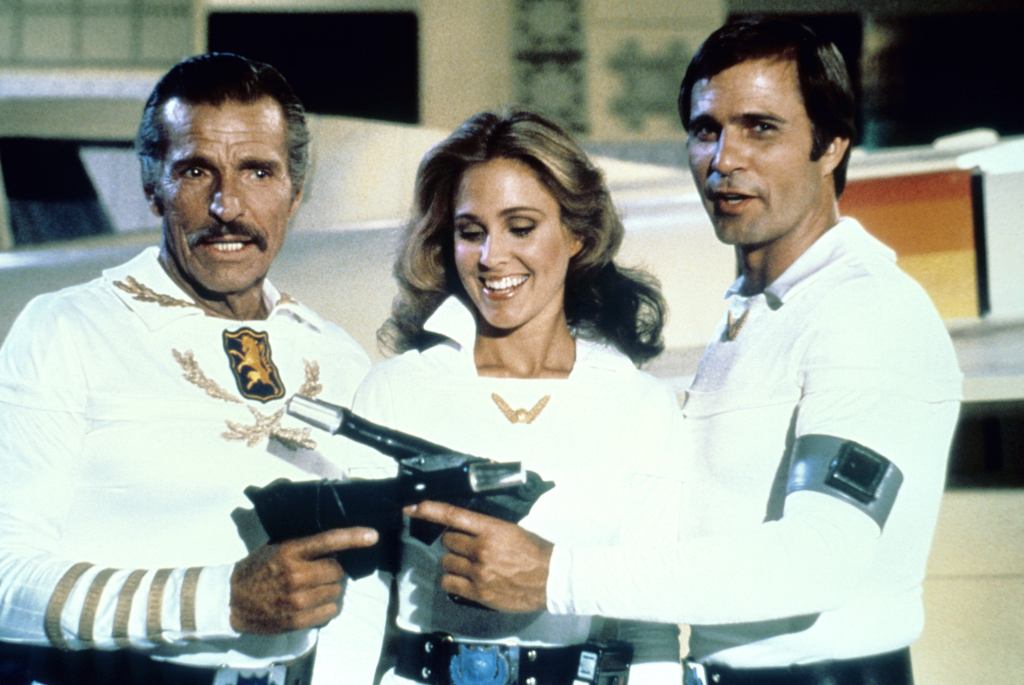
The man Gray couldn’t place turned out to be a director she’d previously worked with on an episode of Magnum, P.I. His presence rattled her for reasons that went back to that earlier experience, and the timing couldn’t have been worse.
ERIN GRAY: “I knew that the role for Captain Janeway was important to the producers and the director because they wanted somebody who could do a lot of dialogue and memorize it and do it quickly. They’d had problems with another actress who hadn’t been able to do that and didn’t like working at the speed that television requires, so she left and they were looking for a replacement. So I knew how important that was going in, but I did not know that the same director who did Magnum, P.I. would be the same director of that episode. I was so humiliated. It was one of those moments. But it turned out to be for the best. My father did wisely say that all things conform to the right way, and he’s right.”
Why Janeway meant so much to Erin Gray
Gray’s desire to play Janeway becomes considerably more understandable when viewed against the career she’d already had. Wilma Deering may have been a colonel, but Buck Rogers in the 25th Century was still built around the title character. She had spent years encountering a familiar limitation for actresses: no matter how capable their characters were supposed to be, the men usually remained at the center. Janeway offered something different.
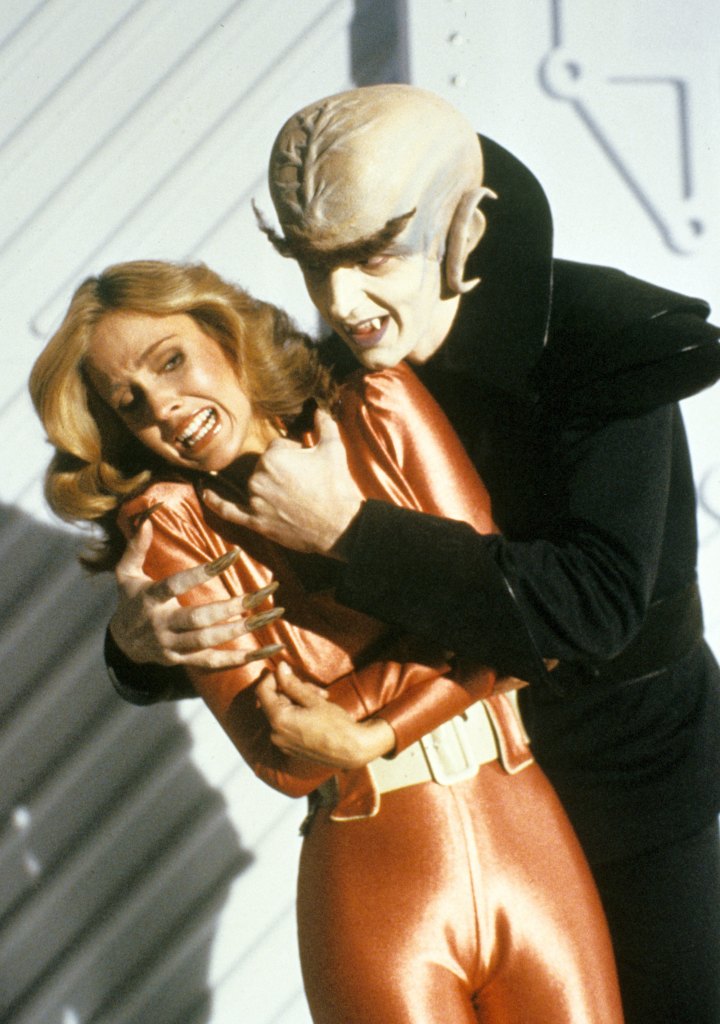
ERIN GRAY: “I think it’s more the fact that there were very few roles for women to star in, period. I was always the objectified, beautiful girl who adoringly looked up at her leading man and whatever, but to be the center and to carry the story was a rare occurrence.”
“The only time I did that was on ‘Vampire in Space,’ the one episode on Buck Rogers [where] the storyline went through my character. So to be in something where I could be pivotal to that storyline was very appealing to me as an actress. I did one movie called Born Beautiful that I was the lead in, and it was a great experience. I wanted to do that again. I didn’t want it to be all about being goo-goo eyes at the leading man kind of thing. I did a lot of that in the ’80s, which is fine. I mean, I love men, so I had no problem with that. But there’s something as an actor, as a talent, that you just want something you can sink your teeth into.”
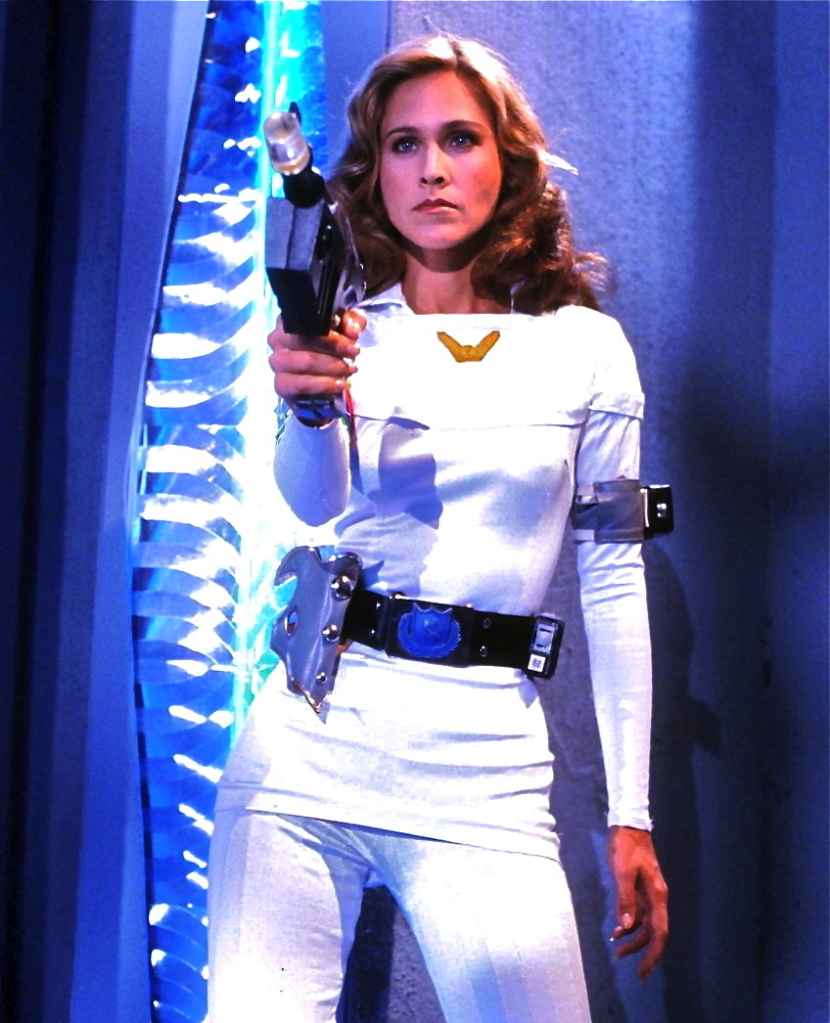
That frustration actually makes Wilma Deering an interesting contradiction. Gray may not have felt she was being given the opportunities she wanted dramatically, yet Wilma was having a profound effect on many of the girls watching. That’s something Gray wouldn’t discover until years later.
ERIN GRAY: “I know that with Buck Rogers, my role had inspired a lot of women to join the military. I had a woman who was one of the highest-ranking women in the Marine Corps come up to my table and she was, like, ‘You’re the reason.’ I’m looking at this almost six-foot-tall woman going, ‘Really? I inspired you?’ ‘Absolutely.’ And she said, ‘Oh, I just got a call. I got to go. I got to go fly the president.’ ‘Yeah, yeah, go. Please.’ But to know that my role did that, I did not ever think when I got the job on Buck Rogers that that would have that kind of influence. It was just a job. It was just do the best you can kind of thing. To find out 10, 15 years later the impact, it was mind-boggling to me.”

In that respect, Gray’s experience with Wilma belongs to a larger science-fiction tradition. Nichelle Nichols famously heard from women inspired by Uhura to pursue careers in science and the space program, while Mulgrew would discover that Captain Janeway had a similar influence on the generation that grew up watching Voyager. Gray never imagined Wilma Deering would be part of that lineage.
ERIN GRAY: “That’s a wonderful gift the universe gave us in a sense, because I didn’t set off to do that. I set off to get a job and survive. I came from a very poor upbringing and left home very early and it was up to me to pay the bills, find a job and discover myself and figure it all out. So thinking of a legacy was not in my upbringing.”
The changing face of Wilma Deering
Even Wilma’s status on Buck Rogers wasn’t necessarily secure. The series was dramatically revamped for its second season, with the characters leaving Earth aboard the space vessel Searcher. Gray remembers meeting incoming producer John Mantley and being greeted with a rather startling declaration.
ERIN GRAY: “When I met the new producer, I think we met him at a bar somewhere near Universal Studios or something, if my memory is correct. Anyway, he said, ‘You know, I’m going to fire you.’ I went, ‘What? Are you nuts?’ Because I knew the success of my spandex, that’s for sure. And I was, like, ‘Really? Okay. What can I tell you? I’m not going to fight for it, but if you think so.’ We continued to have a conversation and he shared his ideas with me. And of course he didn’t fire me.”
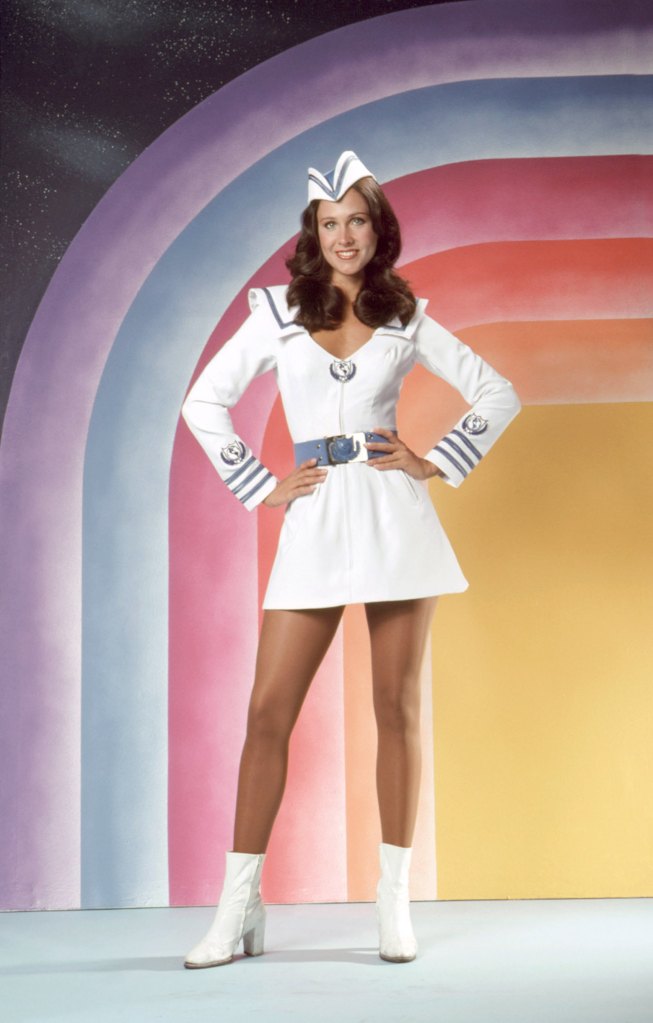
Gray remained with the show, although an attempt was made to change Wilma’s familiar look.
ERIN GRAY: “Unfortunately, I didn’t wear my spandex for a while, a couple of episodes. I was Dairy Queen in space instead, which didn’t last long because I said, ‘Give me back the spandex.’ The hat went first. And then the little skirt, whatever. I just needed the tray and the roller skates to complete the look.”
There’s an irony to all of this that Gray recognizes. Her appearance was undeniably part of the appeal of Buck Rogers, but she was an actress who wanted considerably more than just looking good beside the hero. Which is why, when she read the Voyager material years later, Janeway struck such a chord.
ERIN GRAY: “I did [get a sense of Janeway]. And I wanted to bring my take on it and bring myself into that role. And I felt I was very right for it, but it wasn’t meant to be.”
Gray may not have gotten her chance to join the official Star Trek universe, but years later she did get to put on a Starfleet uniform. She appeared as Commodore Laura Gray in the acclaimed fan-produced series Star Trek Continues, which was designed to recreate the look and feel of the original 1960s series, debuting with the 2014 episode “Lolani” and returning two years later for “Embracing the Winds.” In a coincidence that seems particularly appropriate given her feelings about Janeway, the latter dealt with Commander Diana Garrett (Clare Kramer) challenging Starfleet over the barriers preventing women from commanding Constitution-class starships. Gray’s Commodore was one of the officers presiding over the dispute.
The Captain’s chair that got away
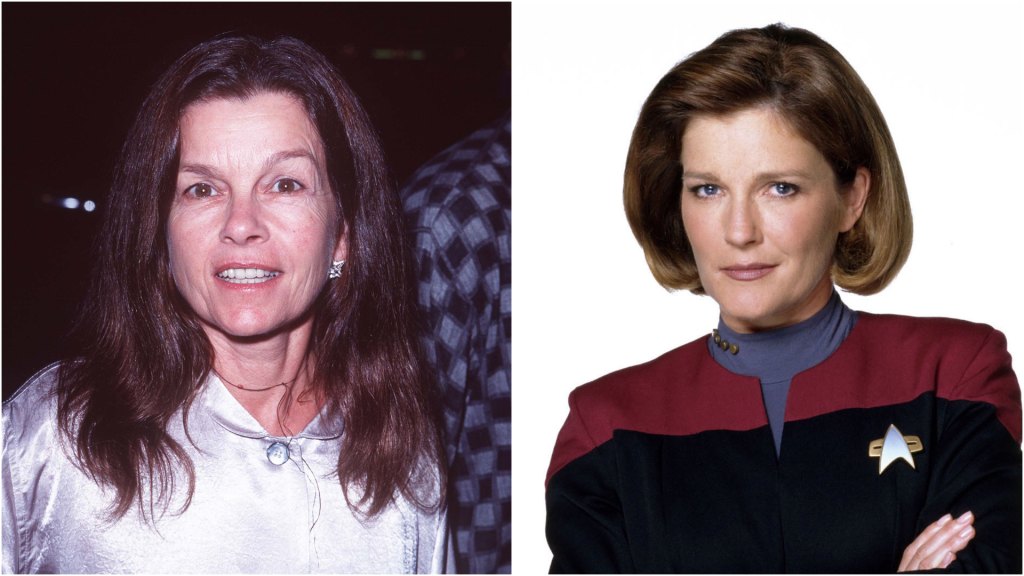
Mulgrew ultimately got that opportunity and made Janeway one of Star Trek‘s defining characters, while Gray came to realize there was another side to the job she had wanted so badly.

She already knew something about the punishing schedule of a weekly science-fiction series from Buck Rogers. By the time Voyager came along, Gray was also a mother. Years later, she recognized her own experience in Mulgrew’s account of the price she paid while trying to balance motherhood with the demands of playing Janeway.
ERIN GRAY: “Looking back, strangely enough, I had said I would never want to work the hours that I worked on Buck Rogers and have a child at the same time. That’s just impossible for me as a mother, and combining the two roles is hard. Kate Mulgrew said in her memoirs, which I read, that she felt that it really damaged her relationship with her sons in that the hours were so long. She talks about sleeping on the set, which [was] similar to what I did on Buck Rogers, sleeping in my dressing room, not even bothering to go home because it was eight hours before we were back in action again.”
“So looking back at it, it was a good thing that I didn’t get the role, because I had another baby at that time, so it was really a blessing in disguise. But, damn, I wanted to be in charge.”
Conversation
All comments are subject to our Community Guidelines. Woman's World does not endorse the opinions and views shared by our readers in our comment sections. Our comments section is a place where readers can engage in healthy, productive, lively, and respectful discussions. Offensive language, hate speech, personal attacks, and/or defamatory statements are not permitted. Advertising or spam is also prohibited.