The 28 Most Memorable ‘Star Trek’ Crossovers That Connect the Universe Across 60 Years
'Star Trek' built a universe through crossovers connecting generations, crews and fans

For nearly six decades, Star Trek has built one of television and film’s most expansive shared universes. But unlike comic book crossovers that sometimes feel reverse-engineered to tie things together, Trek’s connective tissue—from The Original Series to The Next Generation and beyond—has usually grown organically. A familiar character steps through a turbolift, an old starship is spotted or a legacy figure returns to bridge the gap between generations. These crossovers are part of what gives Star Trek its lived-in feeling: no crew exists in isolation and the galaxy always remembers its past.
What follows are some of the most important and memorable times the stars aligned and Trek shows literally crossed paths.
Passing the torch: ‘Original Series’ into ‘The Next Generation’
When Star Trek: The Next Generation launched in 1987, there was skepticism. Could a new crew really live up to Kirk, Spock, McCoy and the rest of the original Enterprise crew? Executive producer Rick Berman later recalled, “We knew we needed to honor the original cast without turning the new show into a continuation. The trick was to create connections without overshadowing Picard’s crew.”
1. Bones in ‘Encounter at Farpoint’ (1987)
The pilot for Star Trek: The Next Generation gave fans exactly that. DeForest Kelley reprised his beloved role of Dr. Leonard McCoy at the age of 137, inspecting the Enterprise-D and comparing Data to a certain Vulcan. Kelley agreed out of loyalty to Gene Roddenberry, reportedly saying he’d do it “for old times’ sake.” The cameo was short but invaluable: it placed a seal of approval from the old guard on the new.
Season 1, Episode 1 (“Encounter at Farpoint,” 1987)
2. ‘Sarek’ (1990)
Mark Lenard’s return as Spock’s father in the TNG episode “Sarek” was equally important. Writer Peter S. Beagle crafted a story about the Vulcan struggling with age and emotional collapse. Patrick Stewart later admitted the mind meld scene was one of his hardest emotionally: “Picard takes Sarek’s pain into himself. We were both shaking after shooting it.”
Adds director Les Landau, “The dynamics between Picard and Sarek reach a level that I think is classic in Star Trek history. The most outstanding moment is when we finally see Picard sitting with Beverly Crusher, where he is in the mind of Sarek thinking about his life that has come before, his former wife and the one and only reference to his son, Spock. If you watch what Patrick did in that scene, it is truly spectacular. Patrick is so capable on so many different labels that one just let’s him go. His ability is s right on, that one is reluctant to make any adjustment.” Season 3, Episode 23 (“Sarek,” 1990)
3. Spock in ‘Unification’ (1991)
When Leonard Nimoy appeared on TNG, it was a major media event. Nimoy explained, “Spock was still out there. I felt there was unfinished business.” The story, centered on Vulcan/Romulan reunification, allowed him to play scenes with Picard and Data, and reminded fans of the ideological threads that bound TOS and TNG together. Season 5, Episodes 7–8 (“Unification I & II,” 1991)
4. Scotty in ‘Relics’ (1992)
James Doohan’s Montgomery Scott became the centerpiece of one of TNG’s most beloved episodes. Writer Ronald D. Moore called it a “love letter” to Trek’s history. Scotty’s wonder at the holodeck recreation of the original Enterprise bridge mirrored the audience’s nostalgia. Doohan himself reportedly wept when he first saw the set. Season 6, Episode 4 (“Relics,” 1992)
A living universe: ‘The Next Generation’ into ‘Deep Space Nine’
When Deep Space Nine premiered in 1993, it wasn’t just another ship show—it was darker, serialized and politically charged. Linking it to The Next Generation was crucial.
5. Picard in “’Emissary’ (1993)
The pilot put Commander Benjamin Sisko (Avery Brooks) face-to-face with Captain Picard, who he blames for his wife’s death during the time Picard had been assimilated by the Borg. Brooks recalled, “It wasn’t a friendly meeting and that was important. It showed that Starfleet officers don’t always get along. It grounded Sisko as his own man.” Season 1, Episodes 1–2 (“Emissary,” 1993)
6. Q in ‘Q-Less’ (1993)
John de Lancie’s Q from TNG showed up, sparring with Sisko. When Q challenged him, Sisko punched him. “Picard never hit me!” Q exclaimed, to which Sisko replied, “I am not Picard.” The moment was a mission statement: this wasn’t TNG redux. Season 1, Episode 6 (“Q-Less,” 1993)
7. Lwaxana Troi
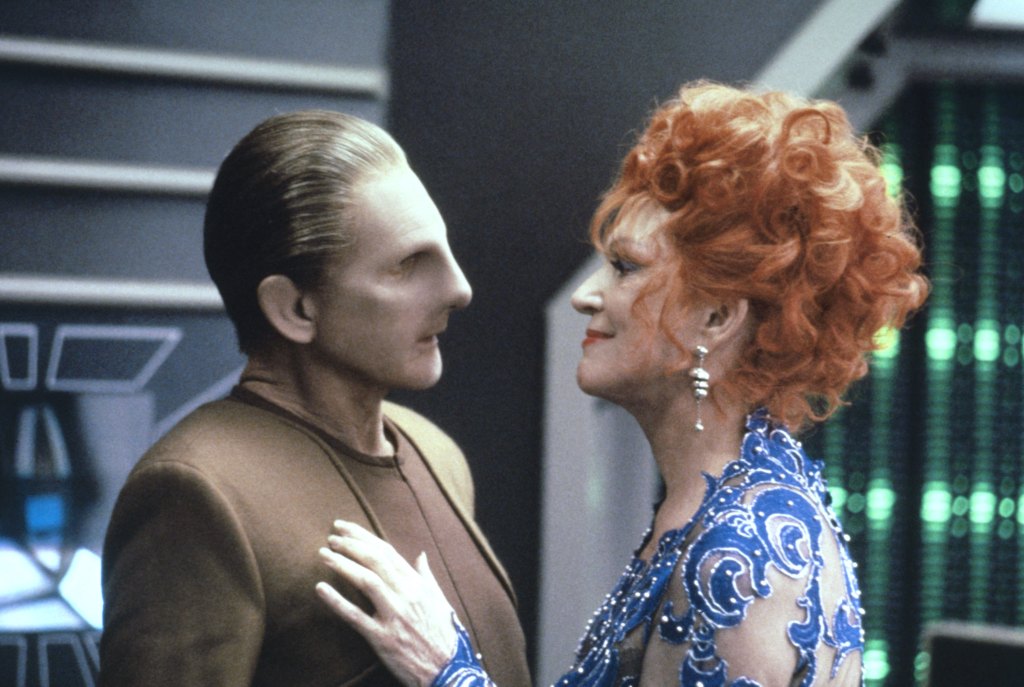
Majel Barrett Roddenberry’s recurring role as Lwaxana Troi (Deanna’s mother, introduced on The Next Generation) added humor but also depth—one DS9 episode explored her vulnerability with Odo, surprising fans who had seen her mainly as comic relief on TNG. (Recurring role across Seasons 1–4, 1993–1996)
8. Thomas Riker in ‘Defiant’ (1994)
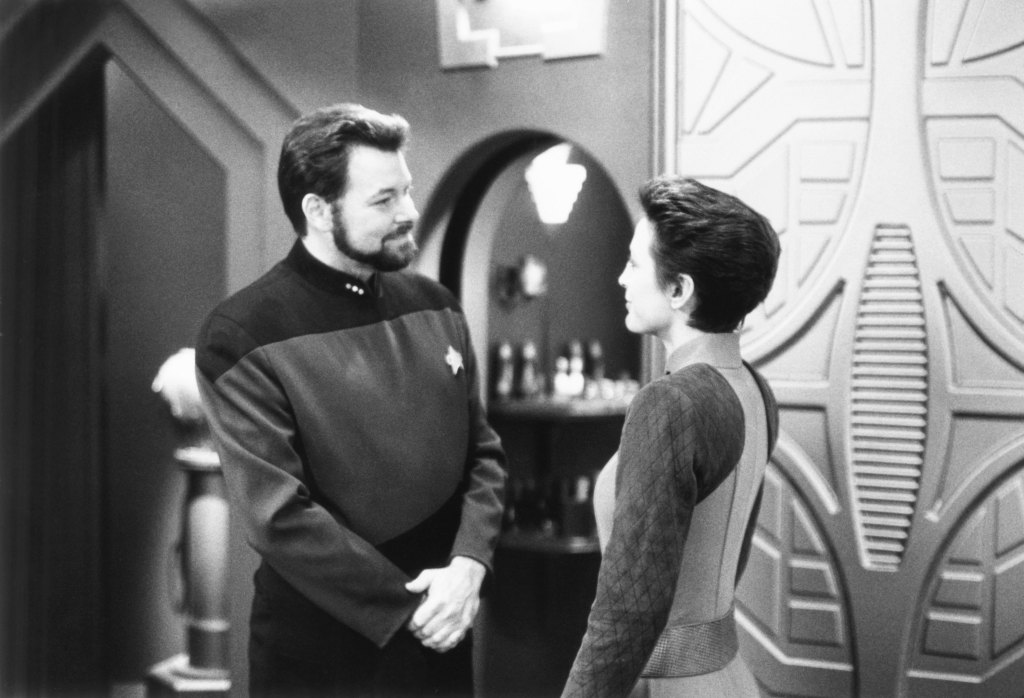
Jonathan Frakes returned as Will Riker’s transporter duplicate, a callback to TNG’s “Second Chances.” The episode underscored DS9’s tense relationship with the Maquis, which Thomas Riker was a part of. Season 3, Episode 9 (“Defiant,” 1994)
9. Worf Joins ‘DS9’ (1995)
After Star Trek: Generations, Michael Dorn’s Klingon warrior permanently transferred to DS9. Ronald D. Moore, creator of the reboot of Battlestar Galactica and Outlander, said, “It revitalized the show. Suddenly, we could go deeper into Klingon politics and Worf gave us a built-in bridge to TNG fans.”
Season 4 onward (1995–1999)
10. Chief O’Brien’s Move
Colm Meaney, a regular face on TNG, became a main character on DS9. Fans affectionately dubbed it “The O’Brien Must Suffer Show” because of the hardships writers heaped on him. Season 1 onward (1993–1999)

Into the Delta Quadrant: ‘Deep Space Nine’ to ‘Voyager’
Star Trek: Voyager had a unique challenge when it premiered in 1995. Its crew would be stranded in the Delta Quadrant, far from familiar faces, though producers nonetheless made sure its beginning tied directly into the established Trek universe.
11. ‘Caretaker’ (1995)
The pilot featured a stop at Deep Space Nine, where Quark tried to con Ensign Harry Kim into an overpriced trinket before Tom Paris intervened. Armin Shimerman later joked, “I got to introduce Voyager by doing exactly what Quark does best—cheating people.” It was a small moment, but it rooted Voyager in familiar ground before the ship was hurled 70,000 light-years away. Season 1, Episodes 1–2 (“Caretaker,” 1995)
12. ‘Flashback’ (1996)
Created for Trek’s 30th anniversary, this Voyager episode revisited the events of the 1991 film Star Trek VI: The Undiscovered Country. Through a mind-meld, Tuvok relived his service aboard the Excelsior. George Takei reprised Captain Sulu and Grace Lee Whitney returned as Commander Janice Rand. Using a blend of film footage and new material, the story honored TOS while celebrating Voyager’s place in franchise history. Takei later said, “This was as close as I got to commanding my own starship.” Season 3, Episode 2 (“Flashback,” 1996)
13. Q on ‘Voyager’
John de Lancie’s mischievous Q appeared in several Voyager adventures, including “Death Wish,” “The Q and the Grey” and “Q2.” His appearances allowed Kate Mulgrew’s Janeway her own sparring partner. Mulgrew reflected, “Q tested Janeway’s resolve in ways no one else could. He forced her to see her own limits.” Season 2, Episode 18 (“Death Wish,” 1996); Season 3, Episode 11 (“The Q and the Grey,” 1996); Season 7, Episode 19 (“Q2,” 2001)
14. Barclay and Troi
Dwight Schultz’s Reginald Barclay, first introduced on TNG, became essential in Voyager’s later years. From his post at Starfleet Command, he developed the Pathfinder Project, a communication link with the lost starship. Marina Sirtis reprised her role as Counselor Troi, usually in tandem with Barclay. Schultz said, “I never expected Barclay to outlast TNG, but Voyager gave him his real purpose.”
Barclay recurring from Season 6, Episode 10 (“Pathfinder,” 1999) onward; Troi recurring in Seasons 6–7 (1999–2001)
These connections, though occasional, reminded audiences that even in the Delta Quadrant, Voyager was still part of the greater Star Trek saga.

The Big Screen Crossovers
The theatrical Star Trek films often served as bridges between crews, allowing characters from different series to share the spotlight or creating connective threads that tied back to the shows.
15. ‘Star Trek Generations’ (1994)
Marketed as the film that united Kirk and Picard, Generations was built around the idea of one captain passing the torch to another. William Shatner reprised James T. Kirk alongside Patrick Stewart’s Jean-Luc Picard in the Nexus, where they joined forces against Malcolm McDowell’s Soran. Producer Rick Berman admitted, “It was about one generation handing off to the next—literally.” The film also included James Doohan’s Scotty and Walter Koenig’s Chekov in its prologue aboard the Enterprise-B, giving fans a multi-era send-off. Released November 18, 1994
16. ‘Star Trek First Contact’ (1996)
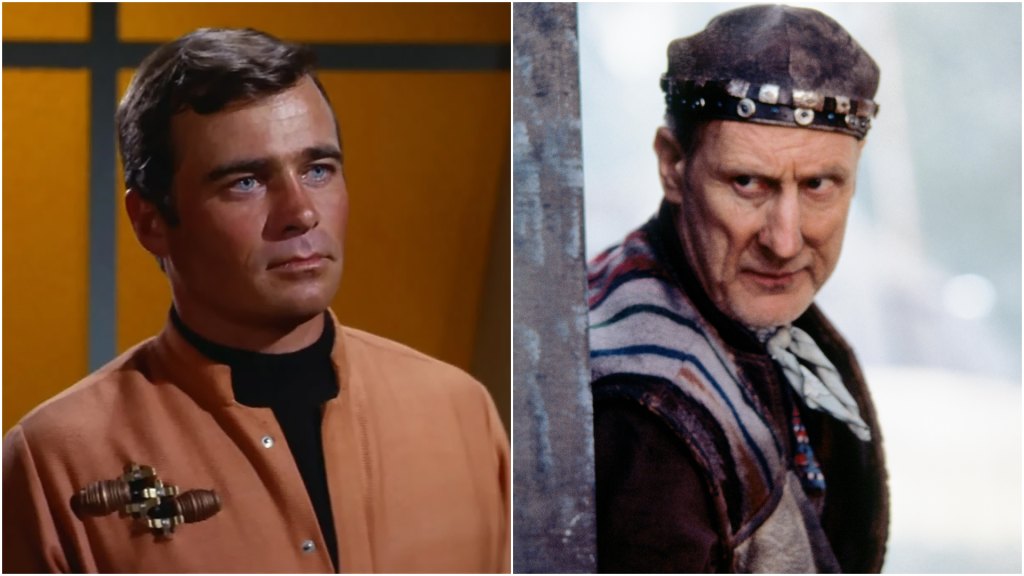
By centering on Zefram Cochrane, developer of the warp drive, the film tied directly to Trek’s past while exploring the future of humanity. James Cromwell played the big screen Cochrane, a character who first appeared in the Original Series episode “Metamorphosis” as played by Glen Corbett. Cromwell said, “It was wild to play someone who’d been talked about for 30 years but never seen.” Released November 22, 1996
17. ‘Star Trek: Nemesis’ (2002)
Though remembered as TNG’s theatrical swan song, Nemesis also included a crossover nod to Voyager. Kate Mulgrew appeared as Admiral Janeway, giving Picard his orders. It was a small cameo, but one that recognized Voyager’s place in the larger Starfleet hierarchy after that series wrapped on television. Released December 13, 2002
18. ‘Star Trek’ (2009)
J.J. Abrams’ reboot leaned heavily on continuity by including Leonard Nimoy’s Spock Prime. His presence created the Kelvin timeline, allowing the new cast to operate freely while keeping the original continuity intact. Abrams explained, “Nimoy was the blessing. Without him, it would’ve felt like a remake. With him, it felt like the continuation of a legend.” Released May 8, 2009
‘Enterprise’: crossovers in a prequel
Set a century before Kirk, Star Trek: Enterprise had the challenge of existing in a timeline before any of the adventures fans knew. Despite this, the producers still found creative ways to tie the prequel into Trek’s larger continuity, offering crossovers that connected the past with the future.
19. Zefram Cochrane in ‘Broken Bow’ (2001)
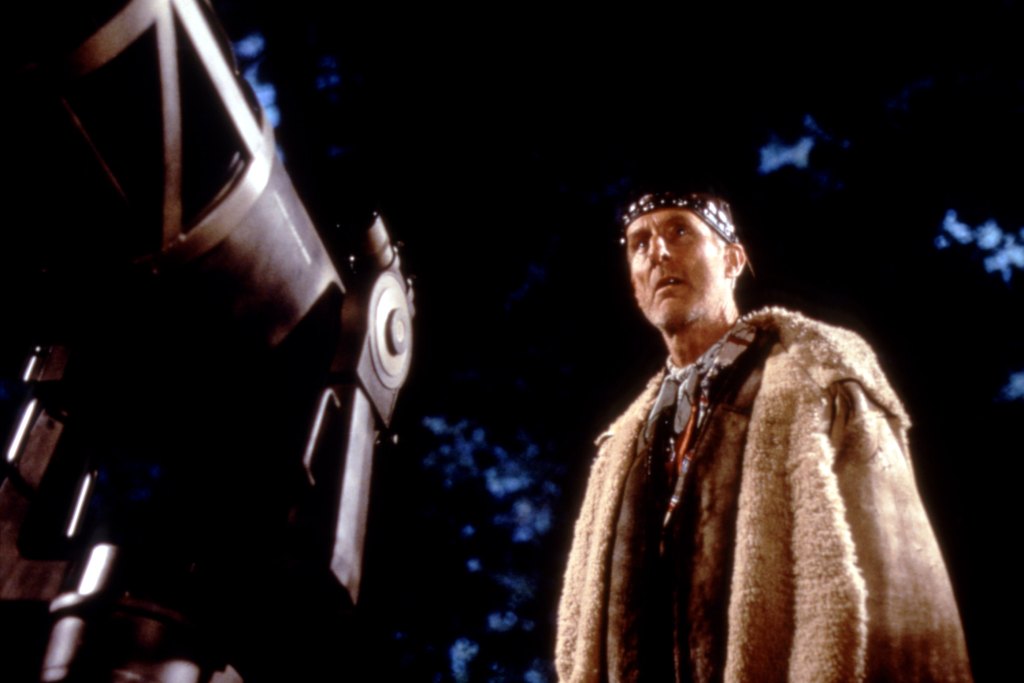
In the pilot episode of Star Trek: Enterprise, a brief appearance of James Cromwell as Zefram Cochrane—the inventor of warp drive first seen in Star Trek: First Contact—helps firmly anchor the show within the broader Trek canon. His cameo appears in archival or recreated footage during a futuristic opening sequence, immediately connecting the show to one of the franchise’s most pivotal moments. The appearance was uncredited.
20. ‘In a Mirror, Darkly’ (2005)
One of Enterprise’s boldest experiments was its two-part Mirror Universe arc. These episodes not only revived the concept first seen in TOS’ “Mirror, Mirror,” they connected directly to “The Tholian Web,” showing what happened to the lost Constitution-class starship USS Defiant. Producer Manny Coto called it “our love letter to TOS fans. We wanted to revel in continuity and connect Enterprise to classic Trek in a direct way.” The result featured re-creations of TOS sets and uniforms, delighting longtime viewers. Season 4, Episodes 18–19 (“In a Mirror, Darkly, Parts I & II,” 2005)
21. ‘These Are the Voyages…’ (2005)
The series finale of Enterprise remains controversial for its framing device: the story of Archer’s crew was presented as a holodeck simulation run by Commander Riker aboard the Enterprise-D, with Marina Sirtis’s Troi also appearing. Jonathan Frakes admitted later, “It was a great Riker episode but maybe not the right Enterprise finale.” Many fans felt it robbed Archer’s crew of their own ending. Still, as a crossover, it explicitly tied Enterprise to TNG, bookending the prequel with a reminder of the future it was leading toward. Season 4, Episode 22 (“These Are the Voyages…,” 2005)
Modern ‘Trek’ crossovers
The streaming era of Star Trek has embraced crossovers with enthusiasm, weaving together legacy characters and new crews in ways that celebrate the franchise’s interconnectedness.
22. ‘Discovery’ into ‘Strange New Worlds’
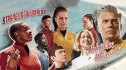
By its second season, Star Trek: Discovery had introduced Captain Christopher Pike, Number One, and Spock, reimagined for a new era. Their popularity led to the spin-off Strange New Worlds. Anson Mount, who took on the role of Pike previously played by Jeffrey Hunter and Bruce Greenwood, said, “It felt like we were making a pilot inside another show. The response made it clear fans wanted to see Pike’s Enterprise full-time.”
23. ‘Picard’ as a ‘TNG’ reunion
Across three seasons, Star Trek: Picard transformed into one of the most ambitious crossovers in Trek history. Familiar faces returned one by one: Riker, Troi, Data, Guinan, Q, Worf, Beverly Crusher and even a surprise appearance by Moriarty. Patrick Stewart reflected, “By the end, we were together again on the bridge. It felt like we had closed a circle that began more than 30 years earlier.” Picard Seasons 1–3 (2020–2023)
24. ‘Lower Decks’ meets ‘Strange New Worlds’
The 2023 episode of Stranger New Worlds, “Those Old Scientists,” delivered Trek’s most playful crossover. Animated ensigns Boimler and Mariner from Star Trek: Lower Decks found themselves in live-action form alongside Captain Pike’s crew. Directed by Jonathan Frakes, it blended comedy with genuine affection for Trek history. Frakes said, “It was pure joy. I’ve never seen actors have more fun stepping into their animated characters.” Strange New Worlds Season 2, Episode 7 (“Those Old Scientists,” 2023)
25. Janeway on ‘Prodigy’
The animated Star Trek: Prodigy gave fans not one but two versions of Kathryn Janeway. The young alien crew of the Protostar was mentored by a holographic Janeway, while later encountering the real Admiral Janeway. Kate Mulgrew said, “I never thought I’d come back twice—flesh and blood and hologram—but Janeway is part of Trek’s DNA now.” Prodigy Seasons 1 and 2 (2021–2022)
When time and space collide
Some of the most memorable crossovers in Star Trek bent the rules of storytelling, blending timelines, universes and even formats to celebrate the franchise’s legacy.
26. ‘Trials and Tribble-ations’ (1996)
For Star Trek’s 30th anniversary, Deep Space Nine produced one of its most beloved episodes. Using digital trickery, Sisko and his crew were inserted into the TOS classic “The Trouble with Tribbles,” interacting directly with Kirk, Spock and Scotty. Ronald D. Moore recalled, “It was a technical nightmare but a fan’s dream. We got to play in the sandbox of The Original Series in the most direct way possible.” The episode was nominated for multiple Emmy Awards and is still celebrated as one of Trek’s greatest homages to itself. Deep Space Nine Season 5, Episode 6 (“Trials and Tribble-ations,” 1996)
27. The Mirror Universe

Beginning with “Mirror, Mirror” on The Original Series, the Mirror Universe became Trek’s longest-running crossover concept. DS9 revisited it multiple times between 1994 and 1999, giving fans a darker look at familiar characters. Enterprise’s “In a Mirror, Darkly” expanded on TOS’s“The Tholian Web” by revealing the fate of the USS Defiant, while Discovery devoted a large arc to the Terran Empire in its fourth season. Producer Manny Coto described the Mirror shows as “a chance to subvert expectations—to play with history while still tying everything together.” TOS Season 2, Episode 4 (“Mirror, Mirror,” 1967); DS9 recurring Mirror episodes (1994–1999); Enterprise Season 4, Episodes 18–19 (“In a Mirror, Darkly, Parts I & II,” 2005); Discovery Season 1 (2017–2018)
28. Holographic callbacks
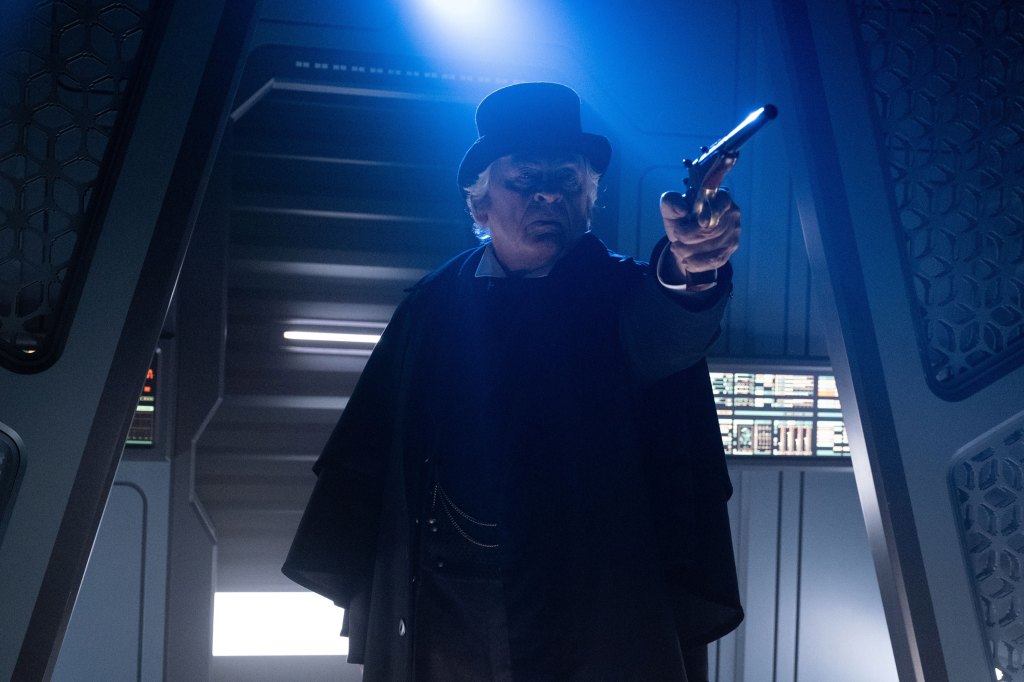
Even holograms became vehicles for crossover nostalgia. In Star Trek: First Contact, Robert Picardo’s Emergency Medical Hologram from Voyager made a brief but memorable cameo. Decades later, TNG’s rogue hologram Moriarty returned in Picard, reactivated as part of a ruse designed by Data’s android “brother.” Showrunner Terry Matalas said, “Moriarty was a deep cut, but he symbolized how memory and history can surprise us when we least expect it.” First Contact (1996); Picard Season 3, Episode 2 (“Disengage,” 2023)
The power of crossovers

For Star Trek, crossovers represent the moments that knit the franchise together, serving as reminders that no matter how many shows or decades pass, it all belongs to the same universe. They let legacy characters step forward one more time, while giving newer faces a place in the larger story. And for longtime viewers, they’re acknowledgments that the history we’ve been watching since 1966 still matters.
From Dr. McCoy gently blessing Data in The Next Generation’s pilot to Boimler geeking out over meeting Mariner’s heroes in Strange New Worlds, these encounters have traced an unbroken line across nearly sixty years of television. They are the connective tissue that makes Star Trek feel alive, constantly evolving and very self-aware. All told, those crossovers build on the past as the franchise charts its own future.
Conversation
All comments are subject to our Community Guidelines. Woman's World does not endorse the opinions and views shared by our readers in our comment sections. Our comments section is a place where readers can engage in healthy, productive, lively, and respectful discussions. Offensive language, hate speech, personal attacks, and/or defamatory statements are not permitted. Advertising or spam is also prohibited.