The Lost ‘Planet of the Apes’ TV Series from ‘Twilight Zone’ Creator Rod Serling—What Could Have Been
Before CBS aired 'Planet of the Apes,' Rod Serling created a darker, deeper version that remains lost

For every television series that makes it to the screen, countless other versions never do. Scripts are written, outlines are commissioned and ambitious ideas are debated in conference rooms—only to be quietly shelved. For fans, these unfilmed or “lost” adventures often prove just as fascinating as the episodes that actually aired, offering a glimpse of what might have been. That’s certainly true of the lost Planet of the Apes TV series from Rod Serling.
Another great example is Star Trek. Over the years, fans have devoured stories of abandoned pilots, reworked premises and episodes that were planned but never produced—from the original cut of the second pilot “Where No Man Has Gone Before” to the story ideas making up the aborted Star Trek: Phase II television series or earlier versions of feature films. These unrealized projects reveal how close the franchise often came to taking very different creative paths.
Planet of the Apes has its own version of that history. When the film series wrapped up in the early 1970s and attention turned to television, what ultimately aired on CBS was not the first—or most ambitious—version of the show. Before cameras rolled, Twilight Zone creator Rod Serling had already written a series bible and two scripts that presented a very different take on the Apes universe. Those scripts were never filmed, but they remain a revealing, often surprising glimpse into a version of Planet of the Apes that audiences never got to see.
TV ‘Apes’
By the time Battle for the Planet of the Apes went into production in 1973, there was a growing sense that the film series was running out of steam. What had begun five years earlier with Planet of the Apes (1968)—followed by Beneath (1970), Escape (1971), and Conquest (1972)—started as bold, adult-minded sci-fi. But with each sequel earning less at the box office, it became harder to justify continuing the story on the big screen. Behind the scenes, there was a feeling that the theatrical version of Apes had reached its natural stopping point. Television, however, offered a new way forward.
The idea of turning Planet of the Apes into a weekly series had been kicking around as early as 1971, but nothing moved ahead while the films were still in production. That changed once Battle wrapped. Producer Arthur P. Jacobs allowed 20th Century Fox to buy out the rights he held to the property, and the studio quickly began exploring what an Apes series might look like on TV. It wasn’t much of a gamble. When the films aired on CBS, Planet, Beneath, and Escape all delivered strong ratings, proving the franchise worked just as well at home as it did in theaters.
To oversee the transition, Fox turned to Stan Hough, a production executive who had been involved with all five Apes films. One of his first decisions was a telling one: he hired Rod Serling to shape the series.
Best known as the creator of The Twilight Zone and a co-writer of the original Planet of the Apes screenplay, Serling was brought in to write the series bible and the first two scripts. From the start, he made it clear he wasn’t interested in simply turning the movies into a weekly TV show. Instead, he envisioned a roaming adventure series built around pursuit, survival and competing worldviews.
In Serling’s version, astronauts Allan Virdon and Stanley Kovak are sent to search for the long-missing Colonel George Taylor. Their mission leaves them stranded on a future Earth ruled by apes, where humans have been reduced to a hunted underclass. Along the way, they team up with Galen, a chimpanzee who believes exterminating humanity is wrong.

From there, the series becomes a story of constant movement. Virdon, Kovak, and Galen are always on the run, pursued by the gorilla military leader Ursus and watched closely by Dr. Zaius, the powerful orangutan who oversees ape science. Each episode drops them into a new environment—an ape city, a hidden human settlement, a forgotten corner of civilization—while ape dominance remains the one unchanging reality.
Combining sci-fi and the Western
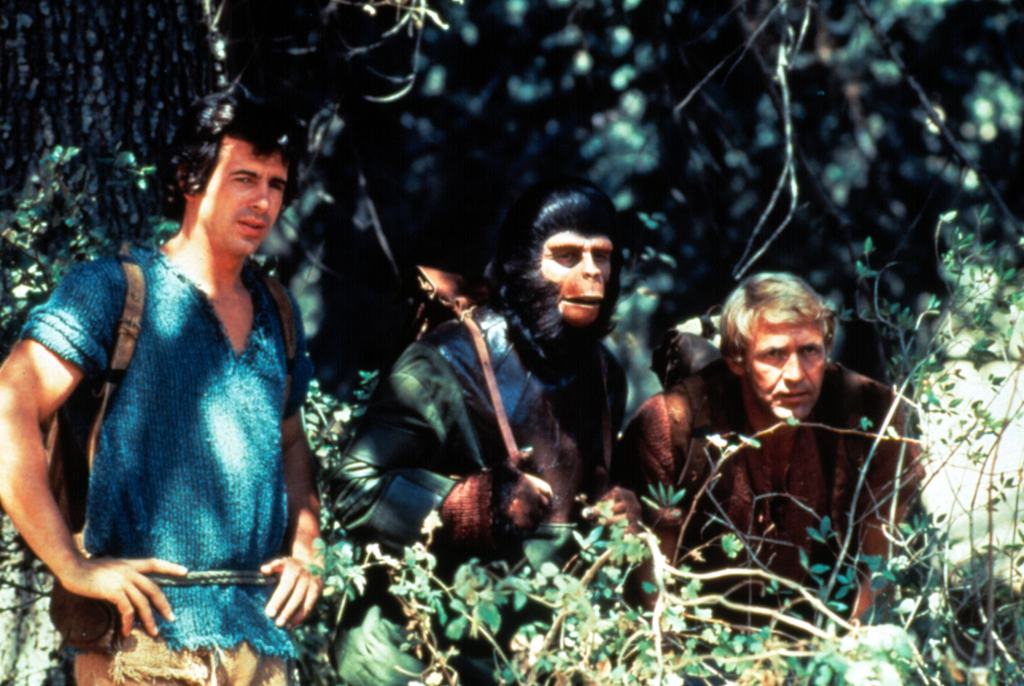
For all of its big ideas, Serling was clear about one thing: the proposed Planet of the Apes series wasn’t meant to feel heavy or academic. First and foremost, it was supposed to be adventure television—something that could hook viewers week after week. Action, visual excitement and momentum mattered. But beneath that surface, Serling saw an opportunity to do something a little smarter.
“I feel what we’re dealing with here is unique,” Serling mused. “The first-time wedding of two classic forms, the Western and the science fiction-adventure. The union is made in heaven. Both forms deal in one solid dramatic basis: the isolated, totally self-contained world cut off from everything else. It could be an alien overlord controlling his planet or a Western Cattle Baron dominating his town—a pacifist race of super-intellects incapable of defending their planet or an isolated band of Quaker farmers—either way, the central story thrust is the same.”
Taken as a whole, his proposal treated Planet of the Apes less as a franchise to be extended and more as a concept worth rethinking. What he delivered wasn’t a traditional spin-off, but a reimagined series that used the films as a starting point rather than a strict rulebook. That mindset showed up clearly in how freely Serling handled continuity.
What Serling was really interested in was character, particularly the relationship between Allan Virdon and Galen, which he saw as the emotional center of the series. “Their relationship,” he noted, “is going to be very special, close, deeply supportive and yet, at the same time, highly competitive. Galen is not a cop-out. In any given situation, he is going to try to explain and defend the ape culture using all the precise logic of Star Trek’s Mr. Spock. Meanwhile, at the opposite pole, Virdon tries to explain the way it used to be. How superior it was, and why it should go back that way. In the final analysis, the edge is to Galen. He has the words and his world is all around them. For Virdon, it’s tougher. His moments don’t come that easily. [For instance], once, when they are deep in mysterious caves beneath the Planet of the Apes searching for a lost community of humans, Virdon uncovers a tile wall embedded in the rock. He scrapes the rubble away and reads the words marked on the tile: ‘IRT SUBWAY – QUEENBORO PLAZA.’ It’s his moment, but somehow, he can’t find the words. How do you explain all that to a 200-pound monkey with an IQ higher than yours?”
‘Apes’ by way of ‘The Fugitive’
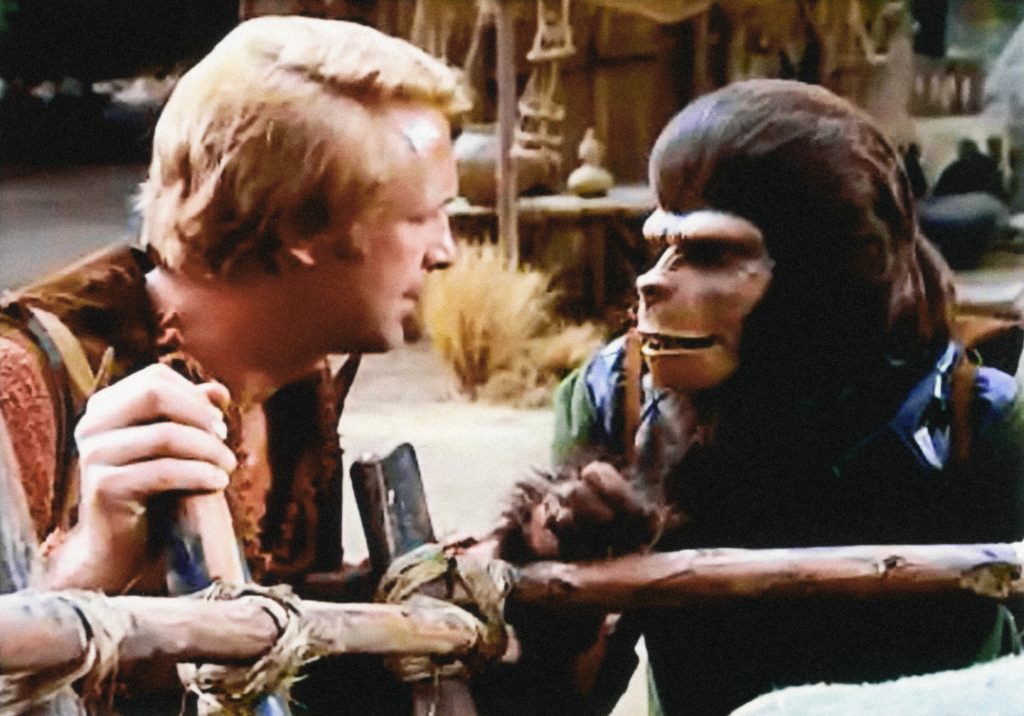
To give the series a sense of purpose beyond constant flight, Serling borrowed a page from The Fugitive: the idea of a destination or goal. In his version of Planet of the Apes, the astronauts weren’t just running from danger week after week. They were chasing a rumor. Somewhere out there, he suggested, was a city untouched by catastrophe—a place where apes and humans lived together, sharing knowledge instead of suppressing it.
Explained Serling, “Will-o’-the-wisp clues are found along the way, and they keep us going. There is an indication that Taylor, the last astronaut who had gone before, had made it to this safe haven. A primitive mute girl is found with his dog-tags but cannot tell how she got them. In a remote village, they find an old wise man whose grandfather saw the city and told of the wondrous things there. Virdon listens, identifying them as from the world he knew. And Virdon pushes on. It’s out there somewhere. Maybe over the next hill, maybe the next mountain and over a rainbow, but it’s there. It has to be.”
That ambition also helps explain why Serling’s version may have been a hard sell for network television in the early 1970s. The mythology required patience. The characters were driven as much by ideas as by danger and the show didn’t assume that humans were automatically right—it suggested they might have to earn their place in the world they lost.
Despite the care put into the framework, Serling’s material was ultimately set aside. The reasons were never clearly documented, but the shift that followed pointed toward a desire for speed and clarity. The project was reassigned to Art Wallace, working with Anthony Wilson, and retooled into a more straightforward, episodic series.

Wallace focused on clear allegory and accessible storytelling. Humans became an openly oppressed class and apes represented entrenched power. Recurring threads, like a damaged spacecraft computer that might offer a way home, replaced Serling’s more abstract quest. By the time the pilot, “Escape from Tomorrow,” was finished, the difference was clear. The show jumped straight into its premise, established its world quickly and moved on. Serling’s structure remained, but his view of that world did not.

Even so, Rod Serling’s influence never completely disappeared. The basic structure he designed remained intact: two astronauts displaced in time, an ape ally torn from his world, constant pursuit and a society built on suppressing inconvenient truths. Stripped of its heavier philosophy, the framework still worked.
What audiences saw in September 1974 was a practical reworking of that foundation. Alan Virdon (Ron Harper) and Pete Burke (James Naughton) crash-land on a future Earth ruled by apes and go on the run with Galen (Roddy McDowall), pursued by General Urko (Mark Lenard) and monitored by Dr. Zaius (Booth Colman). Virdon dreams of getting home, Burke adapts and Galen joins them out of necessity, not idealism. The series was smaller in ambition than Serling’s vision, but more immediately accessible—and for many viewers, that balance made it an imperfect yet appealing show.
But Planet of the Apes only lasted 14 episodes and Serling moved on to the horror anthology series Night Gallery.
Conversation
All comments are subject to our Community Guidelines. Woman's World does not endorse the opinions and views shared by our readers in our comment sections. Our comments section is a place where readers can engage in healthy, productive, lively, and respectful discussions. Offensive language, hate speech, personal attacks, and/or defamatory statements are not permitted. Advertising or spam is also prohibited.