Scientists Rediscovered 21 ‘Lost’ Species in 5 Days, Including a Millipede Unseen Since 1897
A 126-year-old mystery in Madagascar’s largest rainforest just got solved in less than a week

A five-day expedition in Madagascar’s largest rainforest has rediscovered 21 of 30 targeted species, including a nearly 11-inch giant millipede that hadn’t been documented by scientists since 1897. The results are turning heads in conservation circles — and raising urgent questions about what else lives in forests that are shrinking before researchers can study them.
The expedition, conducted by a conservation group funded by Colossal Biosciences, tested a new approach to finding species considered “lost to science.” Instead of searching for one or two animals at a time, the team hunted for 30 at once. The 70% success rate in under a week suggests this model could change how conservation fieldwork operates.
What ‘lost to science’ means
Re:wild, the organization behind the effort, draws a specific line. A “lost” species isn’t extinct. Local communities may still encounter these creatures. But no scientist has formally identified or documented them in a study for an extended period, according to a July 17 news release from Re:wild.
These animals occupy a strange limbo: alive in the wild, potentially seen by people who share their habitat, but invisible to the scientific community that tracks biodiversity and shapes conservation policy.

The scale of the problem is staggering. According to Re:wild’s Christina Biggs, 4,300 species worldwide haven’t been documented in a decade or more.
A new search model, tested in Makira
Previous lost-species searches typically targeted one or two animals per expedition. This time, the team tried something different in Makira, the largest rainforest in Madagascar, located in the island nation’s northeastern region. Madagascar sits off the east coast of Mozambique.
“In the past the Search for Lost Species has primarily looked for one or two species on each expedition, but there are now 4,300 species that we know of around the world that have not been documented in a decade or more,” Biggs, a Re:wild officer, said. “Madagascar is a biodiversity hotspot and Makira is an underexplored area within the country, so we decided to pilot a new model for lost species searches there. We convened a group of scientists to search for as many species as possible, and it proved successful.”
Researchers, entomologists and trail guides spent five days searching trees, ground and rivers for 30 species across multiple categories: three mammals, three fish, seven reptiles, 12 insects and five spiders, according to the release.
Local guides knew where to look
One of the expedition’s most telling details: local guides and fishers helped identify all three targeted fish species.
Guides walked to nearby communities and returned with a Makira rainbow fish. They also brought back photos of another fish described in the release as having “iridescent scales and red highlights.” Scientists hadn’t formally documented these species in years, but the people living alongside them knew exactly where to find them.
That collaboration between trained researchers and community members with deep local knowledge appears to have driven much of the expedition’s success.
The 126-year gap
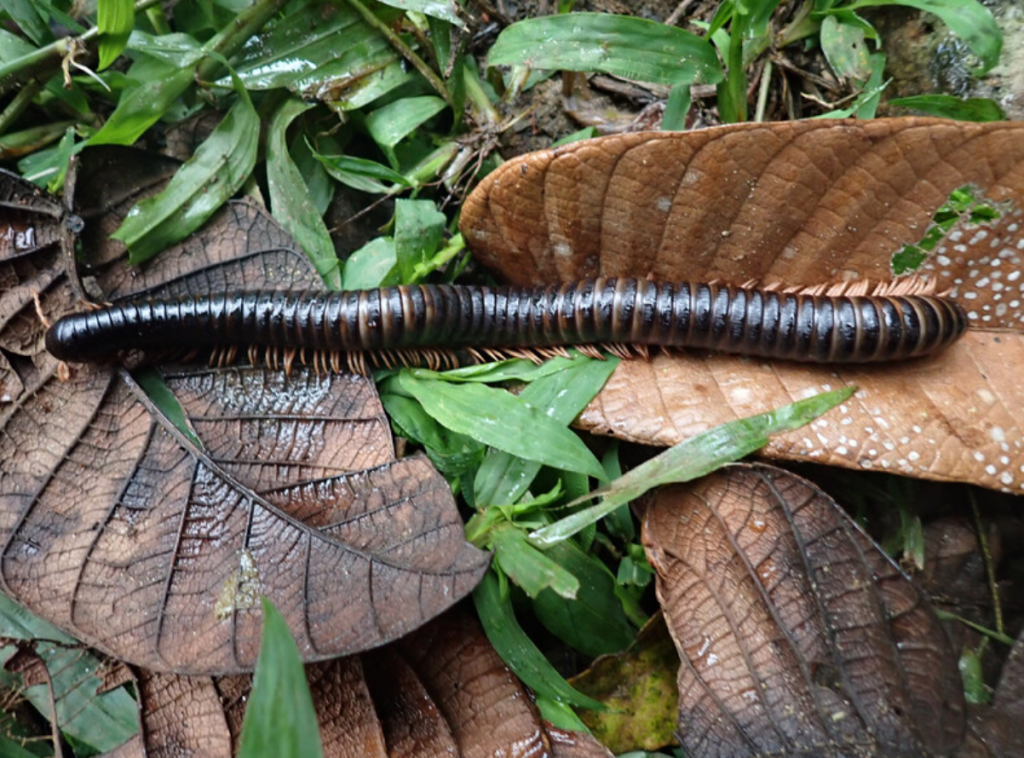
The team rediscovered multiple insect species, including some that weren’t even on the original target list. The standout: the giant millipede Spirostreptus sculptus.
Entomologist Dmitry Telnov described his reaction:
“I personally was most surprised and pleased by the fact that the giant millipede Spirostreptus sculptus, not uncommon in Makira Forest, appeared to be another lost species known only from the type specimen described in 1897,” Telnov said. “The longest specimen of this species we observed in Makia was a really gigantic female measuring (10.8 inches) long.”
The millipede measured nearly 11 inches and had gone undocumented for more than a century. That it turned out to be “not uncommon” in Makira raises an obvious question: how many other species are thriving in understudied habitats while remaining absent from the scientific literature?

Nine species still missing
Nine of the 30 targeted species were not confirmed during the expedition, and some of those gaps are troubling.
The Masoala fork-marked lemur, undocumented since 2004, was not found. A large chameleon species missing since 2006 was also absent. The dusky tetraka, a bird rediscovered on a separate expedition in December 2022, was not located in Makira either, according to the release.
Whether these species have moved to different ranges, declined in population or simply evaded detection during a five-day window remains unclear.
Makira’s forests are shrinking
The expedition results carry an uncomfortable tension. Makira harbors species that science is only now rediscovering, but the forest itself is under threat.

“Though Makira is the largest forest in Madagascar, it is still facing pressure from agriculture,” Re:wild said. “The expedition team worries that species in the underexplored forest could face steep population declines before scientists have an opportunity to study them.”
That pressure gives the new search model its urgency. The team found 21 species in five days that science had lost track of for years — in some cases, for more than a century. But the habitat those species depend on faces ongoing threats, and the window for documenting what lives there could narrow before researchers return.
The combination of scientific expertise, local community knowledge and a willingness to search for dozens of species simultaneously produced results that exceeded what single-species searches have typically delivered. For a five-day proof of concept in northeastern Madagascar, the numbers speak for themselves: 30 targeted, 21 found.
Conversation
All comments are subject to our Community Guidelines. Woman's World does not endorse the opinions and views shared by our readers in our comment sections. Our comments section is a place where readers can engage in healthy, productive, lively, and respectful discussions. Offensive language, hate speech, personal attacks, and/or defamatory statements are not permitted. Advertising or spam is also prohibited.