This Invasive Species Can Be 7-Feet Long and Are Described as ‘Modern Day Velociraptors’
"They're crazy. They're very hard to handle, and you have to take great care that they don't escape and that you don't get bit."

If you care about Florida’s native turtles, nesting birds, and wild spaces, this story will hit close to home.
Nile monitor lizards — powerful, fast-moving carnivores that can grow up to 7 feet long — are breeding across South Florida. And wildlife experts say the window for stopping their spread may already be closing.
For anyone who has watched Florida’s long, losing battles against Burmese pythons and other invasive species, this new crisis follows a painfully familiar pattern.
These dangerous nonnative predators were first introduced to Florida roughly four decades ago. They weren’t added to the state’s prohibited species list until 2021.
That’s a 40-year gap — and in that time, the lizards got a firm foothold in one of the most ecologically sensitive regions in the country.
Nile monitors aren’t friendly little lizards
You may have seen headlines about green iguanas becoming a nuisance across Florida. Nile monitors are a different animal entirely. They are active carnivores that prey on native wildlife.
Nile monitors have been observed eating turtles, snakes, young crocodiles and other reptiles, birds and their eggs, and small mammals. That prey list reads like a catalog of Florida’s most vulnerable species — animals already under pressure from habitat loss and other threats.
The Florida Fish and Wildlife Conservation Commission (FWC) considers these monitor lizards a high priority nonnative species for removal.
The animals are not native to Florida and are not protected in the state except by anti-cruelty law, per the FWC. They can be captured and humanely killed year-round and without a permit or hunting license, even on private property with the landowner’s permission, due to their impacts to native wildlife, per the FWC.
That sounds like a strong stance on paper. But designating them a high priority and actually removing them are two very different things.
Why Nile monitor lizards are so hard to catch
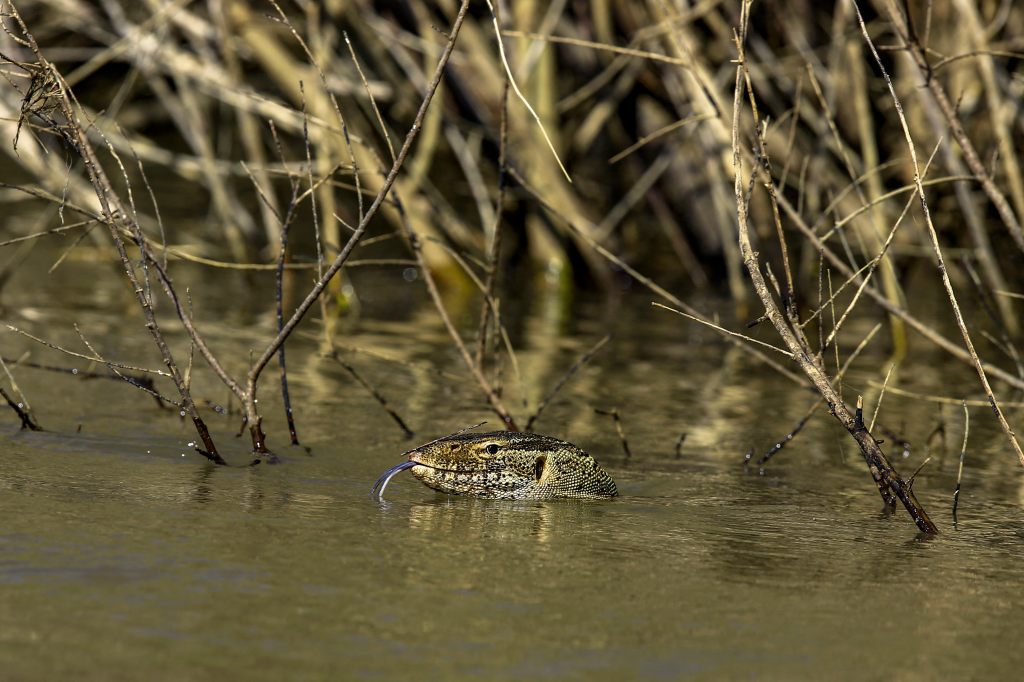
Nile monitors are extremely difficult to catch and aren’t afraid to bite or scratch humans. They can weigh up to 20 pounds and come equipped with razor-sharp claws, a long split tongue, and a lengthy muscular tail.
They are olive-green or black with yellow striping on their head and jaw.
Snake hunter Mike Kimmel, who has firsthand experience trying to capture these animals, didn’t mince words about the challenge.
“Using traps and catching them with the dogs – I’ve interacted with them alive before and they are…it’s like catching a tornado,” Kimmel told Local10. “Swim, burrow, they climb trees, they are like modern day velociraptors.”
An animal that can swim, burrow underground, and climb trees. Once a species like that becomes entrenched across a broad geographic area, removal efforts become extraordinarily difficult.
Where Nile monitors are breeding right now
The FWC is monitoring breeding populations of Nile monitors in Miami-Dade, Broward, Palm Beach, and Lee counties, according to ABC News.
These aren’t isolated sightings. Breeding populations mean the species is reproducing successfully and expanding its range.
The monitors thrive in humid environments, travel over land and through fresh and saltwater, and have a high reproduction rate. South Florida’s subtropical climate and extensive waterway systems provide near-ideal conditions for them.
For native turtles, ground-nesting birds, and small mammals living in these counties, an established breeding population of large carnivorous lizards is an existential threat. Each generation of monitors that successfully reproduces makes eventual eradication less feasible.
Is is too late to stop this invasive species?
Here’s the question that should frustrate every one of us who cares about protecting native wildlife.
Why did it take approximately 40 years from the time Nile monitors were first introduced to Florida for them to be added to the state’s prohibited species list in 2021?
That four-decade gap allowed Nile monitors to establish themselves, breed, and spread—all without the regulatory designation that might have restricted their importation, sale, or ownership earlier.
Frank Mazzotti, a professor of wildlife ecology at the University of Florida, issued a pointed warning about the dangers of waiting too long to act on invasive species.
“You cannot wait until an invasive species has demonstrated its impact upon the ecosystem,” Mazzotti told ABC News. “Because if you do, then it’s too late.”
That strikes at the heart of this problem. Requiring demonstrated ecological damage before taking regulatory action is a standard that guarantees damage will occur. By the time harm to native turtles, birds, and other species is thoroughly documented, the invasive predator is already entrenched.
Mazzotti’s comments suggest the exotic pet trade is part of the story. And his assessment of the animals’ temperament makes clear why they so often end up released into the wild.
“They’re very wild, they’re very active,” Mazzotti said. “They don’t make good pets at all. They don’t calm down.”
“They’re crazy,” he added. “They’re very hard to handle, and you have to take great care that they don’t escape and that you don’t get bit.”

Florida’s experience with Burmese pythons offers a sobering parallel.
A nonnative species enters the state, gains a foothold while policy lags behind, and eventually becomes so established that removal efforts can only manage the population—never eradicate it.
The question now is whether Nile monitors have already crossed that threshold.
Conversation
All comments are subject to our Community Guidelines. Woman's World does not endorse the opinions and views shared by our readers in our comment sections. Our comments section is a place where readers can engage in healthy, productive, lively, and respectful discussions. Offensive language, hate speech, personal attacks, and/or defamatory statements are not permitted. Advertising or spam is also prohibited.