Could You Get a Trump Account $1000 Match? TrumpIRA Income Limits and Key Dates
Trump's new TrumpIRA program matches your retirement savings—here's exactly how much you need to put in

Key Takeaways
- The Trump account $1,000 match covers 50 percent of up to $2,000 in annual contributions.
- Single workers earning under $35,500 and couples under $71,000 may qualify for the match.
- TrumpIRA.gov launches January 1, 2027—no one can enroll in the program quite yet.
During his State of the Union address in February, President Donald Trump hinted that he may be creating a new retirement fund for Americans. The idea wasn’t discussed much more after that, leaving many to wonder if it would ever actually happen. Enter TrumpIRA, the president’s new retirement program that promises $1,000 to workers whose employers don’t offer retirement plans. But, how exactly does the program work? And how can Americans who qualify enroll in it? We break it all down below.

What we know so far about TrumpIRA
On Thursday, April 30, President Trump signed an executive order into law that would allow working Americans without an employee-sponsored retirement plan to find and compare private-sector retirement savings accounts via his soon-to-be-launched website, TrumpIRA.gov. The order also made it so the federal government has to start matching 50 percent of any retirement contributions made by individual workers who earn less than $35,500 a year and don’t have an employee-sponsored retirement plan. For couples that file jointly, that limit increases to $71,000.
The cap for the retirement fund match is currently $1,000 for individuals and $2,000 for couples per year. For example, if an individual who makes less than $35,500 puts $2,000 into their retirement plan, the federal government will match $1,000. If someone puts $500 in, the federal government will only match $250. The max cap is $1,000 for individuals and $2,000 for couples, even if someone puts in $5,000 they will only be matched up to $2,000 depending on their filing status.
The idea for that plan comes from President Joe Biden’s Saver’s Match, which was part of the 2022 Setting Every Community Up for Retirement Enhancement (SECURE) 2.0 Act. That act was based on President Trump’s 2019 SECURE 1.0 act, which has had bipartisan support over the years.
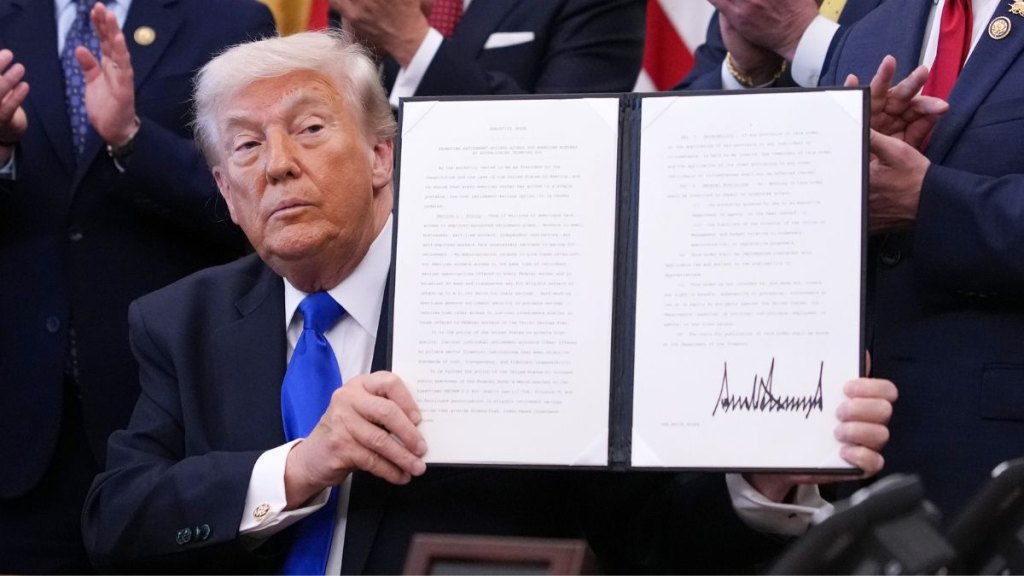
“For millions of Americans who lack employer-sponsored plans, this will be really revolutionary, because they’ll be covered,” Trump said at an Oval Office signing ceremony according to NBC News.
This executive order is a little different from what President Trump first promised Americans during his State of the Union address. During that speech, he said he would give workers without a retirement fund the option to enroll in certain parts of the federal government’s retirement program. Currently, the only part of that plan that’s included in President Trump’s new retirement accounts is the matching, which is similar to the Thrift Savings Plan (TSP) offered to federal employees.
“We have millions and millions of people, because the stock market has done so well, setting all those records. Your 401(k)s are way up. Yet half of all working Americans still do not have access to a retirement plan with matching contributions from an employer,” Trump said during his State of the Union address. “To remedy this gross disparity, my administration will give these forgotten American workers, great people, people that built our country, access to the same type of retirement plan offered to every federal worker. We will match your contribution with up to $1,000 each year.”
Will that $1,000 match be enough for people to retire on?
During the signing of his new executive order President Trump said that if a young employee saves regularly and enrolls in his new program, they should be able to have $465,000 in their retirement accounts by the time they reach 65.
“In other words, they’ll be rich,” Trump said.
But is that statement correct? And will the match he’s promising actually help Americans? Winnie Sun, cofounder and managing director of Sun Group Wealth Partners, told CNBC, ″$465,000 sounds big—and for many, if not most families, it’s definitely meaningful.”
“Sometimes ‘wealth’ isn’t about excess,” Sun continued. “I think these programs aren’t really about creating millionaires, but more about sparking the inspiration to start saving. So maybe the better question isn’t, ‘Is this rich?’ It’s, ‘Is this better than where we started?’”
Certified financial planner Barry Glassman, founder of Glassman Wealth Services, agreed, telling the outlet, “There are advantages to these accounts, but I don’t believe they are going to make people rich.”
“While $465,000 could provide a healthy sum for retirement, with 3 percent inflation, in 30 years that’s equivalent to less than $200,000 today,” he continued, “Again, not a small sum, but certainly does not qualify someone as rich.”

How to enroll in President Trump’s new retirement plan
The millions of Americans who meet the qualifications—making less than $35,500 a year as an individual and $71,000 as a couple at a job without an employee-sponsored 401 (k) plan—and want to enroll in the program will have to wait until the website actually launches to do so. According to the President, the target date for that is January 1, 2027.

Before that happens, President Trump said he is hoping to increase the salary limit. According to Kevin Hassett, director of the White House’s National Economic Council, “We’re working with Congress to significantly expand this program and are looking forward to legislation this year.”

If that happens and legislation is passed, there’s a chance more Americans could become eligible for the program. As of publication, nothing has been decided.
Ready for more? Subscribe to our YouTube channel for video podcasts, health tips and uplifting stories designed for women 40, 50, 60 and beyond.
Conversation
All comments are subject to our Community Guidelines. Woman's World does not endorse the opinions and views shared by our readers in our comment sections. Our comments section is a place where readers can engage in healthy, productive, lively, and respectful discussions. Offensive language, hate speech, personal attacks, and/or defamatory statements are not permitted. Advertising or spam is also prohibited.