This Simple Pelvic Tilt Exercise Relieves Back Pain and Soothes Sciatica
Follow along with step-by-step instructions and video guides

Most of us experience back pain at some point (though it’d be amazing if we could avoid it altogether!) Everything from joint pain to aging to sciatica can trigger a backache, and the pain can range from a mild annoyance to downright debilitating. Rather than suffering through the discomfort, experts say a pelvic tilt exercise speeds healing and strengthens muscles to avoid future flare-ups, too. Read on for our guide to three easy moves that can send back pain packing.
What is a pelvic tilt exercise?
“A pelvic tilt is an exercise that alters the position or rotation of the pelvis in relation to the spine,” explains Cate Schaffer, PT, DPT, multisite clinic director and pelvic floor therapist at ATI Physical Therapy. She notes two main types of pelvic tilt exercises: Anterior (forward) pelvic tilt and posterior (backward) pelvic tilt, both of which can help ease back pain.
In an anterior pelvic tilt, you tilt the front of your pelvis forward and downward, increasing your lower back’s natural curve. To perform a posterior pelvic tilt, you tilt the front of your pelvis backward and upward, flattening the natural curve of the lumbar spine, Schaffer explains.
These exercises isolate your pelvis in relationship to your lower back and hips, adds Milica McDowell, PT, DPT, a certified exercise physiologist and VP of operations at Gait Happens. Why is that so important? Pelvic tilt exercises improve mobility in an area of the back that tends to get stiff and sore when we spend too much time seated.

How a pelvic tilt exercise eases back pain
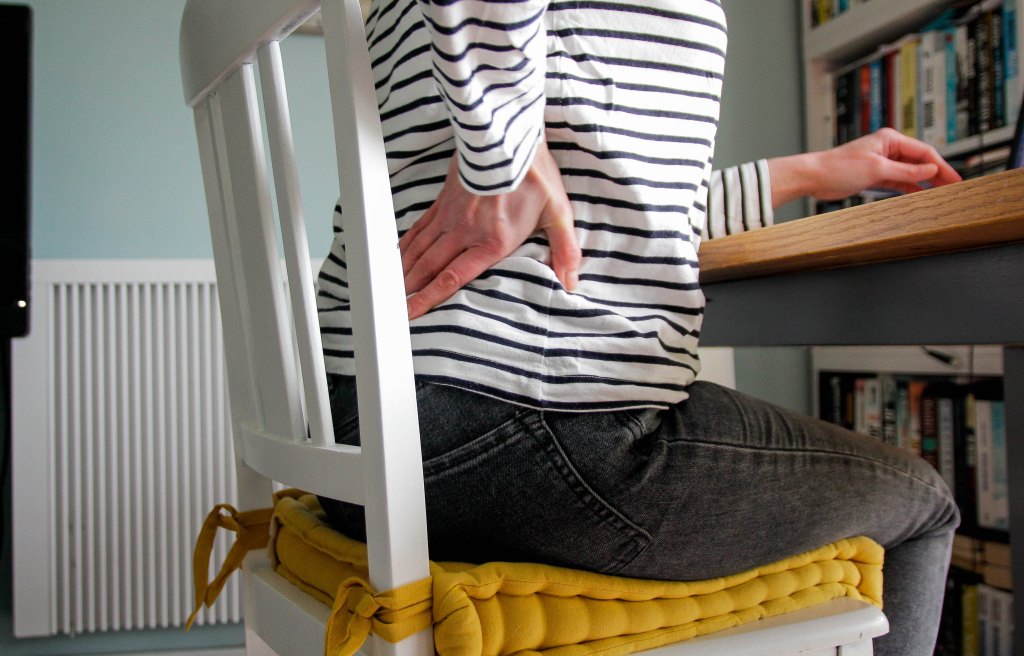
“Pelvic tilt exercises can help with back pain because they teach people to isolate their pelvis area versus their lower back,” says McDowell, who explains that your lower back and pelvis can move independently. “This can be helpful when working on flexibility, mobility, breathing and other exercises that may cause lower back pain.”
And if you’re struggling with sciatica, a type of nerve pain that radiates from your lower back down your buttocks, pelvic tilts are beneficial because they aid nerve flossing.That means “we try to get the nerve to glide to reduce symptoms,” says McDowell.
How to do a pelvic tilt exercise for back pain
Pelvic tilts can be performed in any position, but lying down, seated or on your hands and knees may be the easiest positions, says Melissa L McElroy, PT, DPT, WCS, clinic director at ProRehab Physical Therapy.
McDowell suggests that to perform a pelvic tilt exercise properly, you should think of your pelvis as a fishbowl full of water. “If you want to do a forward (anterior) pelvic tilt, you are trying to spill that water forward onto your toe. If you want to do a backward (posterior) pelvic tilt, you want to spill that water back toward your belly button.”

“If pelvic tilts help relieve your lower back or sciatic pain, you can perform 20 to 30 repetitions, holding each position for three to five seconds,” says Schaffer. “This can be done two to three times a day. But if the exercise worsens your pain, consult a physical therapist before doing it regularly.”
McElroy says the best way to learn is to perform a pelvic exercise while lying on your back. Here, three easy moves that stretch and strengthen to thwart pain:
Standard pelvic tilt exercise
- Start by lying on your back with your knees bent and feet flat on the floor.
- Put your arms along your sides or place them on your hips.
- Take a deep “belly breath” in, then exhale.
- As you exhale, gently draw the front of your hip bones back toward your abdomen as you pull your belly button toward the ground. This is a posterior pelvic tilt exercise.
- Return to a neutral starting position.
- Then take a deep breath and slowly and gently rock your pelvis forward and buttocks back, “as if you’re attempting to create a mouse hole between your lower back and the ground,” McElroy says. This is an anterior pelvic tilt exercise.
- Return to the starting position and repeat up to 30 times.
Seated pelvic tilt exercise
Once you’ve mastered a standard pelvic tilt exercise, you may want to consider a seated pelvic tilt. This movement is a bit more challenging but can still help to reduce pain.
- Sit on an exercise ball with your feet shoulder-width apart.
- Inhale deeply, then roll your pelvis forward, exaggerating your natural lumbar curve for an anterior pelvic tilt.
- Return to a neutral position.
- Then take a deep breath and roll your pelvis backward to flatten your lower back (as if you were “tucking your tail”) without letting your ribcage sink or shortening your posture.
- Repeat up to 30 times.
Standing pelvic tilt exercise

A standing pelvic tilt allows the greatest range of motion, enabling you to stretch and strengthen your lower back even more deeply.
- Lean your back against a sturdy wall.
- Inhale and bend your knees slightly.
- Exhale and pull your hip bone toward your ribcage without moving your lumbar spine (posterior tilt).
- Return to a neutral position.
- Then tilt your pubic bone toward the floor without moving your lumbar spine or rib cage (anterior tilt).
- Repeat up to 30 times.
Avoid these pelvic tilt exercise mistakes
- If you’re new to pelvic tilts, McElroy advises watching out for these common mistakes: Overusing other muscle groups to compensate for the movement, such as moving the upper body/torso/shoulders to force the movement to happen
- Holding your breath
- Pushing through your abdomen
- Clenching the glutes
- Pushing with the legs and hips to force the movement
Shaffer says that pelvic tilts can be a valuable addition to a routine for reducing pelvic, lower back or sciatic pain. But if your pain doesn’t improve, it’s important to consult your doctor.
Conversation
All comments are subject to our Community Guidelines. Woman's World does not endorse the opinions and views shared by our readers in our comment sections. Our comments section is a place where readers can engage in healthy, productive, lively, and respectful discussions. Offensive language, hate speech, personal attacks, and/or defamatory statements are not permitted. Advertising or spam is also prohibited.