The Moment That Changed John Wayne’s Life—and Made Him a Hollywood Legend
A football injury ended his original plans—but launched the actor's iconic career

Key Takeaways
- A football injury ended John Wayne’s plans—and led him to Hollywood.
- A USC scholarship and studio work unexpectedly launched Wayne’s career.
- 'Stagecoach' turned a struggling actor into an enduring Hollywood legend.
For millions of movie fans, John Wayne seemed destined for the screen. With his towering frame, deliberate walk and unmistakable voice, he felt like a figure who had stepped fully formed out of the mythology of the American West.
But Wayne, who was born Marion Mitchell Morrison on May 26, 1907, in Winterset, Iowa, did not grow up planning to become a movie star. In fact, if life had unfolded a little differently, the future Duke might have spent his career in an entirely different profession.
After moving with his family to Glendale, California, Wayne proved himself an excellent student and a standout athlete. By the time he graduated from Glendale Union High School, he had become something of a campus celebrity. According to biographer Scott Eyman, author of John Wayne: The Life and Legend, he was “a natural athlete and had been a very big man on campus at Glendale High. He was head of the debating club, he was in the theater club, he wrote a sports column for the school newspaper and he was the star tackle on the football team, which was a great football team.”
That success opened a door that might otherwise have remained closed. Wayne received a football scholarship to the University of Southern California—an opportunity that meant far more than simply playing sports. “He never would have been able to go to college if he hadn’t gotten a football scholarship to USC, because there was no money,” Eyman explains. “I mean, tuition at that point was probably $400 a semester or something. Not a lot, right? Well, forget it. They didn’t have it.”
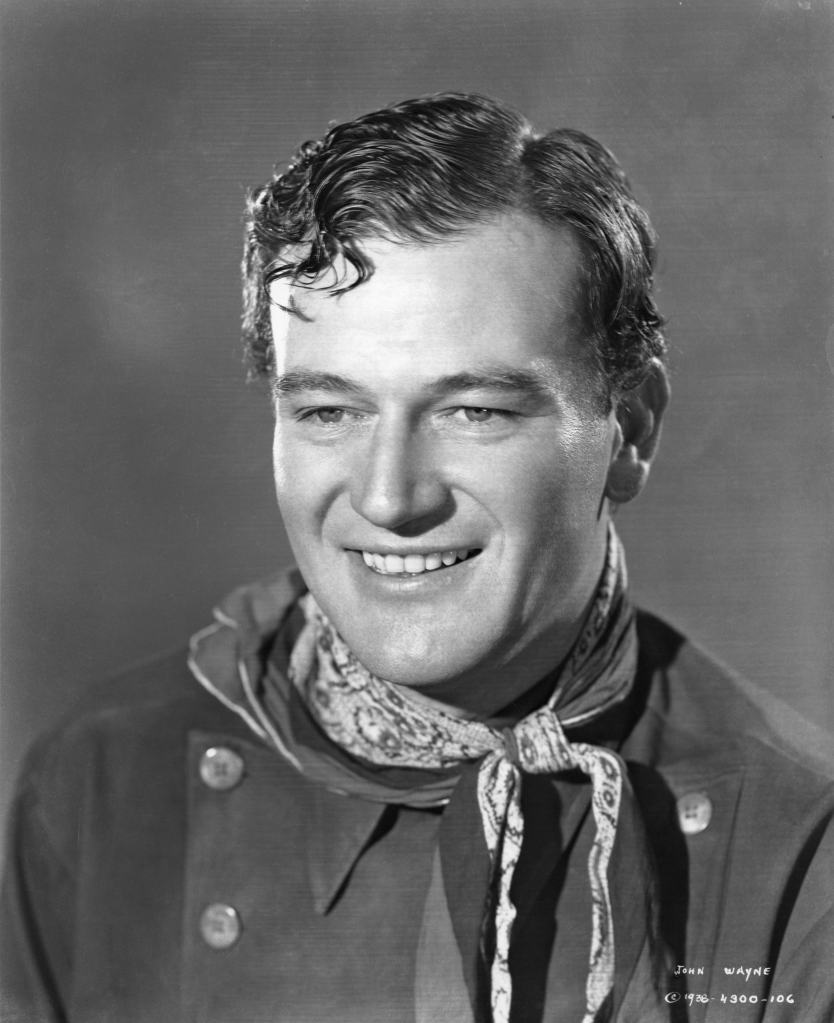
As Eyman describes it, “His father worked as a druggist; in that era, you didn’t necessarily have to be licensed, because you’re working in small towns in Iowa and the Midwest and California. Nobody asked for a license. Hey, if you don’t kill anybody, you can work as a pharmacist. And his father always had a lot of trouble putting bread on the table.”
John Wayne’s early days in Hollywood
At USC, Wayne studied pre-law and imagined a future far removed from Hollywood. But football ended up doing more than paying for his education. It also led him toward the movie business. As Eyman explains, “When the guys on the football team needed jobs, they would go to work at Fox as laborers, because the head coach of the football team had an in at Fox. So that’s how he got in the movie business and that’s how he met director John Ford as a kid on the USC football team.”
Those early studio jobs were anything but glamorous. Wayne hauled equipment, worked behind the scenes and gradually began learning how films were made. But before his life could take shape in Hollywood, fate intervened two years into college. “He busted a shoulder surfing and nobody needs a tackle who can’t block, so he got cut,” Eyman says. “As a result, he couldn’t afford to pay the tuition, which is why he had to drop out.”
For many young people, that moment might have marked the beginning of a setback. For Wayne, it ended up redirecting his entire future. Instead of leaving the studio behind, he stayed.
“At Fox, he became a laborer, an assistant cameraman, he did make-up—he did everything, because he was just a kid trying to make a living,” the biographer points out. “And Ford took a liking to him and made him a part of his crew.”
Director John Ford would eventually become the most important creative partner of Wayne’s career. But at the time, Wayne was simply another young man trying to find steady work.
“Gradually Ford gave him some small parts—walk-on parts, nothing special—because he had a nice face,” Eyman notes.

One of Wayne’s earliest big opportunities came when director Raoul Walsh cast him in the 1930 epic The Big Trail. The job paid far better than his previous studio work. “He got the job working for Raoul Walsh on The Big Trail, because it was $75 bucks a week and he had been making $15 bucks a week,” Eyman says. “In 1929 or 1930, that’s good money for a kid with no college degree who wants to be a movie star. And, of course, it bombed and he spent the next 10 years basically tap-dancing, making five- or six-day Westerns,” Eyman says. “But it was a living.”
That persistence would eventually pay off when John Ford decided to cast him in a film that would change everything. “Finally, Ford came around and said, ‘Let’s do Stagecoach,’” Eyman says.
The movie, released in 1939, transformed Wayne into a star and ensured that the young football player who once dreamed of becoming a lawyer would instead become one of the most enduring legends in Hollywood history.
Conversation
All comments are subject to our Community Guidelines. Woman's World does not endorse the opinions and views shared by our readers in our comment sections. Our comments section is a place where readers can engage in healthy, productive, lively, and respectful discussions. Offensive language, hate speech, personal attacks, and/or defamatory statements are not permitted. Advertising or spam is also prohibited.