As ‘Star Trek IV’ Turns 40, Cast and Crew Share Their Memories About ‘the One With the Whales’
Leonard Nimoy reinvented 'Star Trek' with whales, comedy and time travel—and audiences loved it

Key Takeaways
- 'Star Trek IV' became the biggest film, replacing villains with humor, heart and... whales.
- Leonard Nimoy made 'The Voyage Home' lighter, funnier and more accessible to non-fans.
- Eddie Murphy nearly starred in 'Star Trek IV' before dropping out for The Golden Child.
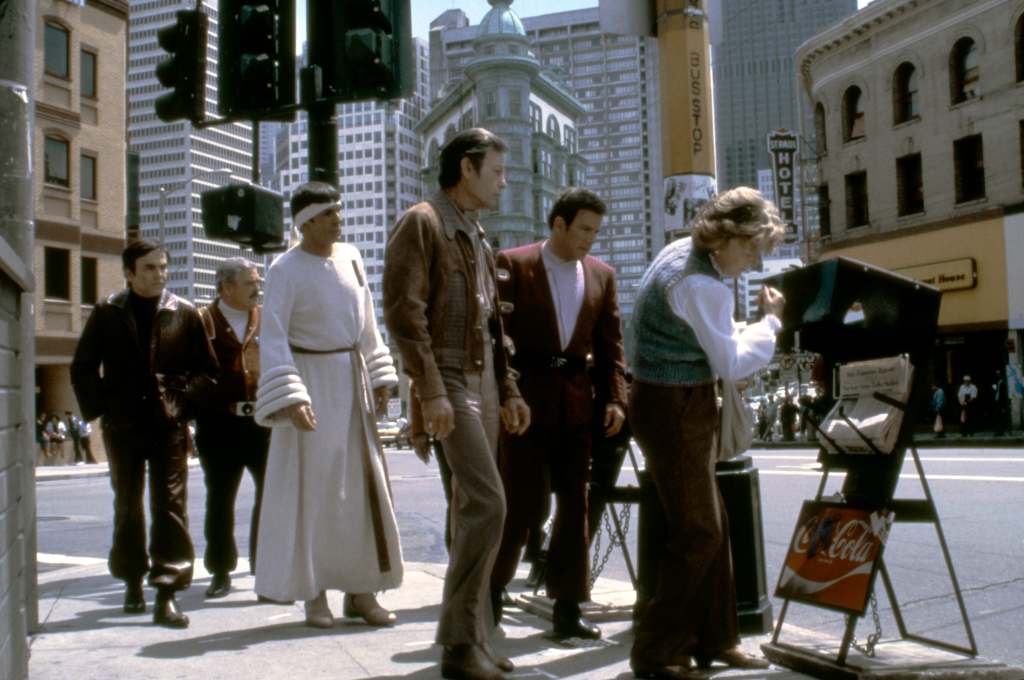
Until the release of J.J. Abrams’s 2009 reimagining, Star Trek IV: The Voyage Home—currently celebrating its 40th anniversary—was the most successful Star Trek film of them all. With little violence and humor that harkened back to classic episodes like “The Trouble With Tribbles” and “A Piece of the Action,” Star Trek IV brought with it an eco-friendly message at its heart and a cautionary warning about endangered species—in this case, the imperiled humpback whale. Additionally, its fish-out-of-water story of 23rd century characters stuck in the San Francisco of 1986 was an irresistible premise that its filmmakers milked to the fullest. Although dismissed by some die-hard fans as too whimsical and slight to be considered among Star Trek’s greatest adventures, there’s little doubt that the success of Star Trek IV would ensure that the franchise would continue to live long and prosper for many years to come (and, yes, we went there).
EDDIE EGAN (unit publicist, Star Trek IV: The Voyage Home): “The difference from the studio perspective on this film was that it was a full-fledged movie again like Star Trek: The Motion Picture with a movie budget, supervised by the movie group. Everyone was just incredibly excited about the potential of the story and the fact that it could take place outdoors on real locations for a legitimate reason as opposed to being stuck on the sets.”
LEONARD NIMOY (actor, director, Star Trek IV: The Voyage Home): “I was asked to do Star Trek IV before Star Trek III even opened. I had had some constraints on Star Trek III. I was told flat out that they wanted my vision on this one. ‘This is a Leonard Nimoy film.’ That being the case, Harve and I were asked to develop a concept. I went off to Europe to work on The Sun Also Rises. While I was there, I also wrote a seven- or eight-page outline of what I thought the film could be about. Harve came over and we collaborated on the material . . . it went in as the very first concept.”
HARVE BENNETT (cowriter, producer, Star Trek IV: The Voyage Home): In moving through the trilogy, I confess that every one of the major tricks I learned in television, I used. Here are the three tricks of the trilogy: Star Trek II, in television we call that the ‘bottle show.’ The ‘bottle show’ in television takes place in an elevator that’s hopefully trapped between two floors. Or it takes place in a mine shaft where people are desperately coming to try to save you and you have to stay down there and talk a lot. Sixty-five percent of the film was on the Enterprise bridge in one incarnation or another. It was also the Reliant bridge, and that is an incomparable savings in terms of time, dollars, and moves. We’d shoot a scene, move the people out, repaint it, and it would now be the Reliant. Star Trek III was the classic television, ‘the leading actor loses his memory’ show. I did that on Mod Squad, Six Million Dollar Man, Bionic Woman. You usually do it when your leading actor is exhausted or needs a rest. He’s in a coma-like state. In Star Trek III, we had a man who was directing the movie, and who had never directed a feature before, and we felt that to act and so forth would kill him. We had our choice of how to utilize that asset and what we did was we spent most of our money building one great set, the Genesis Planet, and the story became let’s find him while he directs. For Star Trek IV we decided to use local location. We had to add some size to the picture, so what do we do? We go out. How do you go out in the twenty-third century? You come to the 20th century.”
Why time travel in ‘Star Trek IV’?
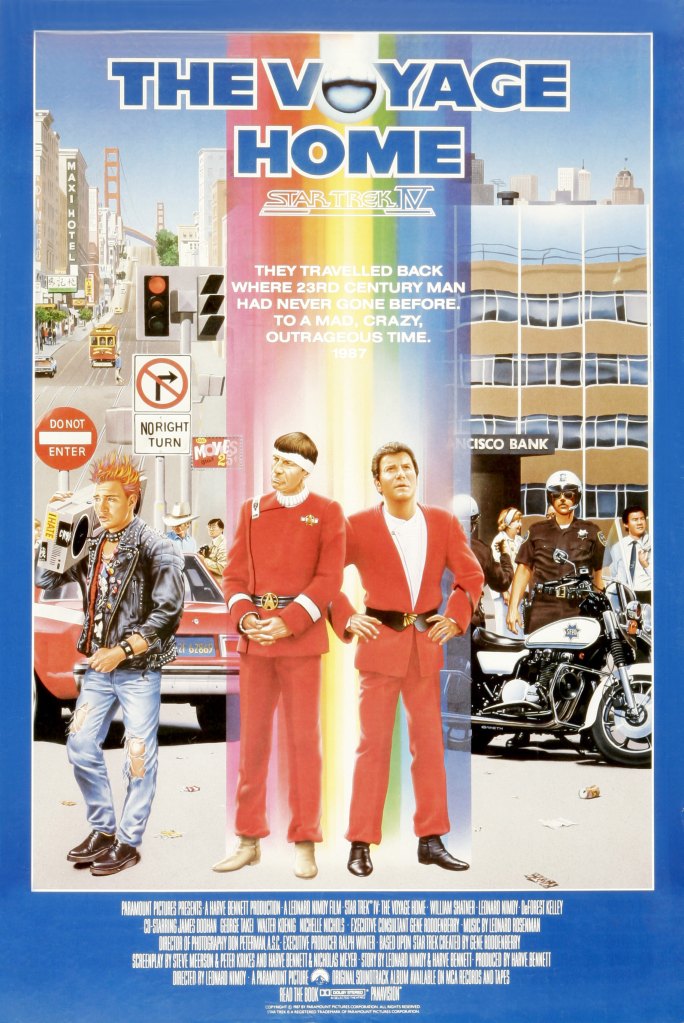
LEONARD NIMOY: “We decided early on that we wanted to do a time-travel story. When I say we, I’m talking about Harve Bennett and I. We were asked by the studio to come up with a story, and our very first conversation was about doing time travel, which we both agreed was a good idea. We also felt that we should lighten up. The picture should be fun in comparison to the previous three.”
STEVE MEERSON (cowriter, Star Trek IV: The Voyage Home): “We sat in a room with Leonard and Harve. Leonard told us that he wanted to do a departure, although they weren’t sure what they wanted to do.”
LEONARD NIMOY: “When we started out to do this picture, I went to three universities—the University of California, Santa Cruz; Harvard; and MIT—to talk to three different professors who are physicists, scientists, and futurists. I spent several hours talking to them about their immediate concerns for the future of the planet. We talked about their ideas for potential contact with extraterrestrials. What it might be like. Where it might come from. How it might come. How we would deal with it. The philosophy of it. And the immediate impact on the sociology of the planet, the religions of the planet. I had some great times.”
PETER KRIKES (cowriter, Star Trek IV: The Voyage Home): “They wanted to do a film sort of based on ‘The City on the Edge of Forever.’ Leonard started talking about plankton, cells, that cells become plankton, that things eat plankton, and then whales entered the conversation. We said, ‘Why not make it as simple as the whale and the whale song?’ That was our idea, though that’s not to say Leonard hadn’t done research on whales, because he had.”
LEONARD NIMOY: “I was also in touch with Edward O. Wilson. In his book Biophilia, he tells us we could be losing as many as 10,000 species off this planet per year—many of them having gone unrecorded. We won’t even have known what they were and they will be gone. He touches on the concept of a keystone species. If you set up a house of cards you may be able to pull away one card successfully . . . and another card successfully. But at some point you are going to get a card that is a keystone card. When that one is pulled away, the whole thing will collapse.”
“The same might be true of species: a planetary imbalance might be caused by the destruction or loss of just one. Our tendency is to say, ‘Here’s this pressure group pestering us—but things aren’t really bad yet. Let’s pay attention to the things we really have to.’ But when the ozone question or the species question or whatever gets really bad, we’ll turn to scientists and say, ‘Okay, here’s the money. Fix it!’ They, at some point, may have to come back and say, ‘It’s too late. We cannot do that anymore, there was a time when we might have . . .’ There is a fantasy that if we did have a holocaust kind of war on this planet, those who are left could eventually rebuild the planet. It’s simply not true. They could never again reach the technical accomplishments that we have reached.”
STEVE MEERSON: “Leonard had mountains of information on various things. We were hired in February of 1985 and between that time and May or June, Peter and I did several outlines of what eventually became the story. Harve and Leonard took our outline and went through it step by step with the studio executives, and we got the go-ahead to start writing.”
LEONARD NIMOY: “What we set out to do, frankly, was very dangerous. I was trying to service a lot of masters. I wanted to continue and wrap up some threads that were left over from Star Trek III. At the same time I wanted to make an entirely different kind of film. Those ideas seemed in opposition to each other, but I think we pulled it off.”
‘There be whales here!’
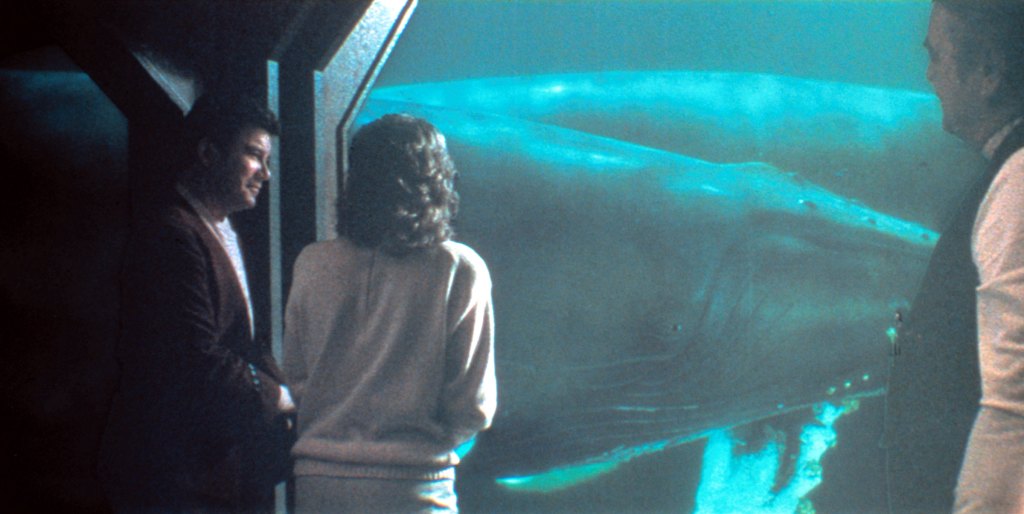
RALPH WINTER (executive producer, Star Trek IV: The Voyage Home): “It was Leonard’s idea about saving the whales as opposed to, as he famously said, ‘trying to save snail darter.’ Saving whales made it a bigger movie.”
LEONARD NIMOY: “At the same time, I wanted to make a film that would be accessible and enjoyable to people who had not seen Star Trek III in order to enjoy this picture. I also wanted to make it accessible to people who don’t go to Star Trek movies. I wanted to make it a movie-movie. It starts out like a Star Trek movie and then makes a left turn. It is intentionally very different. I felt very strongly about the fact that II and III were really two of a kind. They both were played with black-hat heavies. We are the good guys and they are the bad guys and we have to beat them. I really wanted to make a change in that. The first movie had no comedy at all. The second film had a little. The third film had a little. But there we were dealing with a lot of serious drama. There was a lot of life and death going on. I just felt it was time to lighten up and have some fun. That meant that if we were going to do time travel, the best thing we could do was come back to contemporary Earth, where we could have some fun with our people. They would more or less be a fish out of water on the streets.”
WILLIAM SHATNER (actor, “James T. Kirk”): “We discovered something in Star Trek IV that we hadn’t pinpointed in any of the other movies and it just shows how the obvious can escape you. There is a texture to the best Star Trek hours that verges on tongue-in-cheek, but isn’t. There’s a line we all have to walk that is reality. It’s as though the characters within the play have a great deal of joy about themselves, a joy of living. The energy, that joie de vivre about the characters seems to be tongue-in-cheek but isn’t, because you play it with the reality that you would in a kitchen-sink drama written for today’s life.”
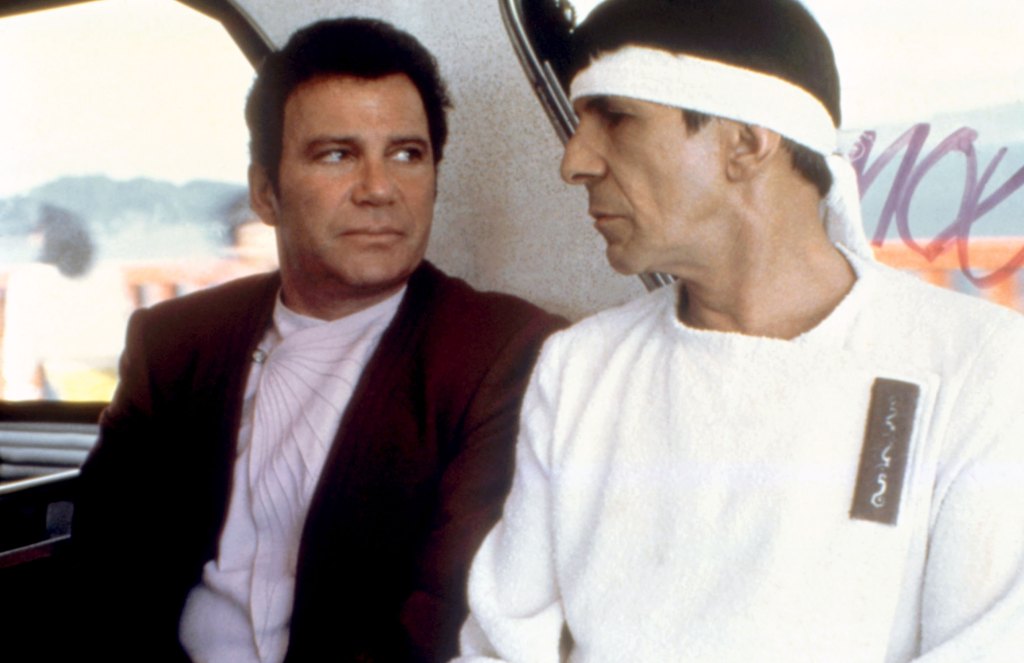
LEONARD NIMOY: “We were talking about the idea that if alien intelligence was trying to contact us, it would probably take quite a long time for us to know what it is saying, and for us to communicate with it. I became intrigued with the idea that there was some lack of communication that was causing the problem. [I was] aware that humpback whales sing this unusual kind of song, which we don’t understand but which obviously means something to them. It’s quite a complex structure, and that’s very interesting. We don’t know, and we may never know, what the communication is all about, so supposing that something in the twenty-third century is trying to communicate with them and they’re gone. That’s how it all happened, and it’s a hell of a lot more interesting and challenging, cinematically, to come back to the twentieth century to pick up a pair of whales than it is to pick up a plant or insect.”
HARVE BENNETT: “We went through every writer we could think of. We finally found Steve Meerson and Peter Krikes, whose work was highly regarded. Nothing came of it. Some of that, in fairness to them, was because we had saddled them with what appeared to be a male character that we thought was going to be Eddie Murphy at one time as a marine biologist.”
There was indeed a period in the development of Star Trek IV where Eddie Murphy was considering a role as a marine biologist, but instead decided to make The Golden Child. Eventually Meerson and Krikes were let go (you can read all about the Eddie Murphy version of the film via a link at the end of this story).
HARVE BENNETT: “I remember saying, ‘Well, I know it’s corny, but it would be better if the marine biologist was a woman. Kirk hasn’t had a woman to play to, which he does so wonderfully. The whole series is the woman of the week. Remember that whale special we saw where the girl was bidding adieu to the whale who had to leave Marineland because the female was pregnant, and they could not keep them, and they had to send then back to the sea, and she was bereft? That’s the lady.” Leonard thought it was great. So now we’re getting down to where we’ve got a movie to make and whole new script to write. That’s when we were fortunate enough to find that Nicholas Meyer was available.”
NICHOLAS MEYER (cowriter, Star Trek IV: The Voyage Home): “The other script, which I never read, involved Eddie Murphy. I got this call from [Paramount executives] Dawn Steel and Ned Tanen who said, ‘We have a situation, we’re going to start this movie and we just threw out the script and we need your help and it’s your friends.’ I remember going to meet with Harve and Leonard and saying, ‘What is it?’ And Leonard said something like, ‘It’s something nice.’ And then they told me the story. And very quickly I could see how it broke down into the bookends in outer space before the journey. And then there’s the middle part on Earth. Harve said, ‘You write the middle part on earth and I’ll write the other parts.’ When I realized they went to San Francisco, I also thought, ‘Well, hey, I’ve done this movie before with Time After Time. Couldn’t they go someplace else?” I suggested Paris. And for whatever reason, they said no, they couldn’t go to Paris. Maybe the whales wouldn’t fit in the Seine.”
Location, location, location
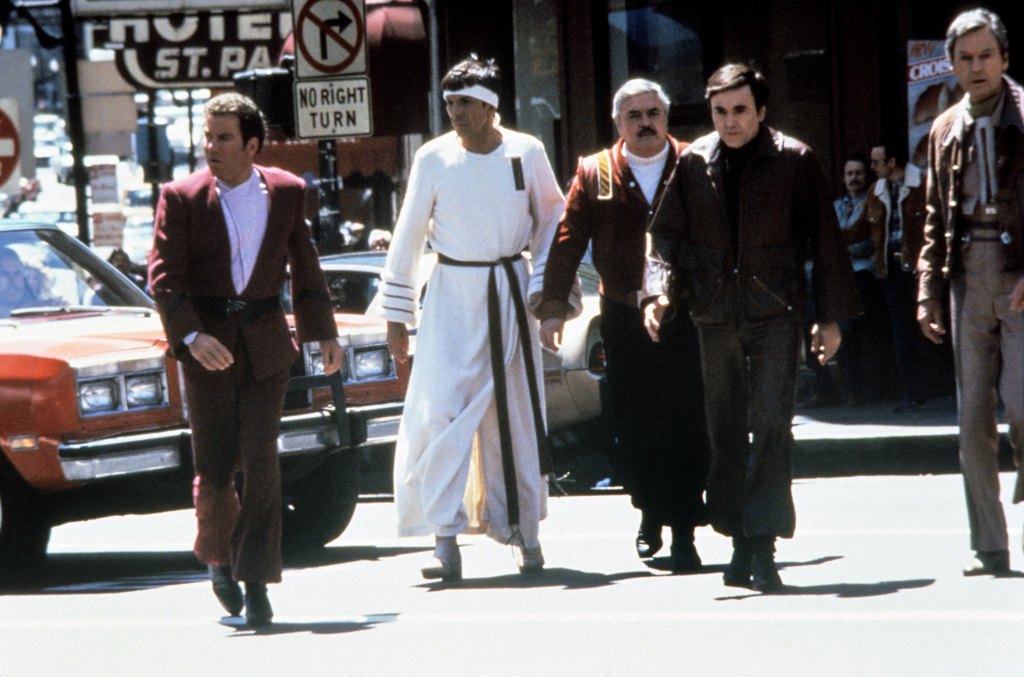
LEONARD NIMOY: “We were off the soundstages for the first time. The first three pictures were almost exclusively on the soundstages. In Star Trek I, we were off the soundstage for a couple of days, on Star Trek III we were off for a couple of nights for the Vulcan exterior scenes. To get off the soundstages on this one was very invigorating. It gave a lot more energy to me and the cast of the picture. I had a little bit more time. I shot Star Trek III in 49 days, and on this one I had 53. Actually, I had 57—and I came in four days early.”
RALPH WINTER: “Being on the street in San Francisco with Leonard, the famous five corners place, and a couple of others where we had a camera hidden in a fan where Chekov was asking innocent bystanders as they came where the nuclear ‘wessels’ are was hilarious when we were shooting it. We had fun doing it. It was real-world environments that you hadn’t seen, and time travel allowed us to do that. Nick had done Time After Time and so he was particularly sensitive about what you can and can’t do. We did some other local locations in L.A. with the transparent aluminum factory and the Apple computer. I wrote that joke for Harve and Leonard. When Scotty picks up the mouse and speaks into it, I said this would be hilarious. They didn’t really understand it, so I wrote a little of that scene. We couldn’t get Apple to play ball with us and donate some computers, but we ended up using the Apple computer anyway. It felt right, the perfect fish out of water from the 23rd century coming back and not understanding what computers could do. We shot some of the stuff on the ground in Golden Gate Park, which was Will Rogers State Park in Santa Monica.”
EDDIE EGAN: “It was a week and a half or so in San Francisco, and things became very tense there between Leonard and Harve. I don’t actually know what precipitated it, but the last month of the production was not a particularly happy time for Leonard. There were things going on in his personal life that were distracting him, and just the size of the production was a little hard for him to wrap his head around sometimes. I don’t know the details, but I do know that at one point Leonard banned Harve from the set.”
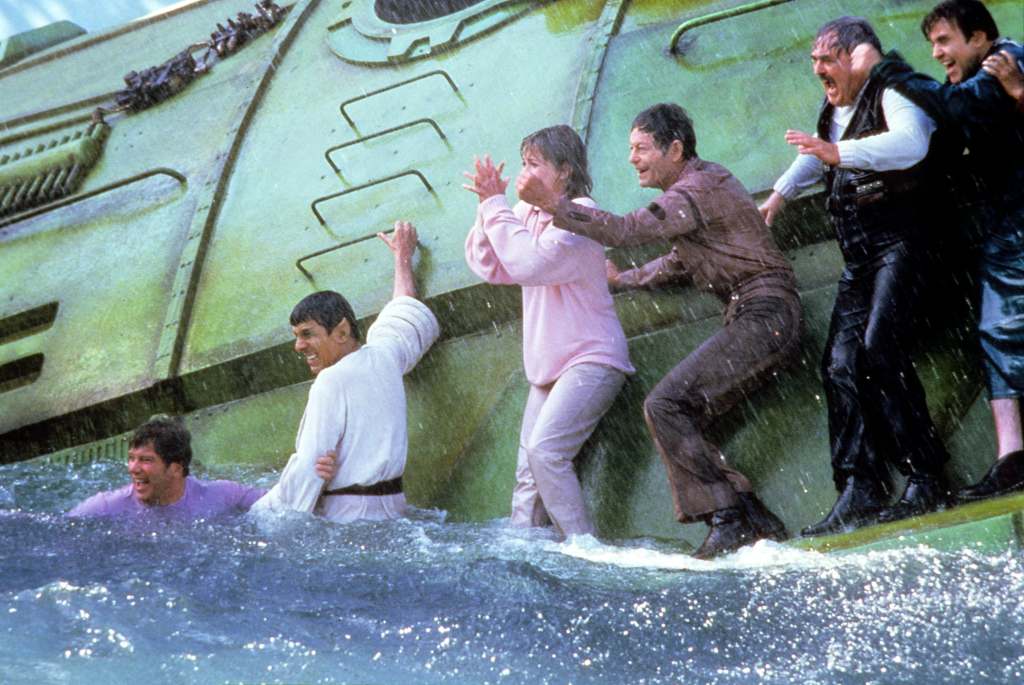
RALPH WINTER: “We also did a lot of old-fashioned effects. For the finale, when they’ve returned to the future and crashed in the bay, we opened up the water tank at Paramount to do the storm—which had not been used in decades. We cleared out that parking lot, we swept it, washed it down, and Michael Lantieri, who was brought on to be the special-effects guy who had worked at Imagineering at Disney, developed a track below the water and it would have a hump on it and a tail. He found a twenty- by forty-foot deep hole in the tank that had never been used. It had been filled up with sand. He was poking around with an iron bar and the bar went through and there’s a very thin asphalt cap on it. When we dug it out, we realized Paramount built that tank in the 20s or 30s and it had tie-downs and everything, so we used that for building sets.”
“When Bill goes down underwater to free the whales, that’s really Bill doing a lot of that stuff. We built those sets dry and then we filled them with water. The tank hadn’t been used in years. We had to call Jimmy the plumber out of retirement, because nobody knew how to turn on the pump. It held over a million gallons of water which had to be filtered, heated, and disinfected. In April of ’86, when we were shooting, it was warm outside, so it became the studio swimming pool during lunch hour. The water was only three or four feet deep but a lot of people came out and ate their lunch with their feet in the water. We used giant jet fans and fire hoses, smoke machines to create all that fog and put the cast out there in wet suits and hosed them down and created that storm sequence right there. Very old-fashioned filmmaking.”
DONALD PETERMAN (director of photography): “We had another unit in Hawaii, right off Maui, photographing live whales. There’s a man and his wife there who have a license to allow photography of humpback whales. You have to have a license to get your boat close to them because of the possibility you’re going to ram into one of them or scare them. So we cut above the water and got these shots.”
RALPH WINTER: “We spent more than the third movie, we spent $21 million, so we had a bigger budget for some of the things that made it feel large. For instance, we spent over a million dollars on the whales. With particular cetacean experts who knew how whales move, what they look like, what the skin texture was. ILM did such a good job on those whales, those whales went on tour for a year or more around the world to museums because of the expertise, the art and science of what they had done was very good. We had a guy who did the basic research for that and he’d been a leading research guy. He just applied the same kind of discipline to this.”
The re-writing process
NICHOLAS MEYER: “It was fun in a weird way. This may be my fanciful recollection, but I don’t think I felt a great deal of pressure. The easiest thing for me to do is write dialogue, which is not always what movies are about but, in this case, it was such a no-brainer. It was a comedy and I don’t get to write a lot of comedies.”
HARVE BENNETT: “Nick and I had written the final script of Star Trek II in 10 days. This one we wrote in about 20, and it was very simple to do it that way because I took act one and act three and Nick took act two. Now, if you think about that in structural terms, I got us into the dilemma and into time travel, he carried us through San Francisco, and I got us back. That was like breathing for me, because it’s pure Star Trek. Then we swapped pages and I rewrote him a little bit and he rewrote me a little bit and we put it all together and had a script.”
“Nick always said, ‘You know the problem with this script is you’ve got five endings.’ And he was right, we did have five endings. He said, ‘Why don’t you have the whales save the Earth and let that be the end of the picture?’ ‘No,’ I said, ‘that’s the end of the picture for the hoped-for extended audience who’s never seen Star Trek before. But for people who have seen Star Trek before, we have a trilogy to complete. So, we’ve got to get them back, get them off the hook, and give them the Enterprise back so that when we finish this picture, we have brought the franchise back to square one and it can go anywhere it wants to go. That’s only fair. Besides, that’s what the fans want.’ So that’s what we did. We kept every ending.”

NICHOLAS MEYER: “In my version of the script originally, when they all leave to go back, she [Gillian] didn’t leave. She said if anyone’s going to make sure this kind of disaster doesn’t happen, somebody’s going to have to stay behind, which I still think is the “righter” ending. The end in the movie detracts from the importance of people in the present taking responsibility for the ecology and preventing problems of the future by doing something about them today, rather than catering to the fantasy desires of being able to be transported ahead in time to the near-utopian future society of the Star Trek era.”
The impact of ‘The Voyage Home’
When Star Trek IV: The Voyage Home was released in November 1986, it became both a critical and commercial triumph, surprising many people who had viewed Star Trek primarily as a niche science-fiction franchise. The film earned more than $109 million domestically — making it the highest-grossing Star Trek movie up to that point — and attracted a much broader mainstream audience than the previous entries. Critics praised its humor, warmth and accessibility, particularly the decision to emphasize character interaction and fish-out-of-water comedy over battles and villains. Leonard Nimoy’s lighter tone, combined with the environmental message involving humpback whales, resonated strongly with audiences during a decade increasingly concerned with ecology and endangered species. Many reviewers singled out the chemistry between William Shatner, Leonard Nimoy and DeForest Kelley, while the San Francisco setting helped make the film feel more contemporary and approachable to non-fans. Over time, The Voyage Home would come to be viewed not only as one of the franchise’s most entertaining films, but also as proof that Star Trek could successfully reinvent itself tonally without losing its core identity.
CATHERINE HICKS (actress, “Dr. Gillian Taylor”): “I’m really proud of Star Trek IV, and that’s coming from a non Trek fan. I must have been on another channel as a kid. I’ve started watching the show since and I’m getting a crush on Spock. But while we were shooting, I deliberately didn’t rent the movies, because I thought I would use my total ignorance as a part of Gillian’s character. She doesn’t know what’s going on either.”
DEFOREST KELLEY (actor, “Dr. Leonard ‘Bones’ McCoy”): “I have always felt from the very beginning that the core of Star Trek was the family. It was always this group of people that were working in this bizarre-type world together. That’s what made the show successful. One of the greatest mistakes in the first motion picture was that they neglected the people.”
CATHERINE HICKS: “I loved her line, ‘I have no one here,’ before she jumps into the transporter beam. I don’t know why, it just touches me. It’s poignant and sad. At the time I didn’t know it, but seeing the film I realized that was my favorite line. My favorite moment, even though I’m not playing it, is when William Shatner as Kirk quotes D. H. Lawrence. Something comes across the ages. It’s such a surprise that this man knows that—it makes us kindred spirits for one second.”
DAVID A. GOODMAN (executive producer, Family Guy): “The cast is at the top of their game in that movie, they’ve never been better. Especially Shatner and Nimoy, so that’s really what you’re enjoying. The comedy still works for me, and there’s a moment where Spock mind-melds with the whale. You buy that he’s actually talking to a whale and the whale understands. That’s also the magic of Star Trek, you believe in it, you believe in him and it works. It’s those little details that make the movie stand above the others in a lot of ways.”
LUKAS KENDALL (editor, Film Score Monthly): “The most unusual Star Trek movie score is Leonard Rosenman’s for Star Trek IV; Rosenman and Nimoy were good friends. I remember, as a kid, thinking, ‘Why is there Christmas music in Star Trek?’ But it captures the spirit of the movie—that was the first time that Star Trek was acknowledged as meaningful American pop culture, not just some goofy TV show. It remains the last Star Trek score to be nominated for an Oscar.”
PETER KRIKES: “The experience was a real roller coaster for us, but it was the most successful in the series. That’s a wonderful feeling.”
STEVE MEERSON: “We were both delighted that we were a part of something that will go on forever, and I also think it said some things that needed to be said. There are some important messages there, and being allowed to have that forum was very exciting. It’s hard for me to say this, but it was worth all the aggravation.”

RALPH WINTER: “The movies endure. I’ve spoken to elementary schools about what I do and when they read off some of the credits, the kids get excited about The Voyage Home. It reminds me that those kids weren’t even thought of when we made the movie, and yet they can still enjoy what the movie is about today. It’s the lasting effect of what we do as storytellers.”
LEONARD NIMOY: “The feeling on the first film was that we had to do a “motion picture.” Nick Meyer brought a jauntiness back to it. I tried in Star Trek III to do a dignified job of resurrection, and do it with a sense of mysticism, a sense of wonder and, above all, to really capture the loyalty of these people for each other; their willingness to sacrifice themselves and their careers for the purpose of helping Spock. Having done that, I really wanted to have a good time. Somebody had been constantly dying in the films, and this time I said, ‘Nobody’s going to die. I don’t want anybody hitting anybody’ or any of that stuff. If anybody was going to be injured, it was going to be accidental. I insisted that there be no bad guy. We had done two pictures in a row with black-hat heavies, and I didn’t want a bad guy anywhere. Circumstances would be the problem. Lack of awareness, lack of concern. Ignorance would be the problem. Not a person. With this one we’ve really gone full circle and come home, which is why, in a sense, we called it The Voyage Home. We’re saying, ‘Enjoy yourself, have a good time, and don’t mind us as we drop off a few ideas along the way.’”
Conversation
All comments are subject to our Community Guidelines. Woman's World does not endorse the opinions and views shared by our readers in our comment sections. Our comments section is a place where readers can engage in healthy, productive, lively, and respectful discussions. Offensive language, hate speech, personal attacks, and/or defamatory statements are not permitted. Advertising or spam is also prohibited.