‘In Thy Image’: The Lost Episode of ‘Star Trek: Phase II’ That Became ‘The Motion Picture’
A look at how the story that began as a two-hour TV movie became the 1979 feature film

Key Takeaways
- 'In Thy Image' reveals how 'Star Trek: The Motion Picture' began as a TV revival
- Creator Gene Roddenberry reshaped the original story to focus on meaning, not machine vs man
- Behind the scenes, 'In Thy Image' sparked battles that changed 'Star Trek'
When people think of Star Trek: The Motion Picture, they tend to think of it as the moment the franchise finally made the leap from television to the big screen. What often gets lost in that narrative, however, is just how many different forms that story took before it ever reached theaters.
Long before it became a feature film, the core idea behind The Motion Picture existed as part of Star Trek: Phase II, the proposed television series that was meant to bring the Enterprise crew back for a new five-year mission. At the center of that effort was a story called In Thy Image, developed from an earlier concept by Gene Roddenberry that had originally been conceived for a completely different project.
That earlier concept—titled “Robot’s Return”—was created during Roddenberry’s work on Genesis II, a pilot he developed in the early 1970s following the cancellation of Star Trek. While Genesis II never evolved into a full series, Roddenberry continued to explore ideas that blended science fiction with philosophical inquiry. One of those ideas involved a machine intelligence returning to its creator—a concept that would eventually form the backbone of In Thy Image.
When Phase II began to take shape, Roddenberry revisited that premise and handed it off to writer Alan Dean Foster, who expanded it into a full story treatment. From there, the material would pass through multiple creative hands, each bringing a different perspective to what the story should be.
What makes In Thy Image so fascinating isn’t just that it became The Motion Picture, but that it reveals a moment when Star Trek itself was being redefined. The question wasn’t simply how to bring the series back—it was what Star Trek should be in a new era, with new expectations and a much larger canvas. The answers to those questions wouldn’t come easily.
Alan Dean Foster and the expansion of ‘In Thy Image’
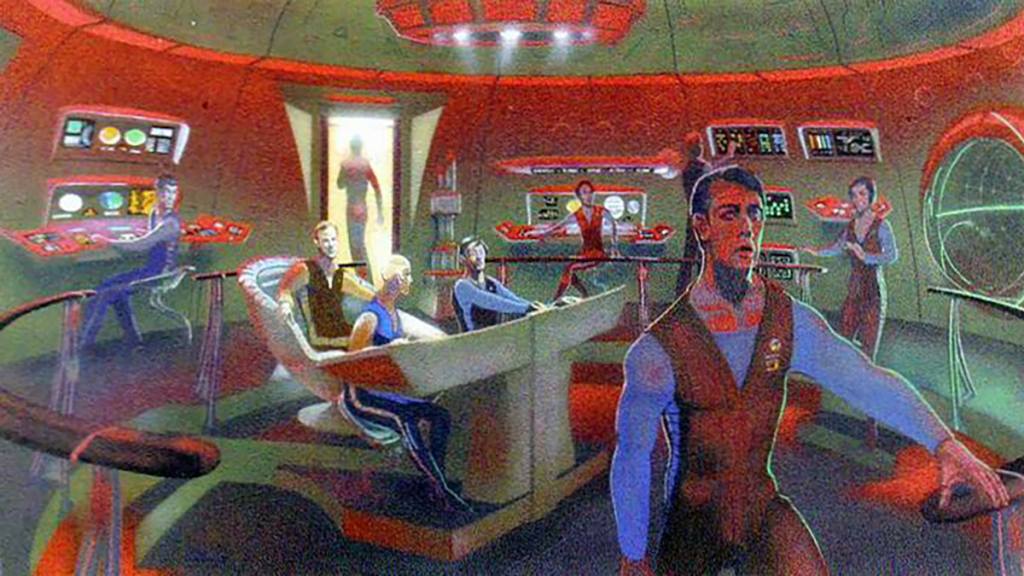
When Gene Roddenberry handed off his core idea for In Thy Image to Alan Dean Foster, what he was looking for was expansion—someone who could take a philosophical premise and shape it into a workable story for Star Trek: Phase II. Foster, who had already established himself as a science fiction writer with a strong sense of structure and character (and had authored the Star Trek Log books, which adapted teleplays from the animated series), approached the assignment by grounding the concept in a narrative that felt both familiar and ambitious.
“Roddenberry had gotten in touch with me because of the Log series,” Foster recalled. “He felt that I was comfortable with the Star Trek universe, and familiar with the characters. So I submitted three story ideas, one of which was based on a page-and-a-half outline for ‘Robot’s Return.’ He thought that could be developed and wanted to see what I could do with it, so he told me to develop it as a full scale treatment.”
At its heart, Foster’s treatment introduces a mystery that unfolds on a massive scale. A powerful and seemingly unstoppable object is moving through space toward Earth, destroying everything in its path. The threat is immediate, but the nature of that threat remains unclear, creating a sense of unease that drives the story forward. As with many of the best Star Trek episodes, the danger is not just physical—it’s intellectual, forcing the crew to confront something they don’t yet understand.
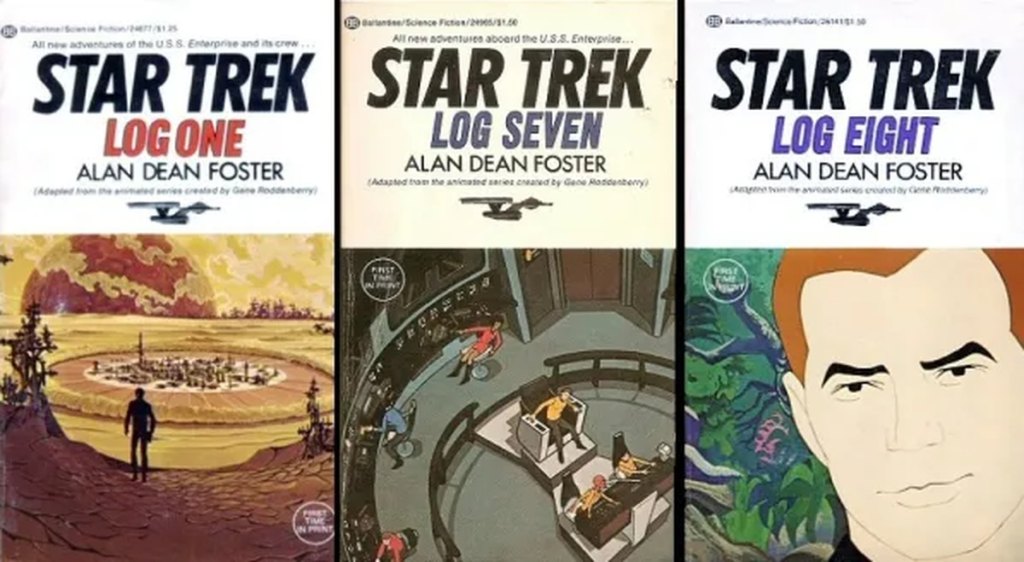
The Enterprise becomes the focal point of that investigation. Under Kirk’s command, the crew is tasked with intercepting the object and determining its purpose before it reaches Earth. Along the way, Foster builds in the kind of procedural elements that had defined the original series: analysis, debate and a gradual uncovering of the truth. The story moves from uncertainty to discovery, with each step revealing a little more about the nature of the machine at its center.
What distinguishes Foster’s approach is the way he balances scale with restraint. The threat is enormous, but much of the story unfolds through observation and interpretation rather than action alone. The machine is not simply an enemy to be defeated; it is a presence to be understood. That emphasis aligns closely with Roddenberry’s broader vision of Star Trek as a series rooted in exploration—of space, of ideas and of the unknown.
At the same time, the treatment reflects the era in which it was written. There are moments where the story leans into more familiar science fiction territory, including hints that the machine’s power might be seen as almost god-like. That tension—between science and something more spiritual—is there, even if it’s not fully explored yet, and it points toward the questions Roddenberry would soon begin raising more directly in his memos regarding the treatment.
Foster also introduces what would become one of the story’s most important ideas: the notion that the machine is searching for its creator. It isn’t acting out of malice, but out of purpose—one that has been programmed into it, yet remains incomplete. That shift changes everything, turning the story from a straightforward threat into something more thoughtful, raising questions about creation, responsibility and the limits of both human and artificial intelligence.
By the time Foster’s treatment was complete, In Thy Image had evolved into something far more substantial than Roddenberry’s original one-page concept. It had structure, momentum and a clear narrative spine. But it also contained the seeds of the challenges that would soon emerge—questions of tone, meaning and execution that had yet to be fully resolved. Those questions would not go unanswered for long.
Refining the story: Roddenberry responds
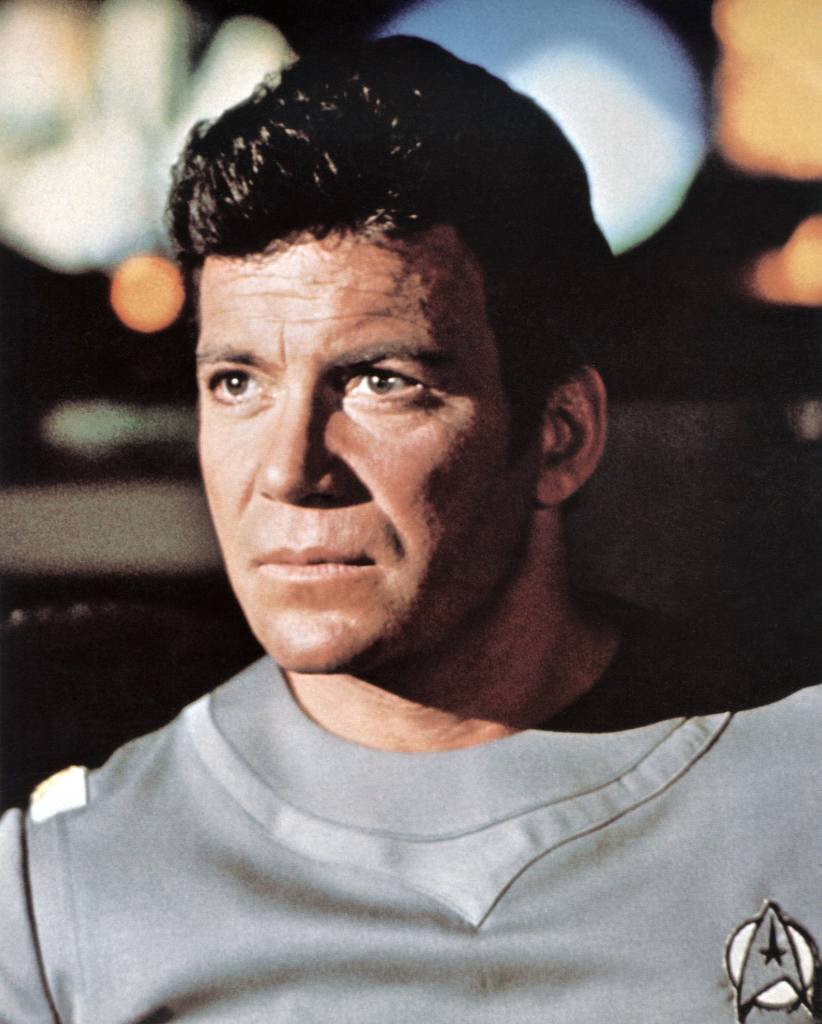
By the time Gene Roddenberry reviewed Alan Dean Foster’s In Thy Image treatment—referred to in his memo as a “story outline”—the story had clearly taken shape, but it wasn’t yet the version he believed Star Trek should be telling. What followed was not a rejection, but a redirection—one rooted in character, logic and believability.
As Roddenberry put it at the outset, “The principal problem in your Star Trek story outline is certainly not lack of imagination. Rather, I believe most of my comments will bear upon control and selective use of that imagination. Believability of characters, incidents and scenes is much more critical in picture/sound science fiction than in printed.”
That emphasis on believability immediately shaped one of his biggest concerns: how the Enterprise crew—particularly Kirk—responds to the approaching object. In Foster’s treatment, there are moments where the ship prepares for or considers aggressive action. For Roddenberry, this ran counter to everything the character represented. “Our captain is simply not going to blast an unknown object containing complex chemical combinations hinting at refining techniques,” he wrote. “He wouldn’t blast it even if it looked like a meteor.”
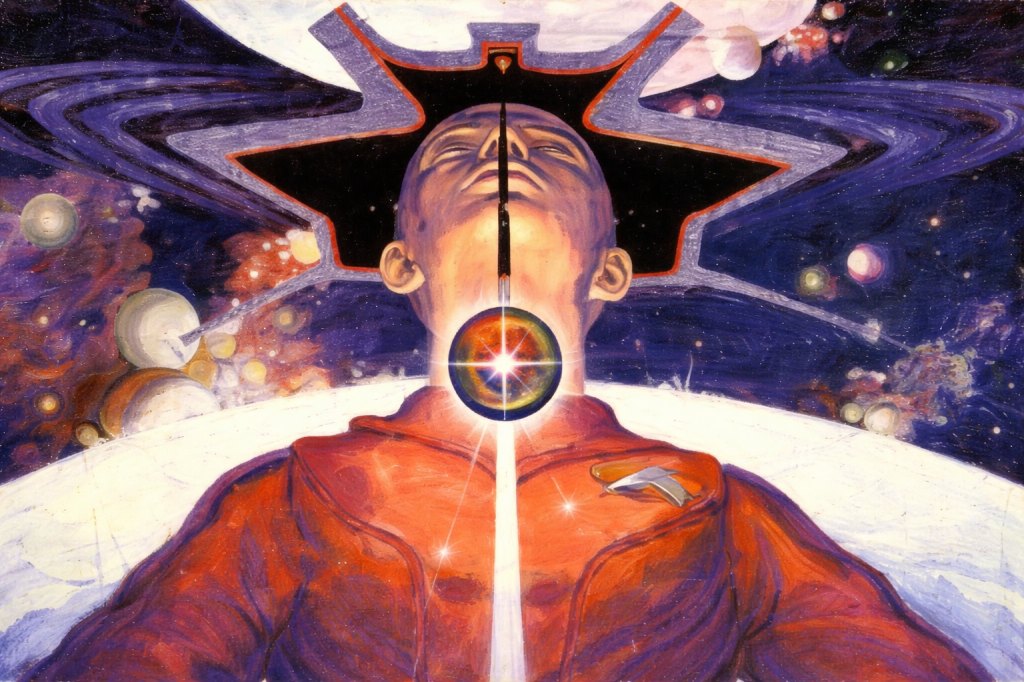
Instead, Roddenberry argued that Kirk’s first instinct would be investigation, not attack—ordering the Enterprise to parallel the object’s course while attempting to understand it. And if the situation ever did require force, it would come at a cost: “Kirk would be going through enormous personal torment at having to blast it before investigating it thoroughly. If that were our direction, the personal torment would be our principal story excitement at that time.”
Beyond character, Roddenberry’s notes push strongly toward internal logic—particularly when it comes to the alien machine itself. He repeatedly returns to the idea that this entity cannot exist without motivation or consistency. “We cannot simply say: ‘This is a machine life form and therefore we don’t have to explain or motivate any of its actions.’ It is a character in our story and the audience is entitled to logic and pattern in its characteristics.”
That concern extends to how the machine is portrayed emotionally and intellectually. Roddenberry questions whether attributing human-like emotions to it makes sense at all, noting that emotions are tied to organic survival. “Human emotions served a very real survival purpose. Would the same be true of machines? I doubt it.” At the same time, he challenges inconsistencies in its behavior—asking why it would view humans as a threat without a clearly defined reason or history to support that conclusion.
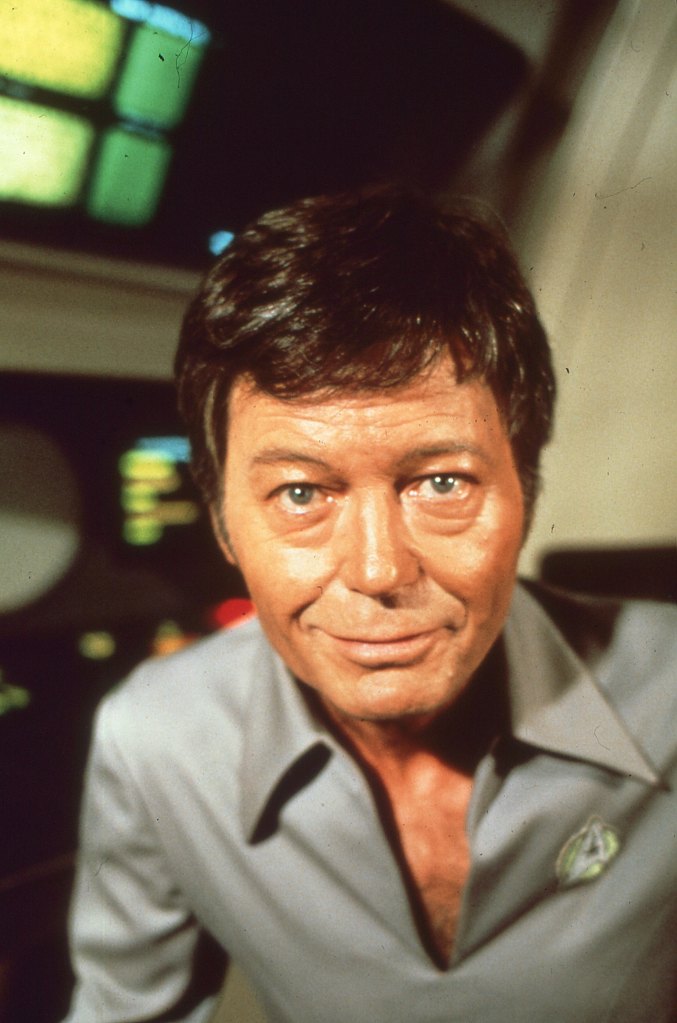
That push for clarity and internal consistency continues in his follow-up memo, where his focus shifts even more directly to the behavior of the alien intelligence. At times in the treatment, the machine seems to operate with a biological understanding that hasn’t been established. “McCoy notes that a machine would naturally try a mechanical approach to wiping out the humans. Does this necessarily follow?” Roddenberry writes, questioning whether its methods align with its nature.
That same issue extends to its perception of humanity. “If the machine knows nothing about organic life forms, how come it talks about humans as a form of germ ‘infection?’ It would have to know about organic life to know about germs.”
As in his earlier notes, Roddenberry continues to treat the machine as a character whose reactions must make sense within its own framework. “Isn’t it impressed? Or at least interested? Does it think Kirk is lying?” he asks, pressing for a clearer understanding of how this intelligence interprets the beings it encounters.
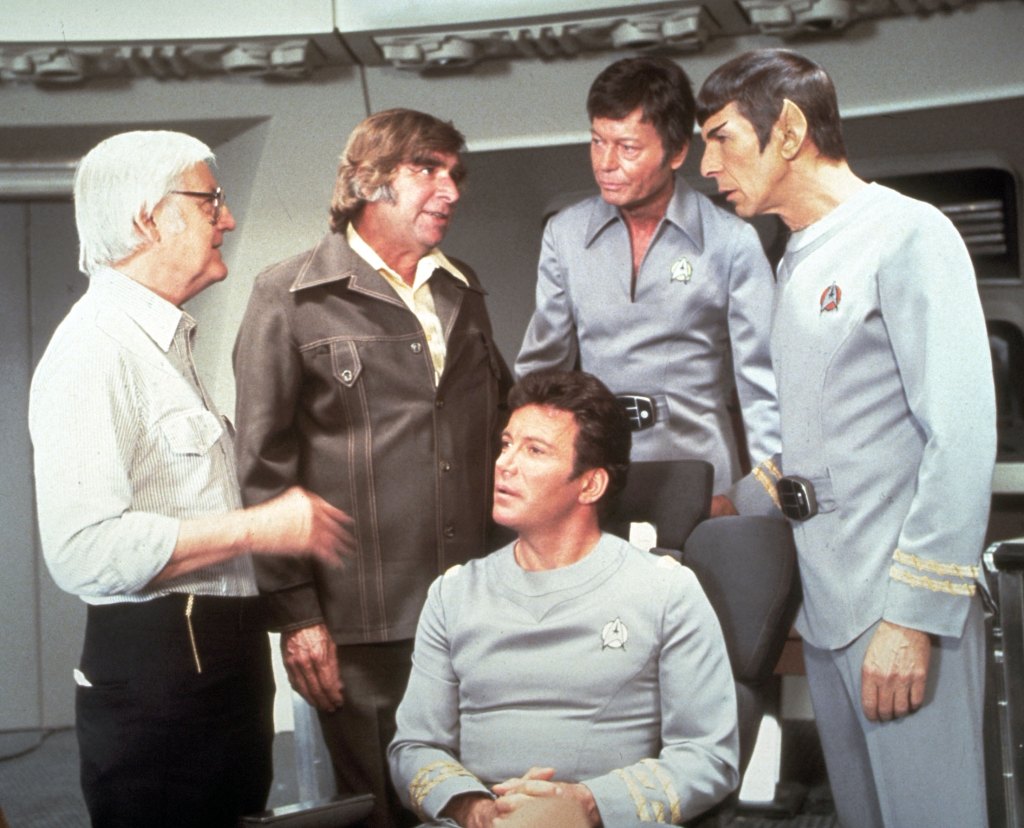
At the same time, he emphasizes the need for stronger dramatic stakes. “What happens on Earth when the great machine gets there? I think we need to build in some kind of big danger to our planet.”
Even elements he responds to positively are filtered through this lens of logic. “I love the replicas of humans being presented in our story as the most dangerous creature known to man. Hope we can keep this,” he notes, while still questioning how those replicas function within the larger narrative.
But perhaps the most revealing note in the memos comes when Roddenberry directly challenges the idea of framing the story around superiority. “At any rate, cannot agree that the point of our story is one convincing the other of its superiority. ‘Who is superior’ is really a very childish game for our 23rd century starship crew to be playing.”

It’s a crucial clarification, and one that makes his intentions even clearer. This wasn’t meant to be a story about defeating a machine—or proving humanity’s dominance—but about understanding, perspective and the limits of both forms of existence. As he ultimately summarized, “Most of our story problem seems to boil down simply to getting to know our alien machine character better—its abilities, limitations, motivations, needs, and so on.”
By the time Roddenberry had finished responding to Foster’s treatment, In Thy Image had been reshaped in fundamental ways. The story’s focus was no longer just on a powerful threat approaching Earth, but on the relationship between humanity and an evolving machine intelligence—one that had to be understood before it could be confronted. And yet, for all that clarity, one problem remained: there still wasn’t a finished script.
Shifting hands: Harold Livingston takes over ‘In Thy Image’
By the time Gene Roddenberry’s memos had clarified what In Thy Image should be, the project had reached an unusual crossroads. The philosophical direction was in place, the thematic core had been defined and the major questions had been identified. But something had to move the story from concept into production. That gap ultimately led to a key shift behind the scenes.
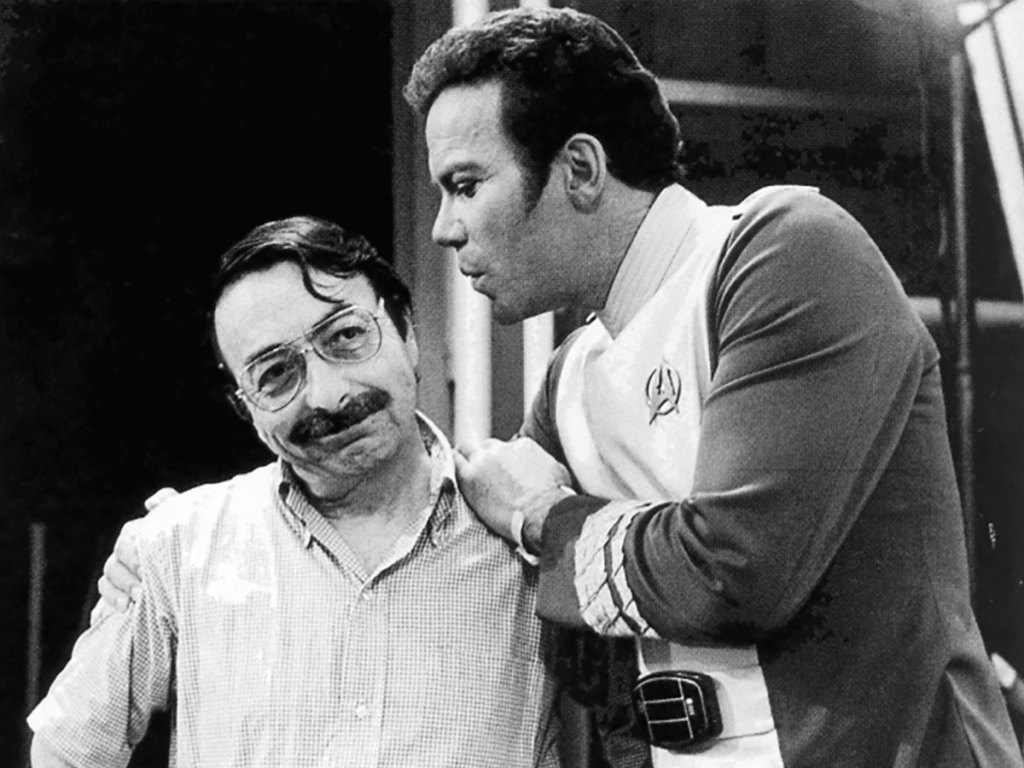
As producer of Star Trek: Phase II, Harold Livingston was responsible not just for overseeing development, but for ensuring that the series actually moved forward. Foster’s treatment had provided a strong foundation, and Roddenberry’s notes had sharpened its focus, but the process of translating those ideas into a workable teleplay was proving more difficult than expected.
“Alan brought me two screenplays he had written, which I wasn’t very impressed with,” recalls Livingston, “and I didn’t want him to write the script. This is obviously a subjective opinion, but that’s what they were paying me for. It was my judgment that they should get someone else.”
The search for a writer to flesh out In Thy Image began with Steven Bochco, who in the ’80s would be represented by Hill Street Blues and L.A. Law, simply wasn’t interested in writing sci-fi. Two other names being considered were British author David Ambrose (who would pen the “Deadlock” script for Phase II) and genre veteran William Norton. An attempt to interest Michael Cimino (future writer/director of The Deer Hunter and Heaven’s Gate) failed as well.
Opined Livingston at the time, “The problem with many name writers is that we do not want to involve ourselves in a situation where we will sign a writer who will be tempted to ‘write down’ to the story. We must have someone who is actively into science fiction, namely Star Trek, and will be so enthusiastic he will give us the very best he has.”
Ultimately, and with what was then a looming deadline, Livingston made the decision to take control of the writing himself. In doing so, In Thy Image entered a new phase—one defined less by concept and more by execution. Livingston’s first draft reflects that shift almost immediately. The story opens with a large-scale display of destructive power, as Klingon ships are annihilated by an unknown force. It’s a sequence designed to establish stakes quickly and visually, signaling a move toward a more cinematic style of storytelling.
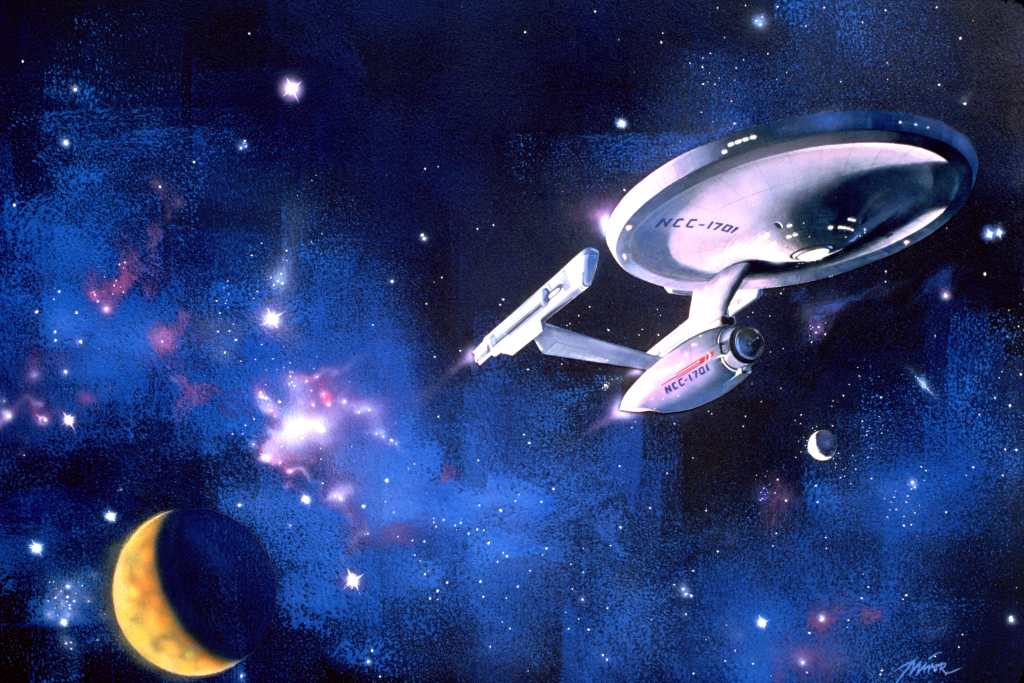
At the same time, Livingston expands the scope of the story beyond what had been suggested in Foster’s treatment. Earth is depicted in greater detail, presented as a world that has achieved a balance between technological advancement and environmental harmony. The future is no longer just implied—it is shown, giving the story a broader sense of scale.
Character dynamics also begin to evolve. Kirk’s return to command is no longer a simple reassumption of authority, but a more complicated transition shaped by time and circumstance. The Enterprise has moved on in his absence, and that reality is embodied in first officer Will Decker, who emerges as both an ally and a point of tension. The relationship between the two men introduces a layer of conflict that had not been as prominent in earlier versions of the story.
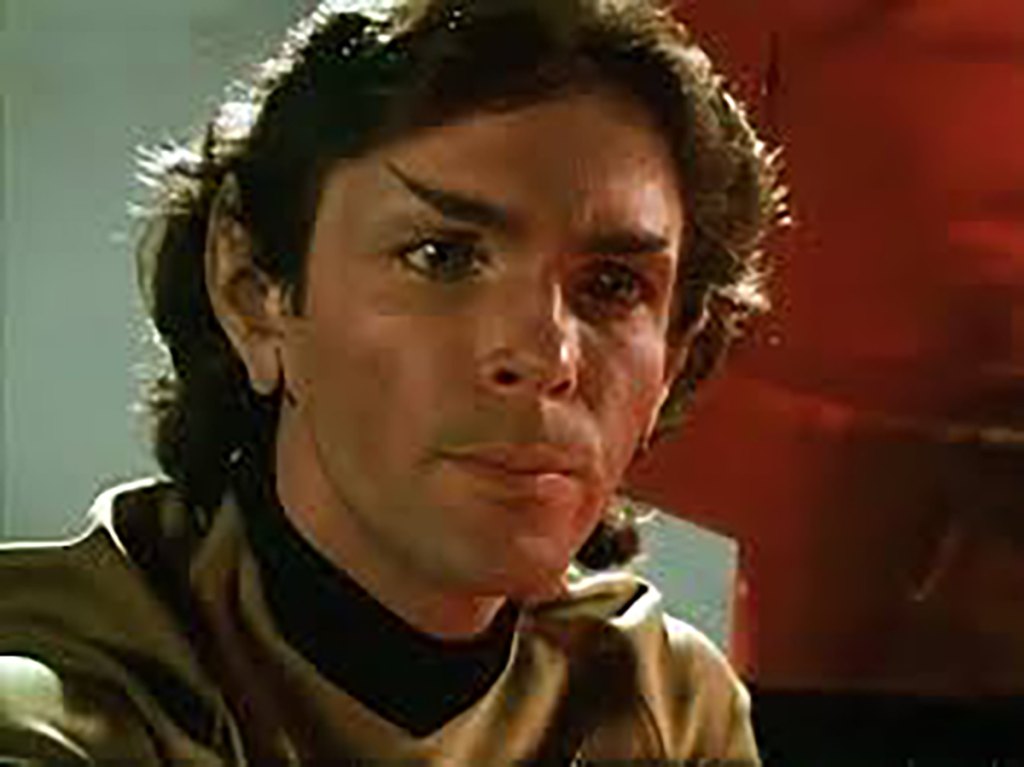
The Vulcan presence in the script reflects the realities of Phase II as it was being developed. With Leonard Nimoy not committed to returning at that stage, the character of Xon is introduced—a younger Vulcan whose strict adherence to logic contrasts with the more balanced perspective audiences had come to associate with Spock. In many ways, Xon represents both a continuation of that archetype and a reminder that Star Trek itself was in transition.

Even with these developments, the screenplay reveals a story still searching for its final form. The machine intelligence remains central, but its behavior and motivations are not always fully aligned with the principles Roddenberry had outlined. At times it feels mysterious and compelling; at others, its actions raise the same kinds of questions about logic and consistency that had already been identified in the memos.
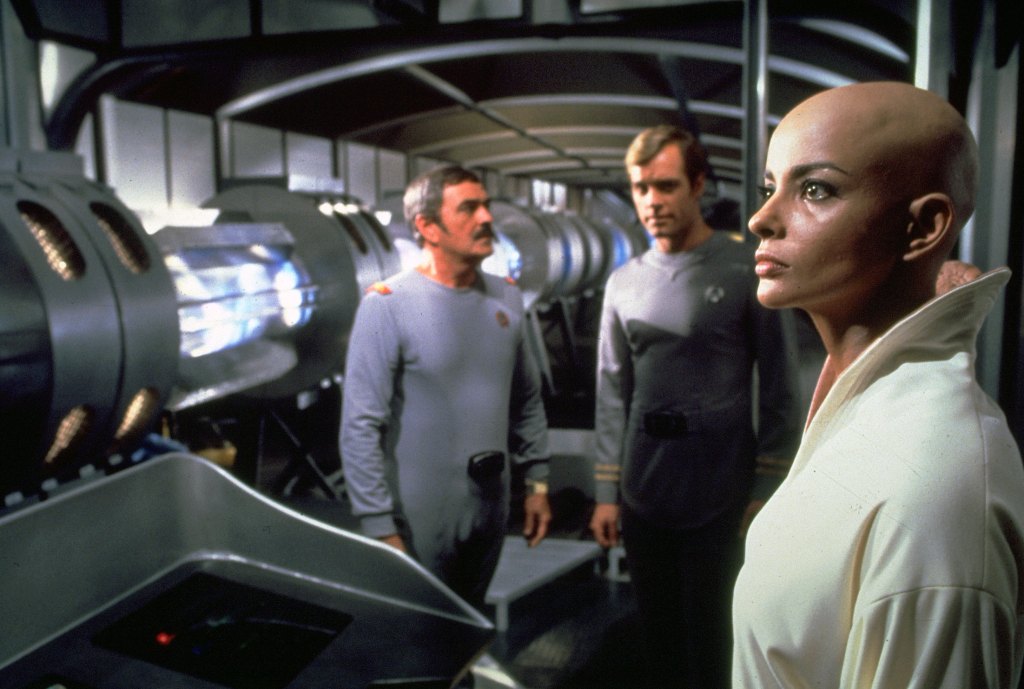
The tone of the script reflects that same tension. There are moments that lean into spectacle and urgency, emphasizing the threat to Earth and the need for decisive action. But there are also clear traces of the more philosophical approach Roddenberry had advocated—one focused on understanding rather than confrontation.
What emerges is not a finished solution, but a transitional version of the story—one that carries forward Foster’s ideas, incorporates Roddenberry’s guidance and yet still struggles to fully reconcile the two. It is, in every sense, a work in progress. And in that unfinished quality, something new begins to take shape—not just on the page, but behind the scenes. And for the production, the In Thy Image wars were just beginning.
Conversation
All comments are subject to our Community Guidelines. Woman's World does not endorse the opinions and views shared by our readers in our comment sections. Our comments section is a place where readers can engage in healthy, productive, lively, and respectful discussions. Offensive language, hate speech, personal attacks, and/or defamatory statements are not permitted. Advertising or spam is also prohibited.