Inside the ‘Star Trek V’ Ending That Was Too Expensive to Film: Why Shatner Had to Cut the Gargoyles
William Shatner reveals how budget cuts forced him to scrap a massive battle for the 1989 climax

Key Takeaways
- 'Star Trek V' explores faith, friendship and the mystery at the center of the galaxy.
- A renegade Vulcan takes the Enterprise on its most dangerous mission.
- Budget cuts forced major changes to the original ending of 'Star Trek V.'
One of the recurring themes in Star Trek’s long and complicated history is that what audiences ultimately see on screen is often only a fraction of what was originally conceived—especially when it comes to endings. Budget constraints, time pressures, and, in some cases, technical limitations have a way of reshaping even the most ambitious ideas into something more manageable. That was certainly the case with Star Trek V: The Final Frontier, a film that set out to explore some of the franchise’s most provocative questions, only to stumble when it came time to bring those ideas to a satisfying conclusion.
Released in 1989, Star Trek V marked a unique turning point for the franchise, not least because it placed William Shatner in the director’s chair for the first—and only—time in his Star Trek career. Building on the lighter tone and commercial success of Star Trek IV: The Voyage Home, the film attempted to blend humor with a more overtly philosophical premise, sending the crew of the Enterprise on a quest to literally meet God at the center of the galaxy. It was an ambitious concept, one that leaned heavily on character interplay while also requiring visual effects that could convincingly bring its cosmic ideas to life—an expectation that would ultimately prove difficult to meet under the film’s production constraints.
At the heart of the issue was the final act. As released, the confrontation at the center of the galaxy has long been criticized for feeling abrupt and underwhelming, particularly given the philosophical and emotional build-up that precedes it. But that ending, it turns out, wasn’t always meant to play that way. Earlier drafts of the script envisioned something far more elaborate—and far more dangerous—for Captain Kirk and his crew. What follows is a look at that abandoned climax, a “lost” version of Star Trek V that might have delivered the kind of spectacle and tension the finished film ultimately struggled to achieve.
Of lost endings…
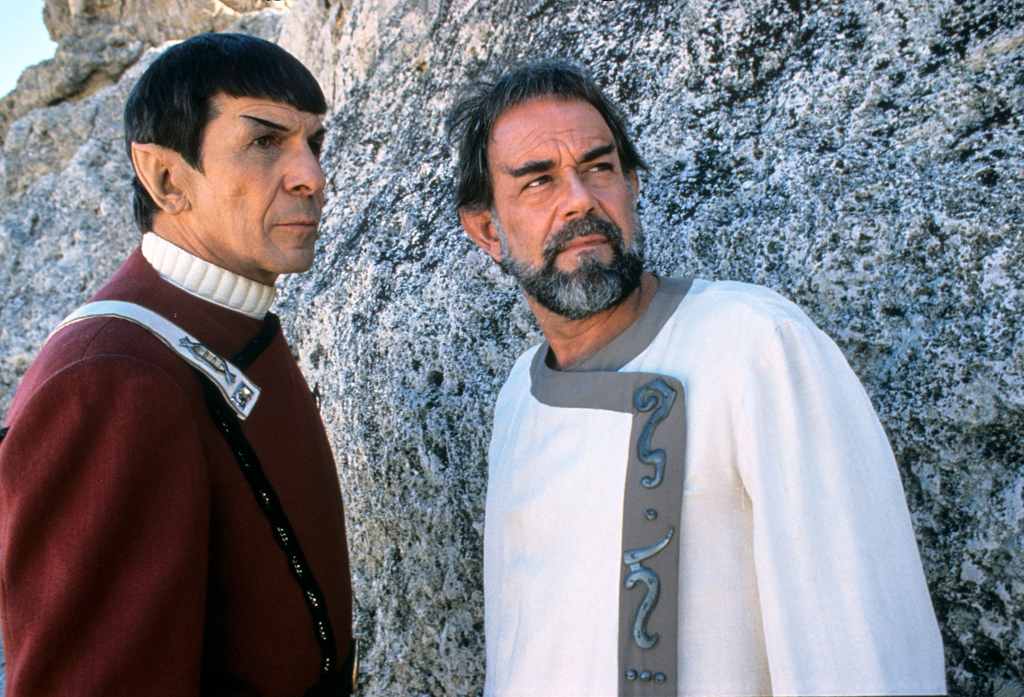
As originally conceived, everything plays out exactly as it does in the finished film—right up until the moment the crew realizes that the being they’ve encountered is most certainly not God. From there, the story takes a far more action-driven turn.
“It would appear that the entity is trapped here,” Spock observes. “This volcanic crater is the power source that contains him.”
Kirk immediately grasps the danger: “And if he gets his hands on the ship, he’ll be able to spread himself across the galaxy.”
“Precisely his intention!”

What follows is a sequence that dramatically escalates the stakes. Sybok—Spock’s half-brother who has forced the Enterprise to follow his quest—leaps into the crater, disappearing along with the entity as fire fills the sky. Moments later, a horrifying shriek signals the emergence of numerous living gargoyles erupting from the pit. Kirk, Spock and McCoy flee for their lives, slowed when McCoy falls and breaks his leg—forcing Kirk to carry him back toward the shuttle.
Their escape is cut short when the creatures disable the shuttle’s thrusters. Scotty begins transporting them aboard the Enterprise one at a time, but disaster strikes when a gargoyle is accidentally beamed up along with Kirk’s communicator. In destroying the creature, Scotty inadvertently takes out the transporter controls as well—leaving Kirk stranded on the planet.
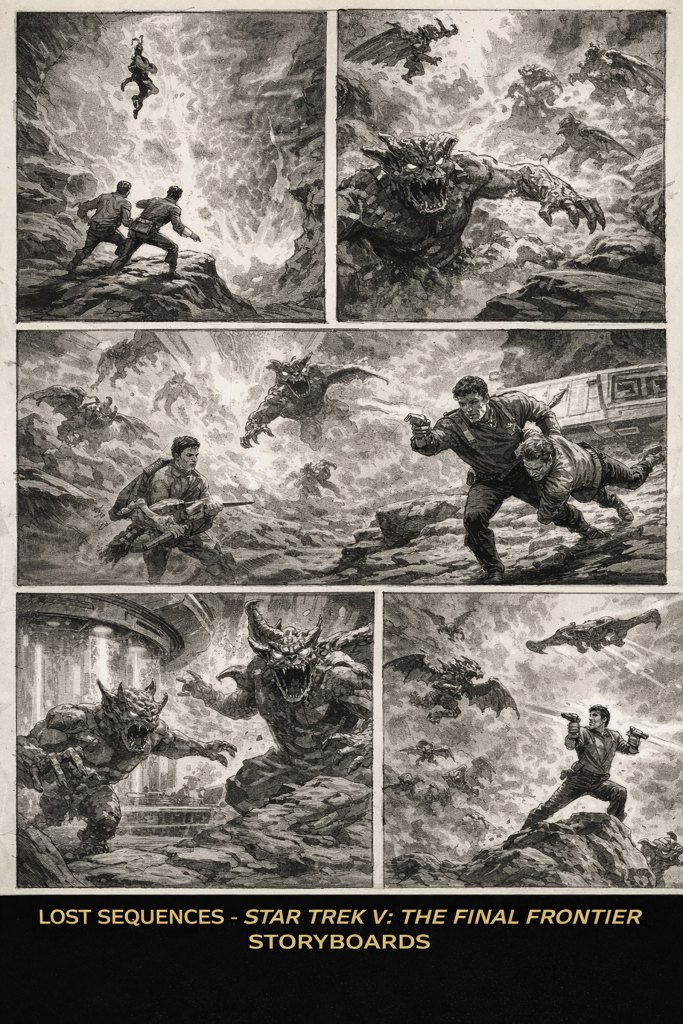
As the Klingon Bird-of-Prey enters the situation, Spock turns to General Korrd for help, pushing past resistance with a blunt, “Damn you, sir, you will try!”
Meanwhile, on the surface, Kirk makes a desperate stand—climbing a mountain and battling wave after wave of attacking creatures with hand phasers. Just as it appears he’s about to be overwhelmed, the Bird-of-Prey decloaks and unleashes heavy phaser fire, driving the gargoyles back into the crater.
“You want me, you Klingon bastards? Come and get me!” Kirk shouts, firing upward.

From there, the story largely returns to the version audiences saw, though with a greater emphasis on the shared rescue of Klingon, Romulan and Federation hostages—hinting at a fragile new understanding between longtime enemies. In the aftermath, Kirk reflects on Sybok’s actions with a bit more nuance:
“He may have been misguided, but perhaps his cause has served a higher purpose. The Federation, the Romulans, the Klingons—none of us—will ever be able to see each other again in quite the same light. We have Sybok to thank for that.”
It’s a more expansive and visually dynamic ending—one that underscores just how much was lost in translation from page to screen.
‘Show me the money!’
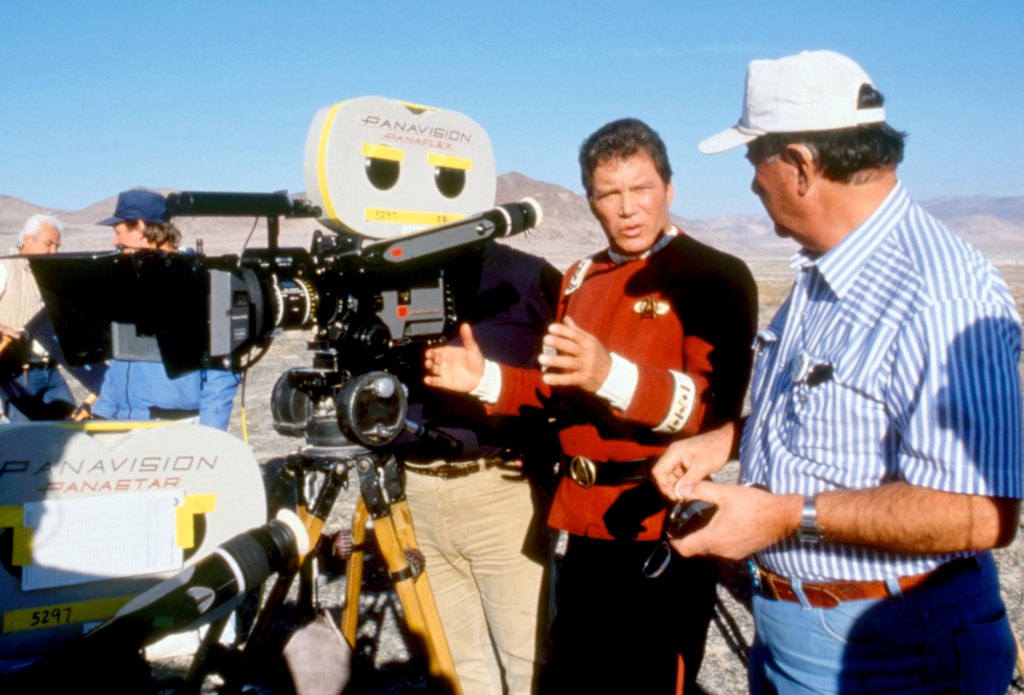
Along with the challenges inherent in realizing what was already a flawed screenplay came a host of production problems, many of them centered on that very finale. The ambitious creature effects—gargoyles, energy bursts, and even a massive rock-like being Kirk would confront—proved too costly and too difficult to execute within the film’s limitations.
WILLIAM SHATNER (director; actor, “Captain James T. Kirk”): “I didn’t have the sense to hoard my money for the grand finale. I was very busy spending wonderful dollars fighting for effects in the opening. I’m not that much of a neophyte not to know that you need a good opening, but I hurt my finale by not having enough money. Nothing I could do to the studio would make them say, ‘Here’s another three million dollars for more gargoyles and special effects,’ which it needed.”
DAVID LOUGHERY (screenwriter): “When the torpedo came down and exploded the hole, it’s like the bottle is uncapped and the imps spill out, free, and chase our characters back to the shuttle. That was our original concept. A movie, especially a movie like this one, goes through so many transformations from original story to final film. Because of all the hands involved in the making of these movies, it sometimes starts to take on a committee atmosphere. Things don’t turn out exactly the way you originally wanted them to, but there are reasons for that.”
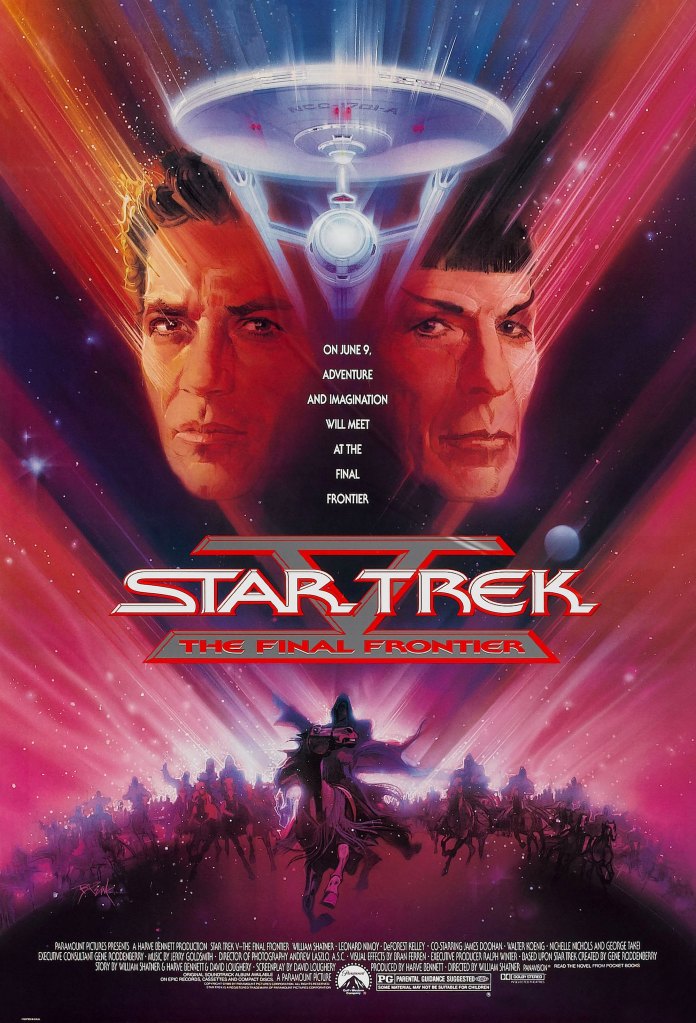
WILLIAM SHATNER: “I was required to reduce the budget, and I kept slicing away at the ending. I didn’t realize until we got there how much of the ending I had lost and what a disservice I had done to the film. That was lesson number one.”
RALPH WINTER (producer): “We never ran out of money. We ran out of good ideas and good execution. What we thought with the rock creature was just completely silly and we bagged it. It became obvious that it was just silly and it would have been more expensive. On some of these movies, the third act doesn’t get developed at the same pace.”

DAVID LOUGHERY: “We certainly wish we could have hung on to some of the concept. That sequence got lost when it became financially impossible for us to create the gargoyle creatures. You’re always sorry to see those things go, because your imagination is one thing and the budget is something else. In various places, we had to make certain cuts and rearrangements based on how much we could afford.”
HARVE BENNETT (executive producer): “Basically, I was called in to control Bill’s appetites. They were extravagant because he didn’t know anything. He had spent all those years in front of the camera, and believed because he had directed T.J. Hooker and Leonard had done it, he could too. Bill would come in and present a concept and he thought he was discovering the wheel. It’s funny how first-time directors try to be pioneers in the craft.”
WILLIAM SHATNER: “A first-time director knows no boundaries, and it’s not knowing them that you shatter them. Rather than accepting the status quo, I tried to break boundaries… But there came a point where I had to compromise.”
In the end, Star Trek V stands as a fascinating example of how even a fully produced installment of the franchise can, in its own way, feel like a “lost” chapter. Not because it was never made, but because what audiences saw was only a partial realization of what had been imagined. Like Star Trek: Phase II, the unproduced films of the 1970s, or even alternate versions of familiar episodes, The Final Frontier exists in two forms: the one that reached theaters, and the one that lives on in scripts, interviews and recollections from those who tried to bring it to life.
Star Trek V: The Final Frontier: quick facts
- Released in 1989, Star Trek V: The Final Frontier marked the directorial debut of William Shatner, who also returned as Captain Kirk alongside franchise mainstays.
- The film centers on Kirk, Spock and McCoy—played by William Shatner, Leonard Nimoy (Spock Leonard to fans) and DeForest Kelley—as they confront a renegade Vulcan named Sybok.
- One of the film’s most beloved sequences is the campfire scene set in Yosemite National Park, offering a rare, emotional look at the friendship between the trio during shore leave.
- The story sends the Enterprise on a mission to the center of the galaxy, where Sybok believes he will encounter God, setting up one of the franchise’s most controversial storylines.
- Leonard Nimoy returned not only as Spock but also as a key creative collaborator, having previously directed Star Trek III and IV.
- Despite ambitious ideas—including philosophical themes and large-scale effects—the film was hampered by budget constraints, particularly impacting its original ending.
Conversation
All comments are subject to our Community Guidelines. Woman's World does not endorse the opinions and views shared by our readers in our comment sections. Our comments section is a place where readers can engage in healthy, productive, lively, and respectful discussions. Offensive language, hate speech, personal attacks, and/or defamatory statements are not permitted. Advertising or spam is also prohibited.