The Lost Eddie Murphy Version of ‘Star Trek IV: The Voyage Home’ 40 Years Later (Exclusive)
How the blockbuster comedy star nearly reshaped the most beloved 'Star Trek' film

Forty years ago, Star Trek crossed over to the mainstream with the 1986 film The Voyage Home, in which Captain Kirk and his crew must travel to present day Earth to retrieve a pair of humpback whales to bring back to the future so that they can communicate with a probe that is threatening all life on the planet. As serious as it sounds, the fish out of water setting generated a great deal of humor that audiences loved, and if things had gone as originally planned—with Eddie Murphy as a marine biologist instead of Catherine Hicks—there would have been even more laughs. Maybe.
As the late Leonard Nimoy, who was not only returning as Spock but directing his second Trek film following 1984’s The Search for Spock, explained in an exclusive interview, “[Producer] Harve Bennett and I decided early on that we wanted to do a time travel story. We also felt that we should lighten up, that the picture should be fun in comparison to the previous three.”
During early development, Nimoy visited three universities to talk to a trio of professors—physicists, scientists and futurists—to discuss immediate concerns for the future of the planet. “We talked about their ideas for potential contact with extra-terrestrials,” Nimoy detailed. “What it might be like. Where it might come from. How it might come. How we would deal with it. The philosophy of it and the immediate impact on the sociology of the planet, the religions of the planet… I had some great times.”
He also reached out to Edward O. Wilson, whose book Biophilia emphasizes that we could be losing as many as 10,000 species off this planet per year, many of their extinctions having gone unrecorded. “He touches on the concept of a keystone species. If you set up a house of cards, you may be able to pull away one card successfully and another card successfully. But at some point, you are going to get a card that is a keystone card. When that one is pulled away, the whole thing will collapse.”

Hence, the humpback whales, driven to extinction in the past and impacting the future when they are not there to respond to the aliens’ signal, leading the heroes to our present. “We discovered something in Star Trek IV that we hadn’t pinpointed in any of the other movies and it just shows how the obvious can escape you,” observed William Shatner, returning as James T. Kirk. “There is a texture to the best Star Trek hours that verges on tongue-in-cheek but isn’t. There’s a line we all have to walk that is reality. It’s as though the characters within the play have a great deal of joy about themselves, a joy of living. The energy, that ‘joie de vivre’ about the characters seems to be tongue-in-cheek but isn’t, because you play it with the reality that you would in a kitchen sink drama written for today’s life.”
Enter Eddie Murphy
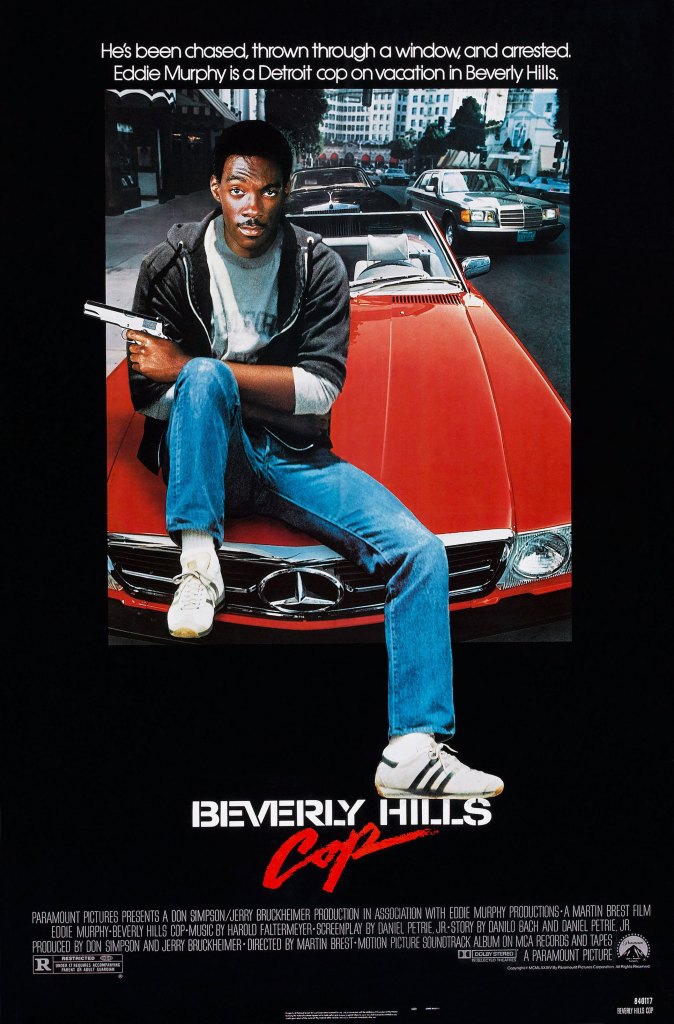
All of that sounds like the final film, but where things could have veered off was with Paramount Pictures’ acquiescence to actor Eddie Murphy—coming off the triple success of 48hrs. (1982), Trading Places (1983) and Beverly Hills Cop (1984), who voiced his interest in appearing in Star Trek as a featured player. This is what screenwriters Steve Meerson and Peter Krikes had to deal with in writing the film’s early drafts.
“Eddie Murphy,” stated Meerson, “was going to play a college professor who taught English, but a professor who we probably all had in the ‘60s or ‘70s, who’s a little bit wacky and believes in extraterrestrials. Every Wednesday, he would open up his class to a discussion and the room would light up with conversation.”
Bennett, who took over the franchise as producer with 1982’s The Wrath of Khan, notes that the initial meeting with Eddie Murphy was a “little bizarre.” Murphy arrived, he says, with a pair of guys, and all three were dressed in black leather. “We told Eddie this story, he thought about it for a while and he said, ‘It’s good. Let me see a script,’ and walked out. We sat there and thought, ‘Would it be terrific to have Eddie in this movie?’

“Later, the studio started getting very anxious and for very good reason,” he added. “Here you have a franchise called Star Trek and it performs in a certain wonderful way. Here, you have a franchise called Eddie Murphy and it performs in an even bigger way. Why not take them together and form one franchise? Well, bad economics because you are probably diminishing by compositing. So, the studio was resistant to it, but Eddie had a certain amount of clout and he said that he hadn’t decided whether he wanted to do it or not and so much of the development of the story was with the very distinct possibility that Eddie Murphy was in it.”

A point driven home by Krikes’ description of the character as originally conceived: “He would play whale songs, and it was the whale songs he played in the classroom that the ship locked on to. That was in the first draft we wrote, but the second draft was different. After you write the first draft of anything, once the director, the cast and the producers come aboard, everything changes, and not necessarily for the better. But the tone was pretty much a reflection of what was in the movie. For example, there was a scene where the Eddie Murphy character was trying to convince the Catherine Hicks character that aliens do exist on Earth. In the first draft, Hicks was a newswoman and there was a marine biologist as well. Gillian Taylor was ultimately a marriage of about three characters. Murphy believed in aliens and saw them beam into his classroom.”
Added Meerson with a laugh, “It was the boy who cried wolf. No one would ever believe him, so he took it upon himself to follow the crew, and in one scene, he lifted a phaser from Kirk, took it back to the newswoman and said, ‘See, they really do exist.’ And she says, ‘What’s this?’ and casts the gun aside, accidentally activating it. The phaser lands on the floor and her cat jumps off the couch. We follow her to her bedroom and she goes to sleep. The cat keeps phasing things out of the apartment by hitting the phaser, and when she wakes up, she sees that all the furniture is gone.”
Murphy himself chimed in on the possibility of his becoming a part of Star Trek and what ultimately happened, offering, “I’m a Trekkie. I’ve always loved Star Trek and have wanted to do one of the films. I wanted to be in Star Trek and that’s where they got the idea of coming back in time to Earth in 1987. The script was developed, but we eventually dropped the idea. Golden Child came along and I decided to do that film instead, because I thought it would be better for my career. In retrospect, I think I might have been better off doing Star Trek IV.”
Conversation
All comments are subject to our Community Guidelines. Woman's World does not endorse the opinions and views shared by our readers in our comment sections. Our comments section is a place where readers can engage in healthy, productive, lively, and respectful discussions. Offensive language, hate speech, personal attacks, and/or defamatory statements are not permitted. Advertising or spam is also prohibited.