‘Star Trek: The Original Series’ Episode ‘City on the Edge of Forever’ Changed TV—and Its Lost Real Story Is Darker (Exclusive)
The writer of Trek's greatest episode reveals what Roddenberry changed—and why he wanted off

Key Takeaways
- The most famous episode of 'Star Trek’ had a very different original story.
- Writer Harlan Ellison’s vision clashed with Gene Roddenberry’s ideal future.
- Two versions of 'City on the Edge of Forever' now exist, each with its own legacy.
Among the episodes of the original Star Trek, few have carried the weight—or the reputation—of “The City on the Edge of Forever.” Broadcast in 1967 towards the end of the show’s first season, it has spent decades near the top of fan rankings and critical lists, often singled out as not just one of the best hours of Star Trek, but one of the strongest episodes of television from its era.
At the time, the writer of Star Trek: The Original Series episode “The City on the Edge of Forever,” Harlan Ellison, was already one of the most outspoken and accomplished voices in science fiction—a writer with a reputation for both literary ambition and an unwillingness to compromise. By the mid-1960s, he had built his career on stories that challenged conventions and refused easy answers, a sensibility that didn’t always align with the more idealized future envisioned by Gene Roddenberry for Star Trek. The result was something close to a creative collision: a writer determined to explore flawed humanity placed inside a series striving to present its best possible version.
The premise of “The City on the Edge of Forever” is deceptively simple. After Dr. McCoy (DeForest Kelley) accidentally injects himself with a powerful stimulant and escapes through a mysterious time portal, Captain Kirk (William Shatner) and Spock (Leonard Nimoy) follow him into the past—landing in Depression-era New York. There, Kirk meets Edith Keeler (Joan Collins), a compassionate woman whose vision of the future is both inspiring and, as Spock eventually determines, dangerously out of step with history.
What follows is built around a dilemma that unfolds with increasing inevitability. If Keeler, a peace advocate, lives—which happens because McCoy stops her from getting killed in a traffic accident—the timeline is altered in a way that prevents the United States from entering World War II when it should, changing the course of history and erasing the future the Enterprise crew knows. If she dies, history remains intact. The episode’s power rests in how that choice is resolved and the fact that Kirk has fallen in love with her.
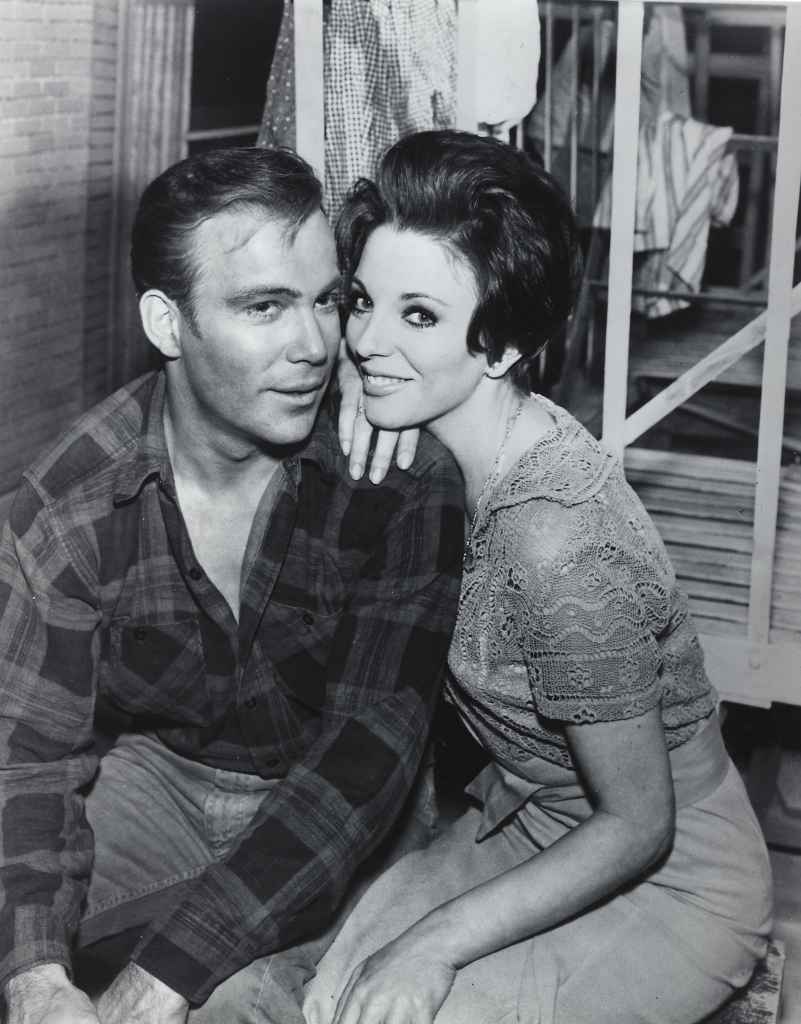
As the moment arrives, Kirk stands in a position where action—or inaction—will determine everything. Edith Keeler is about to step into the path of a truck. McCoy, still disoriented, moves to save her. Kirk stops him and lets her die. It’s a quiet moment, but one that lands with unusual force for a network television series of the 1960s. The hero doesn’t win. He doesn’t find a way around the dilemma. He makes the decision that preserves the greater good at a deeply personal cost.
In the final scene, Spock offers a measured acknowledgment of what Kirk has lost. The episode ends not with victory, but with the weight of what had to be done. And it’s that combination—high-concept science fiction grounded in a very human loss—that has kept “The City on the Edge of Forever” in the conversation for nearly six decades.
What most viewers watching it over the years would not have known, however, is that the version that aired was only one take on the story—and that the path from script to screen was anything but smooth.
The origin of ‘The City on the Edge of Forever’
For all its reputation as a classic, “The City on the Edge of Forever” began taking shape before Star Trek had even fully defined itself—something Harlan Ellison was keenly aware of from the start, as he explains in this exclusive interview, which has never been posted online before.
HARLAN ELLISON: “I started writing the script before Star Trek went on the air. The characters had not been completely defined and my thought was I had been told by Gene Roddenberry that something like 240 people were on a spaceship in space for years. And I said, ‘Well, if you extrapolate from that and use what we know of men and women, people get odd. They get wonky, they become their own individual self, and everyone else is interpreting it.’ So when I got the ground plan, the bible, mine was one of the very first scripts started on, so in some ways I created those characters.” There are probably some who would argue that point, but Ellison was nonetheless inspired to have the drama of the episode instigated by a “guest star of the week” in the form of a character named Beckwith.
HARLAN ELLISON: “In any group of people locked up together, some of them are going to be just like everybody today. Someone is going to have a scam or a thing to drift you into. So I wrote a script that made sense—one of these guys had been out in space for a long time and found himself a way to make a buck. His way was selling gems of sound to the native people. He didn’t care if he corrupted them, and I wrote a solid plot story, the way I’d always written my stories. By the time I got introduced to Roddenberry and Star Trek, I was already an A-list writer.”
Nonetheless, that approach of grounding the story in recognizable human behavior quickly put him at odds with the version of the future that Gene Roddenberry wanted to present.
HARLAN ELLISON: “I handed in the script and they decided that they couldn’t have anybody bad on the ship. And I said, ‘But we have 240 men and women jammed together, is nobody fu**ing anybody? Is no one jealous that someone is fu**ing someone else?’ In other words, I knew human nature, and that’s why they hired me. So I wrote a real script. ‘No, no,’ said Roddenberry, ‘in the future everyone is perfect.’ Well, that doesn’t sound reasonable to me. And so it went from hand to hand and back to me, and back to hand to hand and back to me, and I made as many changes as I could make without damaging my integrity as a writer… or my unbreakable oath that I will never knowingly distort facts or the truth…”
“I finally got down to the point where I wouldn’t make any more stupid changes. I had made one change that I thought was so stupid I didn’t think it was possible… They put in another element that was ridiculous—McCoy injected himself with Cordrazine. If they had said to me, ‘We need him to be the one who goes down the planet,’ I would have figured out a logical way to do so. I would have had Beckwith inject him. But they didn’t want to do that. That was the simple way a good storyteller would do it, but they went ahead and did it the dumb way.”
Two takes on the ‘City’ itself
In the version of “The City on the Edge of Forever” that aired, the mechanism driving the story is one of the franchise’s most iconic creations: the Guardian of Forever—a vast, ancient ring of stone that speaks, opens portals through time and ultimately becomes the gateway to Edith Keeler’s fate. It’s a concept that would echo beyond the episode itself, reappearing in Star Trek: The Animated Series and, decades later, reimagined in a different form in Star Trek: Discovery. But for Harlan Ellison, that familiar image was never part of his original conception.
HARLAN ELLISON: “Very simple where it came from. I work in peculiar ways, and my mind works in peculiar ways. Very often, a story will grow out of not even an idea; it will grow out of a color, a juxtaposition of surfaces. The idea of ‘City’ came from the image of the City on the Edge of Forever, and it was an image of two cities, which is what it says in the script. The city on the edge of forever is the city on this planet. It was not a big donut in my script; it was a city and it was on the edge of time. It was where all of the winds of time met. That was my original idea. All the winds of time coalesce, and when you go through to the other side, here is this other city, which is also on the edge of forever, which is New York City during the depression. It’s the mirror image of each other.”
That imagery—two cities reflecting one another across time—speaks to how Ellison approached the story at its core. Even as the mechanics of the plot differed from what ultimately aired, his focus remained on the emotional throughline that connected those worlds.
HARLAN ELLISON: “All I was concerned about was telling a love story. There are some loves that are so great that you would sacrifice your ship, your crew, your friends, your mother, all of time and everything in defense of this great love.”
In Ellison’s version, the structure of the story grows out of that idea, with the events surrounding the time displacement—and the choices that follow—designed to push that emotional conflict as far as it can go. And it’s in that final choice, more than any visual or structural difference, where his version and the one that reached the screen ultimately part ways.
The conclusion that divided them
If the earlier changes reshaped how “The City on the Edge of Forever” unfolds, the most significant difference between the aired episode and Harlan Ellison’s original script comes at the end. In the version audiences have watched for decades, Captain Kirk makes the decision himself. As Edith Keeler steps into the street, McCoy moves to save her—and Kirk stops him. He allows her to die, preserving the timeline at the cost of the woman he loves. Ellison’s version moves in a different direction.
HARLAN ELLISON: “The script does not end the way the episode does. Kirk goes for her to save her. At the final moment, by his actions, he says, ‘F**k it, I don’t care what happens to the ship, the future and everything else. I can’t let her die, I love her,’ and he starts for her. Spock, who is cold and logical, grabs him and holds him back and she’s hit by the truck. The TV ending, where he closes his eyes and lets her get hit by the truck, is absolutely bulls**t. It destroys the core of what I tried to do. It destroyed the art; it destroyed the drama, it destroyed the extra human tragedy of it.”
If the ending of “The City on the Edge of Forever” marked the point where Harlan Ellison’s version and the aired episode diverged creatively, the aftermath marked where things became personal.
HARLAN ELLISON: “I tried to take my name off the script–I saw the final script and I said, ‘I don’t want my name on it.’ Then, Gene Roddenberry sat me down and said what everyone who thinks they’re God says: ‘You’ll never work in this town again,’ or ‘I’ll fire you.’ And I said, ‘OK, I’ll never work in this town again. I’ve been on the road since I was 12, you can’t threaten me.’ Roddenberry had finally met someone who could neither be bought nor threatened… He said, ‘I’ll give you $10,000 more, leave your name on it, you’re a rising star in science fiction.’ He couldn’t buy me and he couldn’t scare me, so he begged me. Look, I don’t need adulation and I don’t need money. Respect you earn, honor you earn, credit you earn. I wrote the script properly. They fu**ed and fu**ed with it until it was something I couldn’t abide and then I took my name off and Roddenberry wouldn’t let me.”
Which naturally leads to the question of why Ellison would be credited on the episode in the end.
HARLAN ELLISON: “I thought Gene Roddenberry was my friend, and I could not hurt Gene Roddenberry. But Gene was a con man. But I did it out of something that I thought was… affection for what I thought was a friend and I was being used, so I let him use me. Roddenberry played on it and did the one thing I could not combat, which was he played on my friendship, and he played me for a sucker.”
Its legacy continues

For all of Harlan Ellison’s frustration with what “The City on the Edge of Forever” became, the episode itself has endured—remaining one of the most celebrated hours of Star Trek and, for many, the benchmark against which all others are measured. And Ellison never did deny the strength of the underlying story.
Over time, his original version would find its way into the public sphere. He published the script in book form, along with the material surrounding its development, offering readers a chance to see what he had written before the revisions began. Years later, IDW Publishing adapted that script into a comic book miniseries, presenting the story in a form much closer to his original intent.
HARLAN ELLISON: “What it comes down to, after all these years of misigash and all the fame that has been accrued to this episode, to Star Trek and to me over the years, is that it started out with my script. What does it all mean? The true answer is, I don’t know. But if I were asked, ‘What do you think?’—I suppose I would say the only answer that anyone with any brains would give: what is, is. Apparently, I told a good story originally; apparently, it was so good that no matter who readjusted it to make it the way they thought it should be, the story was good enough to have been bought again and again.”
Conversation
All comments are subject to our Community Guidelines. Woman's World does not endorse the opinions and views shared by our readers in our comment sections. Our comments section is a place where readers can engage in healthy, productive, lively, and respectful discussions. Offensive language, hate speech, personal attacks, and/or defamatory statements are not permitted. Advertising or spam is also prohibited.