‘He Hated to Be Alone’: The Surprising, Sensitive Side of John Wayne That Fans Never Saw Onscreen (Exclusive)
His biographer's rare 1972 meeting reveals the thoughtful side to Hollywood’s toughest hero, who hated being alone and loved a good chat

For generations of moviegoers, more than just playing heroes, John Wayne embodied a certain idea of American manhood. Onscreen, he was tough, commanding and seemingly unshakable, the kind of man who walked into danger without blinking and rarely wasted words. That image became so fixed in the public imagination that it was easy to assume there wasn’t much separation between John Wayne the actor and “the Duke” audiences saw in film after film, Western after Western. But according to biographer Scott Eyman, the reality was more layered than that.
Eyman had the unusual experience of meeting Wayne in 1972, long before he would go on to write the biography John Wayne: The Life and Legend. At the time, he was only 21 and knew little beyond the fact that he wanted to write about movies. That meeting stayed with him for decades and helped shape the way he came to understand Wayne as both a star and a man.
As he explains, “If I hadn’t met him, I probably wouldn’t have written the book. Over the couple of hours I sat with him, I found that there was an interesting gap between who he was as a human being and what he played. I mean, not 100%—there was definitely an overlap—but he was much more … thoughtful … as a person than his screen character was. He was much more contemplative than his screen characters. His body language was different as a person than it was on screen. So there were just all of these interesting differences between what he did and what audiences thought of him, and who he actually was.”

That observation gets right to the heart of why Wayne remains such an interesting figure. The screen image was powerful, but it was also, in its own way, a performance—one built over years of work, instinct and careful shaping by both the man and the industry around him. The private John Wayne, Eyman suggests, had more inwardness than the myth allowed.
What makes Eyman’s perspective especially compelling is that he encountered Wayne not in a formal interview setting arranged years into a polished career, but as a young writer who had simply taken a chance. With no real credentials to speak of, he had written letters to a number of Hollywood veterans, hoping one might respond. Wayne did. More precisely, Wayne’s secretary, Mary St. John, wrote back and told him to call if he was ever in California. He did exactly that, and soon found himself ushered into the star’s dressing room. There sat Wayne, cigar in hand, entirely at ease.
Meeting the Duke
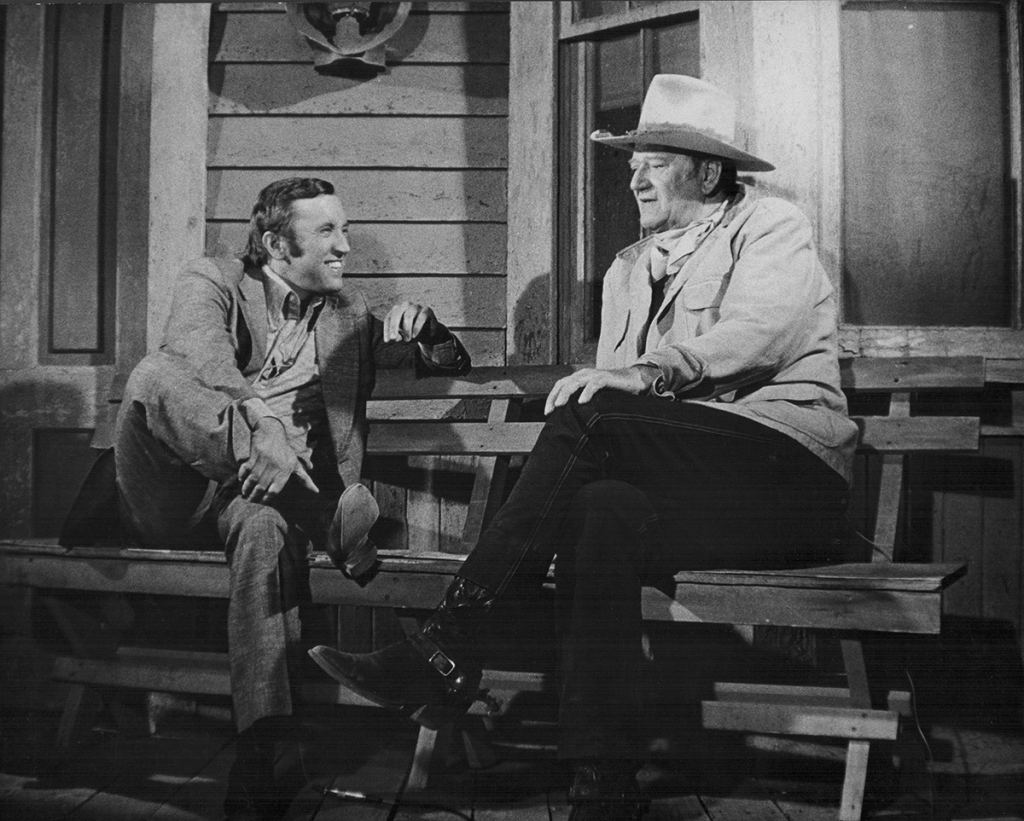
The encounter lasted much longer than Eyman expected, and what happened next revealed something else about Wayne that didn’t necessarily fit the standard public image. Eyman recalls, “What I didn’t know is that he hated to be alone. He liked having people around him, and part of Mary St. John’s job was to fill up his day so that he wasn’t sitting by himself in his trailer. Most actors don’t want to put the public anywhere near or around them, but he would talk to almost anybody rather than be alone. So I got 90 minutes, and every once in a while somebody would stick their head in the door and say, ‘We’re almost ready for you, Mr. Wayne,’ and he’d say, ‘I’m doing fine, I’m doing fine. Got my friend here.’”

That is not necessarily the image most people carry of John Wayne. The public version suggests a man apart—self-contained, even intimidating. Eyman instead encountered someone who enjoyed company, welcomed conversation and seemed perfectly comfortable spending time with a young stranger who simply loved movies.

And the surprise didn’t end there. When Wayne finally had to leave for the set, he brought Eyman along. As he remembers it, “It was a 50th anniversary salute to CBS and Bob Hope was there, Jack Benny was there. And he takes me around, introducing me to all these people who are looking at me, like, ‘Who the hell is this guy?’ I didn’t have a pass and was taking pictures with my 35mm camera and they didn’t know who I was. Nobody wanted to say anything, because I was with John Wayne.”
None of this erases the harder edges of Wayne’s public life, including the political views that became part of his legend as much as his films did. But even there, Eyman’s portrait is more nuanced than the caricature. He notes that despite Wayne’s politics, “Most people, even liberals, loved working with him, because he was a very good actor and he worked hard. He was the first guy on the set and the last guy to leave. He was a pro’s pro and actors like that. He wasn’t phoning it in.”
Conversation
All comments are subject to our Community Guidelines. Woman's World does not endorse the opinions and views shared by our readers in our comment sections. Our comments section is a place where readers can engage in healthy, productive, lively, and respectful discussions. Offensive language, hate speech, personal attacks, and/or defamatory statements are not permitted. Advertising or spam is also prohibited.