Mel Brooks ‘Isn’t Just Sitting By’ at 100: Inside His Wild Comedy Career That Still Us Howling After All These Years
From 'Blazing Saddles' to 'Spaceballs,' an insider looks back at a century of side-splitting comedy
Key Takeaways
- Mel Brooks reshaped comedy with fearless satire and unforgettable classics.
- From film to Broadway, Brooks built one of entertainment’s greatest legacies.
- At 100, Mel Brooks still influences generations of comedy creators.
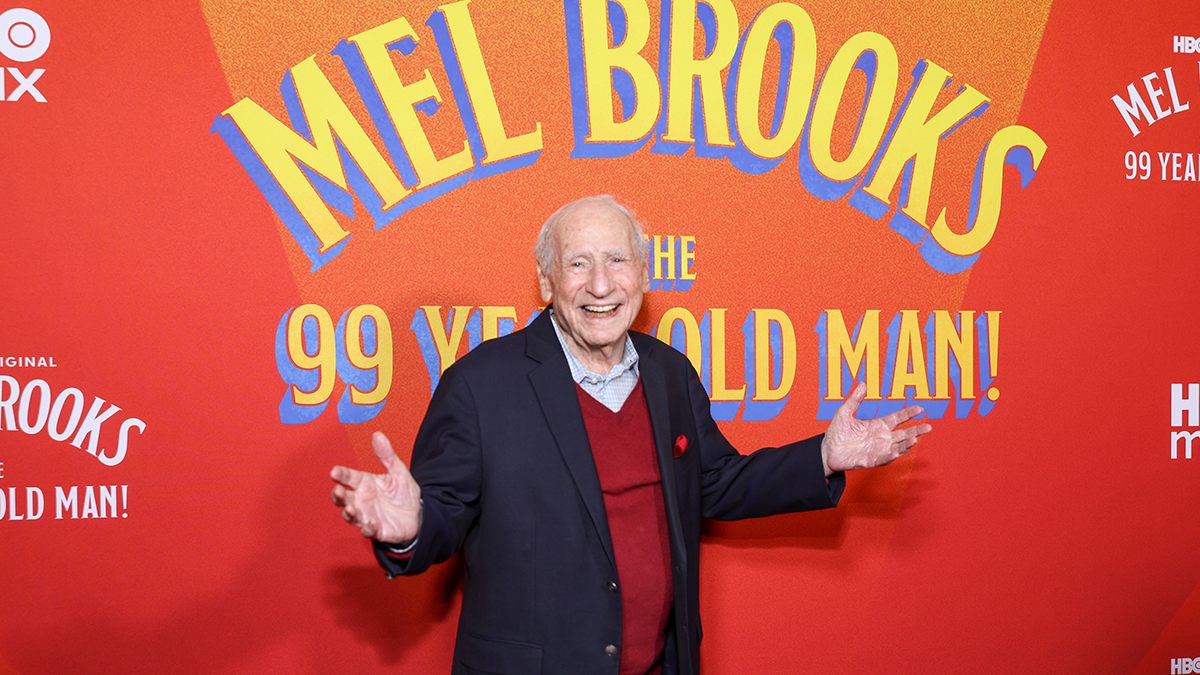
With Mel Brooks turning 100, it’s pretty amazing to consider that he’s spent more than three-quarters of that time creating comedy, whether as part of Sid Caesar’s Caesar’s Hour, co-creating the ’60s spy spoof Get Smart with Buck Henry, or bringing his singular vision to the big screen with films like Blazing Saddles, Young Frankenstein and Spaceballs (the sequel to which he’s produced and will be released next year).
To celebrate Brooks’ life and career, we’ve turned to author Dale Sherman, who has written The Mel Brooks FAQ: All That’s Left to Know About the Outrageous Genius of Comedy, and in this exclusive conversation with Woman’s World looks back at the creative accomplishments of the former Melvin Kaminsky, born on June 28, 1926, in Brooklyn, New York.
‘Caesar’s Hour’ (1954–57)
Caesar’s Hour was a live sketch comedy series that aired on NBC from 1954 to 1957, starring comedy legend Sid Caesar. A follow-up to Your Show of Shows, the program became famous not only for Caesar’s performances but for its extraordinary writing staff, which, beyond Brooks, included future legends like Carl Reiner, Neil Simon and Larry Gelbart. Blending sharp satire, physical comedy and elaborate sketches, the show became a major influence on television comedy and served as an early launching pad for many of the writers who would later reshape American film, television and Broadway.
DALE SHERMAN: “Mel and Sid had both worked as musician-entertainers in the Catskills during the early 1940s, but it was not until after the war that they became friends. When Sid moved to television in 1949 for what would become known as the famous Your Show of Shows, Mel turned up as a somewhat annoying presence outside the writers’ room. Eventually, the writers threw him a bone by asking him to contribute, but it would not be until the second season of the program that he became an official writer on Your Show of Shows. Although Sid once nearly tossed Mel out of a hotel room window high above the streets of Chicago, Mel would continue to write for Sid off and on into the 1960s for various programs and television specials.”
Sid would also appear in two of Mel’s films, Silent Movie and History of the World: Part I.
‘The 2000 Year Old Man’ (1960)
DALE SHERMAN: A character created by Mel along with writer/actor/producer Carl Reiner was a favorite at parties for the two, with Carl as an interviewer asking a 2000-Year-Old Man questions about various historical events and his aged wisdom. After writer/talk-show host Steve Allen suggested they record an album of their routines — and comedian George Burns warned them that he was going to steal their act if they didn’t record it — the pair had their first album released in 1960. It became amazingly popular and gave Mel a golden opportunity to be in the spotlight on television playing the role, instead of just being the guy in the back writing the words for someone else to say. The pair returned to the concept for various records many times over the years, finally winning a Grammy in 1997 for the album The 2000-Year-Old Man in the Year 2000.
‘Get Smart’ (1965–70)
Get Smart was a spy comedy series that aired from 1965 to 1970 at the height of James Bond mania. Starring Don Adams as the bumbling but somehow effective Maxwell Smart, Agent 86, and Barbara Feldon as the capable Agent 99, the series spoofed the spy genre with clever satire, absurd gadgets and unforgettable running gags, including Smart’s shoe phone and his famous line, “Would you believe…?”
DALE SHERMAN: “Mel was bouncing between writing for Broadway shows and television when he was offered a chance to help create a pilot for a new series that was supposed to be ‘Inspector Clouseau meets James Bond.’ Mel was teamed with Buck Henry to develop the concept, with Mel contributing such elements as naming the main character Maxwell Smart, the title of the series and the widely impractical shoe phone. Mel only co-wrote three episodes in the first season before moving on to other projects, but his name appeared in every episode as one of the creators. He was also paid $200 a week as a consultant on the program, which helped keep him afloat while working on other projects.”
‘The Producers’ (1967)
The Producers was Mel Brooks’ directorial debut and introduced audiences to the outrageous comic sensibility that would define his career. The film stars Zero Mostel as washed-up Broadway producer Max Bialystock and Gene Wilder as timid accountant Leo Bloom, who discover they can make more money from a flop than a hit by overselling shares in a sure-fire disaster. Their plan leads them to produce Springtime for Hitler, an intentionally terrible musical that they expect to fail spectacularly—only for audiences to embrace it as brilliant satire. Bold, irreverent and wildly controversial for its time, The Producers initially divided critics but later became recognized as a great film comedy, earning Brooks an Academy Award for Best Original Screenplay.
DALE SHERMAN: “Mel originally planned to write a novel about a Broadway producer who decides to find the worst musical possible so that he can fleece all his investors when it flops, only for the play to be a success. When told it was too talky, he made it a play. When told the play had too many scene changes, he made it a film script. It would be his first film script produced and his first time directing a movie. The movie did not do well initially, but earned Mel an Oscar for the screenplay and began turning a profit by 1969, allowing him a chance to make another film.”
‘The 12 Chairs’ (1970)
The Twelve Chairs was Mel Brooks’ follow-up to The Producers and marked a very different kind of comedy from the style he would later become known for. Based on the classic Russian novel by Ilya Ilf and Yevgeny Petrov, the film is set in post-revolutionary Russia and follows a former aristocrat, played by Ron Moody, who learns that his family jewels were hidden inside one of twelve dining room chairs before the Communist takeover. Teaming with a charming con man, played by Frank Langella, he embarks on a madcap search to recover the treasure.
DALE SHERMAN: “The Russian novel it’s based on had been adapted many times over the years, although Mel was one of the few to place the film in the original time period rather than modernizing it. It was the first Brooks film to feature Dom DeLuise, as well as one of the earliest to feature Mel himself in a small role. The film did not perform well at the box office, but Mel consistently stated that it was one of the top three films he made. It is more understated than his later work, without the broad parody that would define much of his career. Had it succeeded commercially, Mel’s filmmaking career might have gone in a more serious comedic direction. Instead, his next film would become one of the biggest comedies ever made.”
‘Blazing Saddles’ (1974)
Blazing Saddles follows Bart (Cleavon Little), a Black railroad worker who is unexpectedly appointed sheriff of the all-white frontier town of Rock Ridge as part of a corrupt scheme by Attorney General Hedley Lamarr (Harvey Korman) to drive residents out and seize their land. Instead of failing, Bart quickly proves smarter and tougher than anyone expected, aided by washed-up gunslinger Jim, the Waco Kid (Gene Wilder). Packed with outrageous satire, slapstick and fearless social commentary, the film remains one of Mel Brooks’ most iconic comedies.
DALE SHERMAN: “Mel was brought in to work on the script, bringing with him several fellow writers to recreate the kind of writers’ room he loved during the Sid Caesar days, including Richard Pryor. The movie, a parody of classic Westerns, became one of the biggest comedy films of the 1970s. It was also the first Brooks film to feature Madeline Kahn and the second to co-star Gene Wilder, who happened to be working on a script that would become Mel’s next movie.”
‘Young Frankenstein’ (1974)
Young Frankenstein follows young neurosurgeon Dr. Frederick Frankenstein (Gene Wilder), who insists his name is pronounced “Fronkensteen” to distance himself from his infamous grandfather, Victor Frankenstein. After inheriting the family estate in Transylvania, he discovers his grandfather’s secret experiments and is drawn into continuing them, ultimately creating his own monster (Peter Boyle). Helping—and often hindering—him are loyal hunchback Igor (Marty Feldman), lab assistant Inga (Teri Garr) and the mysterious housekeeper Frau Blücher (Cloris Leachman).
DALE SHERMAN: “Mel knew Gene Wilder had been working on a script parodying the classic Frankenstein films of the 1930s and 1940s from Universal Pictures. It was only as Blazing Saddles was wrapping production that Mel signed on to help co-write and direct the film. Columbia Pictures originally planned to produce it, but backed out when Mel insisted the movie be shot in black and white. Instead, 20th Century Fox took it on, becoming Mel’s studio home for years. The film became just as successful as Blazing Saddles, which was released the same year. That one-two punch of hit comedies led many to proclaim Mel the new King of Comedy in Hollywood. It would be the last of the three films Mel made with Gene Wilder, though Mel frequently talked over the years about wanting to work with him again.”
‘When Things Were Rotten’ (1975)
DALE SHERMAN: “Brooks helped write the pilot script for this short-lived ABC comedy series in 1975. He also appears onscreen very briefly as a guard being manhandled by Little John at one point. The show initially had some success but began slipping in the ratings. It was also more expensive to film than most of ABC’s other comedies. Rotten was a one-camera filmed program with a variety of unique one-off sets, while most of ABC’s comedies were three-camera, shot-on-video productions using one or two sets at most. Many kids who watched the series remembered it fondly for years, leading to the entire series being released on DVD in 2013.”
‘Silent Movie’ (1976)
Silent Movie follows washed-up filmmaker Mel Funn (Mel Brooks), who teams with his eccentric friends Marty Eggs (Marty Feldman) and Dom Bell (Dom DeLuise) to save a struggling Hollywood studio by making the first big silent film in decades. As they race to sign major stars for the project, they must also outwit ruthless corporate villains trying to sabotage the movie. True to its title, Silent Movie is largely dialogue-free, relying instead on slapstick, visual gags and physical comedy to deliver one of Brooks’ most inventive spoofs.
DALE SHERMAN: “An homage to silent film comedies, Silent Movie amazingly contains a great many musical moments. Mel originally planned to reunite with Madeline Kahn after working with her on Blazing Saddles and Young Frankenstein, but Bernadette Peters ultimately played the female lead. The film is probably best remembered for its celebrity cameos, including Burt Reynolds, James Caan, Liza Minnelli and Paul Newman. When Newman heard about the wheelchair race in the film, he was disappointed the chairs could only go up to 10 miles per hour. Instead, he offered suggestions to get them up to 70 miles per hour and even test-drove one on a racetrack to prove it could be done.”
‘High Anxiety’ (1977)
High Anxiety follows Dr. Richard H. Thorndyke (Mel Brooks), a respected psychiatrist who becomes the new administrator of the Psycho-Neurotic Institute for the Very, Very Nervous. Soon after arriving, he uncovers a sinister conspiracy involving the institute’s corrupt staff, led by Dr. Montague (Harvey Korman) and Nurse Diesel (Cloris Leachman), while also falling for Victoria Brisbane (Madeline Kahn), the daughter of a former patient. A loving parody of Alfred Hitchcock thrillers, the film blends suspense, visual gags and Brooks’ trademark humor with affectionate spoofs of classics like Vertigo, Psycho and The Birds.
DALE SHERMAN: “Mel’s tribute to Alfred Hitchcock’s thrillers. He spent time with Hitchcock while writing the script and even received suggestions from the Master of Suspense on how to stage certain gags in the film. The movie was a success, although some critics felt Hitchcock had already parodied himself so effectively over the years that Mel’s parody was unnecessary. Writer/director Barry Levinson, one of the co-writers, appears in the film as the crazed bellhop.”
‘History of the World: Part I’ (1981)
DALE SHERMAN: “Originally, Mel planned to work with his usual stable of writers on a war-movie parody called Bombs Away, but then he had the idea of doing a film built around various historical moments. In the end, he wrote the screenplay on his own—the first time in his career he wrote a film without collaborators. The film was a hit and introduced one of Mel’s most famous catchphrases: ‘It’s good to be the king.'”
‘To Be or Not to Be’ (1983)
To Be or Not to Be follows Frederick Bronski (Mel Brooks) and his wife Anna (Anne Bancroft), married actors in Nazi-occupied Poland who become unlikely heroes when the resistance recruits them to help expose a Nazi spy. Using their theatrical skills, disguises and quick thinking, the pair engage in a dangerous game of deception to protect the resistance and outwit the Gestapo. A remake of the 1942 classic directed by Ernst Lubitsch, the film balances suspense, satire and dark comedy while tackling one of Brooks’ boldest subjects.
DALE SHERMAN: “The only Mel Brooks movie that is not really a Mel Brooks movie. Based on Ernst Lubitsch’s classic 1942 film of the same name, this remake had been planned by Mel since 1975 to star himself and his wife, Anne Bancroft. It was directed by Alan Johnson, who had worked with Mel since The Producers, and written by Thomas Meehan and Ronny Graham, though Mel remained heavily involved in shaping the script and offering direction. Some critics objected to anyone remaking a Lubitsch classic, though others responded positively. The film performed only modestly at the box office, and it would be another four years before Mel directed again.”
‘Spaceballs’ (1987)
Spaceballs follows the heroic Lone Starr (Bill Pullman) and his half-man, half-dog sidekick Barf (John Candy) as they set out to rescue Princess Vespa (Daphne Zuniga) from the evil Dark Helmet (Rick Moranis) and President Skroob (Mel Brooks), who plan to steal the air from Planet Druidia. A loving parody of Star Wars and other sci-fi classics, the film packs in rapid-fire jokes, visual gags and outrageous satire, becoming one of Brooks’ most beloved cult comedies.
DALE SHERMAN: “A parody of science fiction films, with a particular emphasis on Star Wars, Spaceballs allowed Mel to form a good relationship with George Lucas, who agreed to let Industrial Light & Magic assist with the film’s effects. The movie performed poorly during its initial theatrical release, only for children to embrace it as a cult favorite. Those children eventually grew up and introduced the film to a new generation, helping Spaceballs become one of Mel’s most beloved movies. There had been rumors for years of a sequel, although in all probability it will never happen.”
‘Life Stinks’ (1991)
Life Stinks follows wealthy businessman Goddard Bolt (Mel Brooks), who makes a reckless bet that he can survive on the streets of Los Angeles for 30 days with no money or resources. Stripped of his wealth and privilege, Bolt is forced to confront the harsh realities of homelessness, eventually forming an unexpected bond with kindhearted homeless woman Molly (Lesley Ann Warren). Blending slapstick comedy with social commentary, the film stands as one of Brooks’ more grounded and heartfelt efforts, exploring class disparity and human dignity beneath its humor.
DALE SHERMAN: “A rare attempt by Mel to make a film that wasn’t a parody of another genre. This film dealt with homelessness, though in a somewhat softened and sanitized way. Perhaps because it was one of his rare films not built around parody, Brooks always considered it one of his personal best. Unfortunately, it did not perform well at the box office.”
‘Robin Hood: Men in Tights’ (1993)
Robin Hood: Men in Tights follows Robin Hood (Cary Elwes) as he returns to England from the Crusades to find his family home seized and the people oppressed by the corrupt Prince John (Richard Lewis) and the scheming Sheriff of Rottingham (Roger Rees). Joining forces with his Merry Men—including Little John (Eric Allan Kramer) and Ahchoo (Dave Chappelle)—Robin fights to reclaim justice while winning the heart of Maid Marian (Amy Yasbeck). A broad parody of classic Robin Hood tales, especially Robin Hood: Prince of Thieves, the film delivers rapid-fire jokes, slapstick and classic Mel Brooks irreverence.
DALE SHERMAN: “A parody of the many Robin Hood films that were appearing in the early 1990s, Robin Hood: Men in Tights also featured an early screen appearance by comedian Dave Chappelle as Robin’s companion. The film performed modestly at the box office, but like Spaceballs, it developed a devoted following among viewers who discovered it as children.”
‘Dracula: Dead and Loving It’ (1995)
Mel Brooks on Broadway

DALE SHERMAN: “For Mel Brooks, there was still Broadway to conquer—finally. Mel had originally tried to break onto Broadway in the 1950s and 1960s, but with limited success. In 2001, his first film, The Producers, was reborn as a Broadway musical starring Nathan Lane and Matthew Broderick. The production became a sensation, running for six years and winning multiple Tony Awards. Mel was involved every step of the way and later appeared in the 2005 film adaptation of the musical. It was followed by a stage adaptation of Young Frankenstein, which did not enjoy the same long run but has continued to be revived around the world.”
“Mel was first inspired by the entertainment business after seeing a Broadway musical as a child. If nothing else, to ultimately achieve that kind of success on Broadway at the other end of his career represented a remarkable full-circle moment.”
‘The Producers’ (2005)
Conversation
All comments are subject to our Community Guidelines. Woman's World does not endorse the opinions and views shared by our readers in our comment sections. Our comments section is a place where readers can engage in healthy, productive, lively, and respectful discussions. Offensive language, hate speech, personal attacks, and/or defamatory statements are not permitted. Advertising or spam is also prohibited.