Lost Episode of ‘Star Trek’ the Original Series That Imagined Comedian Milton Berle as a God
Why a serious Prime Directive story built for Berle was rewritten, rejected and ultimately abandoned

From its earliest days, Star Trek was never just about starships and strange new worlds. Beneath the optimism of a better future and adventure was a recurring anxiety about power—specifically, what happens when advanced beings interfere with cultures that aren’t ready for it. The show’s Prime Directive was its moral fault line, tested repeatedly by well-intentioned officers who believed they knew better.
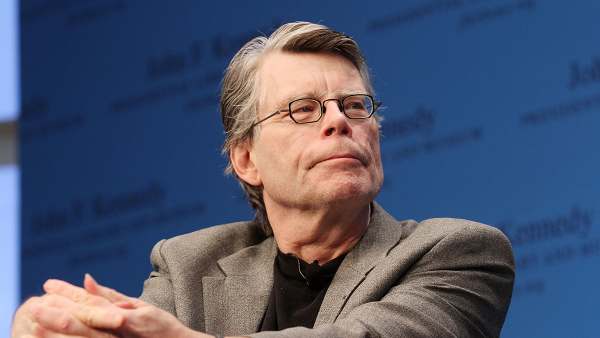
Among the many Star Trek stories that wrestled with the Prime Directive, one stands out—not because it pushed the franchise into forbidden territory, but because it never made it to the screen at all. “He Walked Among Us” wasn’t abandoned because it was unfinished, unfilmable or thematically out of bounds for the series. Star Trek had already explored the dangers of interference many times over, but what derailed the episode was something far more specific: a fundamental clash over tone.
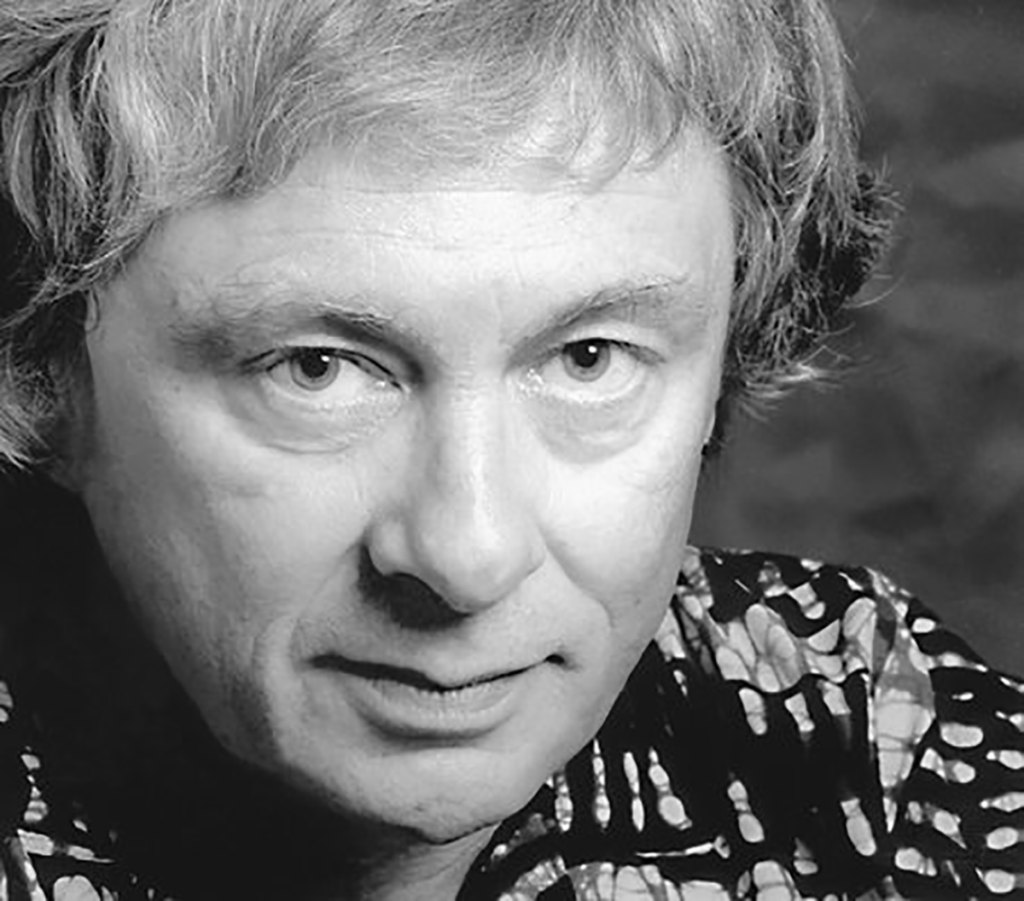
Writer Norman Spinrad (who had previously scripted the classic original series episode “The Doomsday Machine”) conceived the story as a serious, morally complex drama built around a human who had violated the Prime Directive and come to see himself as a god—not out of malice, but conviction. When the script was rewritten by producer Gene L. Coon into a broad comedy and reshaped to fit a very different performance style, Spinrad felt the core of the story had been lost. Rather than see the idea transformed into something he didn’t recognize or support, he asked that the episode not be produced at all. In the end, series creator Gene Roddenberry agreed and, as a result, this script joined such future unfilmed Trek adventures as Roddenberry’s own The God Thing, director Philip Kaufman’s Planet of the Titans and the Star Trek Phase II television series.
A script that fit ‘Star Trek’—until it didn’t
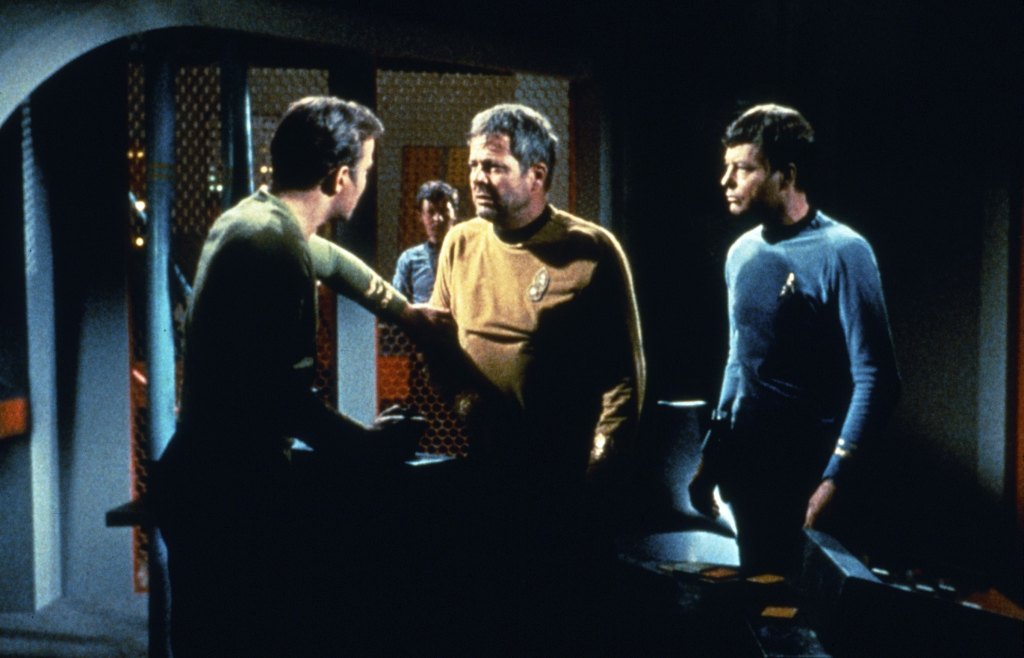
By the time “He Walked Among Us” was written, the original Star Trek was already—and would continue to be—well-versed in stories about cultural contamination and moral overreach. Episodes like “The Return of the Archons,” “The Apple” and “Patterns of Force” established that the Prime Directive was not just a rule, but a recurring source of ethical tension. The series had never shied away from showing the consequences of interference, especially when humans believed they knew better.
In the pages of his three-volume These Are the Voyages, author Marc Cushman describes the premise this way: “In Spinrad’s story, Kirk searches for a way to reverse the interference inflicted on an alien culture by Federation scientist Dr. Theodore Bayne or, at the least, prevent further interference. Bayne, who crash-landed on the planet Jugal, is obsessed with theories of better ways to run a developing society and has seized power to realize his concepts and goals. But Bayne is frustrated that each time he makes a change that should benefit the people of Jugal, the opposite seems to happen. Kirk would like to simply pluck Bayne from Jugal, but this is not possible since the inhabitants have come to think of him as a god and, should he vanish, the two primary power figures, King Kaneb and High Priest Lokar, presented the Earthman to the people as a deity. In light of the problems now being faced on Jugal, Kaneb has come to regret doing this and Bayne’s life is in danger. Kirk uses this information and also proves to Bayne that his tinkering on Jugal has done more harm than good. Bayne agrees to leave with the Enterprise, with a departing message to the people of Jugal that Kaneb and Lokar remain in their present positions, as a shared leadership.”
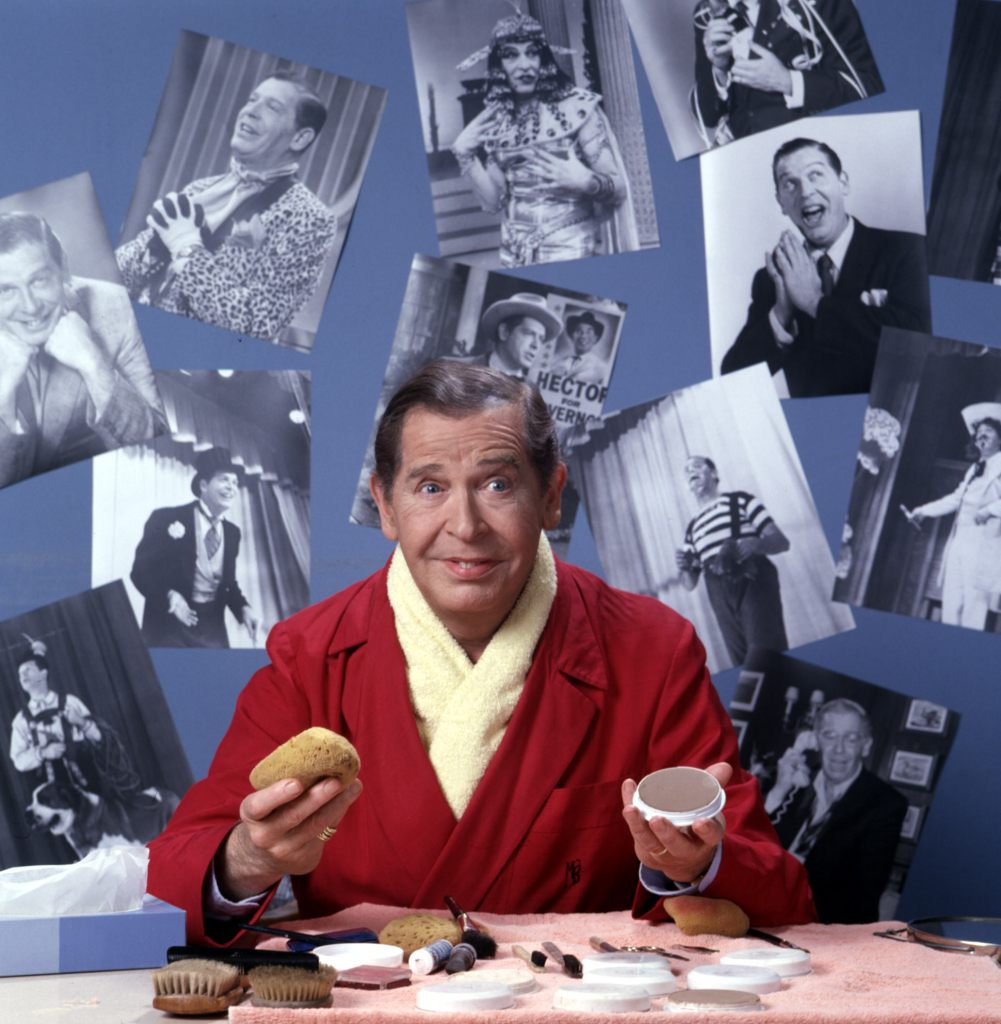
As Spinrad explains it, following the success of “The Doomsday Machine,” he was invited back to work on something very specific for actor/comedian Milton Berle, who was one of the most recognizable figures in early American TV, earning the nickname “Mr. Television” for his dominance of the medium in the late 1940s and 1950s. A veteran of vaudeville, radio, film (one of his best was Stanley Kramer’s It’s a Mad, Mad, Mad, Mad World) and Broadway, Berle built his fame on broad comedy, rapid-fire jokes and an outsized performing style that played directly to live audiences and early TV viewers. By the late 1960s, he remained a major celebrity, though his persona was strongly associated with high-energy humor rather than restrained dramatic work.
“Milton Berle,” Spinrad said, “wanted to do a Star Trek, or they wanted Berle. People argue about this, but the way it was said to me was that Berle wanted to do it as a serious dramatic actor, which he had been. He had a second career as a good character actor. So they gave me two things: They sent me to a backlot way out in Culver City, which was overgrown with weeds, where they had this weird village set. Then they told me about Milton Berle. I know that Berle can be a serious actor, but he likes weird get-ups. I said, ‘OK, let Milton Berle be a messiah,’ and that was the germ of the idea. Milton Berle would go to an alien planet and be set up as a god.
“I was interested in the paradoxes of the Prime Directive,” he continues, “and that’s what the thing was really about. Berle was supposed to play Bayne, a sociologist, a guy trying to do good, who ends up on a more primitive planet. It’s sort of like A Connecticut Yankee in King Arthur’s Court. If you’re going to steal, it’s better to steal from Mark Twain or Herman Melville [whose Moby Dick inspired ‘The Doomsday Machine’] than Fred Saberhagen. So he’s there playing God and he’s violating the Prime Directive.”
Take two
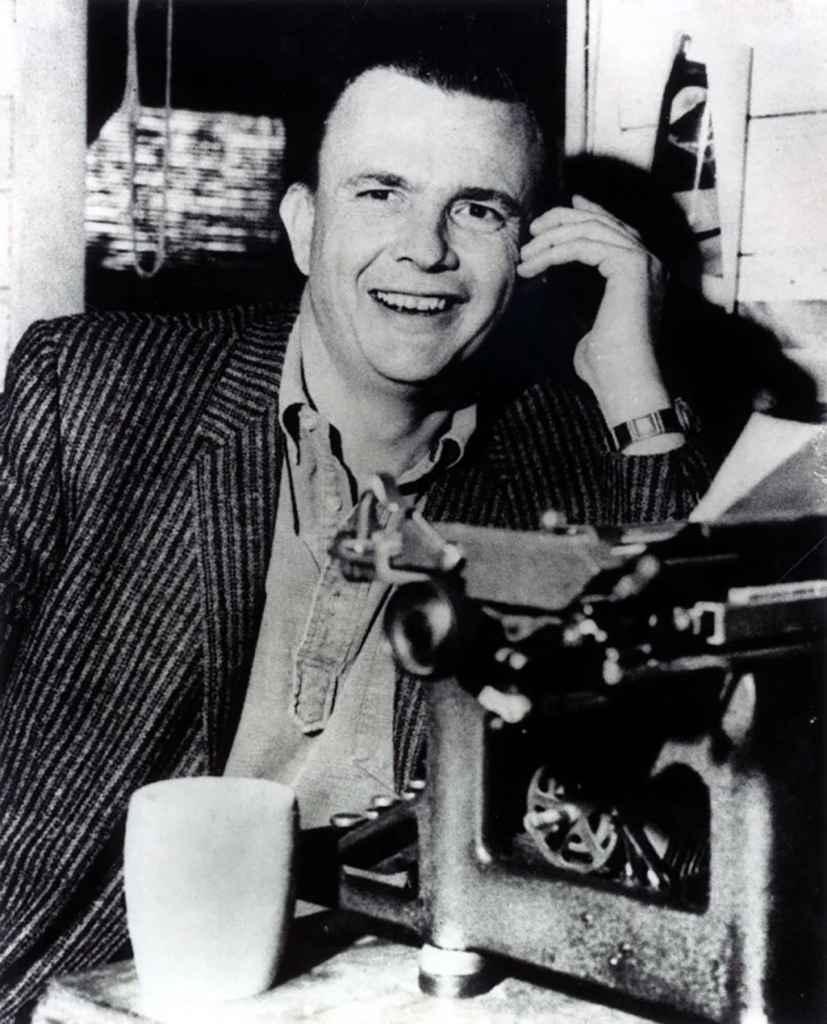
Gene L. Coon, the person who had actually come up with the concept of the Prime Directive in the first place, wrote Spinrad a 22-page long memo on the script that said, in part, “We have many problems with ‘He Walked Among Us.’ In ‘The Doomsday Machine,’ you wrote a story which was 90% action and 10% characterization and dialogue. In ‘He Walked Among Us,’ the situation is reversed. It is a story which depends 90% upon good, accurate, sparking characterization delineation and dialogue. Unfortunately, we don’t’ have these things in this version.”
Added Spinrad, “I was happy with what I had done. It was accepted. They paid me for the full thing—the first draft, second draft polish. I got all my money. Gene Coon, in his wisdom as my story editor said, ‘This script needs a rewrite. Who can I trust to rewrite it? Well, I know somebody who has never disappointed me.’ He did it himself. Basically he rewrote a serious anthropological piece of material into something being played for laughs. It became an unfunny comedy. I complained about it and he said to me, ‘Shut up and play ball with me, kid, and you’ll be making $100,000 a year. If you don’t, you won’t be writing for this show again.’ That was the wrong thing to say to me. I was so pissed off that I called up Roddenberry and said, ‘Gene, you cannot do this. You have to kill this script,’ and he agreed to do that. I killed my own script rather than have it presented in that way.”
More tales of the Prime Directive
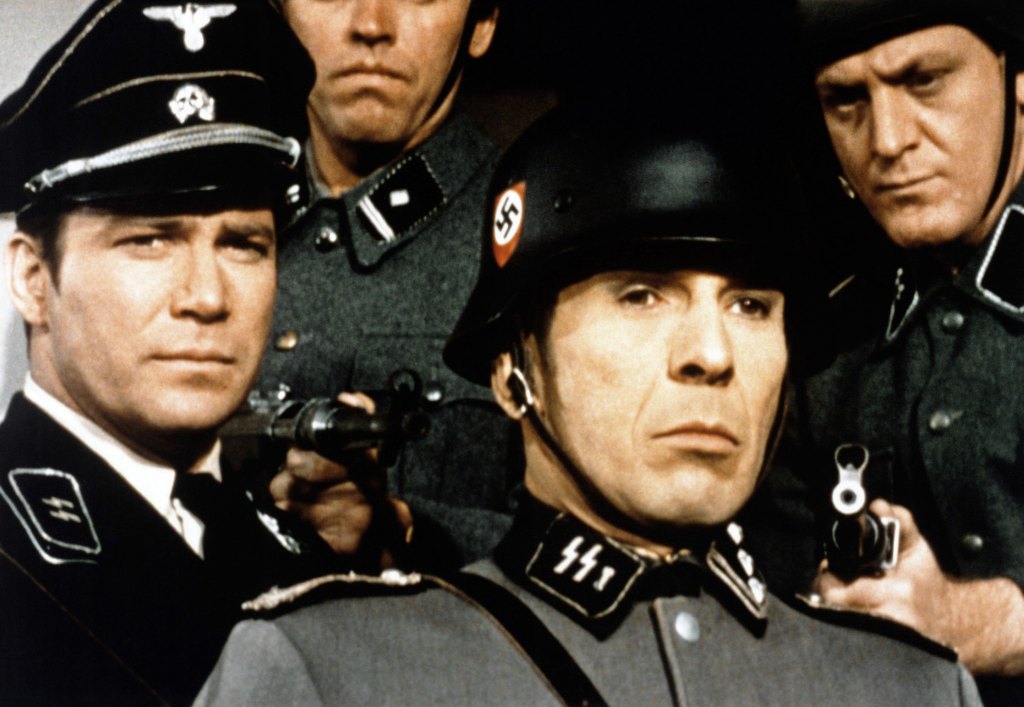
One of the misconceptions surrounding “He Walked Among Us” is that it represented a dramatic leap beyond what Star Trek was already doing. In reality, the series had spent much of its run exploring the consequences of interference, often through human characters who believed they were acting responsibly.
In “Patterns of Force,” Federation historian John Gill introduces Nazi ideology to an alien world, believing he can control its worst impulses. His failure isn’t rooted in cruelty, but in arrogance: the assumption that he can impose a system without becoming trapped by it. The episode ends with Gill mentally broken, his good intentions laid bare as catastrophic misjudgment. It’s a stark warning, but one softened by distance—Gill’s fate absorbs much of the moral fallout.
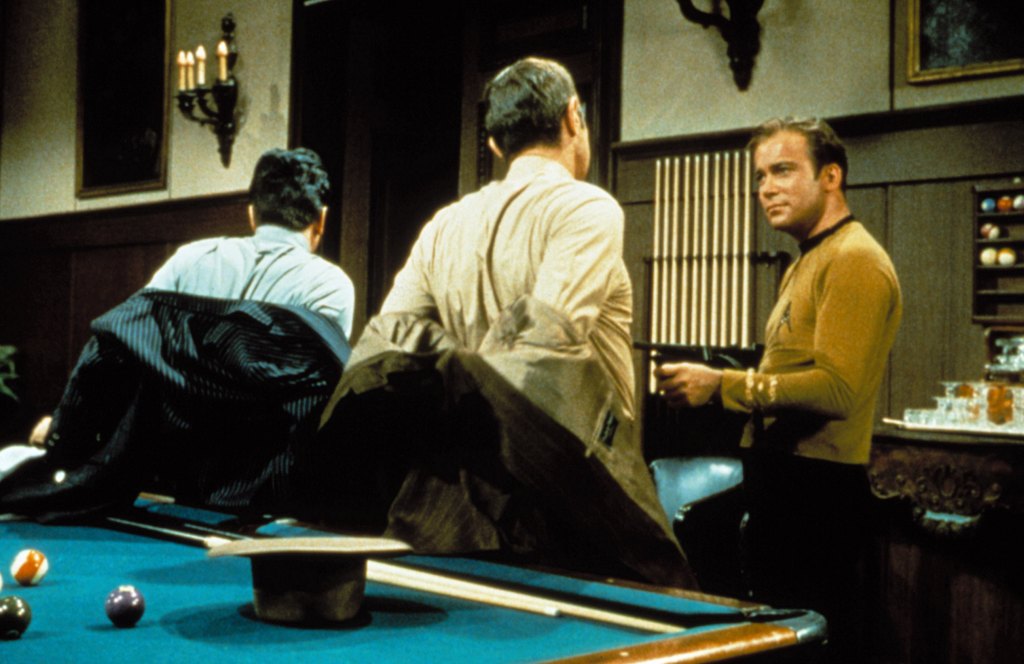
“A Piece of the Action” approaches contamination from a lighter angle. A forgotten book by another starship reshapes an entire society into a pastiche of 1920s gangland America. Played as comedy, the episode nevertheless acknowledges the permanence of the damage. The culture cannot simply be reset, even if the tone invites laughter instead of tragedy.
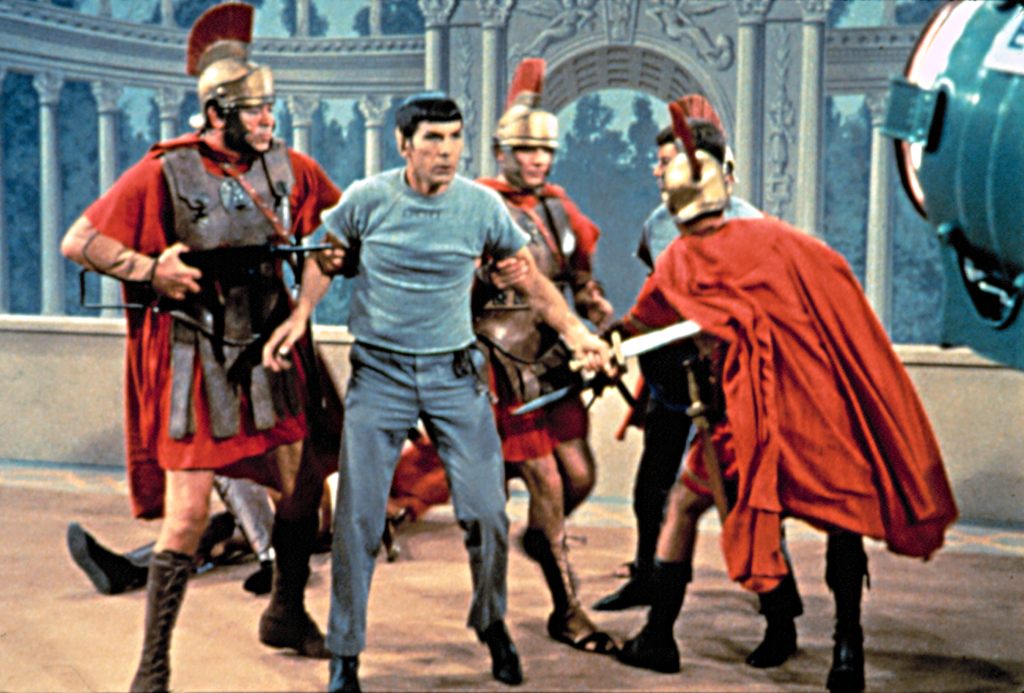
“Bread and Circuses” presents a parallel development shaped by Roman history rather than modern Earth. Here, the danger lies not in direct interference, but in how easily familiar systems can reemerge elsewhere. Kirk and Spock observe rather than intervene, reinforcing the Prime Directive by restraint rather than correction.
Even earlier episodes like “The Return of the Archons” and “The Apple” examine societies rendered stagnant or dependent by imposed authority. In each case, the narrative provides an external mechanism—a computer, a god-machine, a system that can be dismantled—allowing Starfleet to act decisively and restore balance.
“He Walked Among Us” followed the same conceptual path, but without those safety nets. Bayne was not a machine to be shut down or a dictator to be overthrown. He was a human being whose presence had become psychologically and culturally indispensable. Removing him would expose the damage rather than fix it.
The script’s return

After “He Walked Among Us” was shelved, it didn’t circulate widely, nor did it become an immediate piece of behind-the-scenes lore. Unlike abandoned story ideas that were recycled or reworked, this script simply disappeared from view. For years, it existed mostly as a footnote in conversations about Norman Spinrad’s work on Star Trek, mentioned occasionally but rarely examined in detail.
The situation changed decades later, when a copy of the original script resurfaced and was brought to Spinrad’s attention. He ultimately made the script available himself, allowing readers to evaluate it on its own terms rather than through secondhand description. The renewed visibility of the script also sparked interest in seeing it realized onscreen, particularly within the fan-film community. In 2012, a production group associated with Star Trek: New Voyages (also known as Phase II) announced plans to film the original version of the episode, with Spinrad involved. But that effort was short-lived as CBS, which owned the underlying rights to the script as a work-for-hire, issued a cease-and-desist order halting the production before filming could begin.
Conversation
All comments are subject to our Community Guidelines. Woman's World does not endorse the opinions and views shared by our readers in our comment sections. Our comments section is a place where readers can engage in healthy, productive, lively, and respectful discussions. Offensive language, hate speech, personal attacks, and/or defamatory statements are not permitted. Advertising or spam is also prohibited.