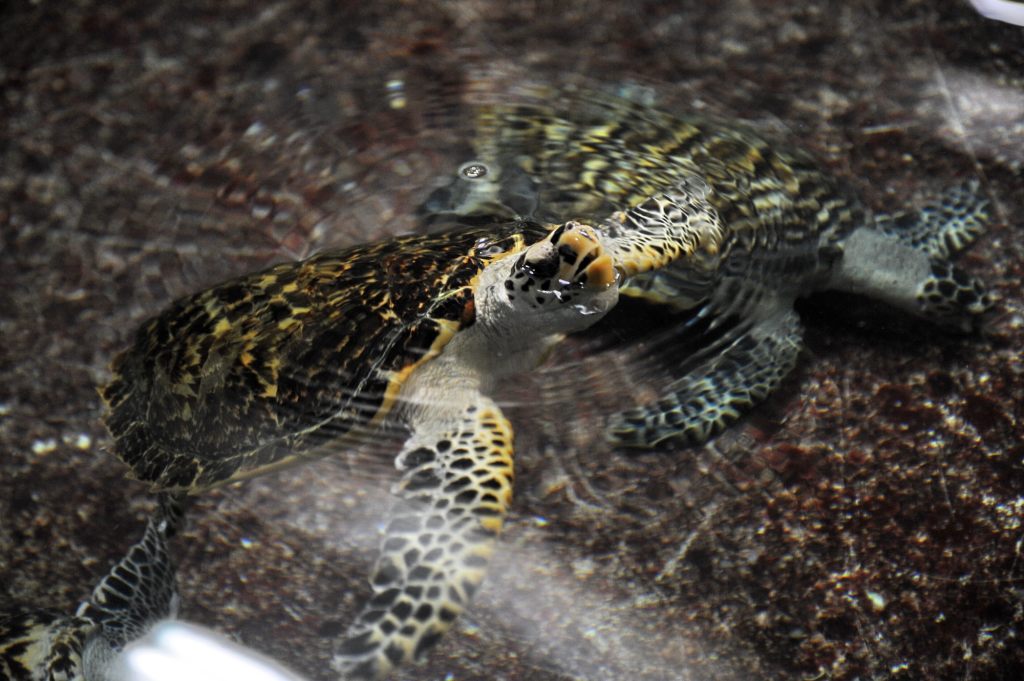
Meet Bear, the Critically Endangered Hawksbill Turtle Who Swam Back Home From the Brink of Death
Bear, a critically endangered hawksbill turtle, made a miraculous recovery before getting released back into the wild.

When the Bermagui Veterinary Clinic posted a video to Facebook on March 22, it captured a moment months in the making: a hawksbill sea turtle named Bear swimming into the ocean.
“Bear is finally strong and free and out to sea! We are absolutely THRILLED to see this. Good luck Bear and thank you to everyone who helped along the way. Every single Hawksbill Sea Turtle is precious. We must protect them from extinction,” the clinic wrote.
Bear’s story began in December 2025. Mudgeroo Wombat & Wildlife Refuge, a family-run sanctuary on 70 acres of natural bushland in Jervis Bay, New South Wales, approximately three hours south of Sydney, took her in alongside two other stranded turtles. The news was grim.
“Unfortunately, two of the turtles were critically unwell and did not survive,” the refuge wrote on Facebook on December 2, 2025. “We still have one, ‘Bear’ the Hawksbill under Veterinary care as he is gravely unwell too.”
The refuge also noted that “a stranded sea turtle found stranded is most likely critically unwell and needs experienced care and for Veterinary assessment as soon as possible.”
Bear the hawkskill turtle had a slow recovery, then a breakthrough
By March 11, Mudgeroo had an encouraging update.
“Since being discovered stranded in December, Bear has shown steady progress, albeit slowly, which is common in sea turtle rehabilitation,” the refuge wrote via Facebook. “The initial stabilization phase requires several weeks, after which gradual changes help us monitor the pattern of physical recovery. Thanks to the dedicated care from our team, Bear is now on a clear path towards recovery. The increase in body weight is particularly encouraging, indicating improved overall health.”
Bear’s prospects for release were “looking increasingly promising,” the refuge said, with a veterinary assessment and blood analysis forthcoming.
Dozens of people made Bear’s release back into the wild happen
Ten days later, on March 21, Bear was free.
“So, Bear has been in care with us since December 2025, coming to us in a terrible state,” the refuge wrote via Facebook. “We came up to Port Stephens, as NPWS told me the southern most region of their range will give Bear a head start on her journey north.”
Hawksbill sea turtles are critically endangered, and the refuge described what the release meant: “Her journey back to begin her reproductive life is so exciting & important to their species. For this reason, it was so special a feeling when she started improving, and further to see her so fit and ready to go.”
The hawkskill turtle species has been pushed to the brink
Hawksbill sea turtles are listed as critically endangered under the Endangered Species Act. Named for their narrow, pointed beak, they have a distinctive pattern of overlapping scales on their shells that forms a serrated look on the edges. Those colored and patterned shells make them highly valuable and commonly sold as “tortoiseshell” in markets.
“In many parts of the world, hawksbills face the unique threat of being hunted for their beautiful shell, also known as ‘tortoise shell,’ which is used by craftspeople to create many types of jewelry and trinkets,” per NOAA Fisheries. “The historical hunting and killing of hawksbills for their shell nearly drove the species to extinction.”
Hawksbills live mainly in the world’s tropical oceans, predominantly in coral reefs, where they feed on sponges, sea anemones and jellyfish. Sea turtles have existed on Earth and traveled the seas for the last 100 million years. They help maintain the health of coral reefs and seagrass beds.
The Mudgeroo Wombat and Wildlife Refuge is fighting to stay open

Mudgeroo Wombat and Wildlife Refuge, licensed under Wildlife Rescue South Coast Inc., was established in 2014 by founders Belinda and Phil. Its mission, per its website, is to “ensure that Mudgeroo Wombat and Wildlife Refuge continues to grow as a safe haven for Australia’s wildlife–rescuing, rehabilitating, and releasing native species while providing lifelong sanctuary for domesticated animals, and those under license for longer term care.”
The sanctuary faces an uncertain future. A GoFundMe campaign describes the challenge: “amidst the ongoing challenges of the cost of living crisis, Belinda and Phil find themselves facing hardship, placing the sanctuary at risk of closure.”
As of publication, the fundraiser has raised over $27,000. The campaign asks those who can to “offer aid through philanthropy, grants supporting wildlife mortgages, or local government assistance.”
Conversation
All comments are subject to our Community Guidelines. Woman's World does not endorse the opinions and views shared by our readers in our comment sections. Our comments section is a place where readers can engage in healthy, productive, lively, and respectful discussions. Offensive language, hate speech, personal attacks, and/or defamatory statements are not permitted. Advertising or spam is also prohibited.