Can AI Find the Perfect Gift? I Tested ChatGPT, Gemini, Perplexity and Alexa to See Which Worked Best
Every tool surfaced ideas I never would have found, but only one made the shopping part actually easy.

Everyone has at least one person who seems impossible to shop for. They already own what they need, buy what they want and rarely offer useful hints. If that person is on your gift list, you’ve probably exhausted the usual wish lists, gift guides and “just tell me what you want” conversations.
Free AI tools are quickly becoming another place to look for help. In fact, 67% of shoppers have used tools like Gemini, Perplexity and ChatGPT to manage their purchases in the last three months, according to a 2026 survey conducted by Attentive.
But could any of them find a gift that actually felt thoughtful?
I gave ChatGPT, Perplexity, Gemini and Alexa for Shopping the exact same challenge. One came up with the most creative ideas, another made buying almost effortless and a third proved that finding a good gift and helping you purchase it are two very different things.

Which AI assistant was best at finding gifts?
There wasn’t one clear winner. Instead, each AI assistant was noticeably better at a different part of the shopping process.
- Most creative: Gemini — Strong personalization and distinctive ideas, but weaker purchase links.
- Easiest to buy from: Alexa — Excellent checkout experience, but limited to Amazon.
- Best browsing experience: ChatGPT — Product photos and varied ideas, with a few accuracy and link issues.
- Most straightforward: Perplexity — Reliable links and clean results, but less adventurous recommendations.
Here’s how each one performed.
How I tested ChatGPT, Gemini, Perplexity and Alexa
To keep the comparison fair, I used the free version of every AI tool and started each test in a new conversation.
Each assistant received the same gift-shopping challenge:
“I need a gift for a friend who already owns most things they want and dislikes unnecessary clutter. They enjoy international cooking, specialty coffee, hiking, game nights and travel, but already own the basic equipment for those interests. My budget is $75 to $125. Recommend five specific gifts. Rank them from strongest to weakest and include the price, purchase link and why each one fits. Before answering, you may ask up to three follow-up questions if they would improve your recommendations.”
Here are the rules I followed:
- I used the free version of each AI tool.
- I started a new conversation with no previous context.
- Every tool received the exact same opening prompt.
- Each tool could ask up to three follow-up questions in a single round.
- I answered follow-up questions using the same predetermined recipient profile.
- I did not steer any assistant toward a particular product.
- I checked whether recommended products, prices and links were accurate.
- I judged the results on personalization, originality, practicality and purchasing convenience.
Gemini found the most creative gifts, but shopping took more work
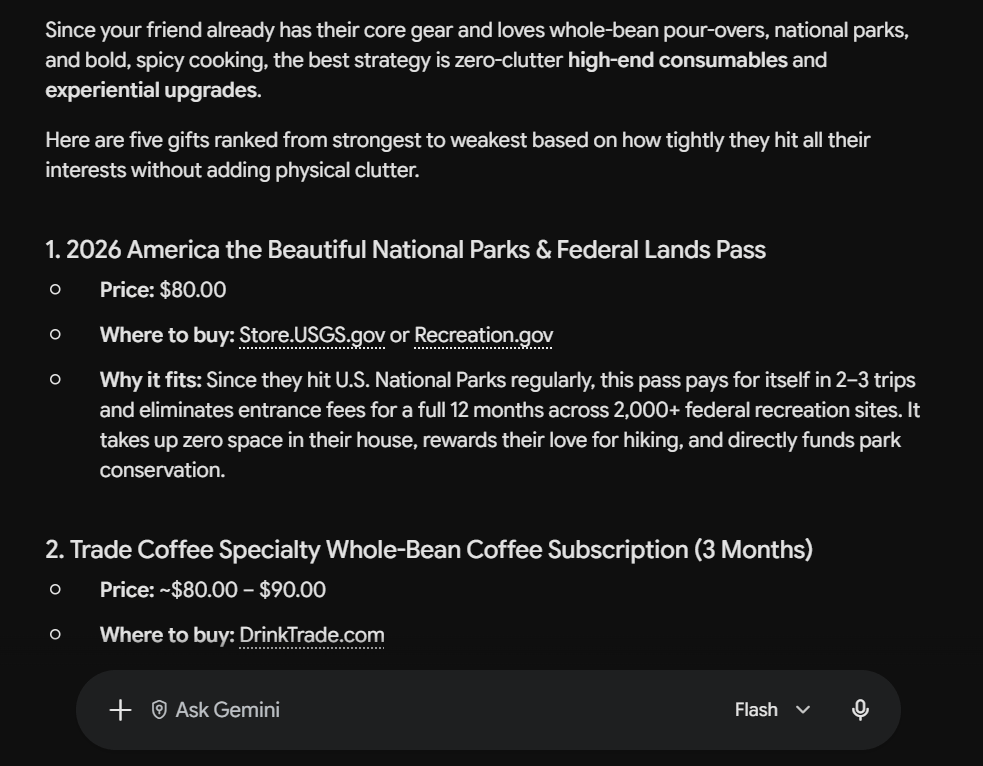
Top recommendations: America the Beautiful annual parks pass, Trade Coffee 3-month subscription, Burlap & Barrel global chili collection, custom game-night gourmet snack crate and Fly By Jing Sichuan pantry essentials.
Gemini was the only tool that asked follow-up questions before making recommendations. It wanted to know my friend’s coffee brewing method, spice and dietary preferences and whether their trips were mostly domestic or international.
Best idea: Burlap & Barrel’s global chili collection and Fly By Jing’s Sichuan pantry essentials were among the most distinctive recommendations in the experiment.
Biggest strength: Gemini actually used the answers to improve its picks. After learning that my friend brews pour-over coffee, it replaced a vague specialty-coffee suggestion with a specific Trade Coffee subscription. The national parks pass also moved to the top once it confirmed my friend mostly hikes domestically.
Biggest weakness: Several recommendations were easier to research than buy. The “custom game-night gourmet snack crate” led to a homepage rather than a specific product, while other links went to a press release, the wrong regional site or a page that wasn’t live yet.
Verdict: Gemini was the best brainstorming partner, but I had to do more work to turn its ideas into purchases.
Alexa made it easiest to actually buy a gift
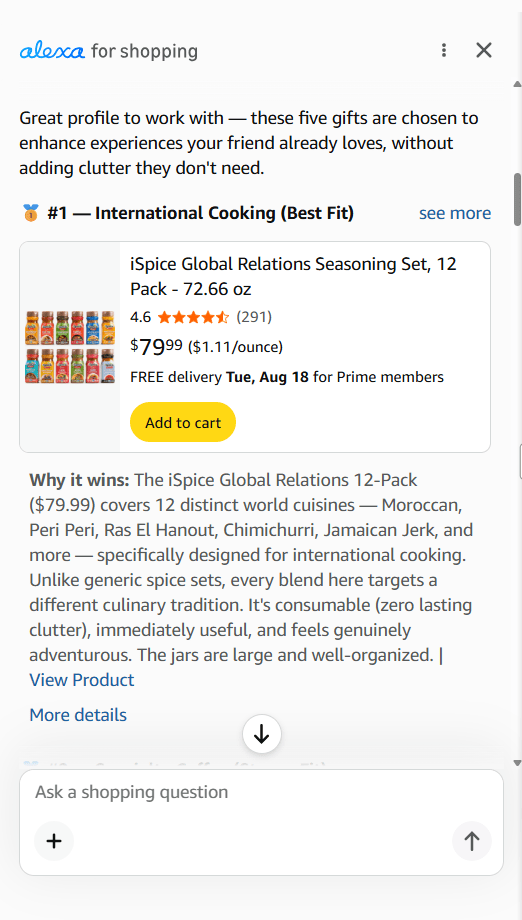
Top recommendations: iSpice Global Relations 12-pack, Volcanica Coffee Lover gift box, Ticket to Ride Legacy: Legends of the West, Horizon Hound packable down blanket and Mysterium (2025 Refresh).
Alexa had the tightest character limit, so I had to shorten my prompt without changing the information it received. It also asked its follow-up question after making recommendations rather than before.
Best idea: Ticket to Ride Legacy: Legends of the West was the strongest game-night recommendation across all four tools because it connected two interests — games and travel — in one gift.
Biggest strength: Alexa had the best shopping experience. Each recommendation came with a photo, price, star rating and add-to-cart button inside the conversation. When I told it my friend already owned packing cubes, it replaced the pick instead of trying to justify it.
Biggest weakness: Everything came from Amazon. That made checkout easy but excluded experience-based gifts and subscriptions sold directly by specialty companies.
Verdict: Alexa was the best choice for going from recommendation to purchase with as little friction as possible.

ChatGPT felt the most like browsing an online store
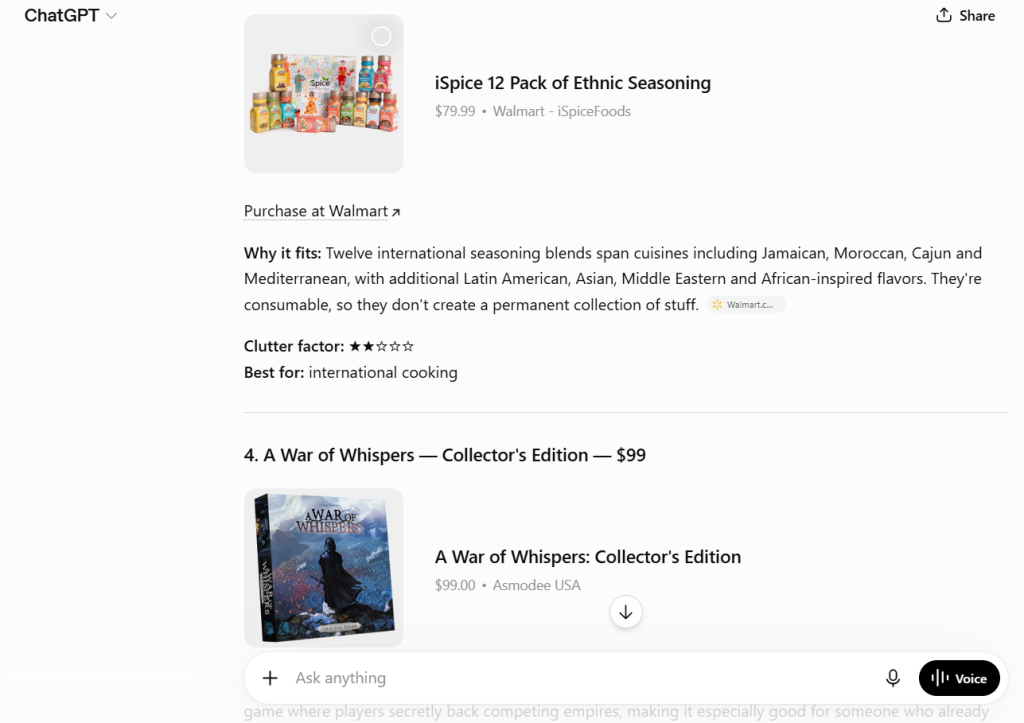
Top recommendations: America the Beautiful annual parks pass, Atlas Coffee Club 6-month subscription, iSpice Global Relations 12-pack, A War of Whispers board game Collector’s Edition and Osprey Daylite expandable travel pack.
ChatGPT skipped follow-up questions and went straight to recommendations, but still landed several strong ideas.
Best idea: The Atlas Coffee Club subscription was one of the gifts I would actually consider buying. ChatGPT also spotted a $99 sale price that other tools missed.
Biggest strength: It was one of only two tools, along with Alexa, to show product photos. It also added a “clutter factor” rating to every recommendation and included a summary table at the end, making the results easy to compare.
Biggest weakness: The board game recommendation didn’t fit the type of games my friend enjoys, and the Atlas Coffee Club link wouldn’t let me complete checkout.
Verdict: ChatGPT offered a strong mix of ideas and useful shopping features, but I still needed to verify some recommendations before buying.
Perplexity was practical, simple and easy to act on
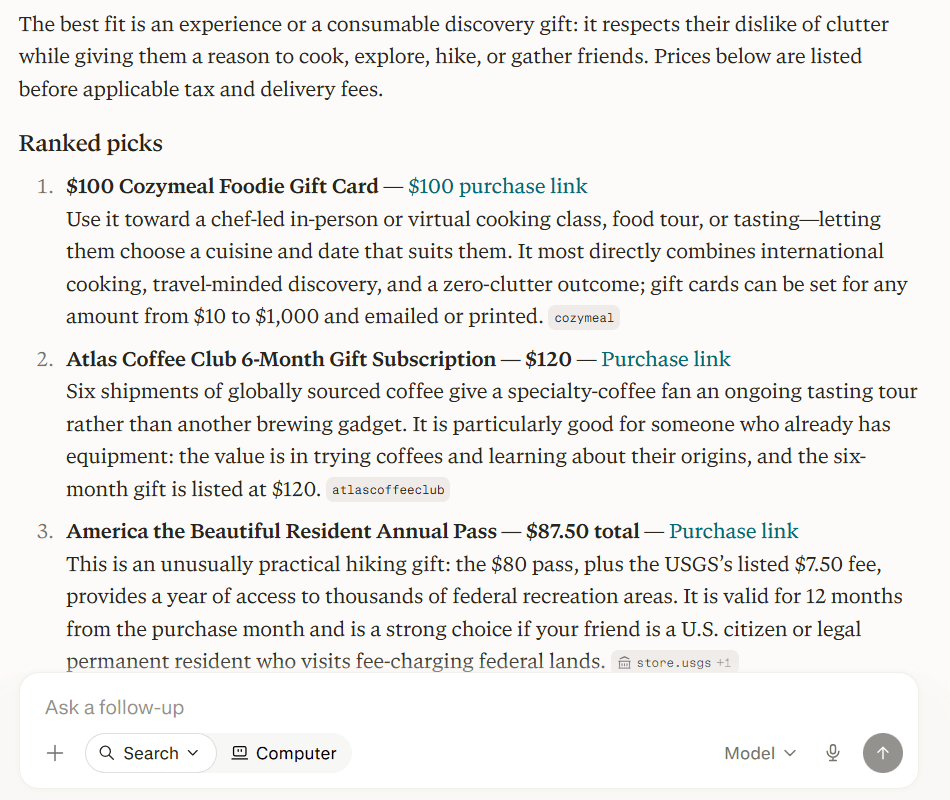
Top recommendations: Cozymeal foodie gift card, Atlas Coffee Club 6-month subscription, America the Beautiful annual parks pass, Airbnb eGift card and The Escape Game gift cards.
Perplexity skipped follow-up questions and returned the cleanest, most scannable answer of the four.
Best idea: The national parks pass and coffee subscription were both strong fits, even if neither was unique to Perplexity.
Biggest strength: Every purchase link worked and took me somewhere I could actually buy the recommended item.
Biggest weakness: Three of its five picks were essentially gift cards, which suited the anti-clutter constraint but made the list feel safer than personal. It also recommended The Escape Game even though my friend doesn’t live near a location—a miss that a follow-up question likely could have prevented.
Verdict: Perplexity was the simplest option if you want usable links and don’t need the most adventurous recommendations.

What testing four AI gift assistants taught me
Follow-up questions can make a noticeable difference
Gemini was the only assistant to ask questions before recommending anything, and its results became more specific because of them.
Some of the other tools’ biggest misses likely could have been avoided the same way. ChatGPT might have learned what kind of board games my friend enjoys, while Perplexity could have ruled out a location-dependent experience.
The experiment reinforced that the amount of context you give an AI can matter as much as which tool you choose.
Finding a good idea and helping you buy it are different skills
Gemini and Alexa showed the clearest contrast.
Gemini delivered some of the most distinctive recommendations, but several links required extra searching. Alexa worked from a narrower Amazon catalog, yet made it incredibly easy to move from recommendation to checkout.
Depending on how you shop, the best AI assistant may be the one that generates the strongest ideas or the one that removes the most friction after you’ve chosen one.
Can AI find a good gift for someone who has everything?
Yes—but I wouldn’t hand over the entire decision.
After testing all four assistants, I’d seriously consider the Atlas Coffee Club subscription or America the Beautiful parks pass. I’d also consider the Airbnb gift card Perplexity suggested. I don’t normally love gift cards, but an Airbnb card feels less like handing someone store credit and more like helping fund a trip they get to design themselves.
AI expanded the pool of possibilities and surfaced ideas I might not have found on my own. I still had to decide which one actually felt right for the person receiving it.
For someone who already has everything, that may be where AI is most useful: not choosing the gift for you, but getting you to an idea you wouldn’t have reached on your own.





Conversation
All comments are subject to our Community Guidelines. Woman's World does not endorse the opinions and views shared by our readers in our comment sections. Our comments section is a place where readers can engage in healthy, productive, lively, and respectful discussions. Offensive language, hate speech, personal attacks, and/or defamatory statements are not permitted. Advertising or spam is also prohibited.