Meet Cindy Eckert: The Woman Changing the Conversation About Low Desire (Exclusive)
The Addyi pioneer is challenging what women have been told about sex, menopause and desire

Key Takeaways
- Cindy Eckert helped bring Addyi, the first FDA-approved HSDD treatment, to market.
- Addyi is approved for women with HSDD under age 65, regardless of menopause status.
- Eckert encourages women to speak up when changes in sexual desire cause distress.
There was a moment when the question driving Cindy Eckert’s life changed from “what do I have to prove?” to “what do I have to give?” The history-making entrepreneur and health advocate tells Woman’s World, “The impact we make matters most to me. It comes from the courage and conviction my parents raised me with: Speak up. Say it out loud if you don’t agree. Stick to your guns.”
We’re enjoying a renaissance right now of menopause awareness, and this woman is a big reason why. Few have made a bigger impact on the conversation around women’s sexual desire than Cindy, 53. She’s the force behind Addyi, the first FDA-approved prescription medication for hypoactive sexual desire disorder (HSDD)—a persistent loss of sexual desire that causes a woman distress and isn’t explained by another condition, relationship problem or drug side effect.
For Cindy, the fight became personal when she learned that changes in desire weren’t always about stress or “trying harder.” Biology plays a big role too. I sat down with Cindy for this week’s cover story (get your copy here) shortly after she lost her mother to talk about desire, grief, courage, the women who made her who she is—and why she believes we deserve to ask for more.

You deserve desire
Most women with HSDD go years without a name for what they're experiencing. See if this sounds like you
‘Common’ isn’t normal
For years, women have been dismissed, told their vanishing desire is simply stress, aging or menopause. Up to 50 percent of us will suffer from low libido at some point in our lives. But Cindy wants women to make a key distinction: “So many things in women’s health have been branded as normal,” she says. “They might be common, but they’re not normal.”
Her message isn’t that every woman should want more sex. “Ask yourself: ‘Was it different at one point? Do you want to do something about it?’ If something matters to you, it’s worthy of a conversation and it’s worthy of science.”
Wondering where your desire went? Our Desire Hub has expert answers and ways to get your spark back.
We all want to want
Cindy’s awakening came while she was working in the male sexual health field and discovered how few medical options existed for women. Then she was stunned by brain-scan research comparing women with desire difficulties and those who were sexually content. Their brains didn’t respond the same way to romantic cues. Cindy says, “The brains of women with HSDD lit up differently. And the scientific community went, ‘Oh my God. It’s biology.’ It’s remarkable evidence—and it struck me like lightning.
“I experienced it,” says Cindy about her own journey with HSDD. “Women are only treated on the basis of our emotions and not our biology and that is where things go sideways in women’s health. I looked around and said, ‘There are 26 FDA-approved products for men to lead a more satisfying sex life, but not a single one for women.’”
Cindy spent a year talking with women about this. “I thought, Oh my God, she’s me. I’m her. We were different ages, different menopause statuses, different relationship statuses. But for all of our differences, all of us wanted to want.” Over and over, each woman said: I love my partner. Yet Cindy explains, “the world has told her that it’s her problem.”
That’s why it was vital to Cindy to bring this medication to market to support women. The realization that bedroom problems often begin in the head, not the heart, can be freeing, she says. “When you realize something’s going on biologically and you can address it, nothing is better than watching a couple receive that news. That relief.”
After tireless work, Cindy helped Addyi earn FDA approval in 2015 for premenopausal women. She didn’t stop there. She kept fighting for those in the prime of life.

Desire doesn’t expire
For Cindy, one piece of unfinished business was women after menopause. It took more years and added trials, but in 2025 the FDA expanded Addyi’s approved use to women with HSDD up to age 65 regardless of reproductive status, meaning postmenopausal women can now benefit from the pink pill too.
“We’d counted postmenopausal women out on these issues for so long,” she says. “We told them the narrative, ‘Ah, sex doesn’t matter to you.’ How is that true?” The science mattered—but Cindy believes culture had to catch up too. “We felt like desire came with an expiration date,” she says. “It doesn’t!”
Connection matters

Cindy is careful not to define a good sex life by frequency (or even a partner). “The standard shouldn’t be how much you want sex,” she says. “But do you miss a part of yourself?
“We talk about sex in society as a performative act,” she says. “We fail to look at it through the female lens of connection.” And decades-long research from Harvard links strong relationships with better health as people age—but the research is about intimacy, not sex itself.
Cindy never gets tired of hearing how she’s restored the spark for people. “Sometimes somebody will say, ‘I just sent my first nude,’” she laughs. “Then the next woman will say, ‘We hold hands when we watch Netflix again.’”
It’s not an aphrodisiac
“We had 13,000 women in our clinical trials and we’re proud of that,” says Cindy. “I think it’s important that you have realistic expectations with Addyi. You’re not going to take it and swing from the chandelier tonight,” she laughs.
“If that’s what you’re looking for, you’ve come to the wrong place,” she adds. “It works on neurochemistry. It builds in the system over time. It allows spontaneity. It gets you back into that place where you are responsive.”
Some women who respond notice thoughts, fantasies or receptivity returning gradually. Cindy describes the progression she hears as “fantasy first, receptivity second, initiation third.” But desire is complex. The FDA labeling says women should discontinue Addyi after eight weeks if they haven’t noticed improvement.
Curiosity is key

When asked what she looks for in a founder, her answer is immediate: “Insatiable curiosity.”
She learned early on from her mom that showing emotion is a strength. Once, a woman pitching Cindy an invention became tearful as she showed prototypes she’d painstakingly built. The male investors in the room viewed the tears as a liability. But she saw it differently.
“The moment she cried is the moment I knew I was investing,” Cindy says. “That’s passion. What a gift it is that people come to me with big ideas to change the world. That keeps me going.”
Low desire is a real medical condition
Persistent low libido in women is a real, clinical diagnosis called hypoactive sexual desire disorder (HSDD). And it’s more than simply not being in the mood. The FDA defines acquired, generalized HSDD as low sexual desire that causes marked distress or interpersonal difficulty, develops after a period without desire problems, occurs across situations and partners and isn’t explained by a medical or psychiatric condition, relationship trouble or medication.
Cindy comes back to the same three questions for any woman wondering, Am I just tired?
- Was my desire different before?
- Has the change lasted?
- Is it causing me distress?
If you answer yes to any of these, talk to your healthcare provider. “There’s no obligation to want sex a certain amount of times a week,” Cindy says. “If you miss something you once had and you want it back, you’re entitled to have that conversation.”
Between advocates like Cindy and the awareness raised by her award-winning documentary, The Pink Pill (streaming on Paramount+), women are finally being heard and getting the help they deserve.

What is the ‘pink pill’?
One misunderstanding still makes Cindy laugh: calling Addyi “female Viagra.”
“They’re completely different!” she says. Drugs such as Viagra help improve blood flow involved in erection. Addyi, or flibanserin, acts in the brain and is taken daily. It was initially studied as an antidepressant when scientists discovered it had a unique side effect: improved desire. It affects serotonin and other neurotransmitters involved in the pleasure response.
Cindy describes the difference more simply. “Viagra is directed blood flow to the genitals. That’s arousal. For women, sex isn’t just mechanics,” she notes. “It’s about being in the mood. Addyi is desire. It’s what happens to the brain in that sexy headspace—being open, being interested. And once you understand that difference between desire and arousal, you’re speaking an entirely different language about sex. I think you’re speaking women’s language about sex.”
In addition to the daily Addyi pill, there is another FDA-approved option for HSDD: Vyleesi (bremelanotide) is an on-demand, occasional-use injection available for premenopausal women to use before sex.
Addyi, explained
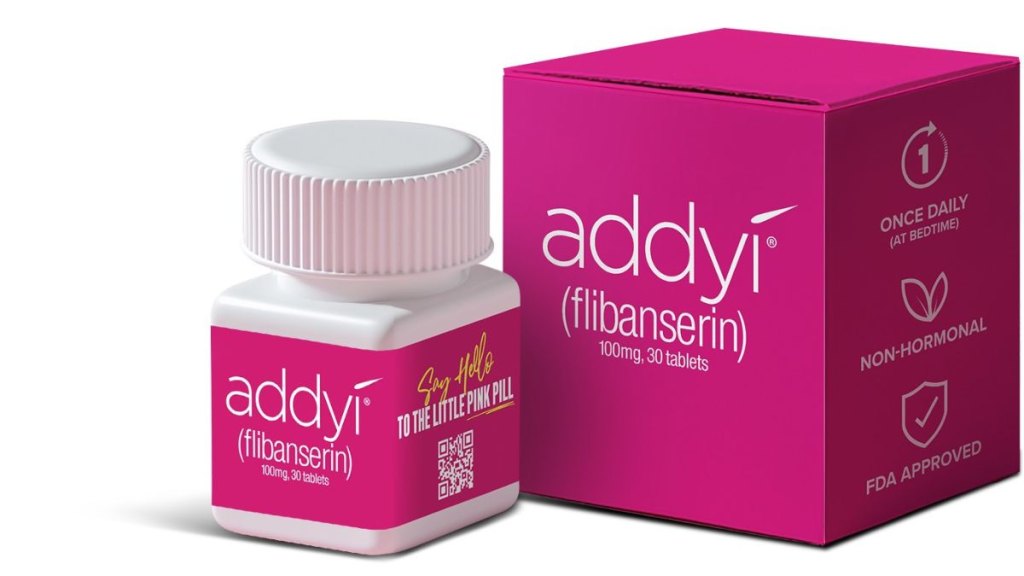
What is it? Addyi (flibanserin) is a prescription drug approved to treat acquired, generalized HSDD in women younger than 65. It is not approved simply to enhance sexual performance.
How is it taken? Women take one 100-mg tablet at bedtime each day.
Is it “female Viagra”? No. Erectile-dysfunction drugs act
6 libido myths—busted
Myth: “Losing desire is just part of menopause.”
Cindy says: “No.” Menopause can affect sexual function in multiple ways, but persistent low desire that is distressing shouldn’t be dismissed.
Myth: “If I don’t want sex, something must be wrong with my relationship.”
HSDD, by definition, is diagnosed only when low desire isn’t better explained by relationship problems.
Myth: “Women don’t desire sex.”
“We’ve told men it’s important to them, not women,” she says. Desire varies per person. Women can experience spontaneous desire too.
Myth: “Once desire disappears, it probably isn’t coming back.”
“Absolutely not,” says Cindy. Medical issues, medications, menopause-related changes, relationship factors and HSDD can all affect desire, so identifying the cause matters.
Myth: “Sex shouldn’t matter after 50.”
“The standard shouldn’t be how much you want sex,” Cindy says. “The standard is if you miss a part of yourself.”
Myth: “I have to take hormones to boost my desire.”
Addyi is nonhormonal. It works on brain chemistry and will not affect your sex hormones.
A version of this article originally appeared in the November 9, 2026 print issue of Woman’s World.
Ready for more? Subscribe to our YouTube channel for video podcasts, health tips and uplifting stories designed for women 40, 50, 60 and beyond.
You deserve desire
HSDD is a recognized condition, and most women who have it have never been told. If what you've read here sounds familiar, answering a few questions can tell you whether this might be what you're dealing with. Start the 60-second assessment