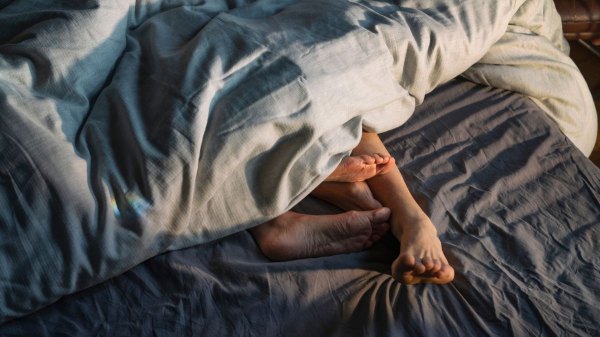
Why You Have Sore Knees in the Morning and the 5-Minute Fix That Loosens Stiffness Fast
Discover the simple stretches that soothe that rusty-hinge feeling when you wake up

You swing your legs out of bed in the morning, and your knees protest like rusty hinges. Those first few steps feel sore, stiff and maybe a little crunchy. By the time you reach the kitchen, things loosen up—but for a few minutes, you wonder what happened overnight. If this sounds familiar, you’re far from alone. What your knees do in those first waking minutes can tell you a lot about your joint health, hydration, activity levels and even your sleep habits. Keep reading as a leading physical therapist shares a few simple ways to soothe sore knees in the morning and get your day off to a great start.
What really happens to your knees while you sleep
Simply put, your joints don’t like being still for eight hours, reveals physical therapist Jonathan Su DPT, C-IAYT, CSCS, author of 6-Minute Knee Pain Cure. In fact, prolonged immobility—like sleep—causes joints to stiffen. Once you start your day and begin moving, they loosen up again.
The top culprit? Sluggish synovial fluid, your body’s natural joint lubricant. “When joints move, this fluid circulates and keeps everything gliding smoothly,” he explains. “But when we sleep for six, seven or eight hours, circulation slows and the synovial fluid turns more gel-like, creating that stiff, resistant feeling when you first bend your knee.”
He adds that this happens after any extended period of sitting—a long flight, a desk-bound workday—but because sleep is the longest stretch most people go without being physically active, mornings hit hardest.

What causes knee pain in the morning?
Morning knee discomfort doesn’t affect everyone equally. Several factors influence how creaky you feel when the alarm goes off. Here, Su shares a few common underlying reasons you may be waking up with knee pain:
Age and hormones
“For women over 50, decreased estrogen levels affect the entire musculoskeletal system, increasing osteoporosis risk and decreasing muscle mass,” he says, adding that less muscle means less support for your knee joints. (Check out a few easy ways to boost joint health and strengthen muscles.) The result: Knees that feel painful and stiff in the morning.
Your sleep position
Sleeping with the knees bent increases the pressure on the knee joint—more specifically, the patella femoral joint—which is the joint behind the kneecap, explains Su. “When we straighten our legs in the morning, we feel the cumulative effects of this pressure, and that’s why we feel stiff.”
“If I’m sitting for a while, I like to straighten one leg out for a bit, then switch to the other side,” he continues, explaining that the same idea applies when you’re sleeping. Also smart: “A lot of people are side sleepers, and it can help to put a pillow under the knee of your top leg to keep things more aligned” and potentially reduce pain.
Extra weight
You’ve heard it before, but it bears repeating: Every extra pound translates to additional stress on your knees with each step. The encouraging news? Losing just three to five percent of your body weight can produce noticeable improvement, promises Su. “Imagine what a five or 10-pound weight would feel like on your back all day—losing just that much takes the stress off your knee joints.”
High blood sugar
If unchecked, diabetes can damage blood vessels, which means less blood flow reaches your joints to help them repair and heal, explains Su. The operative words here are “if unchecked,” so as long as you’re taking care of your diabetes, your knees (and entire body) will thank you.
Dehydration
When your body lacks fluid, muscles can spasm, there’s less synovial fluid lubricating joints and blood flow decreases, leading to joint pain and sore knees in the morning. This is especially important as we get older, says Su. “Those thirst signals don’t work as well, so we may be dehydrated without knowing it.” To keep our joints “well-oiled,” he recommends drinking about two to three liters of water a day.
3 simple stretches that soothe sore knees in the morning
The “Three Musketeer” muscle groups that support the knees? Quadriceps, hamstrings and calves, notes Su. “The quads and hamstrings are big muscle groups that cross the knee joint, keeping them flexible, while the calf muscles help stabilize and cushion the knees.” Here, he shares a few easy stretches to help you kick morning knee soreness to the curb in the long term.
Quad stretch
Stand near a wall for balance, then bend one knee and bring your heel toward your buttocks, grasping your ankle with your hand. Gently pull until you feel a stretch along the front of your thigh. Hold 30 to 90 seconds, then switch sides and repeat.
Seated hamstring stretch
Sit in a chair and extend one leg forward. Hinge forward at your hips while trying to bring your chest towards your thigh or knee (without rounding your back). “Keeping the knee straight while hinging at the hips is what makes the stretch effective,” says Su. “The hinge is important because sometimes people will try to round the spine, which makes the stretch less effective and puts them at risk for injuring their back.” Hold 30 to 90 seconds; repeat once or twice.
Standing calf stretch
Position yourself in a lunge stance with your hands against a wall. Stretch your back leg, keeping the heel pressed to the floor. Hold for 30 to 90 seconds; repeat once or twice.

When to see a doctor for sore knees
Most morning knee stiffness due to lack of movement overnight is manageable, but certain signs warrant medical attention, says Su:
- Sharp pain during rest or with movement that doesn’t seem to get better
- A knee that gives way or buckles unexpectedly
- A knee that locks (you temporarily can’t bend or straighten it)

“These could indicate structural damage that your doctor needs to evaluate,” he cautions, adding that if your knee is swollen and warm to the touch, that could also indicate an infection which needs immediate attention.
The bottom line on sore ‘morning knees’
Those creaky mornings don’t have to be your reality. A few simple stretches, better hydration and smarter sleep positioning can transform how your knees feel—starting as soon as tomorrow.
Ready for more inspiration? Subscribe to our YouTube channel for video podcasts, health tips and uplifting stories designed for women 40, 50, 60 and beyond
Conversation
All comments are subject to our Community Guidelines. Woman's World does not endorse the opinions and views shared by our readers in our comment sections. Our comments section is a place where readers can engage in healthy, productive, lively, and respectful discussions. Offensive language, hate speech, personal attacks, and/or defamatory statements are not permitted. Advertising or spam is also prohibited.