Andrew Huberman’s Two Simple Sleep Tricks Help Women Over 50 Doze off in Minutes
See the methods you can try at home (for free!) starting tonight

Key Takeaways
- Andrew Huberman recommends slow eye movements as a way to relax when you wake at night.
- A warm shower or bath before bed may help your body cool down and promote sleep.
- Neither technique is a guaranteed cure for insomnia or underlying sleep disorders.
If you’ve been staring at the ceiling at 3 a.m. again wondering why sleep keeps slipping away, you’re in very good company. Stanford neuroscientist Andrew Huberman, PhD, has two simple sleep tricks that could change your nights. Both are free, take only minutes and are grounded in real science.
Huberman, who has published more than 75 peer-reviewed research papers and hosts one of the country’s most popular health podcasts, shares them in his new book Protocols: An Operating Manual for the Human Body. Here’s how to put them to work tonight.
Andrew Huberman’s 30-second trick for 3 a.m. wake-ups
This is the one Huberman shared on The Diary of a CEO podcast, and it’s made for those maddening moments when your body is exhausted but your mind won’t stop spinning. Woman’s World writer Allison Nemetz tried it after a decade of menopause-related insomnia and was stunned that it helped her snooze until morning.
The best part? You do it all with your eyes closed, without even lifting your head from the pillow:
- Step 1: Close your eyes and, under your eyelids, move them slowly to one side, then the other, then up, then down.
- Step 2: Make a counterclockwise circle with your eyes, then a clockwise circle.
- Step 3: Point your eyes toward your nose and let out a long exhale. Repeat two to three times.
Why does something so small work? “To fall asleep or to fall back asleep, you need to stop thinking about your body position,” Huberman explains. The eye movements quiet what he calls the “proprioceptive circuits” in the cerebellum, the brain’s internal GPS that tracks where your arms and legs are in space. Hush those signals, and sleep can slip back in.
He’s the first to admit it sounds a little unusual. “But it works well for many people, and studies are indirectly starting to suggest why,” he writes in Protocols. He notes that new eye-mask and rocking-bed technologies trigger the same eye movement pattern, and he’s fallen asleep using them “in less than two minutes.”

Why sleep experts say it’s worth a try
The doctors we spoke with agree there’s real reason to be hopeful. “It’s free, low effort, carries essentially no risk and has solid reasons it could help,” says Shelby Harris, PsyD, a board-certified sleep expert with BetterSleep.com. “The eye movements give your brain something simple and repetitive to focus on, and the exhale helps shift your body into a calmer state. It’s gentle, doesn’t require getting out of bed and it’s easy to do in the dark.”
Shantan Ravula, MD, head of clinical outcome for SOMOS Health, sees it the same way. “It hands a busy brain one simple, repetitive thing to focus on, and that pulls you out of the anxious ‘why am I awake again’ loop that keeps so many people up.” That final exhale matters too, he adds: “It switches on the body’s calming parasympathetic system, and you get a real relaxation response. So yes, it likely works, and works well.”
Women over 50 are especially good candidates for this sleep hack from Huberman. “Sleep naturally becomes more fragmented with age, with less time in deep sleep and more time in the lighter stages where it’s easy to wake up,” Harris says. Hormonal shifts only add to the challenge.
Andrew Huberman’s shower trick for falling asleep faster
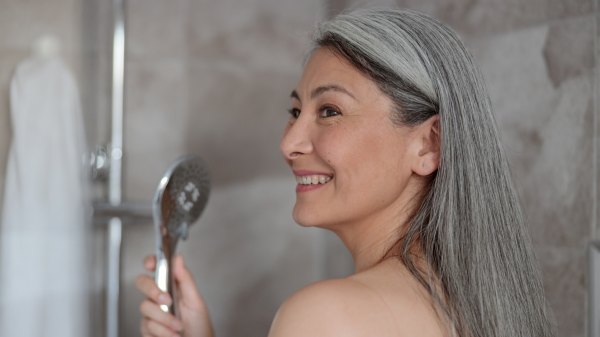
Huberman’s second protocol for sound sleep tackles the other half of the puzzle: drifting off in the first place. The key, he explains in his book, is lowering your core body temperature, because the sleep hormone melatonin releases in sync with that nightly drop. His surprising move? Warm yourself up first by taking a hot shower or bath 30 to 60 minutes before bed.
The heat “can help induce drowsiness by warming hands and feet and by triggering a drop in core body temperature in compensation for this heating,” Huberman explains. In other words, your body responds to the warmth by dumping heat, and that cooldown is what cues sleep.
The best news? It still works even if you’re battling night sweats. “This approach is still effective for perimenopausal and postmenopausal women,” says Allie Buttarazzi, MD, an internal and lifestyle medicine physician and founder of AllieMD Coaching. “A hot shower or bath induces vasodilation (widening of blood vessels), which allows the body to release heat and subsequently lower your core body temperature.”

A reminder before you try Andrew Huberman’s sleep tricks tonight

Neither remedy is a cure-all. “It won’t work for everyone, and it won’t fix a genuine sleep disorder,” Dr. Ravula cautions of the eye exercise. “But as a way to quiet your head at 3 a.m., it’s a good one.”
Pair a warm shower before bed with the eye stretch if you wake in the night, and you’ve got a two-part sleep plan that costs nothing—and just might get you back to sweet dreams faster than you’d expect.
Ready for more inspiration? Subscribe to our YouTube channel for video podcasts, health tips and uplifting stories designed for women 40, 50, 60 and beyond.
Conversation
All comments are subject to our Community Guidelines. Woman's World does not endorse the opinions and views shared by our readers in our comment sections. Our comments section is a place where readers can engage in healthy, productive, lively, and respectful discussions. Offensive language, hate speech, personal attacks, and/or defamatory statements are not permitted. Advertising or spam is also prohibited.