The Classroom Where Children Learn to Think Like Founders

Entrepreneurship has often been associated with adulthood, business plans and startup culture. Suzanne Appel believes that view overlooks one of its greatest strengths. In her eyes, entrepreneurship is first and foremost a way of thinking, and the earlier children develop that mindset, the better prepared they could be for a future that artificial intelligence is rapidly reshaping.
As founder of Young CEO Squad, Appel has built classroom programs that are designed to teach elementary and middle school students how they can launch real businesses. She sees her work as practical support for schools already navigating unprecedented technological change.
“Schools are genuinely trying to adapt to the new environment of AI. They’re like a large ship, and they can’t turn this fast. A company like mine can provide supplementary courses that schools can easily bring into the classroom,” she says.
Parents, she argues, are asking a question with no definitive answer: How can children prepare for careers that may not even exist yet?
“AI is going to tell people information, but students still need to ask, ‘Is this factual? Is this true? Is this what I want to say?’ Those critical thinking skills and judgement are going to matter more than ever,” Appel explains. Her response acknowledges the dynamic nature of technology, yet she points out that qualities such as resilience, adaptability, critical thinking and problem-solving will remain valuable regardless of how the world changes.
Real-World Classroom Experience
Young CEO Squad turns those ideas into classroom experiences. Students do not spend weeks studying entrepreneurship through theory before acting. They begin building businesses almost immediately. Elementary students create customized keychains, consult with customers, calculate pricing, manage expenses and record profits. Every sale, Appel notes, becomes an opportunity to practice communication, decision-making and financial literacy within a supportive environment.
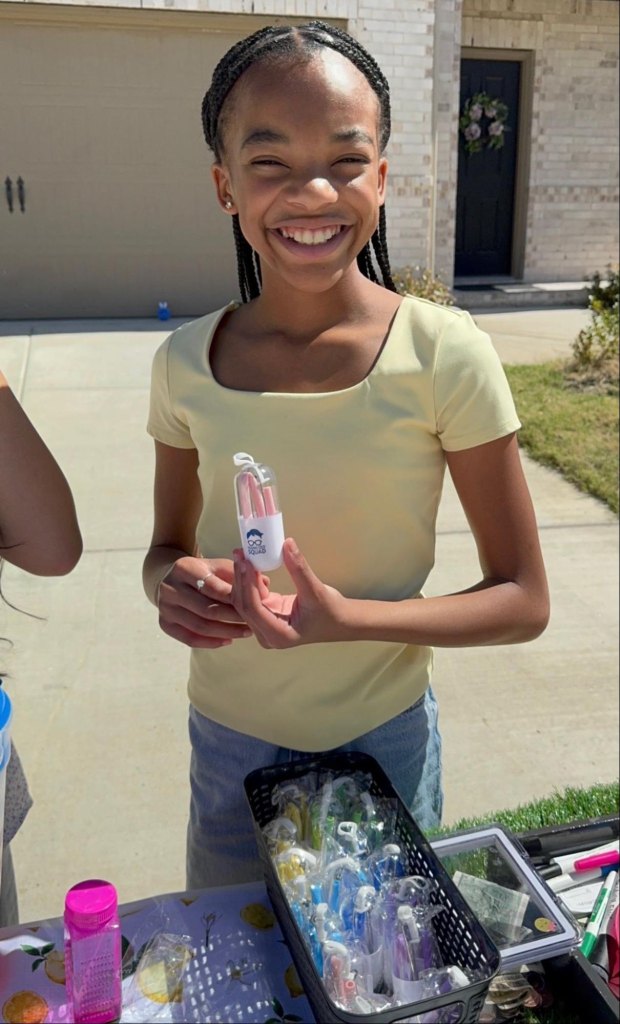
Appel recalls: “A student’s parent once told me, ‘What surprised me most was watching my daughter decide to reinvest in her business by using some of the earnings instead of spending it all. Seeing her think about money as something she could grow at her age is something I’m truly grateful for.’ ”
Ownership, Appel believes, changes how children see themselves.
“The effect happens immediately when they realize they’re practicing real-world skills instead of completing another worksheet. They have ownership over a business and their own decisions while the stakes are still low. That’s where confidence starts,” she explains.
Appel notes that mistakes are welcomed with grace inside the classroom. There, students can test ideas, refine products and interact with customers while teachers provide encouragement instead of judgement.
Empowering Teachers and Schools
Equally important is the program’s accessibility for educators. Appel notes that every ‘Workshop in a Box’ arrives ready for immediate use, eliminating the need for extensive lesson planning or entrepreneurial expertise. Teachers can simply distribute the materials, which include the curriculum guidebook and products to sell. She highlights that the experience was intentionally designed around the realities busy teachers face every day.
“Teachers don’t need more work,” she says. “They can open the box, hand everything out and the students begin learning.”
According to her, many schools reinvest the proceeds into classroom projects, purchasing equipment such as 3D printers or funding future entrepreneurial activities, allowing students to witness how their own efforts create lasting value for their communities.
Scaling the Learning Journey
The learning journey also grows alongside students. Programs for grades three through five focus on confidence and introductory business ownership. Middle school students progress into marketing psychology, consumer behavior, branding, teamwork and assembly-line production while operating increasingly sophisticated ventures. High school programs, currently being introduced, will expand into artificial intelligence, consulting, and business optimization, preparing students to solve practical challenges facing local businesses.
Appel’s long-term vision reaches well past middle school. Young CEO Squad will be launching AI entrepreneurship for high school students. She says, “Students should learn to think about what repetitive processes they can optimize instead of seeing AI as something that simply writes answers.” She envisions mentorships and internships where students can help peer businesses integrate AI into everyday operations, creating graduates who arrive in the workforce ready to contribute immediately.
According to her, regardless of the path students take, entrepreneurial thinking can still encourage initiative, resourcefulness, and curiosity inside every profession.
She often credits her daughter for inspiring the Young CEO Squad, watching firsthand how entrepreneurial experiences strengthened confidence at an early age. Appel reflects, “I started this business because I was inspired by my daughter Marlee, who was hosting live sales online and making thousands of dollars. I realized that kind of brilliance doesn’t show up on a report card. I wanted that experience for every kid.” That personal lesson has since evolved into programs now reaching a myriad of classrooms, each giving children an opportunity to discover exceptional abilities.
Preparing for an AI-Driven Future
Artificial intelligence will continue transforming classrooms and workplaces in ways few can fully predict. Appel believes education does not need to compete with that change. It needs practical opportunities that help students question information, recognize opportunity and adapt with confidence. Entrepreneurial education, she argues, offers exactly that foundation.
Skills developed in elementary school may ultimately become one of the greatest advantages children carry into whatever future awaits them.


