Listening to the Body: How Acupuncturist Karly Bannister Bridges Somatic Healing and Emotional Well-Being

For many people, the body often whispers what the mind isn’t ready to admit. A stomach ache here, tight shoulders there, nagging symptoms one writes off as “just stress.” But for Karly Bannister, founder of Keahi Health and a seasoned acupuncturist with a trauma-informed lens, these physical signals are anything but minor. They are the body’s way of speaking, and it’s time individuals start listening.
“People come in with headaches, digestive issues, or chronic muscle tension,” says Bannister. “And more often than not, these symptoms are the body holding on to stress, whether from the past or the present. What we’ve normalized as everyday discomfort is often emotional pain stored in the body.”
With over 15 years of clinical experience, Bannister has cultivated a powerful intersection between acupuncture and somatic healing. Her mission: to help people reconnect to themselves, body, mind, and spirit, by addressing not just symptoms, but the emotional and physiological roots underneath.
In the modern world, ‘stress’ has become a throwaway line, used to minimize rather than investigate discomfort. Bannister pushes back against that mindset. “Stress changes our biology. It rewires our brains, changes our DNA expression, and alters us at the cellular level,” she explains. “When a patient tells me, ‘I think it’s just stress,’ my response is: Yes, and that itself is a significant problem, but there is something we can do about it.”
Through years of practice, Bannister has identified consistent patterns between emotional trauma and physical symptoms. While digestive issues often point to unresolved trauma from a patient’s family of origin, chronic headaches and migraines may tend to track with current, daily stressors, as per Bannister. And persistent neck and shoulder tension? “That’s the armor,” she says. “That’s how we hold the weight of the world.”
This is where acupuncture enters not as a cure-all, but as a bridge. According to Bannister, acupuncture works by stimulating the body’s bioelectricity: a concept both ancient in Chinese medicine and now may be supported by modern science. The body is conductive. So are the needles. And the points she targets are areas of least resistance where the body’s electrical signals can flow freely again.
“Some of the most effective points are as simple as one on the top of the head or between the eyebrows,” she says. “These points increase blood flow to the prefrontal cortex, our thinking brain, and help regulate the vagus nerve, which governs our fight-or-flight response.”
In Bannister’s words, acupuncture doesn’t just relax the muscles. It gently overrides the limbic system, the primal brain, and allows patients to access their higher selves again. “You can’t think your way out of trauma,” she explains. “But you can access the parts of the brain that help you regulate emotion and feel safe again.”
Bannister wants people to know that acupuncture doesn’t have to be intimidating. “You don’t need to undress or even lie down. I can treat someone in a chair, or even standing up, with just a few needles,” she says. “It’s about doing what and how much the body needs.”
Her treatments are known for their customizability. For new or anxious patients, Bannister starts small. “One needle on the outside of the ear might be all we need to start regulating the nervous system,” she shares.
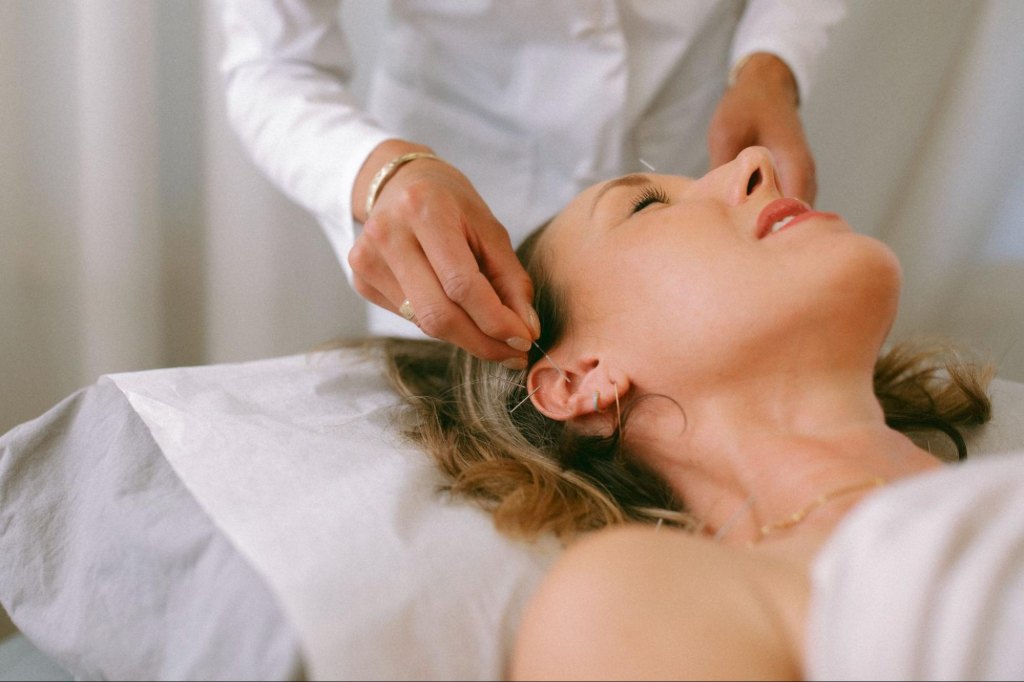
She also uses what she calls to-go needles: tiny Japanese ear needles placed on specific vagus nerve points, designed to prolong the calming effects of treatment after the session ends. These techniques are so effective that they’ve been adopted by the U.S. Army to help treat trauma and pain in high-stress environments.
Bannister sees a growing number of high-performing professionals in her clinic: athletes, entrepreneurs, and corporate leaders running on empty. “They’re often so used to pushing through that they don’t even realize how disconnected they are from their bodies,” she says. “The first time they feel truly relaxed, it can be shocking.”
In a world of endless hustle and constant stimulation, acupuncture offers something rare: an invitation to pause. “This is about the balance of performance and peace,” she adds. “You don’t have to burn out to be successful. In fact, success is more sustainable when your nervous system is regulated.”
Beyond acupuncture, Bannister supports her patients with herbal remedies known to help reduce stress and improve mood. Herbs like white peony, peppermint, licorice, and ginger, many of which may have been shown to support liver function, are carefully selected for their ability to calm the nervous system and support digestion, hormones, and emotional balance. “It’s about giving people resources they can take home, may it be herbs, ear seeds, or even simple lifestyle shifts,” she says. “In the end, my aim is to empower them so that they continue to feel better after they leave my practice.”
For Bannister, somatic work isn’t a buzzword; it’s been the cornerstone of her practice long before it became a trend. She gently coaches patients on how to tune into their bodily sensations as messages rather than inconveniences. “Your body is always talking to you,” she says. “Acupuncture helps you understand the language so that you can take conscious action.”
Her core message is one of hope and empowerment: “There is a way to manage stress. And it starts by getting to know yourself through your body. Acupuncture is one of the best starting points I know.” In a culture that tells humans to toughen up, Karly Bannister reminds individuals instead to soften, to listen, and to heal, not by running faster, but by finally slowing down.
This article is for informational purposes only and does not substitute for professional medical advice. If you are seeking medical advice, diagnosis or treatment, please consult a medical professional or healthcare provider.
Woman's World partners with external contributors. All contributor content is reviewed by the Woman's World editorial staff.


