Harris Faulkner on Patriotism, Family and Life Lessons from Her Military Father (EXCLUSIVE)
Award-winning journalist Harris Faulkner reflects on her military upbringing and father’s influence

As a bestselling author, award-winning journalist, the only Black woman to helm back-to-back programs on cable news and mom of two daughters, Harris Faulkner is making waves in the political industry. She anchors her solo hour of news on The Faulkner Focus at 11 a.m./ET, continues reporting live on Outnumbered at 12 p.m./ET, and will play a role in Fox News’ election night coverage on November 5th.
Harris Faulkner on the lessons she learned from growing up in a military family
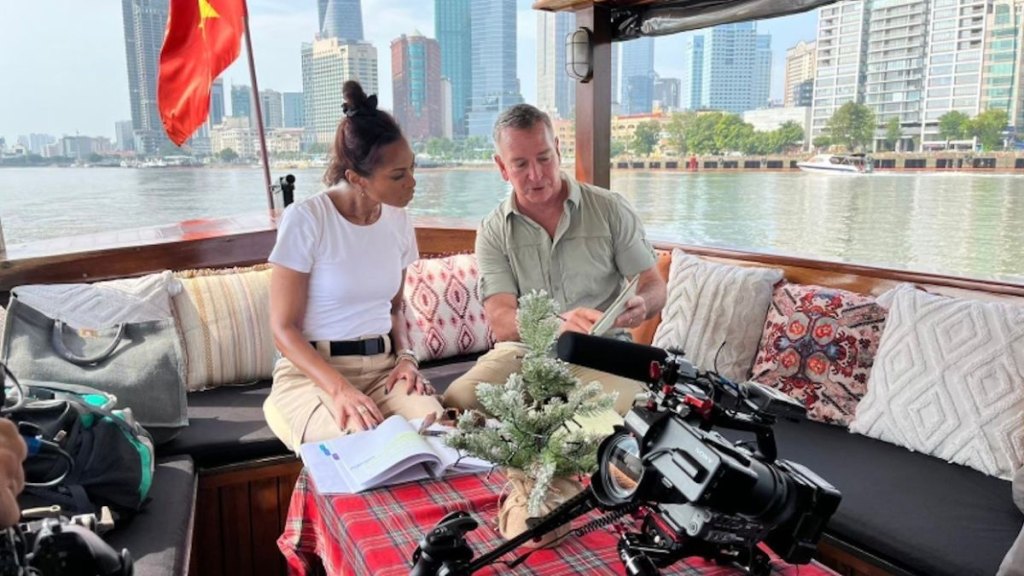
Growing up as a “military brat” came with its fair share of challenges, but Faulkner looks back on her childhood with fondness as she often recounts the incredible lessons her father, Lt. Col. Bobby Harris, taught her. To honor him, she also created a special, Vietnam: Footsteps of My Father, where she retraces his footsteps through Vietnam when he served two tours of duty as an Army Combat pilot during the war.
Her special, which is available for streaming is on YouTube TV, details her journey with military historian Brian DeToy, a retired US Army officer and former Director of the Defense & Strategic Studies program at West Point, to many iconic locations that are embedded in the history of the Vietnam War—like Red Beach in Da Nang where hundreds of U.S. Marines landed in 1965, the former Vung Tau Air Base on the Southern coast of Vietnam along the South China Sea and the Saigon rooftop where the last Americans were evacuated nearly 50 years ago.
Harris Faulkner gears up to cover the 2024 election
Along with her usual roles at Fox, she also hosted the recent all-women town hall, where she simply felt grateful for the opportunity to be part of the experience. “I’m excited that women are part of the conversation,” she said of the town hall. “Women are the largest group of registered and active voters in America, and we haven’t even voted the entire length of time we’ve been a nation. Issues which are important to them represent so much about who we are as Americans, and can bring us together.”
In this exclusive Q&A with Woman’s World, Harris shares what she learned from her father throughout her years as a “military brat,” her passion for remembering the sacrifice of those who have served and what we can start doing today to invest in future generations.
Woman’s World: We’d love to hear from you about your father, and your special “Vietnam: Footsteps of My Father.” What are some of the lessons you learned from your parents growing up as a “military brat”?

Harris Faulkner: Growing up in a military household, my father was the one in uniform, but my father saluted my mother’s casket a few years ago, and he said, “I salute the greatest civilian warrior I’ve ever known.” My parents were both strong in their own right and from the military side, I learned the power of respect, respect for others, respect for authority and respect for self.
I learned all of it at different times in my life, but all of it was so critical. You treat human beings as if you’re going to know them for the rest of time. When they’ve been wronged, if you think you can advocate for them, do it. When they’ve been lied to, and you want to make sure they know the truth, chase the truth and tell it as often as you can. Go forward knowing who you are and whose you are. I am Harris Kimberly Faulkner, mom of two, married 21 years to Tony. I belong to God, I belong to my parents, and now I’m accountable to my family, Tony, Bella and Danika.
I’m really proud of the lessons that I learned from a military perspective, the idea of: “Die trying to finish what you started.”
And my mom went on to be a social worker when I was growing up in junior high and high school. She was such a great diplomat. She didn’t like to see people argue. She was always trying to find ways to moderate every discussion. She wanted to make sure that everybody felt like their voice was heard.
Today, I make sure to tell the truth and do all those things that my father fought for the right to do in this country—to believe what you believe, to vote and do those things that are patriotic actions. My mom taught me to listen to everybody. Make sure you’re hearing it all. They both taught me concepts of leadership, love, respect and fairness—and all of that informs me every day with what I do in front of millions of people.
WW: Do you feel that learning about the iconic locations in the special and highlighting what happened there helps to stir patriotism and help viewers realize the magnitude of what was sacrificed to get America where it is today?
HF: Yes to all of it. We have tremendous capacity for love, and we have tremendous responsibility when our friends and allies need our help. We don’t win every battle, but we gotta try.
We were divided when my father went to serve in the late 50s—he joined the military in the very last year of college—and then went on to fight in Vietnam. We were a nation that was raw and struggling with civil rights. But when questioned by relatives in our family, my father would always say, “Ours is the nation with the greatest potential, and we are struggling right now, but we will get beyond this. This too shall pass, and we are the ones who can do the most for the rest of the world just by being a beacon of light. So it is my honor to go serve this country. It will move forward, and we will still remain the greatest.”
So, that’s the heart of patriotism—believing that while things are imperfect, you still go forth and you love this country. That kind of example taught me about the sacrifice of war when it looks unwinnable.

I met veterans that, if it were not for my father’s footsteps, I would never have met. I sat down and read with a former member of the United States fighting forces and a former member of the Viet Cong. They are friends with a common mission of treating people on both sides of the war who suffered from Agent Orange being deployed during the war as a weapon. We had military who suffered from that. They had military who suffered and died from the use of Agent Orange. So now, those two men have come together around that common cause and the idea that two mortal enemies can, with the passage of time and the grace of God, learn respect for living that they both cherish and come together.
They didn’t just sit down and become friends, right? This is our decades of figuring out how can we both be useful and let it feather out from there, spread to others and their constellations of influence, their friends, their families.
From everything that I know about that war, my dad was right. There’s so much potential in who we are as Americans now. We are strong. We can go back and lift up whatever we choose to, and that’s amazing.
WW: Do you feel like the opportunity to make this special kind of just brings your book to life? What was that experience like making this project?
HF: I learned so much about it, but I also learned just how cruel the war was. I mean, our men were so brave to go down into these tunnels. I got down into one of these tunnels. I’m very claustrophobic, and I tell the audience this on camera. It’s just raw, and I’m getting into the ground, and I realize while on camera that I may not be able to do this. There were even food shortages, so they lived down there for some period of time without sustenance. There were women on their side of the war, who were having babies down there. There’s very little oxygen and it’s very hot. I’m getting down there, and I’m realizing there is a price to pay to fight. When you fight for America, you believe in what she is fighting for because you’ve been tasked as a soldier. You don’t have a political game. You’re on order, and you go in. We owe them a huge debt. I just thank them for believing in our nation to go so far and sacrifice so much.
WW: What inspired you to write “9 Rules of Engagement: A Military Brat’s Guide to Life and Success“? What do you hope readers get out of reading it?
HF: I’m often asked to give high school commencements, talk with people in college or do things with younger generations. I’ll usually speak for a bit, but then it’ll be open for questions, and that’s my favorite thing. I’m a mom right now of two teenagers, 16 and 17, both in high school, and when the questions come, I’m always asked: What is the best advice you’ve ever been given?
So I wrote this book. It’s not just advice that I was given, it’s advice that I lived. It’s things my dad and my mom would say. Things like—think like a general and understand the role of every person in your life. They’re your special forces, so there’s a chapter about choosing your special forces.
Remember that you have to play every role too. That’s the best general. When the war is intense, the general goes to the front line. Know the role that you can play for your special forces to lift them up. That’s what’s in the book, and I’m glad to share that with people.
WW: You also wrote “Faith Still Moves Mountains: Miraculous Stories of the Healing Power of Prayer,” how does your faith play a role in what you’re doing now?
HF: Oh, it’s everything. Yeah, there were a lot of moments when what I cover in the news is really hard. And here lately, I started to wonder, after the hurricanes had hit, there was so many people who are left suffering.
When difficult times come, I think sometimes we forget that that happens not on our schedule. But my faith is always restored in people when I’m able to see them in different ways. As a journalist, I’ve seen people at their best and worst, and by writing Faith Still Moves Mountains, I realized how important it is to just find your purpose. Find your personal divine assignment. We’re not accidents.
My divine assignment is to be a witness, which also requires that I tell the truth. It’s hard because sometimes it’s difficult to witness what I do without balancing that with sharing with people that miracles happen every day. There will always be miracles that come forward.
In the book, I wrote about 19 miraculous stories that happened to other people. One is about a woman whose town in Lee County, Alabama, a couple of years back, was hit by a vicious line of twisters. It indiscriminately took out entire streets of houses. She had a prayer closet in her house, and when the emergency medical technicians found her, the first responders, they could hear someone screaming, “Thank you, Lord, thank you for bringing me through the storm!” Her house crumbled around her. The foundation was gone. She had a broken hip, but she said that praying in that prayer closet every day saved her life.
We don’t always know the meaning or the ‘why’ of things when they happen, but I loved what she taught us all that day. You pray before the storm, you pray during the storm, and you pray in gratitude after the storm.
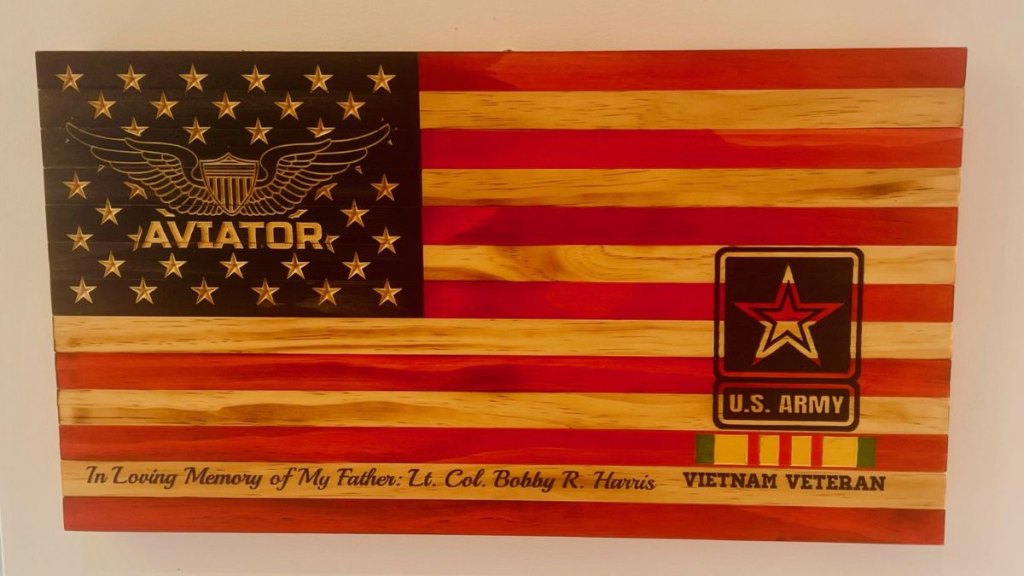
I keep a piece of hand-carved wood that’s the American flag, and it says, “In loving memory of my father, Lieutenant Colonel Bobby R Harris, Vietnam veteran.” Someone sent it to me to honor my father, and it reminds me of Matthew 17:20, which is where the title of the book came from: “Truly I tell you, if you have faith as small as a mustard seed, you can say to this mountain, ‘Move from here to there,’ and it will move. Nothing will be impossible for you.”
WW: Most of our readers are mothers, how do you juggle being a mom on top of everything else you do? What is something you’d like to say to encourage working mothers?
HF: It is hard to always find the time, but we must listen to our children and make eye contact as often as possible. We must make the effort to show them how much they matter, and this is whether we are loving on them or we are disciplining them.
You know, our children are in a space with technology, and we must compete with their time and attention. And one thing I tell my daughters—one is a sophomore and one is a senior in high school now—is “I don’t want to see the top of your head right now. I need for you to look up!”
I want them to give me some delicious details. We must listen to them and let them finish their sentences before we lean in and try to fix anything. My big thing to remind every mom is: The greatest gift we can give our children is sustainability, and the biggest lessons I learn are when I pray.

My mother taught me that, and so we must give them sustainability. You have the answer inside of you.

It’s important that they feel heard at home for as long as we can keep their attention. Now, when they become teenagers and early adulthood, they will have an entire world pushing and pressing and pulling on them in different ways, but home should feel like the place where you come at the end of the day and feel seen.
Keep up with Harris Faulkner on Instagram and stream Vietnam: Footsteps of My Father now on YouTube TV.
Conversation
All comments are subject to our Community Guidelines. Woman's World does not endorse the opinions and views shared by our readers in our comment sections. Our comments section is a place where readers can engage in healthy, productive, lively, and respectful discussions. Offensive language, hate speech, personal attacks, and/or defamatory statements are not permitted. Advertising or spam is also prohibited.