The Lost Version of the ‘Star Trek: Generations’ Movie: The Kirk-Picard Adventure Fans Never Got to See
Before the final version, there was a very different plan for the two captains of the starship Enterprise

There are actually two versions of Star Trek: Generations—the one that reached theaters on November 11, 1994, and another incarnation—dubbed the lost Star Trek: Generations movie—that audiences never saw. Both were conceived around the same irresistible idea: bringing together Patrick Stewart’s Jean-Luc Picard and William Shatner’s James T. Kirk, two Starfleet captains separated by nearly a century in time, for a shared adventure on the big screen. But long before the final script was locked and cameras rolled, an early draft by The Next Generation veteran Maurice Hurley charted a markedly different course for how that historic meeting would unfold. What ultimately arrived in theaters was the product of rewrites, test screenings and recalibrations, while the version that might have been promised a very different first cinematic voyage for the Enterprise-D crew.
Having inherited Gene Roddenberry’s stewardship of the franchise, executive producer Rick Berman had spent seven years guiding The Next Generation through its growth, controversies and creative evolutions. Like Roddenberry before him, he had accumulated both loyal allies and determined critics along the way. Auteur theory aside, Generations was now seen as his film, and whatever happened next—commercially or creatively—would land squarely at his feet.
RICK BERMAN (producer, Star Trek: Generations): “When I was first asked to do this, I was not asked to do anything with the original series characters. Paramount wanted a Next Generation movie. I went to them and said, ‘I would like to integrate the characters from the original series, do you have any problem with it?’ Sherry Lansing and John Goldwyn, the people I was dealing with in the motion picture division, said, ‘Great. Contact Bill Shatner and Leonard Nimoy and see if they have a problem with it,’ and they did not. The plan was I would write two stories with two separate writers and that I would be involved with selecting which one was the best. One writer for the film was [former TNG co-executive producer] Maurice Hurley, who worked with us before, and the other was the team of [then current TNG writers] Brannon Braga and Ron Moore.”
RONALD D. MOORE (writer, Star Trek: Generations): “We thought we were being fired. Rick said he wanted to meet with us and didn’t tell us the reason. Brannon was sure the series was being cancelled. We finally got over to Rick’s office and we were both pale and he said, ‘I’ve just completed two months of negotiations with the studio and I’ve been asked to produce the next two Star Trek movies. I want you boys to write one of them.’ We just sort of stared at him, dumbstruck. It was completely out of left field. He said there’s a possibility the original cast might be involved. He told us not to say anything to anyone until it was official. We walked out of his office, going, ‘I can’t believe this.’ We flipped out.”
MICHAEL PILLER (executive producer, Star Trek: The Next Generation): “I rejected an opportunity to write a script for the seventh Star Trek film—the first one to star The Next Generation cast. Rick had been hired to produce the movie, his first. The studio wanted to prepare two separate scripts. The best script would be filmed. From the studio’s point of view, it made perfect business sense. Rick was a first-time feature producer. This was the studio’s most lucrative franchise—why take a chance on one writer; why not have two scripts written and pick the best one? But from a writer’s standpoint, there’s something deeply discouraging about knowing that you’re writing against someone and that one of you is wasting his or her time. Having guided the stories and the scripts for The Next Generation for five years, I found it very difficult to participate in a contest and turned the offer down.”
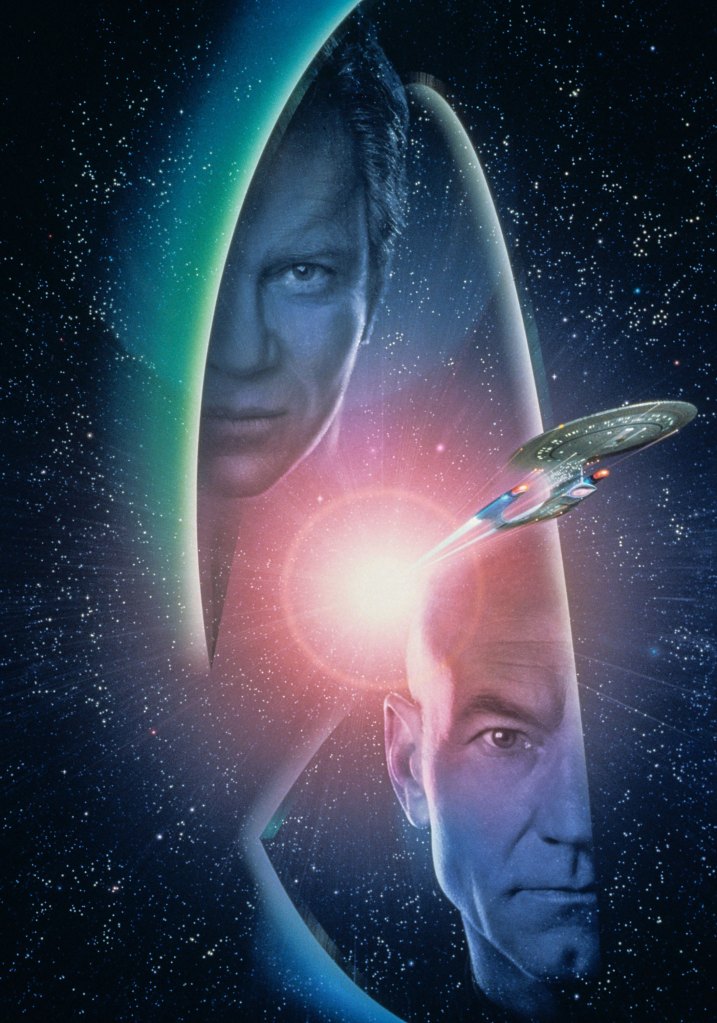
BRANNON BRAGA (writer, Star Trek: Generations): “Rick eventually would ask us to write the first movie, although there were some complications there—we weren’t his first choice. Paramount had a process where they wanted two scripts developed simultaneously so that they could pick the better one. Maurice Hurley was chosen for the other one, and to my recollection, Piller really chafed at this. He said, “I’m either writing the script or I’m not.” So, Rick went to Ron and I and said, ‘Will you write the first movie? And by the way, there’s another script being done jointly.’ And Ron and I, we couldn’t care less, it was going to be our script of course, and it was. But that’s how that went down.”
While Moore and Braga worked on their story treatment, in conjunction with Berman (who receives a story credit on the final film), Maurice Hurley, the veteran TNG producer from Seasons 1 and 2, was hard at work on his own treatment for the film, in which the Enterprise encounters a destructive inter-dimensional phenomenon which prompts Picard to recreate Kirk on the ship’s holodeck. This version is considered the “lost” version of the film.
MAURICE HURLEY (co-executive producer, Star Trek: The Next Generation): “There was basically a fold in space and an adversary who had been in a battle was blown through it into our universe. It is trying to get home to save its species, but in order to do that—and in order to get home—it has to basically destroy us. You can compare it to a parent in a schoolyard with his two-year-old child, with the parent on one end and the child on the other. The child is in a dangerous situation, about to die. You rush across the schoolyard, stepping on toes, knocking down children, breaking bones and smashing heads to get to your baby. Then you save your baby and you look back at all the mayhem and chaos and blood that you have caused among all these other two-year-old children.”
“You could have killed one of them, but it wouldn’t have made a difference to you until after the fact when you looked back and said, ‘Oh my God, what did I do? I’m sorry, but I just didn’t have a choice.’ That’s the story. These other people who are here and are about to destroy us are basically saying, ‘Sorry, but there’s nothing we can do about it.'”
BRANNON BRAGA: “I don’t think he ever finished the script. I read parts of it and it wasn’t going very well. That’s what leaned Rick to our script, although our script had its share of problems, God knows.”
MAURICE HURLEY: “My story was a chance to put these two classic characters—Picard and Kirk—and two really good actors together and let them bang on each other. Picard realizes there’s no subtext to the attack. In a battle with a Klingon or a Romulan, there’s a subtext. Romulans want to kick your ass and, in the process, they want you to know how damn smart and superior they are. These people have no subtext and Picard begins to investigate. What he finds is that the only other time on record that this has ever happened, and the only person who witnessed it was Kirk. Picard attempts to get a point of view from the Kirk character that is different from what he’s getting from pure facts. But that’s not enough, so he starts manipulating the image, which produces a couple of bizarre scenes between Picard and Kirk—and they get pretty confrontational at certain moments. You want to bring back Kirk and not have it get confrontational? Kirk will get confrontational with anyone. In Star Trek V, Kirk got confrontational with God!”
RICK BERMAN: “We spent early spring of 1993 writing both stories and by the late spring the studio and I agreed we wanted to pick the one with Brannon and Ron involved.”
BRANNON BRAGA: “We knew it was big screen cinemascope and everything had to be bigger. We knew it had to have action, a villain, humor and less internal character scenes and less Star Trek lore. It had to be a film that someone who has never seen Next Generation in their life could sit down and enjoy.”
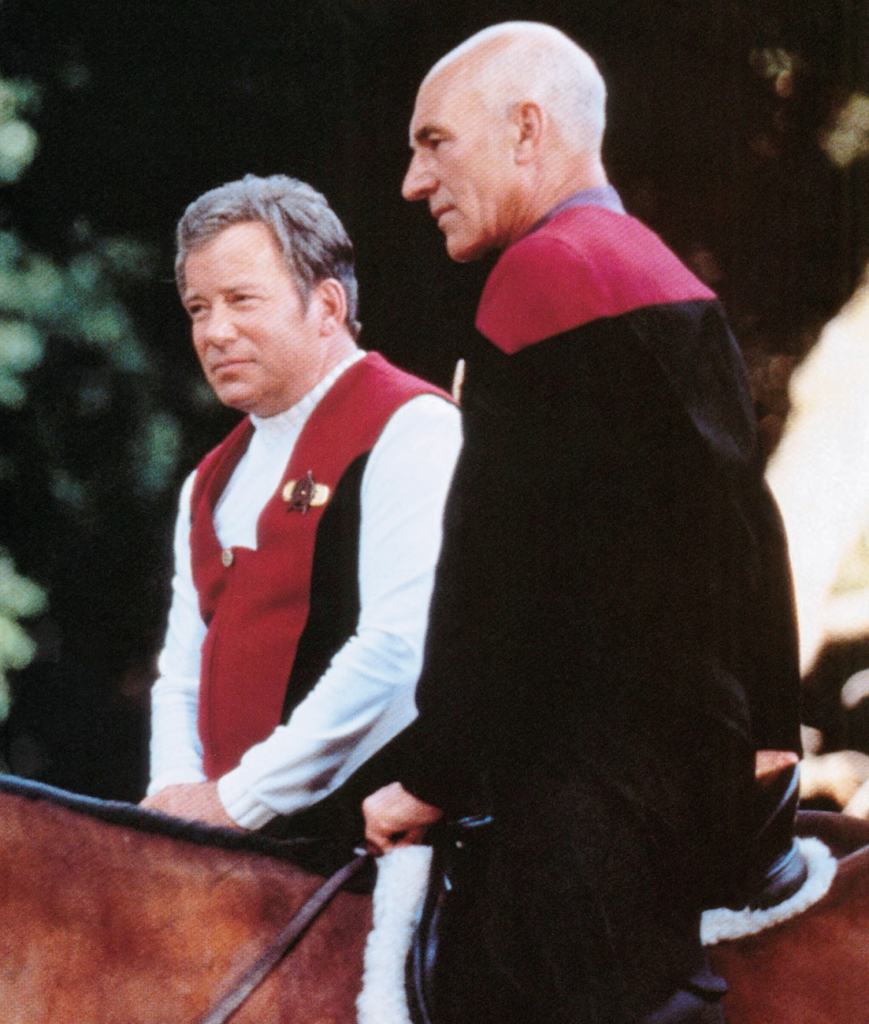
RONALD D. MOORE: “We sat down and watched the first six films several times. We watched IV closely. We watched The Wrath of Khan several times, because it’s my favorite of the six films and the best as far as the story level and execution. We just sort of looked for how they handled some things. We didn’t really say let’s make this like the other ones, but we wanted to get a feel for how Star Trek translated to the big screen and what the action sequences were like.”
“For instance, we got very, very used to writing tightly-controlled space battles on the series where there were only one or two phaser hits and you shake the camera a lot. To break ourselves out of that, we watched the Reliant attack on the Enterprise in Wrath of Khan and how they really milk it.”

BRANNON BRAGA: “Undoubtedly, the two best films are Wrath of Khan and The Voyage Home. Voyage Home was laughs. It’s the most fun, it’s the best movie, I think. But II was wonderful because it had a very serious undercurrent and Khan was a great villain. We were hoping to capture the best of both worlds. Ron and I both were after the right mix of humor, action and character.”
RONALD D. MOORE: “We started talking right from the start about how to integrate the two crews, and to what extent. The image that Brannon and I were most in love with was the idea of a movie poster for the film showing the Enterprise-D and the Enterprise-A locked in combat, shooting at each other. If you could have a situation where you had the two ships coming to blows, that would be really cool. But it quickly became apparent that finding the motivation for the two to be at such odds and then keeping them both sympathetic and heroic was going to be a real tough sell. It was going to be too much trouble to get to this one cool scene at the end of the film.”
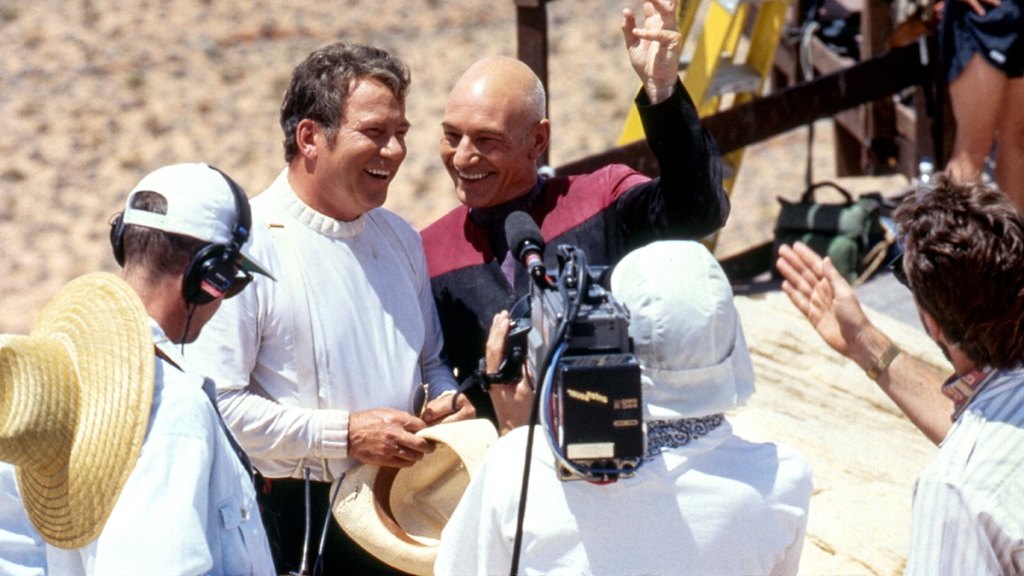
“We knew that we didn’t want to do a time travel story and we didn’t want the original crew to all be ancient like McCoy, who was in the 24th Century in the Next Generation premiere, so Rick came up with the idea of a mystery that started in the 23rd Century and picked up 78 years later in the 24th century. We knew that everyone was going to want the two captains to meet, since they had never met, and that led to a discussion of having them meet somewhere other than the 23rd or 24th centuries, in a place where time had no meaning. That led us to the Nexus.” Which in turn led to the final version of 1994’s Star Trek: Generations.
Conversation
All comments are subject to our Community Guidelines. Woman's World does not endorse the opinions and views shared by our readers in our comment sections. Our comments section is a place where readers can engage in healthy, productive, lively, and respectful discussions. Offensive language, hate speech, personal attacks, and/or defamatory statements are not permitted. Advertising or spam is also prohibited.