Why the ‘MASH’ Finale Stills Makes Us Cry 40 Years Later: The Emotional True Story Behind TV’s Most-Watched Goodbye
In time for METV's annual Veterans Day event, the cast and crew recall the legendary last episode that drew over 100M viewers

Back in its heyday of the 1950s, I Love Lucy was credited with emptying streets around the country every Monday night when the classic TV sitcom aired new episodes. Flash forward about 30 years (specifically the evening of February 28, 1983) and history repeated itself. In a time before streaming, DVRs and even before most households had cable, more than 100 million people tuned in for one shared purpose: to bid adieu to the doctors, nurses and misfits of the 4077th. “Goodbye, Farewell and Amen,” the final episode of M*A*S*H, proved itself to be more than just another TV finale. It made history, was originally viewed by more than 100 million people and now it’s being aired in its entirety by METV on its annual Veterans Day event.
For most of the audience, saying goodbye to Hawkeye, Margaret, Potter and the rest of the 4077th felt like saying goodbye to old friends. Series editor Stanford Tischler remembered that night vividly—not just the broadcast itself, but the strange stillness that surrounded it. “A bunch of us were going out to eat,” he recalled. “I remember we ran the show in the projection room about an hour before it aired, and then came out of Fox Studio onto Pico Boulevard, heading to the restaurant. By that time, the show was airing on television—and the street was empty. It was like a ghost town. It was eerie. Everybody was inside watching that show. There wasn’t a car on the street. We drove up Pico Boulevard, Westwood Boulevard—not a car anywhere. It was like an atomic bomb had hit. A real eerie feeling.”
That eerie silence said it all. The country had collectively gone indoors to witness an ending that was both fictional and achingly real—the final chapter of a show that had made them laugh through tears for over a decade. “Running the length of five episodes,” suggests Dale Sherman, author of the book M*A*S*H FAQ, “‘Goodbye, Farewell and Amen’ represented a golden opportunity to give major and minor characters on the program a chance to wrap up their stories as we see the Korean War finally come to an end after over 250 episodes.”
It was a collective goodbye to an era—11 years of laughter, tears and reflection (all beautifully intertwined in this episode)—that explored the cost of war and the power of humanity. And it’s rarely been seen in its entirety. Says Sherman, “The length of the episode is why the finale is usually broken down into half-hour segments. The infrequent nature of seeing the episodes makes its airing on MeTV somewhat unique. Yet it should be mentioned that there is a great sense of displacement in the episode that may throw frequent viewers of the program thanks to the finale’s length, its storyline and even the locale used.”
The end of an era

By the time production began on M*A*S*H’s finale, everyone involved knew they were closing one of television’s most extraordinary chapters. The emotions ran deep, but so did the logistics. More than a simple half-hour sitcom wrap-up, it was conceived as a two-hour television movie designed to bring the story of the 4077th to a proper conclusion.
Executive producer Burt Metcalfe remembered those final months as a mix of ambition, chaos and unexpected fate. “It was always intended to be a two-hour movie—that was the agreement from the start,” he said. “But as we were shooting, there were just so many elements to tie together, so many people to say goodbye to and so many stories we wanted to tell. One day I called CBS and said, ‘We’ve got more material here. We could easily go two and a half hours. Would that be of interest to you?’ They called back and said, ‘You bet.’”
Then, in a strange twist of real-life echoing fiction, disaster struck. “There was a fire—the Fox ranch burned down,” Tischler recalled. “Whether you know that or not, it was just a coincidence, but they incorporated it into the final show. With the fire and everything else, it became a two-and-a-half-hour program.”

Metcalfe explained how quickly the creative team adapted. “It was completely accidental, not something that happened during production, but it destroyed parts of the ranch where we filmed,” he said. “Suddenly, scenes we’d planned couldn’t be shot. Alan and I went out to assess the damage, and that’s when we decided to use it—to make it part of the story. That became the thread where the unit has to ‘bug out,’ which is what they really did in wartime: pick up and move the entire camp. When they returned, everything was burned. That’s how we turned disaster into story.”
Even without the fire, the finale was already a massive undertaking — a sprawling farewell that demanded care and coordination. “Alan Alda and I were originally going to co-direct the finale,” Metcalfe noted, “but the Directors Guild stepped in. They’re always watchful of producers who try to exert too much influence or take credit for something they don’t necessarily deserve. The Guild said, ‘No, we won’t allow that. He’s the producer —if you want to direct it, you can, but you can’t both have credit.’ I had no issue with that; neither did Alan. He wanted to share credit with me, but I understood the Guild’s position, so Alan directed it alone.”

Metcalfe recalled that Alda’s vision, both as a director and co-writer, gave the finale its emotional through line. Each section was co-written by different members of the writing staff, but Alda oversaw every page to maintain tone and continuity. “He worked from page one to the end,” said Metcalfe. “Some pairs took certain acts; I had one, others had their own and then we’d all come together for rewrites. So while Alan kept the continuity, everyone contributed to the structure and tone.”
In a way, it mirrored the manner in which M*A*S*H itself had evolved: a true ensemble production that drew strength from its collaboration. Eleven years earlier, few could have imagined the little army field hospital born from Robert Altman’s 1970 film would become a vehicle for television’s most profound storytelling. But by the end, it had become exactly that: a reflection of its creators’ own humanity, shaped through laughter, loss, and improvisation—even when that meant rewriting the ending around a literal fire.
Behind the tears

For Loretta Swit, filming “Goodbye, Farewell and Amen” was, at times, surreal. After 11 years of living as Major Margaret “Hot Lips” Houlihan, she found herself saying goodbye to a woman who had grown and matured alongside her. But even as she filmed the finale, the sheer logistics of production made it hard to process that the end was really happening.
“David Ogden Stiers did this perfectly lovely thing during the filming,” Swit recalled. “There were certain moments—like my last words to Harry [Morgan] in the script—that were very emotional. But otherwise, it was just shooting every day. The big difference was that the story was about the end of the war, about peace about going home. That gave it a special feeling.”
That feeling was easy to lose amid the chaos. “We didn’t film in sequence, though. In fact, it was worse than that—not only was it non-sequential within the film, but we were also shooting two other episodes at the same time,” she said. “Then there was the big fire at the ranch. So many things were happening that it didn’t really feel like we were shooting a two-and-a-half-hour movie.”

Still, the moments that stayed with her were the small ones, like that quiet act of kindness from Stiers that would become one of her most cherished memories. “I always teased him,” Swit said with a laugh. “He was very much his own person, didn’t socialize much, very into his music and Shakespeare. Nobody even had his phone number. We didn’t really know where he lived; you had to reach him through his agent. But he wasn’t unfriendly at all. He was wonderfully warm, and we loved working together.”
During one scene, when Margaret is angry with Winchester for his pettiness over a returned book, the two characters have an emotional reconciliation. “Later, at the end, he wants her to keep the book as a memento, and he’s about to give it to her,” Swit remembered. “When we filmed my close-up, David handed me the book and when I opened it, it wasn’t addressed to Margaret—it was to me. And inside was his phone number. If you rewatch the movie, you can actually see my real reaction in that moment. It was David the actor doing something kind and funny for Loretta, and that reaction was real.”

That authenticity carried through to her final moments with Harry Morgan’s Colonel Potter, a relationship that had become deeply personal over the years. “As for Harry, he’s still the love of my life,” she said simply. “The writers captured the essence of that relationship beautifully. Margaret had a very special bond with Colonel Potter. He was like the father she never had, with the warmth and guidance she missed growing up. He was her commanding officer, her friend, her teacher—so many things.”
When it came time to film her farewell, Swit wondered if the dialogue could possibly capture what she felt. “When I first read that final line in rehearsal, I wondered if it was enough, if it expressed all I felt. And then I realized it did. No one could have written it better: ‘You dear, sweet man—I’ll never forget you.’ That line said everything.”

But the emotion of the moment was almost too much to contain. “When we filmed it, Harry and I couldn’t stop crying. Burt [Metcalfe] finally came over and said, ‘People, please, it’s going to be two and a half hours of people crying—I can’t have that!’ I have this lovely photograph from that day with our heads touching, trying to pull ourselves together. It’s one of my favorite pictures. I have it framed at home.”
There was another photo she treasures just as much—a playful one of her and Jamie Farr, nose to nose, teasing each other between takes. “Those are the moments that stay with me, not just saying goodbye, but sharing something real with the people I loved,” she said.
Real farewells
When Colonel Potter rode off on his horse for the last time, it was the end of an era. For Harry Morgan, who had guided the 4077th with quiet authority since joining the series in its fourth season, filming that final moment brought home what everyone had been avoiding: the war was over and so was M*A*S*H.
“At the end of the show, we all kind of said farewell to one another and I rode off on my horse,” Morgan remembered. “Everyone stood up and saluted me, which was very unusual. They didn’t often show that kind of visible respect for the Colonel during the series, even though it was always there. But in that moment, it was formal and it was very touching.”
The emotion in that scene was no act. “When I turned around and saw them saluting, it hit me,” Morgan said. “This was it, the real goodbye. What we were doing wasn’t just acting; it was actually happening. It was a very profound moment, and I think we all felt that deeply.”
After so much time with the series, Morgan admitted it was difficult to let go. “It was hard to say goodbye to M*A*S*H,” he said. “I could have done it for another 10 years, and I think most of the cast felt the same way. Maybe not Alan—he had other fish to fry—but for most of us, nothing that came afterward ever equaled M*A*S*H in any form. Not for me, and honestly, not for any of us.”
Jamie Farr echoed that sentiment. After years of bringing comic relief to the horrors of war as Corporal Maxwell Q. Klinger, he was grateful for the way the finale honored every character’s journey. “Yes, I thought the finale was excellent,” he said. “They did a great job wrapping everything up. Some people felt it got a little too dramatic in places, but I always had tremendous faith in our writers, our producers and in Alan [Alda] as director.”
By the time the final scene was shot, the laughter had quieted, replaced by tears and embraces. Stanford Tischler shares, “I remember the last shot of the day—it was in the newspapers—everybody on the set kissed and cried and everything else,” he said. “When we put it together, it was just a sad thing.”
Crafting closure
What made “Goodbye, Farewell and Amen” more than a sentimental goodbye was its honesty. The finale didn’t shy away from the darkness of war or the psychological scars it leaves behind. For executive producer Burt Metcalfe, much of that came from a personal experience.
“My own contribution was influenced by a trip I’d taken to Korea a few years earlier,” he said. “Gene Reynolds and Larry Gelbart had visited in 1974 when there were still several MASH units, but by the time I went, only one remained. I wanted to get a sense of how civilians had been affected by the war. I heard a lot of stories, but two really stuck with me and found their way into the finale.”

The first story, he explained, became the emotional core of the film: the moment when Hawkeye breaks down during therapy with Dr. Sidney Freedman after recalling a woman smothering what she claims was a chicken on a crowded bus. “That came from a story told to me about a group of refugees hiding under a bridge while a North Korean patrol passed nearby,” Metcalfe recalled. “A woman’s baby started crying, threatening to give away their position. The baby was smothered to save the group. When I repeated the story to others, they’d all heard similar accounts. For us, it was shocking, but to them, it was part of their collective trauma. That became the basis for Hawkeye’s psychological collapse and his treatment by Sidney Freedman.”

The second story would bring Klinger’s journey full circle. “I’d met several men who had served in Korea and decided to stay afterward, because they’d fallen in love or simply found a sense of belonging there,” Metcalfe said. “And of course, that immediately clicked: who’s the least likely person to ever stay in Korea? Klinger — the guy who’d spent years trying to get out. That led to the storyline where he falls in love with a Korean woman and decides to remain there. It was a perfect resolution to his character and carried over into AfterMASH, where he brought his war bride home.”
Even in its construction, M*A*S*H’s finale mirrored the unpredictability of war itself. Scenes had to be reimagined after the Malibu Creek Ranch fire and dialogue rewritten to reflect new realities. Yet those changes only deepened the story’s authenticity.
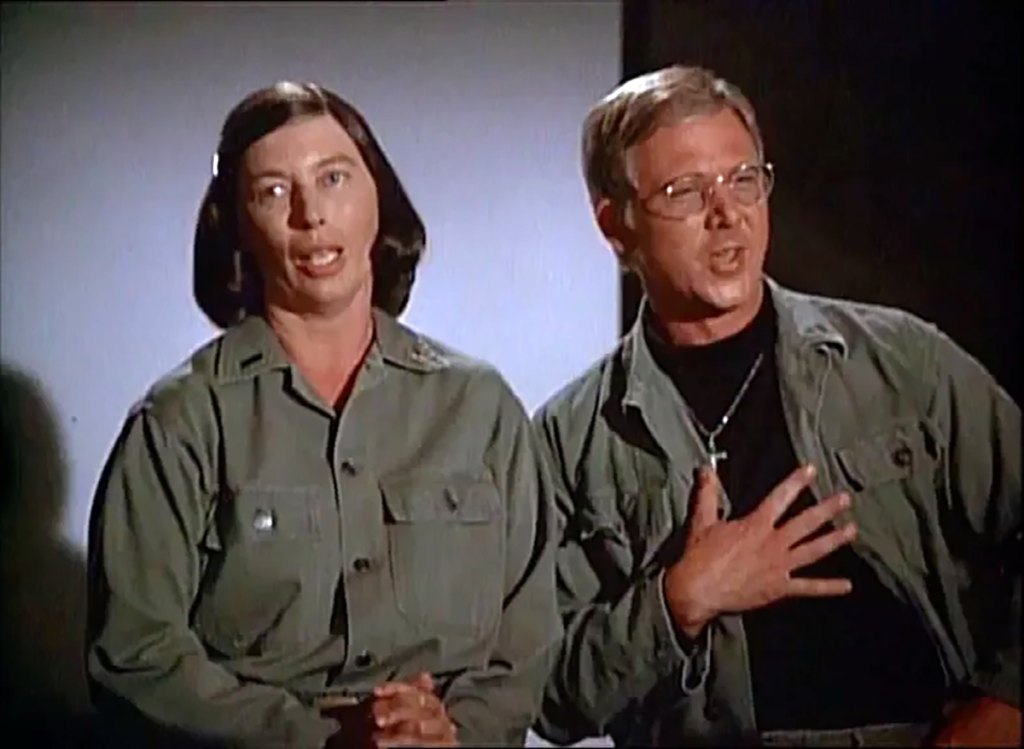
When the episode finally came together, it was sweeping, reflective and true to life. “There were just so many elements to tie together, so many people to say goodbye to and so many stories we wanted to tell,” Metcalfe said. “And of course, the result was extraordinary. The two-and-a-half-hour finale became, and still remains, the highest-rated television broadcast of all time. Nothing has ever come close. Not because we were special, but because the industry has changed. With cable, DVRs and streaming, audiences are fragmented now. Back then, everyone was watching M*A*S*H that night. It was a shared national experience and one that simply can’t happen again.”
‘Goodbye’
By the time the last scene of M*A*S*H faded to black, something had changed — not just for the actors, but for the millions of viewers who’d shared in their laughter and grief for over a decade. “Goodbye, Farewell and Amen” wasn’t a typical series finale. It was a moment where television became a little more than just entertainment, but instead was an emotional experience shared by nearly half the country.
For Alan Alda, who had lived at the center of that experience as actor, writer and director, pride was never the point. Growth was. “I don’t get ‘proud’ about things,” he said. “I get ‘glad I’m able to do things.’ I got better at everything I did on M*A*S*H. I got better as an actor, I got better as a director and writer. But I think the thing that I came away with that was the most valuable to me for the rest of my life was what we did between scenes—sitting around waiting an hour for them to light the next shot. We would kid one another and play. Sometimes we would rehearse a scene, but mostly we would just connect.”

“When I think about it today, there are tears,” admitted Mike Farrell, who portrayed B.J. Hunnicutt. “I knew I’d never be in this position again with this character. I’ll never be in this spot again. BJ is saying goodbye to people he loves just as Mike is saying goodbye to someone he loves. Even though we, the cast, knew we’d see each other afterward, we also knew it’s not going to be under the same circumstances. It’ll never be this.

“It makes me very proud, I must say. It also humbles me greatly. I’m hugely indebted to the people that made it possible to be part of that show and then hugely indebted to the people who embraced me and helped me be part of that show. I will never forget it and will always think of it as the gem of my theatrical experience.”

For fans who grew up with M*A*S*H, the finale was a jolt of reality wrapped in fiction. Author Dale Sherman, who watched the original broadcast as a teenager, reflected on how his understanding of that ending had evolved with time.
“Back in 1983, when I saw the finale air on CBS, I wasn’t sure if I cared for the ending of the series,” he admitted. “Now, after all these years, I’m finally starting to see that perhaps this is the ending it always needed—with characters unprepared to leave, missing events that shape the lives of friends around them or, as in the case of what happens with Klinger, leading them down a new path in life. The real world never ends its stories with neat little bows, and in following that pattern in ‘Goodbye, Farewell and Amen,’ the show ended up being somewhat closer to the truth as well.”
Conversation
All comments are subject to our Community Guidelines. Woman's World does not endorse the opinions and views shared by our readers in our comment sections. Our comments section is a place where readers can engage in healthy, productive, lively, and respectful discussions. Offensive language, hate speech, personal attacks, and/or defamatory statements are not permitted. Advertising or spam is also prohibited.