Michael Shanks’ ‘Stargate’ Homecoming: The Heartfelt Reason He Returned to the Role He Left Behind
After walking away from sci-fi stardom, Michael Shanks realized that his heart never truly left SG-1

Most people reach a point in their lives when they look around and realize that, on paper, everything seems fine—maybe even great—and yet something still feels off. The job is steady and the routine familiar, and it’s likely others envy where you’ve landed, but deep down there’s a sense that things are starting to… stagnate. It’s a feeling that’s difficult to ignore, which is exactly where Michael Shanks found himself in the early 2000s.
As a central cast member on Stargate SG-1, Shanks was part of a hit sci-fi series with a devoted fan base with a future that looked secure. But by 2002 he began to wonder whether staying put meant standing still. He loved the work, but he wasn’t sure it was still challenging him in the ways he needed or that his character was still evolving. Like so many people who’ve reached a comfortable place in their careers, he started to believe that the next step—whatever it was—might only come if he was brave enough to walk away.
When Stargate SG-1 debuted in 1997, more than stepping into a television spinoff, Shanks was taking on a character with a very specific legacy. Daniel Jackson had already been introduced to audiences in the 1994 sci-fi feature film Stargate, played by James Spader as a brilliant but jittery academic who always seemed slightly out of step with the people around him. Spader’s Daniel was smart, impatient, socially awkward and more comfortable with ancient languages than human connection. Shanks brought something else to Daniel almost immediately.
MICHAEL SHANKS (actor, “Daniel Jackson”): “My story is that I auditioned [for the show]. Rick [Richard Dean Anderson] was gracious enough to come to the screen test that we had in LA and he read with everybody. I was actually told afterwards that I was the second choice by most people; that they went around the room and everybody else was going towards the other guy. Brad Wright was the one who said, ‘No, Michael’s the guy.’ After a certain amount of convincing, they trusted Brad to make that decision. I was kind of almost not chosen for the part.”
BRAD WRIGHT (co-creator/executive producer): “For Daniel, there were people we had narrowed the search down to. Rick [Richard Dean Anderson] did scenes with Michael and the other two candidates and, for me, Michael Shanks was Daniel hands down. Trouble was, and what MGM was a little concerned about, that he was very young. I think he was 26 at the time and it just seemed to lack a little bit of credibility that this character knew these languages and was as smart as he was at such a young age. But I said, ‘I promise you one thing: he will get older. So, Daniel is a wunderkind and the character’s a bit different,’ and nobody batted an eye at it. He was terrific. And his performance evolved quite wonderfully from kind of an impression of James Spader to his own Daniel.”
MICHAEL SHANKS: “James Spader is a pretty darn good actor, so when the opportunity came, I went, ‘Oh, boy, I don’t know if I can do the job that he did,’ but I also ripped off his performance completely. So, in one way it was a crutch, but in another it was a terror, so I guess it balanced itself out. And how did I do? Well, given that I had over 200 hours to play the character, then, yes, I would say I did a better job than he did in his two.”
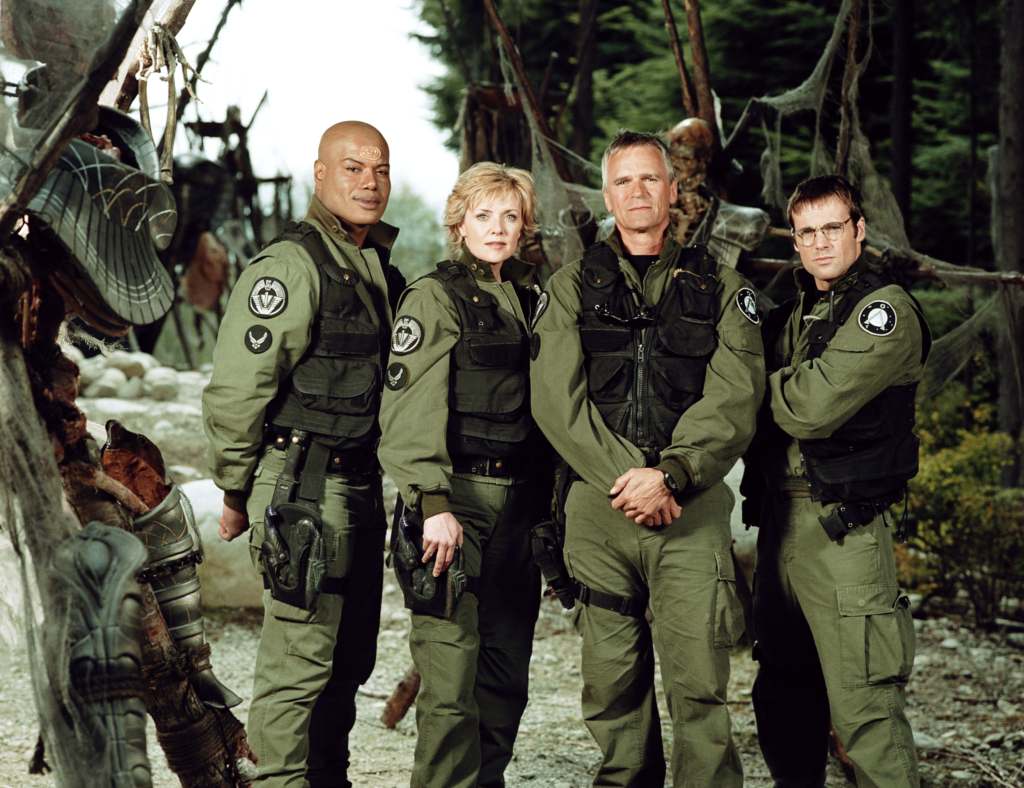
JONATHAN GLASSNER (co-creator/executive producder): “What Michael had that the others didn’t is that he looked a little bit like Spader, and he had that comic timing that he brought out in the reading, even on lines that weren’t all that funny. He did well. And, let’s face it, he’s a great looking guy, which is always a value, because he could be a romantic lead as we went on. He was the easiest role to cast, frankly. The only debate about him, again, was that because he looked a little bit like Spader, we worried that people would think we were trying to find a lookalike. But then, of course, when he came in, he didn’t look anything like him; he had just kind of put on the glasses and done himself up to make himself as much like Spader as he could.”
ROBERT C. COOPER (executive producer): “I think Michael would admit that he started with a little bit more of an impersonation of Spader but quickly settled into his own interpretation of the character.”
JOSEPH MALLOZZI (co-executive producer): “He is such a phenomenal actor and brought such passion to the character. In many ways, I think he was our eyes into the character for a lot of the audience in that he was kind of the outsider, not the military guy and was almost like a fish out of water. And yet his enthusiasm in exploration and discovery was very much what resonated with sci-fi fandom in general. In that respect, Michael was so great at really connecting with the audience on that level.”
RICHARD DEAN ANDERSON (actor, “Colonel Jack O’Neill”): “As an actor, I don’t get that deep. Michael does. He’s a fine, studied actor. First thing I saw him do in Vancouver was Hamlet and he was really good. Come on, let’s face it, if you’re really objective and you look at all the regulars on the show, Michael’s the only one that really knew what he was doing as an actor. I mean, Amanda was good but is more of a comedian and she’s got that down. Michael knows what he’s doing. I’m so jealous, I’m getting all teary. Not really.”

PETER DELUISE (writer/director/producer): “What was nice about Michael’s Daniel Jackson character is because Carter was military, she could not offer what we call the ‘moral center.’ Many people felt hat Daniel Jackson was the moral center of the group. If something was military, it fell to O’Neill. This was set up in the movie in that Kurt Russell brought the bomb to Abydos, just in case. And he was about to commit suicide, because his son had just died. And then Daniel Jackson goes, ‘Hey, we can’t blow these people up. It’s not their fault that this happened.’ So that was handed over to us from the movie, that relationship. Plus, because he was civilian and not military, Daniel was going to be at odds with O’Neill all the time. O’Neill’s job was to carry out military assignments with military precision and discipline, and, of course, Daniel Jackson was there to argue the humanity of how that was wrong.”
RICHARD DEAN ANDERSON: “When we were shooting the pilot and I heard Michael’s dialogue, I thought at the time, ‘What the hell is he talking about?’ Actually, he said a lot of things where I said, ‘What the hell is he talking about?’ Even today.”
MICHAEL SHANKS: “I was reading some swath of expository mumbo jumbo, and I rattled it off in one take and sort of sat there, feeling prideful, like, ‘Yeah, I did that.’ And Rick came up and said, ‘Well done, well done. You know you’re screwed, right?’ I said, ‘What do you mean?’ He goes, ‘You showed them you could do it. They’re going to keep making you do it.’ He said, ‘I have this little rule; call it the rule of thumb. Any passage of dialogue that’s longer than my thumb on the page, I won’t say it.’ He spent the entire first season, even when he was completely capable of doing it, screwing up any line that was longer than his thumb. They tried to get him to do some other stuff and, no freaking way. Sure enough, what ended up happening was that Amanda and I became these sleep-deprived dimwits, because we’d have to go home and learn six pages of exposition. He was absolutely right.”
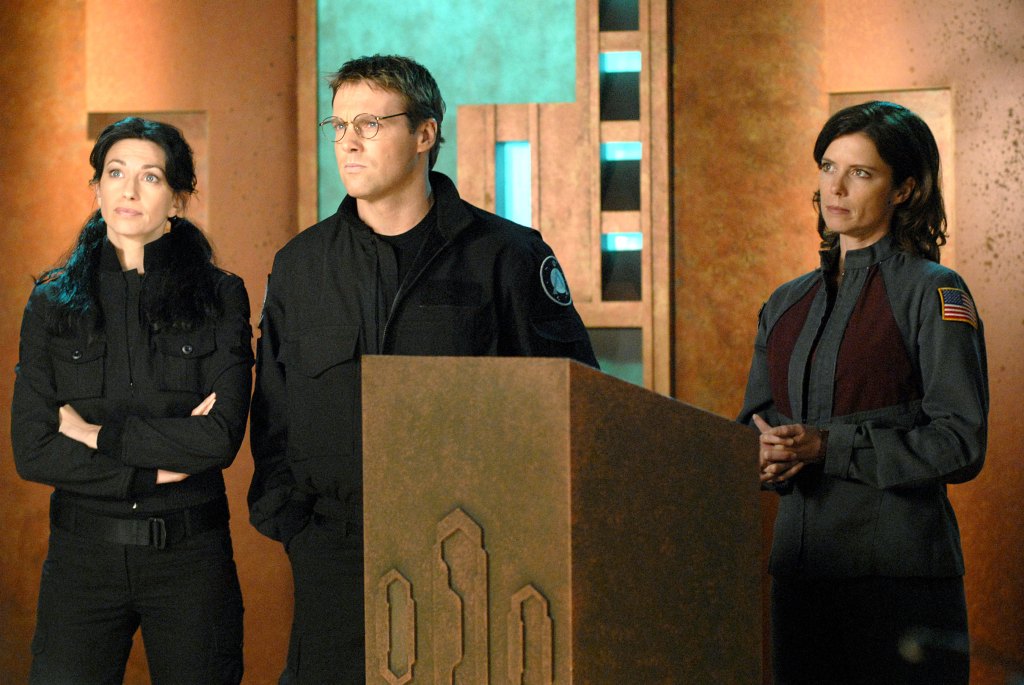
From the start of SG-1, Shanks’ humanity is what made Daniel Jackson resonate so strongly with viewers. Over time, he became more than the guy translating alien languages or unlocking ancient mysteries. He was the character who reminded the others and the audience why exploration mattered in the first place. And for several seasons, Shanks poured himself into that role, but by the early 2000s, something had shifted.
Flash forward to Season 5 and he began to feel that Daniel’s emotional core was being pushed aside. The character was still important to the show’s mythology, but Shanks felt he wasn’t being challenged in the same way anymore. So, in 2002 he made the choice to leave the show and pursue other creative avenues. He did so with no acrimony from himself or anyone else involved with the show in contrast to, let’s say, when McLean Stevenson decided to leave M*A*S*H. In the same episode that he departed the 4077th, his character was killed off camera, ensuring that Colonel Henry Blake would not make a return. Such was decidedly not the case with SG-1.
BRAD WRIGHT: “I had said to Michael when he left that we would do it in such a way that he could potentially come back. At the time it was a little contentious, but I think he recognized that, at the end of the day, it was a gift, because he was, like, 25-years-old when he started Stargate. He hadn’t really tested the waters of anything and working on this show was grueling. We were working on a show 22 episodes a year and that is grueling.”
“I remember when he came back in Season 6, writing a script that was a really strong episode, because he had meaty stuff to do. And I had to think that maybe I had not given him enough before. Maybe he was a young actor in the first few seasons with significant chops, who was always basically in support of Richard Dean Anderson. At the same time, Rick’s name was above the title. That’s where MGM wanted us to focus things and what they were spending the money on. When Michael came back in Season 7, there was more for him to do, because Rick’s role kind of started to get smaller as he pulled back, which is when I pitched the idea of General O’Neill, which meant he wasn’t running and jumping and shooting as much and wouldn’t be needed as much in front of the camera.”
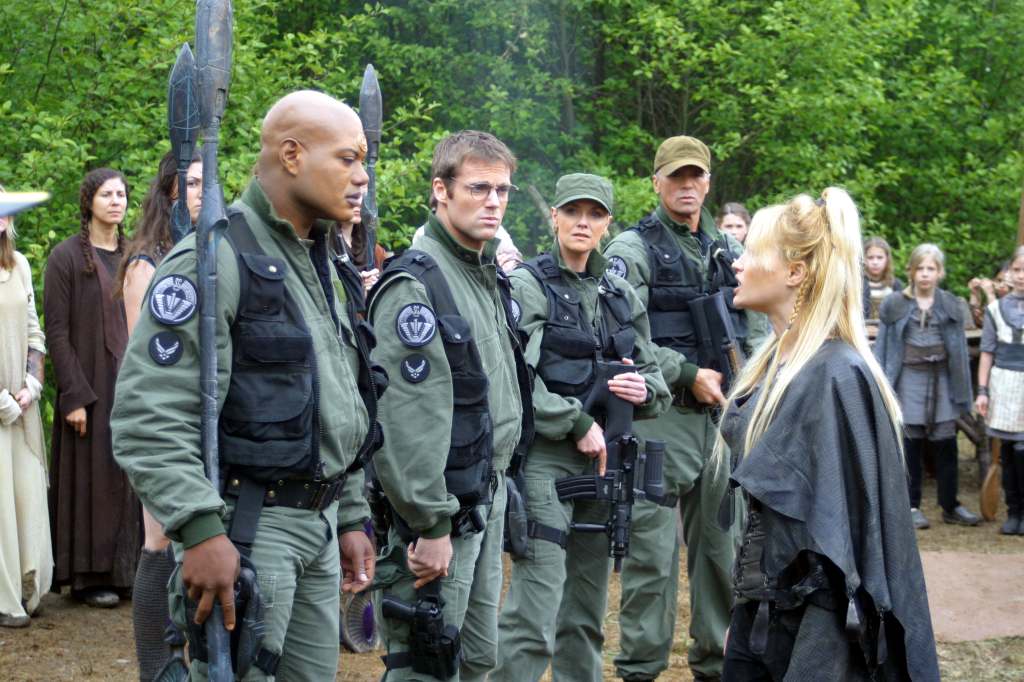
JOSEPH MALLOZZI: “After Michael Shanks left, there was the ‘Save Daniel Jackson’ campaign. You see it with Star Trek today, you see it with Star Wars. I think you’ve got to be cognizant of what the fans enjoy, but you can’t take dictation. It’s tough, because I get fandom. I was a fan of Star Trek. I get it. If you’re invited to take part in something, let’s say, and you do, your support is kind of fueled by the production. And then they make a creative decision that you feel kind of pulls the rug out from under you … That was kind of the Michael thing, even though it was a mutual decision, really, more driven by Michael. And so, I know a lot of people online—a lot of creators and a lot of fans—get upset with fans who basically criticize a show for changing or doing something different, and they will go out there and say, ‘Don’t watch!’ You may ask, ‘How can people take all this time to be so negative about something?’ Well, you as a production got these people hooked, got them to support the show and now you’re doing something different. Not everybody is going to like it. That’s what happened with Stargate after Michael left, and not everybody liked it.”
BRAD WRIGHT: “I’ve had people come up to me and say, ‘I just want you to know that your show was really important to me, because I had issues with my family’ or ‘I felt alienated at school’ or ‘I felt disenfranchised by ‘X,’ and your team never let me down. Your show never stabbed me in the back. It never disappointed me and always gave me what I needed emotionally.’ That’s kind of cool, because that’s not just the actors. That’s what we were projecting. It was a positive force in a lot of people’s lives and you can’t not be proud of that.”
“But then there are the fans who are furious and say, ‘Why did you destroy the show when Michael left?’ I got mailed a picture of me with a target drawn on it. One day I was pacing in the office and Robert said, ‘Sit down,’ and I go, ‘What?’ Somebody had what was probably a laser pointer on my face from outside my office. Fans would come and just stare through the gate at Bridge Studios, so I just didn’t know. That was scary. And it’s a true story. You’ve got to take the good with the bad, but I do know that there are people to whom the show was important and I know there are people who saw Carter as a role model and it was a positive force in their lives. There’s nothing about that that you can’t feel pride in.”
ROBERT C. COOPER: “Change has to be embraced. We realized at one point, ‘Oh my God, Michael Shanks wants to leave. What are we going to do about not having Daniel in the show? Are our fans going to still watch?’ We brought in Corin Nemic to play Jonas and the show kept going; it didn’t miss a beat. Not to disrespect Michael or Daniel, and obviously we had a giant lift when he came back, and that’s not to in any way disrespect Corin and his performance or Jonas, but it just proved to us that the show itself was bigger than any one element, and that the change actually made a difference. It kept the energy up and it was the dynamic that changed. The conversations were suddenly different between the characters because we changed that element. So, the short answer is that changes are good for shows as long as you keep enough of the foundation and enough of what the fans love that it doesn’t feel like an entirely new show.”
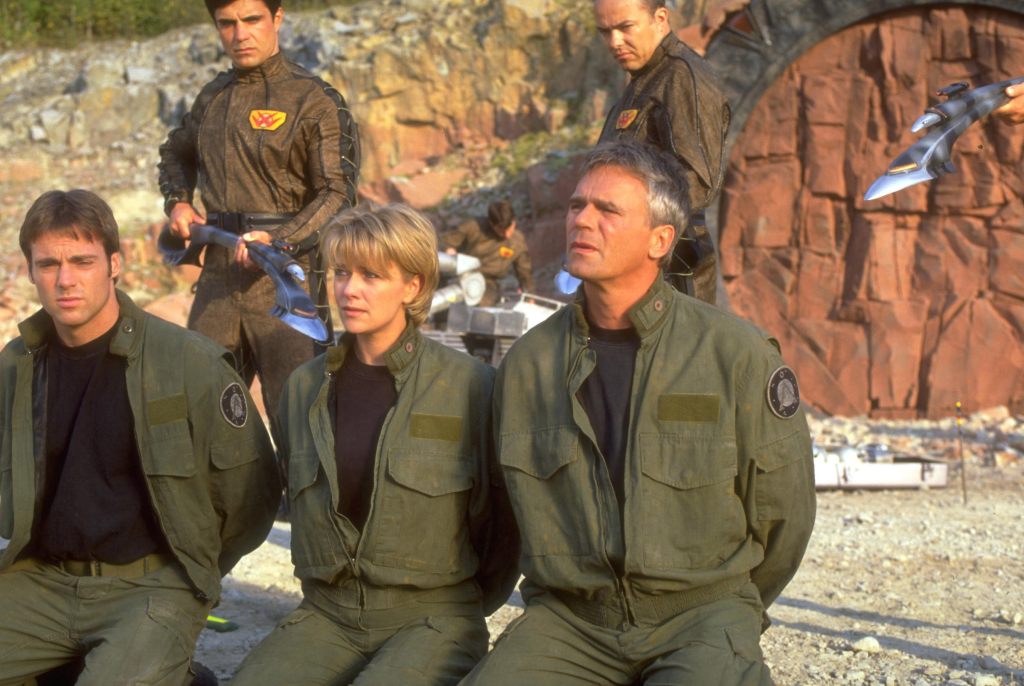
During Stargate’s sixth season, Shanks certainly kept busy. He made three guest appearances on SG-1, while also starring in the movies Samuru, All Around the Town and Door to Door. There were also guest appearances on Andromeda, the 2002 version of The Twilight Zone and The Outer Limits. Additionally, he started to explore the idea of writing and pitching scripts, eventually getting credit on the SG-1 episodes “Evolution” and “Resurrection.” But then, things changed and he found himself returning to the series to reprise the role of Daniel Jackson, the experience of being gone somehow changing things.
As to how they handled all of this on screen, at the end of Stargate SG-1’s fifth season, Jackson was written out of the series when he was exposed to a lethal dose of radiation and ultimately “ascended,” transforming into a higher plane of energy rather than dying outright. The storyline allowed the character to exit in a way that honored his intellect and spiritual curiosity while keeping the door open for future appearances. During Season 6, Daniel appeared only sporadically, portrayed as an ascended being who could observe events but was forbidden from interfering, a limitation that underscored his physical absence from the team and the emotional gap he left behind. In Season 7, the arc came full circle when Daniel was forced to retake human form after breaking the rules of ascension, rejoining SG-1 permanently and restoring the team’s moral and emotional balance.
BRAD WRIGHT: “There was a natural change in the dynamic when Michael left the show and Jonas came on, but when Michael basically wanted to step back in, it made sense for Jonas to go back to his home world and for Michael to resume his role. And it was seamless. Everybody just went, ‘Yeah, he’s back.’ He and I ended up on good terms. To this day, I love seeing him. We’re not friends, but we’re definitely friendly and I would love to work with him again.”
MICHAEL SHANKS: “Without going into too much detail in terms of the business and creative side of it, I’ll just say that the reasons that I left are not the reasons why I came back. They’re two separate situations, and I was walking back into a different situation that was much more acceptable than the one which I left. The bottom line is, I don’t think there was any bad blood between myself and the production people, except in theory. And, once we actually sat down in a room and talked over some things, they were resolved instantaneously. Nobody bent over backwards; MGM wasn’t over a barrel, nor was I coming back with a cap in hand. It was more like the situation changed and they said, ‘Hey, what do you think about this?’ And I said, ‘Well, that’s better.’ And it’s as simple as that. For me, on a more personal level, I would say the acceptance of the character and the expression of sentiment towards the character was a factor in me deciding to come back.”

In the end, Shanks’ departure from the series was unfortunate, but in many ways necessary for him to feel that Daniel Jackson could tap into all he could be. And while the actor has not spoken in detail about the decision to depart and return to the show, it’s obvious that it did nothing to harm his relationship with those he shared the overall experience with. Or the connection that they obviously still feel for each other nearly 30 years later.
MICHAEL SHANKS: “It’s very rare that you get people who work so often, so many hours a day, that actually after so many years still like one another, because we know way too much information about each other. It’s amazing that the chemistry and the original dynamic that sparked in an audition room so many years ago has managed to remain consistent and bonded us as a family. It’s just a wonderful experience to share with those people.”
Conversation
All comments are subject to our Community Guidelines. Woman's World does not endorse the opinions and views shared by our readers in our comment sections. Our comments section is a place where readers can engage in healthy, productive, lively, and respectful discussions. Offensive language, hate speech, personal attacks, and/or defamatory statements are not permitted. Advertising or spam is also prohibited.