‘I Was Going Into the Lion’s Den’: How Richard Hatch Bridged the ‘Battlestar Galactica’ Divide
The original star faced fear and anger when his beloved series was reimagined

For many fans, Battlestar Galactica went far beyond being just another TV show, becoming an important part of their childhood. It was the sound of the theme music kicking in, the comfort of familiar characters and the thrill of a story that felt heroic and hopeful, even when the Cylons were closing in. So when word spread that Battlestar Galactica was coming back in a very different form, the reaction wasn’t curiosity—it was fear. Fear that something beloved was about to be taken apart, reshaped and brought to life in an unrecognizable manner.
One person who certainly felt so was late actor Richard Hatch, who had starred as Apollo in the 1978 original and had valiantly fought to resurrect the series years later, only to learn that, instead, the show would be brought back under the guidance of writer/producer Ronald D. Moore. And Moore, whose credits include the Star Trek entries The Next Generation and Deep Space Nine as well as Outlander, envisioned a darker, more realistic version that would eventually be brought to life as a 2003 miniseries followed by the 2004-2008 weekly version.
Which brings us back to the idea of fear amongst the fans; a fear that quickly turned into anger for some, confusion for others and cautious curiosity for a few. Longtime fans had kept Battlestar alive for decades through conventions, conversations and sheer devotion, and now it felt as though the show they loved was being handed to a new generation that didn’t understand why it mattered in the first place. The pushback was really about whether the people behind the new version truly understood what the original meant to those who had never let it go.
What’s often forgotten is that, behind the noise, there were people genuinely trying to reach across that divide. Not to dismiss the past, but to honor it in a new way. Some of those efforts were awkward, some were risky and some required stepping directly into hostile rooms and listening to voices that were angry. The story of Battlestar Galactica’s rebirth isn’t just about reinvention — it’s about what happens when creators and fans collide, and the rare moments when that collision leads not to destruction, but to understanding. What follows is a look at the efforts made to bridge the generations, with Hatch, whether he realized it or not, standing right in the middle of it all.
When Battlestar Galactica debuted in 1978, it was conceived as a mythic space adventure—a hopeful, action-driven saga about humanity on the run from the robotic Cylons, infused with allegory but grounded in clear heroes, noble sacrifice and the promise of survival. Its reimagining took the same basic premise and stripped it of certainty, recasting the story as a darker, more introspective examination of politics, identity, faith and moral compromise in the aftermath of near-total annihilation. Where the original leaned into optimism and spectacle, the new series embraced ambiguity. Hatch, as noted, uniquely occupied both worlds—first as Apollo, the embodiment of the original show’s idealism, and later as Tom Zarek, a radical voice shaped by disillusionment—making him a living conduit between two visions of Galactica that asked very different questions of the same sci-fi universe.
RONALD D. MOORE (co-creator/executive producer): “The script for the miniseries had leaked, and there was a lot of fan reaction about making Starbuck a woman. You know, ‘What are they trying to do here?’ Glen Larson, creator of the original series and who I didn’t have a lot of happy feelings for, came out and said, ‘They’re just doing a show with a lot of dirty words in it.’ What the hell does that mean? A lot of dirty words? So it was a fan backlash that we were starting to get, which I didn’t really care about, because I knew that the Galactica fan group was a pretty small one and I was convinced that what we were doing was going to work.”
MARK STERN (Sci-Fi Channel Head of Programming): “There was some concern on our part about Battlestar Galactica on the Sci-Fi Channel, that people would say, ‘Oh, it’s just another Sci-Fi thing,’ and it was going to feel limiting to people. There was also the other side of that, which is people were not going to come because they remembered the old one. And then there was the concern that the people who did remember the old one wouldn’t come because they don’t want to see it reinvented. There was a relatively big outcry — certainly from the fanboys and the fan base — about turning Starbuck into a woman. In fact, we had a panel at Comic-Con, a small panel in one of the smaller rooms, the summer before the miniseries aired that December. So not a lot of people really knew about it. But there was a whole conversation about how people were going to throw popcorn at the stage, because I guess Ron had made some comment about the old version being very popcorn-y. They were going to protest the Starbuck thing and we were, like, ‘Man, we have this real potential to alienate everybody.’”
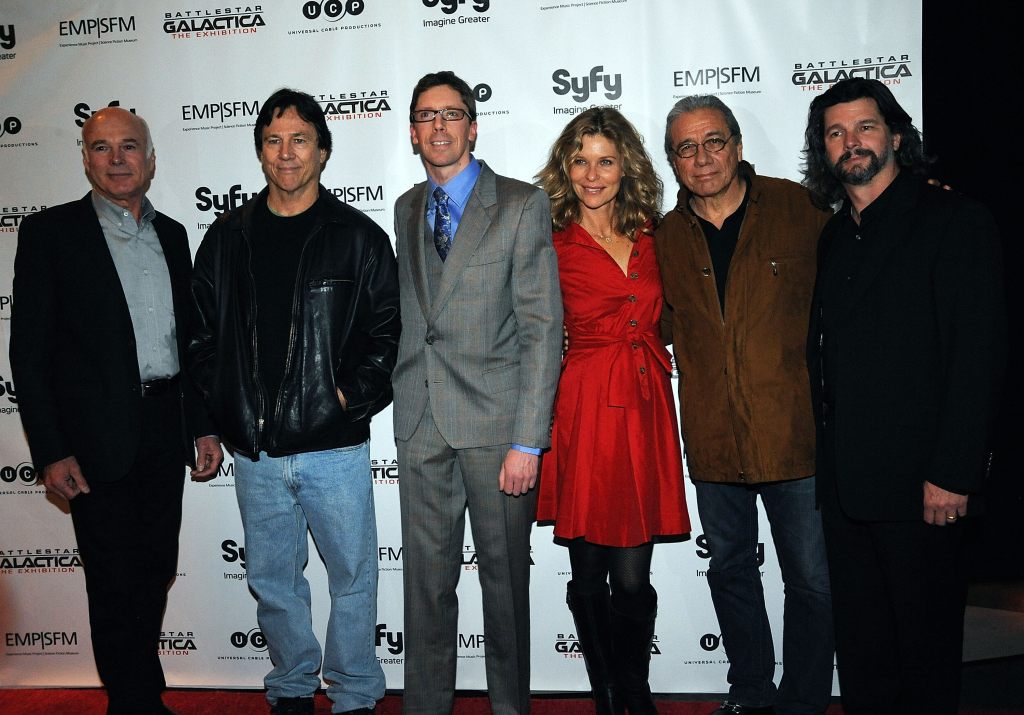
RONALD D. MOORE: “I got this invitation to appear at Galacticon, which was going to be at the Universal Hilton about a month before the miniseries was on the air. They invited me to come. It was a Con put on by Richard Hatch and some other people that was dedicated towards celebrating the original Battlestar Galactica. So they invited me to come talk about the new one. And let’s face it: I kind of knew I was going into the lion’s den on this, but I said, ‘I want to take a bunch of clips.’ I wanted to take the entire first act, but Universal wouldn’t let me. So I pulled together five or six minutes of material from the miniseries.”
DAVID EICK (co-creator/executive producer): “I didn’t attend the convention, because I thought, ‘The hell with those guys.’ I said to Ron, ‘I think it’s great you’re extending an olive branch, but I think they’re going to throw it right back at you. I don’t know why you’d want to hang around those people, but have fun.’”
RONALD D. MOORE: “So I got up on stage at Galacticon and I said, ‘Well this reminds me of a scene in Patton where Patton gets up in front of the crowd and says, “I just thought I’d stand up here and let you people see if I’m as big a son of a b-tch as some of you think I am,”‘ which got like virtually no laughs. Maybe a couple of titters. Not much. This is not a friendly crowd. I said, ‘Well, let me show you some clips. No one has seen these before. This is exclusive to you, and then we’ll talk about it afterwards.’ So I brought the house lights down, played the show, played it all the way through, and then the house lights come up and they booed and hissed. They really did. I’m not making it up. I’m, like, ‘Holy sh-t.’ And then it was, ‘Alright, time for questions.’ So I’m taking questions from the audience and they were unremittingly hostile. Didn’t like it, thought it was an affront, thought it was an insult to the original show and terrible. And they hated Starbuck.”
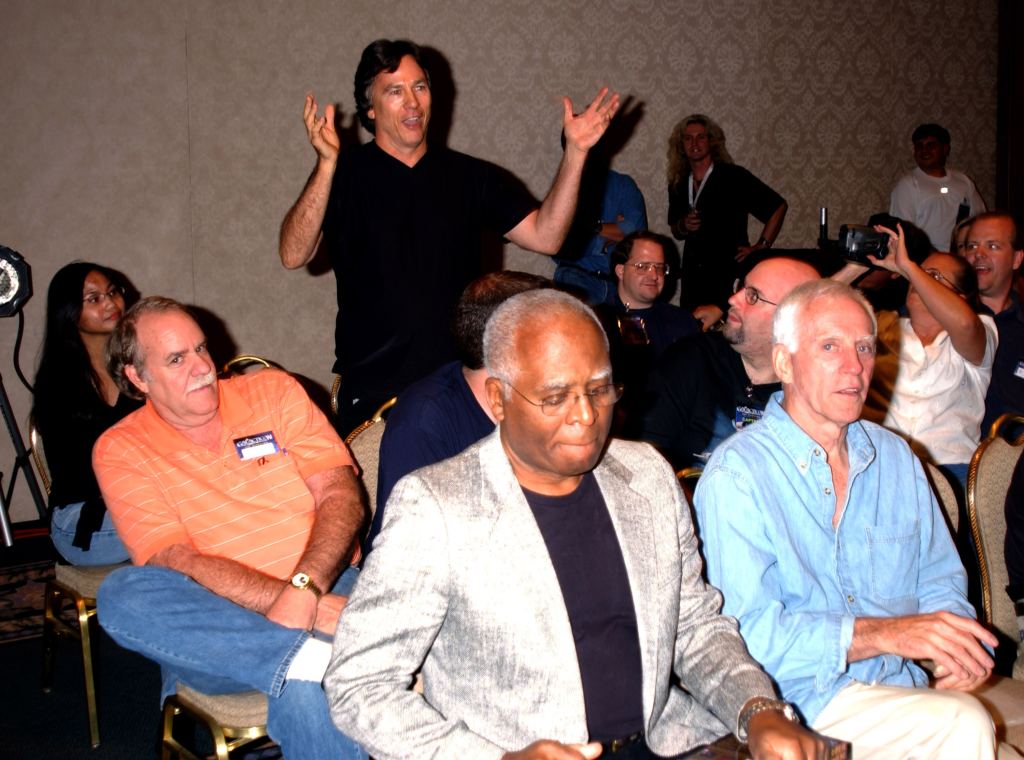
“I’m fielding questions as best I can, and at some point somebody got up and finally said, ‘Well, I think you can see our reaction and our feelings about what you’ve done. If you actually go to series with this, will you make a commitment today to do a show that’s more in keeping with the Galactica that we know, and that we love, that would be a true Battlestar Galactica?’ And I said, ‘Well, how honest do you want me to be?’ And suddenly people are yelling, ‘Be honest! Tell the truth!’ And I went, ‘Well, the truth is, no. If we do the show, it’s going to be this show. You don’t have to watch it and you don’t have to like it, and that’s fine. But this is the show we’re going to do.’”
“Now people are really upset and they’re standing up and they’re yelling. Suddenly, out of nowhere—and I hadn’t even noticed him in the audience—Richard Hatch stands up like Moses and goes, like, ‘Oh, children of Israel.’ Everybody shuts up and he’s standing in the audience and says, ‘Look, this isn’t what I would do with the show, but this isn’t fair to Ron. He’s our guest here and we have to treat him with respect. I don’t like the things said today, but I just think we have to stop this. You know, he’s an artist. It’s not my vision of the show. I really disagree with some of the things he’s doing, but this isn’t right.’ And it just took the wind out of the audience and it was an amazing thing.”

RICHARD HATCH (actor, “Apollo”; Tom Zarek): “I was producing the 25th Battlestar anniversary convention for mostly the original fans at the time, and they were very angry that I was inviting Ron Moore. It was a very, very difficult convention, because of all the controversial feelings, and people had gotten bags of popcorn to throw at Ron Moore because Ron had made a statement—he’d taken so much criticism and had gotten a little frustrated with everything—and said, ‘If you don’t like it, throw popcorn’ or ‘eat popcorn’ or something like that… I can’t remember the exact wording, but I was sort of terrified that they were going to throw this popcorn at Ron.”
RONALD D. MOORE: “Later, I went backstage and met Richard for the first time in the green room. And I said, ‘Wow, I really appreciate you doing that.’ He was, like, ‘Well, I meant what I said. I mean, I really don’t like what you’re doing here. I don’t think it’s the right way to go, but that just wasn’t cool and I just couldn’t stand that.’”

RICHARD HATCH: “I didn’t change my mind. People mistake changing your mind. To clarify that, I have always been for a continuation. I think the most viable way of going with the series would have been a continuation, evolving the story forward twenty-five years. And then you could have evolved the Cylons and you could have got into the cutting-edge, provocative storylines that the new show [did]. But you would have had a continuation. That would have been the difference and obviously, that was my preference.”
“But they, Universal, made a decision not to do that. So for me, it wasn’t about being against the new show, because I didn’t know what the new show was. It was always for the original continuation. But I always was fighting to get into the darker, more provocative storylines, getting into the struggle to survive in space, getting into the meat of what Battlestar‘s story is all about. But we couldn’t do that, the network (ABC) wouldn’t let us. I was always frustrated as an actor and also as a creative artist. I felt it was such a great story, but we were barely touching the surface of what that story was all about. The network, the studio, everybody was afraid of science fiction. Everybody was afraid of rocking the boat. Everybody was afraid of getting too deeply into something that might alienate somebody, so they played it very safe.”

RONALD D. MOORE: “When we were backstage at that con, I said to Richard, ‘You know I have a lot of respect for that. I really admire you. If we actually do get picked up to series, I want to talk to you about appearing in the show.’ He says, ‘Well, we’ll see. Let’s just talk about that when the time comes.’ So I just kind of filed that away in my head and once we got picked up to series, then I was going to find a place to bring Richard Hatch into that show.”
DAVID EICK: “There was a time, not too soon before hiring Richard Hatch, when both Ron and I would’ve absolutely scoffed at the idea of bringing anybody from the original Battlestar into the show. We were trying to stake out our claim because we knew the fans of the old show didn’t like what we were doing anyway, and some of the stars of the original show had said really nasty things about what we were doing, so we were, like, ‘F-ck them.’ We’ll have our nods — we designed the Galactica to kind of evoke the original, we kept the Viper [ship] sort of the same, we reinvented other stuff. We thought, ‘We’re nodding enough; we don’t need to be bringing in Lorne Greene’s daughter or something.’ You know, give me a break.”
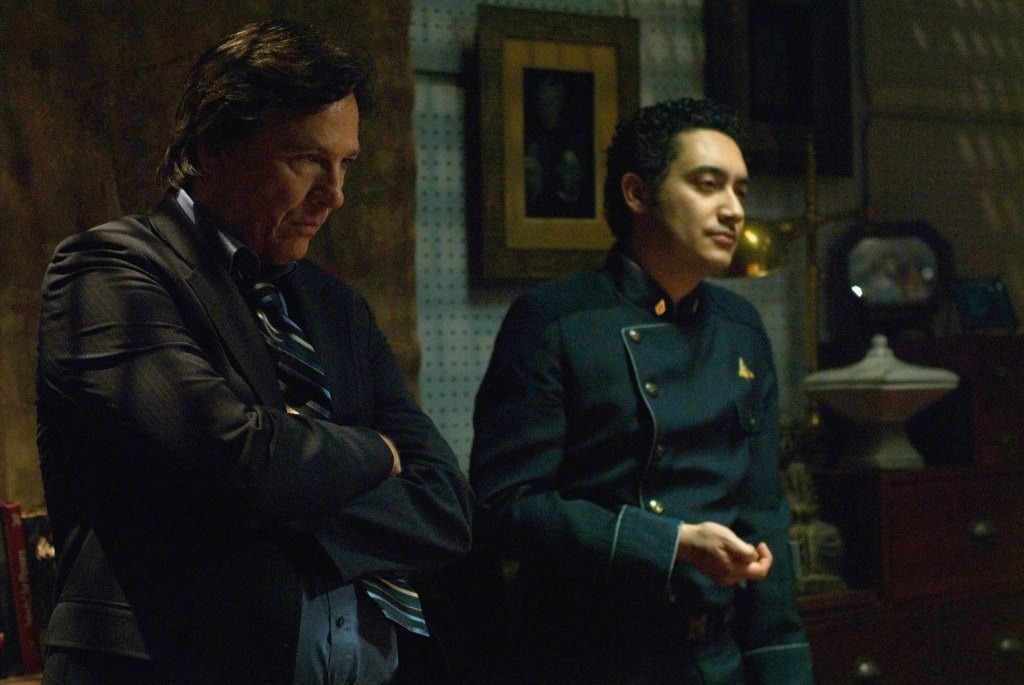

RICHARD HATCH: “Battlestar Galactica has played such a huge part in my life, from playing Apollo in the original version up to the new version, where I would get to play one of my most challenging and favorite characters ever: The complex and unfathomable Tom Zarek. It is rare in an actor’s life that he gets the opportunity to play two such diverse characters in the same story so many years apart that not only speak to the heart of who I am as a human being, but who I have become as a result of the trials, struggles and tribulations that follow all artists in their journey to find meaning and their place in the world.”
DAVID EICK: “When Ron came back from that convention and said, ‘Look, I spoke to Richard Hatch, and I think we should offer him a job,’ it was still a shock to me. But at that point in time, I could see some wisdom in it. I could see that this guy, who’s been the most outspoken about this version of Battlestar, and played the original Starbuck… whatever his name is, Dirk Benedict, was just sort of nasty and dismissive, but Richard Hatch had tried for years to do his own version. He had made a short and tried to pitch and sell it. He wrote novelizations and did a bunch of conventions, so to me it almost became ironic. And then I started to love it, because I thought if we get the most outspoken critic, the guy who was the most vociferously against what you’re doing, to be on your show, that’s so insidious and underhanded that I love it. It’s like we went and robbed their bank. I think Ron had very different reasons for liking this idea. Mine were probably much more childish and subversive. I loved the idea of subverting all of that nasty blogosphere stuff about what we were doing by taking one of their own.”

RONALD D. MOORE: “When Richard did appear on the show once it went to series, I think it absolutely changed the view of some of the fans. The thing about it is, it could’ve gone either way. If he had been a rallying point for the fans as someone from the show saying terrible things about it, it could’ve really kept a core group of people that were opposed to what we were doing. I don’t think it would have affected the sense of the show overall, but there would’ve been more of a negative core to some elements of the fandom. But Richard’s endorsement and participation in it, and then advocacy of it, I think, went a long way towards just saying, ‘Hey, look, they’re not crapping on the original. They’re just saying, “Hey, we’re doing a different version of it and they’re actually trying to celebrate the original in some ways.”‘ And everybody just kind of got onboard. There’s that moment in the miniseries where the ships are flying to the original theme. I never wanted to pretend that it was completely original. I’d always wanted it to be Battlestar Galactica.”
Conversation
All comments are subject to our Community Guidelines. Woman's World does not endorse the opinions and views shared by our readers in our comment sections. Our comments section is a place where readers can engage in healthy, productive, lively, and respectful discussions. Offensive language, hate speech, personal attacks, and/or defamatory statements are not permitted. Advertising or spam is also prohibited.