Scientists Discovered Multiple New Species in 6 Days—5 Disguise Themselves as Excrement!
From 'invisible' geckos to spiders that mimic bird droppings, see the year's wildest new discoveries that hide in plain site

A single week in late October 2025 produced a wave of new species discoveries across five countries, all connected by camouflage strategies so effective that the animals evaded scientific detection until now.
Researchers described animals from Vietnam, India, the Philippines, Borneo and Peru during a six-day window. The work was led by Dr. Jérôme Constant at the Royal Belgian Institute of Natural Sciences (RBINS). His team confirms new species by comparing body structures, habitats, and genetic data across known relatives, using DNA barcoding — short gene sequences that identify separate lineages.
What emerged was a catalog of creatures whose concealment tactics range from mimicking tree bark to smelling like bird droppings on purpose.
A planthopper that becomes part of the tree

On October 24, 2025, the planthopper Gelastyrella vuquangensis was described in Vu Quang National Park, Vietnam.
“The specimens were found sitting on tree trunks and larger branches covered in moss and lichen,” wrote Dr. Constant. The bark-level camouflage reduces contrast with the background, letting the insects resemble debris until physically touched.
Live specimens were first observed on July 14, 2023, but a formal description took more than two years of verification.
Spiders that weaponize disgust
The same day brought two new crab spiders: Phrynarachne gorochovi from the Philippines and Phrynarachne storozhenkoi from Borneo. Their strategy goes well beyond visual trickery. These spiders mimic bird droppings, which serves a dual function: avoiding predators that have no interest in excrement, and attracting flies that do.
Researchers noted the spiders emit a foul odor and sit on thin white silk to draw flies closer. The visual mimicry, the smell, and the silk platform work together as a system. Flies approach what they perceive as a food source and become food themselves.
A gecko smaller than your thumb
On October 27, 2025, the gecko Hemiphyllodactylus venkatadri was described from the Seshachalam Biosphere Reserve in southern India. Six individuals were collected, the largest measuring just 1.3 inches (33.7 mm) from snout to vent.
These geckos hide under bark during daytime heat, making detection nearly impossible without night surveys. Some small geckos can change skin tone within minutes using pigment cells called chromatophores. Light levels, stress hormones, and temperature influence this color change, turning the animal into a real-time adaptive surface.
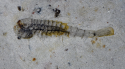
A legless amphibian revealed by a CT scan
On October 29, 2025, Ichthyophis griseivermis was described from evergreen forests in north-central Vietnam at 2,300–2,600 feet (700–800 m). This is a caecilian — a legless amphibian that burrows and hunts in soil using head and rib movement.
Micro-CT scans of the caecilian’s skull revealed bone patterns that helped distinguish it from close relatives. The authors suggested a Data Deficient status on the IUCN Red List, meaning insufficient data exist to assess extinction risk. That designation carries weight: scientists know too little about this animal to even gauge how threatened it is.
A frog found at only one spot on Earth
On October 30, 2025, Phrynopus manuelriosi was described from Yanachaga-Chemillén National Park, Peru, at 10,760 feet (3,280 m). Frogs were found 20–100 cm above the ground in high-elevation “elfin” forests. Long fingers and toes help them grip leaves at that altitude.

The species is microendemic, meaning it is only known from its type site — one specific location on the planet. That extreme geographic limitation makes it especially vulnerable. Microendemic species are sensitive to habitat changes such as roads, erosion, and logging.
Naming is the first step, not the last
Naming species allows surveys and legal attention, though it does not replace on-the-ground habitat protection. Taxonomists designate a holotype specimen for each new species, and tissues, photographs, and bones are stored for future DNA testing and morphological comparison.
Stable funding and proper museum conditions are essential for preserving those reference materials, yet many biodiversity hotspots lack these resources. A frog known from a single Peruvian mountaintop can’t benefit from conservation funding if no one knows it exists. Formal naming opens the door to Red List assessment, habitat surveys, and legal protections — but the door only stays open if the infrastructure behind it holds up.
Conversation
All comments are subject to our Community Guidelines. Woman's World does not endorse the opinions and views shared by our readers in our comment sections. Our comments section is a place where readers can engage in healthy, productive, lively, and respectful discussions. Offensive language, hate speech, personal attacks, and/or defamatory statements are not permitted. Advertising or spam is also prohibited.