Scientists Found a New Scorpion Species With Eight Eyes Under a Rock at a Thai Campsite
Scientists camping in a Thai forest discovered a new scorpion species hiding beneath a rock.

A research team camping in one of Thailand’s most protected forests discovered a never-before-documented scorpion species hiding beneath a rock—a tiny predator barely an inch long with an unexpectedly complex set of biological tools.
The species, named Scorpiops krachana, was formally described in a study published March 6, 2024 in the journal ZooKeys. Zoologist Wasin Nawanetiwong and colleagues from Chulalongkorn University found the scorpions while surveying rocks near their campsite during a field expedition inside Thailand’s Kaeng Krachan National Park.
Beneath a single rock resting on moist leaf litter near a seasonal stream, the team collected four specimens: three males and one female. That small sample yielded enough anatomical data to confirm a species never before documented by science.
A coin-sized predator with outsized abilities
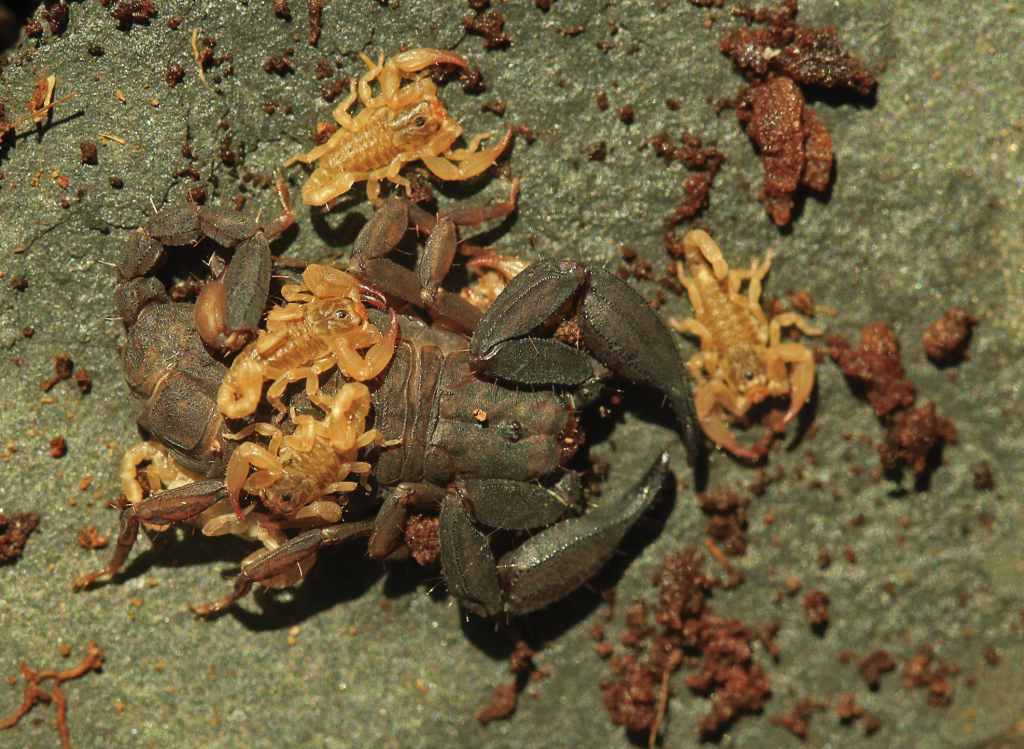
Scorpiops krachana ranks among the smallest members of its subgenus. Nawanetiwong wrote in the study that “Males reach just over one inch from head to tail.” Adults measure between 0.85 and 1.06 inches from head to stinger, according to the paper.
Despite its size, the species carries biological tools that punch above its weight class. Its elongated pedipalps end in straight claws, and field measurements reported in the study indicate those slender claws can close quickly enough to capture prey larger than the scorpion’s own body.
Along its pincers, the scorpion has sensory hairs known as trichobothria. According to the researchers, these hairs allow it to detect air movement and locate prey in low-light environments—functioning as a built-in motion sensor for an animal that hunts while staying still.
The species also has eight eyes, the maximum number typically found in scorpions. The study suggests that having eight eyes may improve depth perception during stationary hunting, giving this small predator an edge in sensing the distance to passing prey.
Visual differences between sexes and a UV twist
Researchers documented visible physical differences between males and females. According to co-author Natapot Warrit, females have a darker chocolate-colored shell, while males appear more tan.
The study also referenced research suggesting that scorpion exoskeletons can fluoresce under ultraviolet light and may function as a light-sensing surface. For a creature that relies on stealth and stillness in low-light forest habitats, that potential ability to sense ambient light through its own body adds another layer to an already unusual sensory profile.
A UNESCO World Heritage habitat still revealing new species
The discovery site sits inside Kaeng Krachan National Park, which lies along the Tenasserim Range near Thailand’s western border. The park is part of the Kaeng Krachan Forest Complex, designated a UNESCO World Heritage Site in 2021.
According to UNESCO, the forest complex contains at least 459 animal species, including 48 endemic species and 81 species classified as rare. The location where the scorpion was found—a transitional forest zone where secondary forest meets older growth—also supports frogs, crickets and beetles, all potential prey for a scorpion this size.
Nawanetiwong noted the new scorpion may be unique to the region. “This new taxon may represent one endemic element for the scorpion fauna of Thailand,” he wrote in the paper.
The discovery pushes the number of described Euscorpiops species in Thailand to 13 and raises the total number of known Scorpiops species worldwide to more than 115, according to the study.
DNA work underway, but habitat pressures loom
The research team is not finished with Scorpiops krachana. They are conducting genetic sequencing of the mitochondrial cytochrome c oxidase I gene to better determine the species’ evolutionary relationships with other Asian scorpions. That DNA work could clarify how this species fits into the broader family tree and whether related undescribed species might exist nearby.

The authors note that land-use changes near the discovery site could affect the scorpion’s habitat, as areas outside the park transition into farmland. For a species that appears to occupy a narrow ecological niche—moist leaf litter in a transitional forest zone near seasonal streams—even small shifts in land cover at the park’s edges could squeeze its range.
What this discovery signals

A research team camped in a well-known national park, flipped a rock, and found a species that had never been recorded. That suggests the inventory of life on Earth, especially small-bodied and ground-dwelling species in tropical forests, is far from complete—even within areas that already hold World Heritage status.
The scorpion’s combination of features—eight eyes, prey-detecting sensory hairs, claws that can snag animals larger than itself, and a body that may glow under UV light—demonstrates how evolution packs complex adaptations into a frame barely over an inch long.
Where one new species turns up, others often follow. The genetic sequencing now underway could open doors to more discoveries in the same region.
Conversation
All comments are subject to our Community Guidelines. Woman's World does not endorse the opinions and views shared by our readers in our comment sections. Our comments section is a place where readers can engage in healthy, productive, lively, and respectful discussions. Offensive language, hate speech, personal attacks, and/or defamatory statements are not permitted. Advertising or spam is also prohibited.