DEXA Scans Transform Weight Loss: How One Woman Lost 27 Pounds of Hidden Belly Fat
The scan helps reveal where your body is holding onto fat instead of lean, calorie-burning muscle

Key Takeaways
- DEXA scans reveal where you carry fat vs. muscle, helping you lose weight in the right places.
- Nicole lost 27 pounds of belly fat by tracking body composition to guide her efforts.
- Tracking body composition instead of scale weight can improve your long-term health.
For years, the basic bathroom scale has ruled the worldwide weight-loss discussion like a tyrant. But it’s being dethroned for a comprehensive body-composition scan called DEXA, known as the gold standard for bone density tests. Sure, scales can tell us what we weigh, but what we really need to know is whether those pounds are fat worth shedding or muscle worth saving. And discovering exactly what you’re made of helps. This scan reveals where your fat is hidden, giving you a roadmap to your healthiest, strongest body. “A DEXA scan can serve as an important tool in a weight-loss journey,” explains Stanford-trained radiologist Mia Kazanjian, MD.
Just ask Nicole Yelland, 43, who discovered this game-changing approach at exactly the right moment. She’d been stress-eating her way through the pandemic. But one DEXA scan changed everything—revealing not just her weight, but exactly where she needed to focus. The result? She lost 60 pounds and trimmed 27 pounds of dangerous belly fat. Here’s how to use a simple DEXA scan for weight loss.
Why a DEXA scan for weight loss can be life changing
Nicole felt overworked and exhausted. Between work stress and family demands, she’d stopped taking care of herself. “I’d never stress-eaten in my life until COVID.” Suddenly she found herself snacking on Oreos and doomscrolling, waking up tired. “My health took a backseat.”
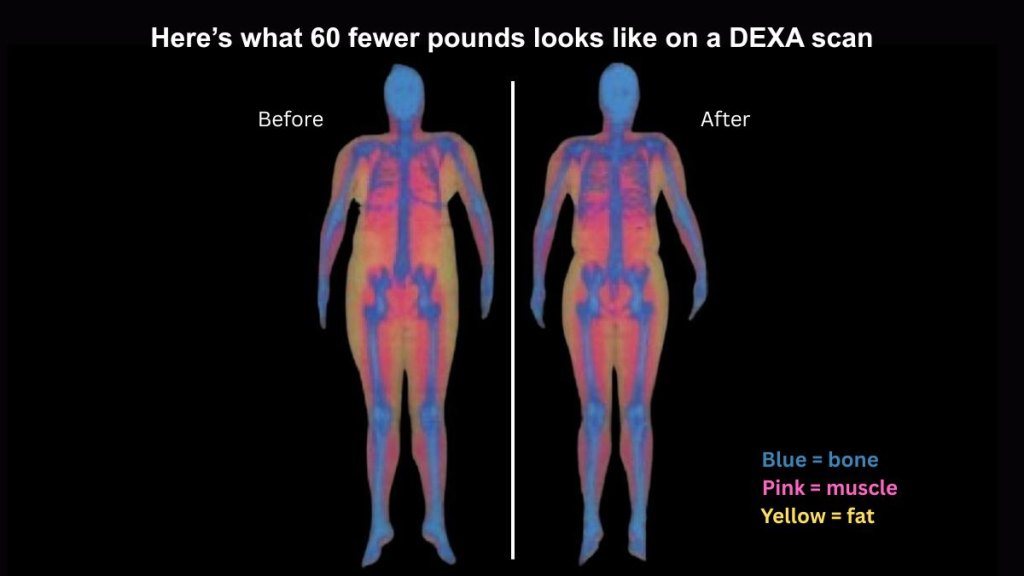
Then, at a silent auction, Nicole won a gym membership to Xceleration Fitness in Auburn Hills, Michigan. The prize came with a DEXA (dual-energy X-ray absorptiometry) test. The scan was painless. She lay on a table, while an imaging arm glided over her body, using X-rays to measure her visceral (hidden) fat, muscle and bone density.
When Nicole saw the color-coded results on paper, she was shocked. At 200 pounds, her body was almost 43 percent fat. “My poor heart, my poor lungs. No wonder I was out of breath. There was no muscle infrastructure supporting my major organs!”
She recalls, “That was a wake-up call. I wanted to see those numbers improve.” She realized, “The scale was a superficial tool. DEXA felt like something I could have a true conversation about with my doctor.”
The lifestyle changes that helped Nicole lose weight
Armed with her DEXA scan insights, Nicole made strategic changes to support her weight-loss journey and overall health. Here are the changes she made—and what you can try too:
Nutrition tweaks
The trainer at the gym took that data from the DEXA scan and told Nicole which macros to eat to reduce harmful visceral fat and build lean muscle mass. Before, Nicole’s approach was “less food, less calories, less weight.” This time it became: “How can I get more protein, more healthy carbs, more fat?” She used the free app NetDiary to track her intake, aiming to eat 120 to 140 grams of protein (about a palm-sized portion at each meal), 100 to 120 grams of carbs and 50 to 70 grams of fat daily.
What did Nicole eat during her weight-loss journey? She started each morning with 2 cups of “proffee” (coffee with chocolate protein powder). For breakfast she enjoyed grilled Ezekiel bread with butter and honey or eggs with toasted kale. For lunch she ate TikTok rainbow salad with peeled carrots and cucumbers, sesame seed oil, rice vinegar and soy sauce, topped with chicken and chili flakes. As for dinner: “A cheeseburger is the perfect macro meal: protein, carb, fat.”
She also found satisfying swaps: Instead of pasta, Nicole chose spaghetti squash with meatballs and cottage cheese whisked into marinara sauce.
Fitness focus
Three mornings a week, Nicole headed to her bootcamp-style gym for weight lifting and high-intensity interval training. Her DEXA body composition scan even guided her workouts. “I learned my left side was stronger than my right side. No wonder my back hurt.” So Nicole lifted five pounds heavier on her right to balance things out. She found, “I’m happier, sharper and smarter when I workout.”
In the process, Nicole’s strength grew. She started out not being able to do a single push-up. Now she can complete a full workout and run a seven-minute mile. Her weightlifting mantra: “Don’t be a baby. You can go heavier.” That tough-love approach to herself paid off when it came to her long-term health.
At 5’3”, now just 140 pounds, Nicole can deadlift more than her bodyweight: 185 pounds. Plus, she is teaching her kids about health. “My 7-year-old asked when she can come to weightlifting classes too!”
She lost 27 pounds of unhealthy belly fat
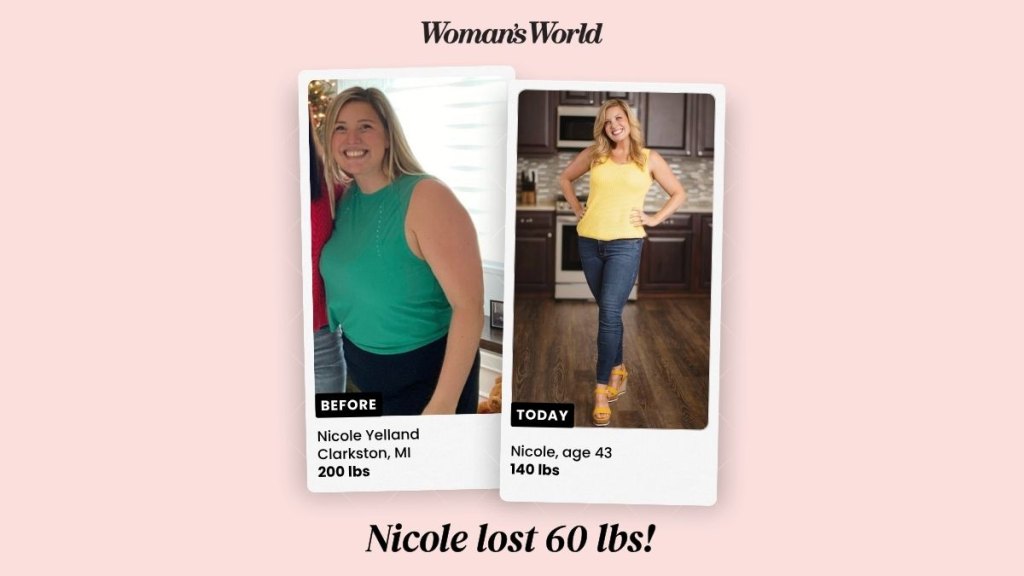
In six months, Nicole felt her energy and confidence soar, so much she started her own business, GRIT PR. In two years, she lost 60 pounds, switching from size 16 to 4. A follow-up DEXA scan revealed she’d lost 27 pounds of organ-stressing fat, dropping from 42.7 to 33.6 percent—from 137 square centimeters to 64.6 cm2.
At home one day, wearing a dress, Nicole recalls, “My underwear fell off!” More importantly: “I built muscle and cut my disease risk.” Her once-high cholesterol is perfect. She’s proud to be aging well: stronger and healthier. “I often get mistaken for being younger!”
How to get the most out of a DEXA scan for weight loss
Try to get it covered by insurance: DEXA scans are often available through many health centers and gyms. But ask your doctor if you can get one for bone mineral density (which is often covered by insurance.) If not, you can use HSA and FSA funds to cover an out-of-pocket DEXA scan for body composition. (Average cost is about $125.)
Use the same machines: Get a baseline DEXA scan, then an annual follow-up to chart your progress. Using the same machine can ensure the highest level of accuracy.
Track your progress at home: Many smart scales now have technology to measure body fat, muscle and bone at home. Try: RunStar Body Composition Scale for $50.
Make adjustments as needed: When reviewing your follow-up DEXA scan, if you see that you’ve primarily lost water or muscle rather than fat, “Add resistance training, a higher-protein diet and a workup for any underlying health issues,” Dr. Kazanjian advises.
Why DEXA scans give you a fuller health picture
The pounds on our body are not created equal. Some, like muscle, rev metabolism and boost longevity. And others, like deep belly fat, raise our risk of heart disease and fuel inflammation. So when we lose weight, it helps to ditch the right kind.
“The scale can make you think you are winning if the number is lower, when you are losing valuable muscle, which is essential for metabolic health and blood sugar management,” explains orthopedic surgeon Cory Calendine, MD, with the Bone and Joint Institute of Tennessee. That’s why many doctors prefer an in-office DEXA scan, which gives you much more detail.
Why losing fat matters more than losing weight
We know getting educated about our specific body composition improves health outcomes. In one BMC Public Health study, women who saw their scan results, in this case for their bone health, were more likely to implement behaviors that drove benefits, leading to annual increases in bone density. The same can work with body-fat insights.

“Chasing a lower number on the scale often forces women into relentless, self-defeating cycles of muscle loss and rebound weight gain,” says preventive medicine expert Michael Doney, MD. DEXA scans are a better gauge of your weight loss and better insights into your body composition. Even when the scale doesn’t move, DEXA results may reveal profound changes in fat loss or muscle growth. “These results completely reframe success from a focus on losing weight to promoting lifelong health.”
Ready to try it for yourself? Talk to your doctor or search “DEXA scan near me” to find body composition testing in your area.
This story originally appeared in the August 17, 2026, issue of Woman’s World.
Conversation
All comments are subject to our Community Guidelines. Woman's World does not endorse the opinions and views shared by our readers in our comment sections. Our comments section is a place where readers can engage in healthy, productive, lively, and respectful discussions. Offensive language, hate speech, personal attacks, and/or defamatory statements are not permitted. Advertising or spam is also prohibited.