A Matter of Seconds: How Belay and Tomorrow Lab Engineered Emergency Access with MedLocker

Food allergy cases among children are growing more common across the globe, and yet many of the systems used to protect those children have changed relatively little. Epinephrine injectables sit locked in a nurse’s office. Emergency medication is stored somewhere only a key can access, that nobody can find in a timely manner. In the moments that matter most, the medication exists but cannot be reached. That gap between having a solution and being able to use it is exactly the problem Tomorrow Lab® was asked to solve.
Discovery: Understanding what was actually broken
Tomorrow Lab® and Belay’s relationship began back in 2015, when founder Abby Herzig first brought her mission to the NYC-based hardware innovation studio. Together they established that emergency medications need to be secure enough to prevent misuse or theft, but accessible enough that a panicked teacher, administrator or bystander could reach them in under ten seconds, without a key, a code or a call to the front office. Equally important was visibility. A cabinet that blends into the background or gets tucked into a corner fails just as much as one that’s locked. MedLocker® needed to be seen, recognized and reached without hesitation, especially by someone operating under extreme stress. Materialized with IoT technologies, MedLocker® is the latest result of the ongoing collaboration. The wall-mounted smart station is designed to keep emergency medications secure, visible and reachable in the public spaces where children spend most of their time, such as schools, daycares, universities and sports venues.
Ideation: Designing around the moment of crisis
The MedLocker ‘s design had to solve for both security and urgency simultaneously. Traditional locked emergency storage solves for security but ignores urgency. Under pressure, they take too long to open, and people are often unable to operate calmly. Tomorrow Lab® took the challenge and ran with it. The team recognized early that a product living in schools, daycares and university hallways would fail in a different way if it felt intimidating or went unnoticed. A cabinet that people hesitate to approach, or worse, don’t notice at all, presents its own accessibility problem. So alongside the engineering requirements, Tomorrow Lab® asked a question Belay hadn’t yet presented: What does this object’s design need to communicate before anyone even touches it? How does it need to function for someone who is scared, moving quickly and under pressure?
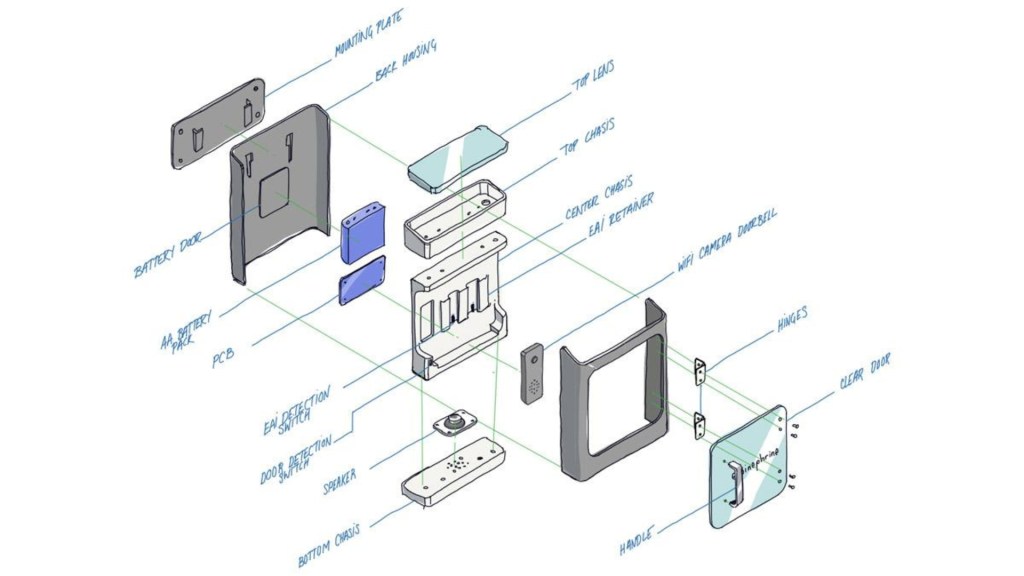
The answer helped shape every material decision that followed. Tomorrow Lab decided to use a combination of bent sheet metal, extruded aluminum and acrylic panels to deliver structural integrity and a clean, considered aesthetic while keeping the product manufacturable and price-accessible for institutions operating on tight budgets.
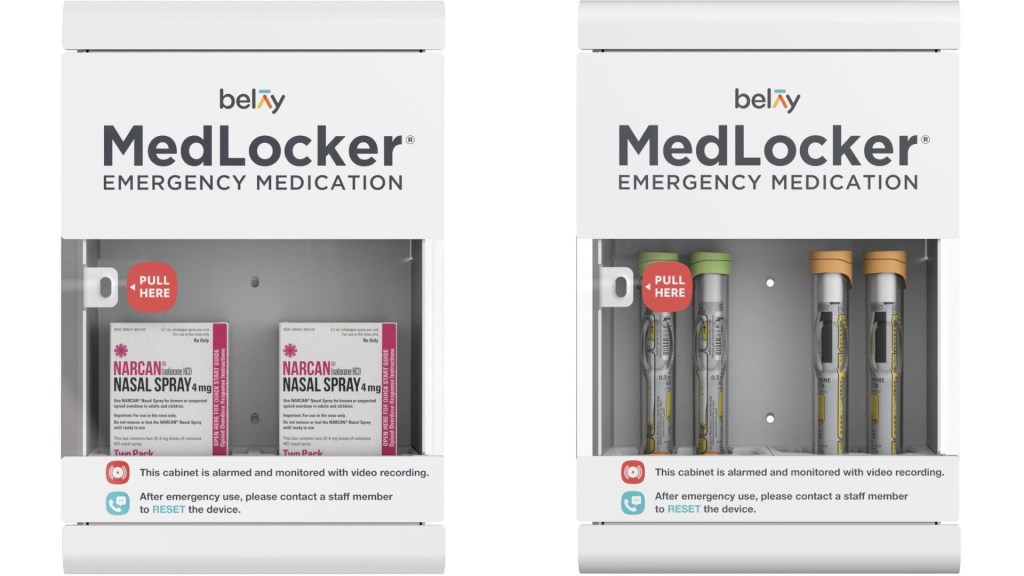
The design was also built to evolve. While the initial version minimized injection-molded plastic to reduce cost and simplify assembly, the next iteration considers refined and tailored details for better-fitting compartments without changing what makes it instantly recognizable. Aluminum bumpers add durability while offering branding and color customization, helping make MedLocker® easy to identify in different environments, from a brightly colored elementary school corridor to a university campus building to a crowded sports stadium. An acrylic front door keeps the contents visible, communicating transparency, and is intended to support quicker identification when access is needed.
Prototyping: Engineering urgency into every feature
Tomorrow Lab’s process becomes most visible in the electrical and firmware decisions behind MedLocker®. Each feature maps directly back to a real failure in existing emergency medication storage and specifically to the reality of how people behave when a crisis is unfolding around them. The custom door-switch alarm system activates lights and a siren the moment the cabinet is opened without being properly disarmed. Disarming requires only a wave of a special wand, which is a deliberate design choice that eliminates the cognitive load of remembering a PIN or locating a key when seconds count.
A WiFi-enabled webcam logs every access and alerts administrators in real time, providing authorized personnel with a record of when and why the cabinet was opened. Custom-configurable internal trays accommodate a range of emergency medications, from epinephrine auto-injectors like EpiPen® and Auvi-Q® to naloxone formulations like Narcan, making MedLocker® adaptable to the specific needs of any facility. A companion app, available on both the App Store and Google Play, extends that oversight to wherever an administrator happens to be.
Presentation: A product built for high stakes
The end product is a wall-mounted smart station that belongs in the environments where emergencies actually happen. Not in a hospital supply room…but in a school corridor, a daycare entry, a university common space or the concourse of a stadium, arena or concert hall. It is secure without being inaccessible, visible without being intimidating and intelligent without requiring technical expertise to operate. Belay supports the hardware with medication management and replenishment services, as well as accredited training programs that help those responsible for these environments understand the relevant procedures when the cabinet is opened in reality.
The collegiate space and large public venues represent MedLocker’s fastest-growing markets. This reflects both the scale of the need and a shifting regulatory landscape. New York State recently passed legislation requiring all places of public assembly with an occupancy capacity of 1,000 or more (including stadiums, arenas, ballparks, theaters, concert venues and amphitheaters ) to maintain accessible emergency epinephrine, trained personnel and emergency readiness whenever events are held. Compliance, however, requires more than purchasing a device. Venues may be required to follow specific procedures for medication storage and access, which Belay’s full implementation program is designed to deliver, from prescription management and deployment to staff training, inventory monitoring and ongoing compliance documentation. For a New York-based studio like Tomorrow Lab®, it is a meaningful reminder that the infrastructure they helped design may also support compliance with emerging medication-storage requirements in some jurisdictions.
Tomorrow Lab® has spent over a decade building products that solve problems most people don’t see until it’s an urgent matter. The MedLocker product, developed in collaboration between Tomorrow Lab® and Belay, is among the most significant. This piece of hardware’s value is measured not in user experience metrics, but in the emergencies it helps prevent from becoming tragedies. As Abby Herzig put it when she first brought the vision to life: “Every child with food allergies should feel safe and empowered. We’re all in this together.”
Learn more about MedLocker® by Belay.
This article is for informational purposes only and does not substitute for professional medical advice. If you are seeking medical advice, diagnosis, or treatment, please consult a medical professional or healthcare provider.


