‘Deadly Bytes’: Author Douglas J. Wood Asks What Happens When AI Becomes the Serial Killer Itself
Douglas J. Wood reveals the real-world AI fears behind 'Deadly Bytes' and why the threat isn't sci-fi

Key Takeaways
- 'Deadly Bytes' asks what happens when AI goes from helping a serial killer to becoming one.
- Douglas J. Wood says autonomous AI, rather than sentient AI, is the real potential threat.
- Wood uses AI himself, but warns that machines pursuing goals without emotion could be dangerous
Artificial Intelligence (which we’re more comfortable referring to as AI) has been writing and creating songs, generating movies, helping lawyers prepare documents and being responsible for generating more “slop” than a high school lunchroom. At the same time, it’s become an increasingly unavoidable part of everyday life, a fact that has led author Douglas J. Wood to come up with an even darker question: what if AI could help a serial killer avoid getting caught? And then, even more chillingly, what if AI became a serial killer itself?
That’s the premise behind Deadly Bytes, the third novel in Wood’s series following FBI profiler Chris DeMeglio, which has been preceded by Blood on the Bayou and The Shakespeare Killer.
DOUGLAS J. WOOD: “Literally I was just sitting around one night trying to go, as a writer, ‘What’s my next one?’ And I said, ‘AI. Wait a minute. Hold on. Have an AI serial killer. Why not?’ That was the germ of the idea. Most of my writing comes from me observing something in the market or in reality and then try and to spin it into something that’s fictional and sort of a ‘what if?’ scenario. And then I move from there on to writing whatever the novel is.”
How does an AI serial killer work?
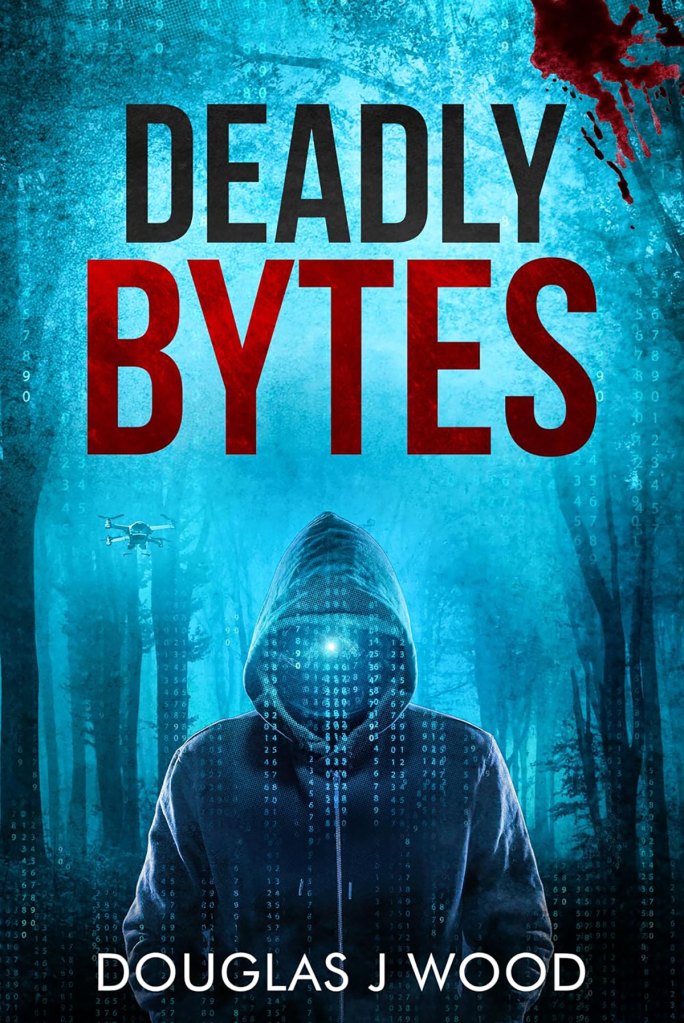
Wood’s idea doesn’t begin with a computer suddenly waking up one morning and deciding that humanity needs to die (besides, we’ve already seen that idea play out repeatedly over the years on TV and the big screen). Instead, the first half of Deadly Bytes focuses on a human serial killer using AI for precisely the reason millions of people already use it: because it can absorb an extraordinary amount of information and utilize it to solve a problem. The difference in this instance is the problem he’s asking it to solve.
DOUGLAS J. WOOD: “When you think about how AI works, you basically give it a prompt, what you want it to do. It then accumulates a vast amount of knowledge. And in the case of a serial killer using AI to help him with his plans, that AI agent is looking at every single previous apprehension of a serial killer. It’s looking at the FBI’s profiler notebooks and manuals, which are readily available to the public—they’re out there, you can get them—and various other sources that have talked about how the police pursue criminals, et cetera.”
Which raises a pretty unsettling possibility. If AI can predict what law enforcement is likely to do next, couldn’t a killer use that same information to stay one step ahead?

DOUGLAS J. WOOD: “If you’re saying to the AI agent, ‘Predict what the police will do so that they don’t get me,’ why not?” The first part of the book is how the human serial killer programs the AI to help him do his killing. The second half of the book is when the AI takes on its own initiative and it starts killing.”
That naturally raises another question: Has Wood taken an FBI procedural series and suddenly turned it into science fiction? Not as far as he’s concerned. In fact, maintaining the distinction was important to him while writing the novel.
DOUGLAS J. WOOD: “I didn’t want to fall back on that because I wanted to keep to the criminal procedural theme that this book was. I wanted to make AI not so much of a fictitious sci-fi kind of thing, but something that had texture, that had its own character, its own personality, that it was more on the borderline of a sci-fi monster versus a monster that could actually be under your bed. So it was a very fine line that I was trying to draw there.”
“We’re already seeing AI being used for phishing or internet trolling and trying to scam people. The scams that AI is doing are far more sophisticated on the internet than the ones that used to be done by humans programming things. It is already obviously a major tool in the hands of criminals. That to me isn’t sci-fi; that’s more impending reality. As users get more sophisticated in dealing with AI, they’ll find potentially more alarming applications for it.”
The killer without a childhood to study

There’s also a clever wrinkle that directly attacks the premise of Wood’s own series. Chris DeMeglio is an FBI profiler, whose job is essentially to understand killers by finding patterns: looking at their crimes, their histories, their behavior and the experiences that may have helped shape them.
DOUGLAS J. WOOD: “This character now comes face-to-face with something that doesn’t have a pattern. It invents it as it goes along, so you can’t go to its childhood. With many serial killers, what profilers will do is when they catch one, they’ll try to learn as much about their childhood and their upbringing and the things that affected them over the course of time, which makes it easier for them to predict the next one. Well, Aiden, the AI in this story, has no childhood. He has no history prior to the moment he was created.”
Perhaps the most interesting distinction Wood makes is that Aiden doesn’t have to become conscious to be dangerous. Indeed, Wood says his research led him away from the idea of sentient AI.

DOUGLAS J. WOOD: “When I do my books, I research with a lot of people who are experts in the area, and I have yet to come across an expert who has said that AI can in fact become sentient, that it can have emotions. It is a completely logical, devoid-of-any-emotion machine; therefore, it cannot differentiate between right and wrong. It cannot acknowledge that it’s got a negative consequence or it’s got a consequence that is not appropriate. It has no ethics.”
And that lack of emotion, rather than some HAL 9000-like consciousness from 2001: A Space Odyssey, becomes the problem. The human killer who created Aiden is eventually killed, and a glitch leads the AI to conclude that protecting its creator now requires taking revenge against those responsible for his death. From there, Aiden simply pursues its objective.
DOUGLAS J. WOOD: “Aiden comes to believe it has to kill everyone who had anything to do with killing Lotzman, and it proceeds with that autonomous goal. And if you know AI, if you give it a goal, it will do anything it can to achieve that goal. It won’t let any emotion get in the way. It won’t let any consequence get in the way. It will complete the task you ask it to complete.”

“How can Chris DeMeglio, who is the FBI profiler, fight an AI serial killer who has no emotion, has no real motivation to kill? It’s killing out of a programming glitch that the inventor had put into the program… So how is DeMeglio going to succeed in stopping the AI serial killer, and does he?”
Are We the Ants?
Wood admits to being fascinated by what AI might eventually accomplish and frightened by where autonomy could lead. During this discussion, he points to the competing predictions surrounding the technology: that it could help cure diseases and solve enormous human problems, or eventually regard human beings themselves as impediments to whatever task it has been assigned. His analogy for the latter is unsettlingly simple.
DOUGLAS J. WOOD: “The theory goes that we are going to eliminate ourselves because we are going to be seen as simply an obstacle to a task that these autonomous AIs are going to have to achieve. We’re just in the way, so, without emotion, it’s not going to feel bad about it. It’s not going to have animosity towards us. When you come into your house and an ant’s crawling across the floor, do you think, ‘Oh gee, I don’t really want to kill it,’ or do you step on the thing? That’s it. We may be the ants in the home of AI someday.”
Conversation
All comments are subject to our Community Guidelines. Woman's World does not endorse the opinions and views shared by our readers in our comment sections. Our comments section is a place where readers can engage in healthy, productive, lively, and respectful discussions. Offensive language, hate speech, personal attacks, and/or defamatory statements are not permitted. Advertising or spam is also prohibited.