Steve McQueen vs. Bruce Lee: The Friendship, Rivalry and Competition Behind Two Legends
Bruce Lee wanted Steve McQueen's success, which created a rivalry between the two stars

Key Takeaways
- Bruce Lee openly wanted the fame and success Steve McQueen had achieved.
- Lee hoped 'The Silent Flute' would make him a star, but McQueen refused to participate.
- Despite their rivalry, McQueen served as a pallbearer at Bruce Lee's 1973 funeral.
Steve McQueen and Bruce Lee occupied very different corners of popular culture, yet their lives intersected in ways that neither man could have anticipated. McQueen was already one of Hollywood’s biggest stars, the actor whose cool, understated screen presence had made him a box-office powerhouse through films like The Great Escape, Bullitt, The Magnificent Seven, The Getaway and Papillon. Lee was still fighting for recognition in an industry that offered few meaningful opportunities to Asian actors, even as he was developing the martial arts philosophy and screen presence that would eventually make him an international sensation.
Their relationship began through Lee’s work as a martial arts instructor. Among his students were some of Hollywood’s most recognizable faces, but none carried more status than McQueen. The two men quickly developed a mutual respect. McQueen admired Lee’s discipline, confidence and extraordinary physical abilities, while Lee looked at McQueen and saw something he desperately wanted: the kind of stardom that seemed almost impossible to achieve.
That shared respect, however, was accompanied by a competitive edge. McQueen had worked his way out of a troubled childhood to become one of the most bankable actors in the world and was fiercely protective of his position. Lee was equally ambitious and openly discussed his desire to become a major movie star. As Lee’s confidence grew and his ambitions expanded beyond teaching martial arts, the friendship between the two men developed an undercurrent of rivalry.
The dynamic was complicated. There was admiration on both sides, but also jealousy, frustration and the natural tension that can develop when two driven personalities begin pursuing similar goals. Over the years, stories emerged involving career opportunities, romantic interests and personal interactions that revealed a relationship far more nuanced than either a friendship or a feud. According to biographers Marshall Terrill and Matthew Polly, the truth lay somewhere in between.
Was there actually a rivalry?
MARSHALL TERRILL: “Lee’s wife insists there was no competition, but I assure you there was. There always is when you get into that stratosphere. It wasn’t an outright rivalry, I would say, but there was definitely an undercurrent there of it. At the same time, I have to say that these two guys really liked each other. They respected each other, and that’s foremost. Where the competition started was when Bruce Lee pretty much announced to Steve that he wanted to become a major movie star, and I feel like McQueen probably said, ‘Well, now you’re encroaching on my territory.’ But McQueen was not unique in that way. I’ve read biographies of Warren Beatty and Robert Redford, and I saw the same sort of characteristics in those guys.”
MATTHEW POLLY: “Their relationship was like a professional sibling rivalry. I feel that McQueen used Paul Newman as his personal benchmark for what he wanted to achieve. Newman had slightly better parts, even though McQueen was the bigger box office draw, but as soon as I read that description of them, I was, like, ‘Oh, that’s what Bruce was to Steve.’ He was his kung fu coach, and so he had something Steve wanted, which was to be better at fighting. And Steve admired how tough Bruce was and what a great fighter he was, and he wanted to be that good a fighter himself. I think Lee did the same with McQueen, which is to say he was the younger brother in the sibling rivalry. There was mutual love and respect and affection between McQueen and Lee. After all, McQueen went to Lee’s funeral and he hated to attend funerals — famously skipping [friend] Sharon Tate’s after the Manson murders.”
McQueen never shared his true feelings about Lee
MARSHALL TERRILL: “What’s so interesting is that even though he served as one of Lee’s pallbearers, McQueen never gave a quote about Bruce Lee. James Coburn did tell me it was a very emotional funeral, but McQueen was the only guy that didn’t cry or show his emotions. But that’s who McQueen was. And even though he didn’t show much emotion at the funeral, I think it must have deeply impacted him, because there were a lot of friendships in his life where people did die. There’s actually a huge body count. He had a drug dealer friend who died the same year of a heart attack, and he had Jay Sebring and Sharon Tate, who died in the Manson murders. He was very close to them and was supposed to go over there that night, but at the last minute didn’t. So McQueen saw a lot of darkness in his life, and this was just one of those episodes.”
“And as far as him not ever talking about Bruce Lee, McQueen didn’t want anybody to know that he knew karate. If you had to get into a fight, he didn’t want anybody to know and he didn’t want that to be used against him in a court of law. That’s what his last karate instructor, Pat Johnson, told me; that he wanted the element of surprise and that he didn’t want to be sued.”
Lee wanted to be the bigger star
MATTHEW POLLY: “Bruce wanted everything that Steve McQueen had. He didn’t just want one aspect; he wanted to be a bigger star than Steve McQueen.”
MARSHALL TERRILL: “Getting to the top is such a struggle that you don’t want anybody to knock you off your perch, right? And Bruce Lee was saying to him, ‘I plan to be the world’s biggest superstar.’ The ironic thing is that McQueen was very jealous of other people. For example, I remember an actor turned writer named John Gilmore talked about how he would see Steve in auditions, and McQueen would just stare daggers at him, because he looked at him as someone trying to take away a job from him. I really think that’s where the undercurrent takes place. Also, even though McQueen respected Lee, you have to remember that Bruce was teaching him and, therefore, McQueen was paying him. So I think that McQueen himself, especially on the set of The Reivers, where he brought Lee, thought of Bruce as an underling. But then, suddenly, you’ve got this new dynamic that pops up.”
‘The Silent Flute’ becomes divisive
The competitive nature of their relationship became especially apparent when Lee developed a project called The Silent Flute. Conceived as a philosophical martial arts adventure, the film was deeply personal to Lee and represented far more than another acting job. He saw it as a potential breakthrough, the project that could finally establish him as a major Hollywood star. To help make that happen, he set his sights on one of the biggest names in the business: Steve McQueen.
Lee envisioned McQueen playing the story’s hero while he himself would appear in a variety of roles encountered along the character’s journey. From Lee’s perspective, attaching McQueen to the project would dramatically increase its chances of securing financing and reaching the screen. But what began as an opportunity for collaboration soon exposed the underlying tension that had been building between the two men.
MATTHEW POLLY: “But Steve turned it down. Still, Bruce kept pushing him and Steve finally said, ‘Look, I’m not going to carry you on my shoulders. You want to do this movie so you can be a star and use me to do that, and I’m not in the business of making other people stars.'”
MARSHALL TERRILL: “McQueen was an ambitious guy, but I’m thinking that Bruce Lee was probably even more ambitious, because Bruce had so much more to overcome than McQueen. You know, stranger in a strange land, and the fact that there were no Oriental superstars that had been established yet. So he had to be the first and he had to find his own way. If you think about it, if McQueen hadn’t rejected him, Bruce Lee probably would not have gone on to become the person that he was, because it forced him to find his own way.”
Dreams of superstardom
MATTHEW POLLY: “When McQueen turned him down, Bruce was furious. He shook his hand and said, ‘One day I’m going to be a bigger star than Steve McQueen.’ [Screenwriter] Stirling Silliphant, who was with him at the time, said, ‘Bruce, it’s a white man’s world. You’re Asian. You’re never going to be a bigger star than Steve McQueen.’ Of course, afterward Silliphant commented, ‘And dammit if he didn’t prove us wrong.'”
Romantic rivalry
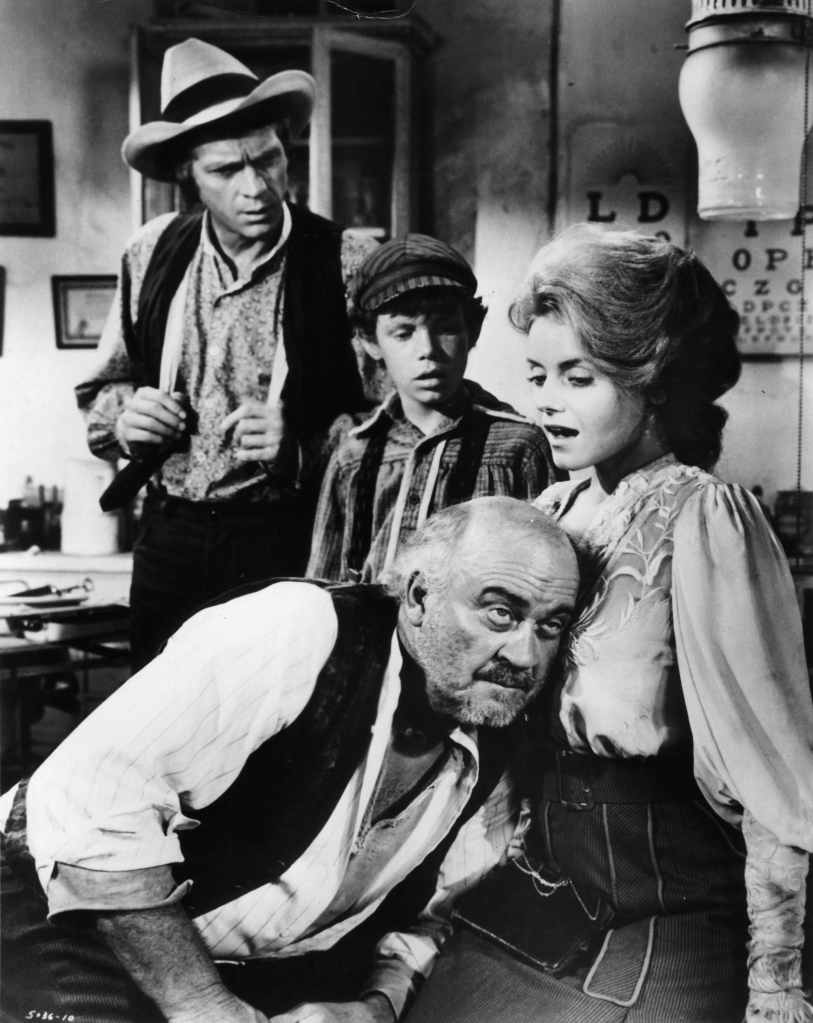
Professional ambition wasn’t the only area in which McQueen and Lee found themselves competing. There was also an unexpected personal dimension to their relationship involving actress Sharon Farrell. Farrell crossed paths with both men in 1969, appearing opposite Lee in Marlowe and McQueen in The Reivers. What neither actor seemed willing to acknowledge was that they were both married at the time, a fact that did little to discourage either man’s interest in her.
The situation added another layer to an already complicated relationship. By this point, McQueen and Lee were navigating a friendship built on mutual respect, but also one marked by professional jealousy and competing ambitions. Farrell’s presence introduced a more personal element into the equation, creating one more arena in which the two men found themselves measuring up against each other.
MATTHEW POLLY: “Bruce did a movie with Sharon, but before that, McQueen had had an affair with her. Of course, Bruce was a married guy as well, but nonetheless, there was some jealousy on Bruce’s part in regard to that. McQueen didn’t know anything about it and it wasn’t as if McQueen went out to steal this lady from Bruce Lee. I would nonetheless say that Bruce Lee was probably very upset about that. She ended up picking Steve over Bruce, so there’s a romantic element to this rivalry with Steve, which kind of blew my mind when I found that one out. That it wasn’t just professional, it was also personal. To me, it was a little high school, you know? It was like Steve was the captain of the team, and Bruce was the new kid in school, and they ended up dating the same girl. They’re friends and they both really liked each other, but they’re also jockeying for status. But that’s the way it is with a lot of actors: they live messy lives.”
The rivalry’s lighter side
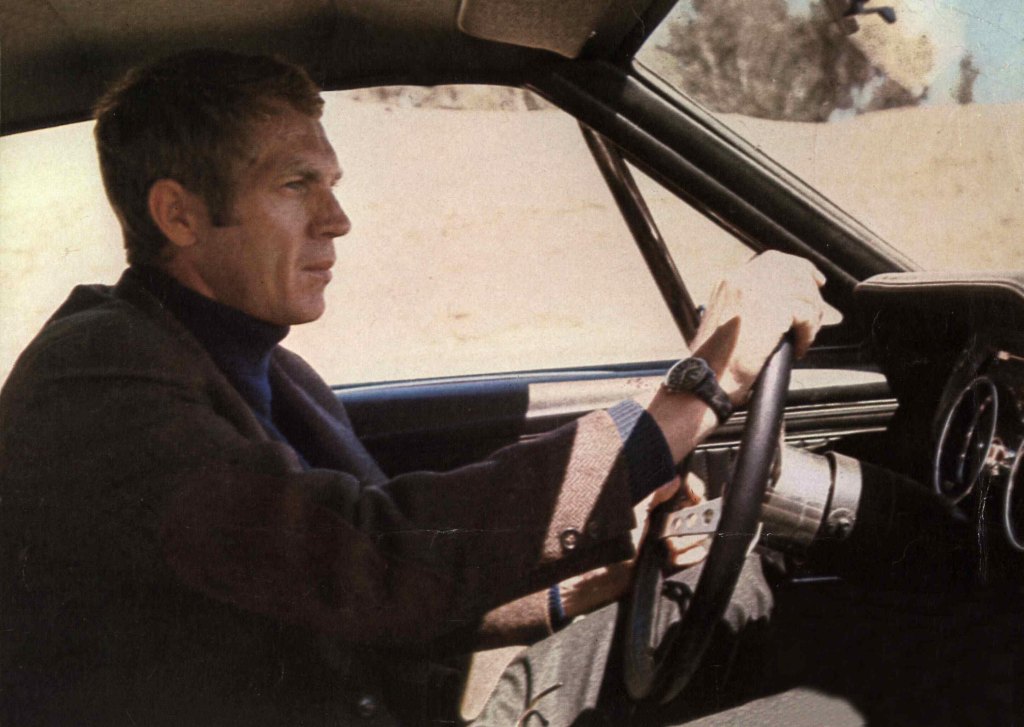
MARSHALL TERRILL: “The two did share one last bonding experience when Lee purchased his first Porsche after the money came rolling in. McQueen insisted Lee let him drive it to see how the car handled, and he took Lee on a hair-raising tour through Mulholland Drive, one of the most winding thoroughfares in Los Angeles, and he gunned the sports car up to nearly 100 mph. Lee, who was a control freak, was a white-knuckled passenger. ‘Now watch how I can slide it through these tight curves,’ McQueen said while Lee cringed, keeping one eye on the road and the other shut tight. ‘Now watch how this baby can do 180 in the middle of the road,’ McQueen said as he downshifted and slammed on the brakes, spinning the car halfway around and heading back the opposite direction at full speed.
“Lee, who was naturally wound tight, exploded, ‘McQueen! You crazy mudda——! I kill you!’ McQueen laughed, but his smile vanished when he saw Lee was livid with anger. He began to accelerate the car again, attempting to gain control of the situation. ‘Bruce, I’m going to drive the car as fast as I can until you calm down,’ McQueen said. Lee put his hand up and conceded, ‘Okay, okay, I’m calm, Steve.’”
Personally, we don’t think he was.
10 things to know about Steve McQueen and Bruce Lee’s friendship, rivalry and lasting bond
1. Did Bruce Lee teach Steve McQueen?
Yes, Bruce Lee taught martial arts to a number of Hollywood celebrities, including Steve McQueen, James Coburn and Roman Polanski. McQueen became one of Lee’s most famous students and admired his physical abilities and fighting skills. Their teacher-student relationship eventually evolved into a friendship.
2. Did Steve McQueen know Bruce Lee personally?
Very well. The two men spent significant time together during Lee’s years in Los Angeles. Beyond martial arts lessons, they socialized and shared many conversations about movies, fame and success. Their friendship was genuine, though it also contained a competitive streak.
3. Was there really a rivalry between Steve McQueen and Bruce Lee?
According to biographers Marshall Terrill and Matthew Polly, yes—but it wasn’t a bitter feud. Lee openly wanted the kind of movie stardom McQueen had achieved, while McQueen was known for being protective of his place at the top of Hollywood’s food chain. The result was what Polly described as something closer to a sibling rivalry.
4. Why did Bruce Lee want Steve McQueen for ‘The Silent Flute’?
Lee believed attaching McQueen to the project would virtually guarantee financing. The film was deeply important to him and represented his best opportunity to break into Hollywood as a major star. McQueen declined, and the rejection reportedly hit Lee hard.
5. What was ‘The Silent Flute’?
The Silent Flute was a philosophical martial arts adventure developed by Bruce Lee, screenwriter Stirling Silliphant and actor James Coburn. Lee planned to play multiple roles while McQueen would portray the central hero. The project eventually evolved into the 1978 film Circle of Iron, but Lee had passed away and David Carradine was cast.
6. Were James Coburn, Steve McQueen and Bruce Lee friends?
Yes. James Coburn was one of Lee’s closest friends and training partners. Along with McQueen, he belonged to Lee’s inner circle during the late 1960s and early 1970s. All three men shared an interest in martial arts and personal development.
7. Did Steve McQueen attend Bruce Lee’s funeral?

He did. In fact, McQueen served as one of Lee’s pallbearers when the martial arts legend was buried in Seattle following his death in July 1973. Considering McQueen’s well-known dislike of funerals, his attendance spoke volumes about the respect he had for Lee.
8. What’s the story behind ‘Steve McQueen almost killed me’?
One of the funniest stories involving the pair came after Lee purchased a Porsche. McQueen insisted on taking the car for a test drive and reportedly pushed it to extreme speeds through the winding roads of Mulholland Drive. Lee, who preferred being in control, was terrified. According to accounts from the time, McQueen delighted in the experience while Lee threatened to kill him if he didn’t slow down.
9. Did Steve McQueen ever talk publicly about Bruce Lee?
Surprisingly little. Despite their friendship, McQueen rarely discussed Lee in interviews. Biographer Marshall Terrill has suggested that McQueen preferred not to publicize his martial arts training and generally kept many personal relationships out of the spotlight.
10. Who was tougher: Steve McQueen or Bruce Lee?
Even McQueen’s admirers generally concede this one to Bruce Lee. McQueen was athletic, competitive and trained extensively, but Lee was a world-class martial artist whose speed, conditioning and fighting ability became legendary. McQueen respected those abilities enormously, which may have been one reason the two men connected so strongly.
Conversation
All comments are subject to our Community Guidelines. Woman's World does not endorse the opinions and views shared by our readers in our comment sections. Our comments section is a place where readers can engage in healthy, productive, lively, and respectful discussions. Offensive language, hate speech, personal attacks, and/or defamatory statements are not permitted. Advertising or spam is also prohibited.