The Magical Family of ‘Bewitched’: What Really Happened to Agnes Moorehead, Paul Lynde, Marion Lorne and the Rest of the Cast (Exclusive)
From Endora to Tabitha, a leading pop culture historian brings you the true stories behind the show's most unforgettable characters

Agnes Moorehead (Endora)

By the time Bewitched entered production, Agnes Moorehead was already a seasoned performer with decades of experience across stage, film and radio. Yet, as Geoffrey Mark points out, her career had always been complicated by Hollywood’s narrow definition of stardom. She was, he says, a “brilliant actress who, because she was not a great beauty, did not become the huge star she thought she should be.”
When Moorehead joined Bewitched as Samantha’s mother, it came more than 20 years after her formative work with Orson Welles’ Mercury Theatre and her appearances in Citizen Kane, The Magnificent Ambersons and radio classics like Sorry, Wrong Number. By then, Mark explains, she was “touring mostly to make her money” and accepted Bewitched largely for practical reasons. The series “could keep her in Los Angeles, keep her at home and making a decent income.”
Creatively, however, Moorehead was dissatisfied almost from the start. “She did not appreciate being on the show,” he says flatly. “She felt Endora was a one-note character. And the way it was written, it was.” While she remained professionally committed—“She did the show because she had a contract. She did the show because she was very fond of Liz”—she was unhappy with how the role evolved.
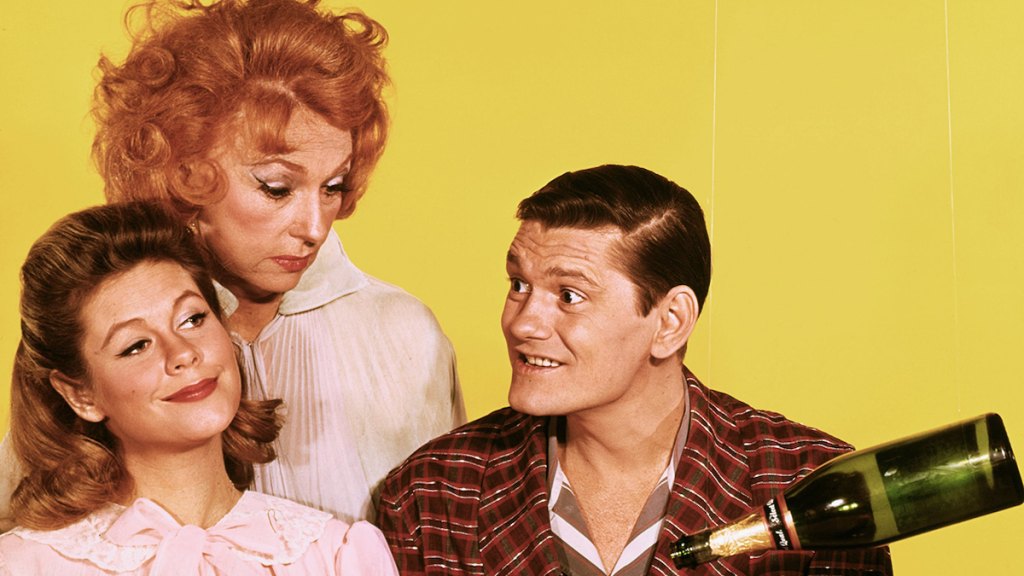
That dissatisfaction extended even to Endora’s appearance. Early in the series, Mark recalls, the conceit was that when Endora appeared in full witch regalia, mortals could not see her. “So for Darren or anyone else to see her, she had to wave her arms and all of a sudden her hair was beautifully coiffed… and she was wearing a beautiful dress or a beautiful suit and furs and things.” That visual distinction was later abandoned, and “you didn’t see Endora wearing very chic clothing anymore—and Agnes didn’t like that.”
Although Moorehead stayed with Bewitched for the duration of her contract, she did attempt to reduce her involvement. “So in the later seasons, we saw a little bit less of Endora,” he points out. Once the series ended, she returned to what he calls her “first love, the theater,” appearing on Broadway shortly before her death from cancer in 1974.
Behind the scenes, Moorehead’s financial need was deeply personal. Mark speaks candidly about her troubled home life, explaining that she had adopted a son who rebelled against her strict religious beliefs. “Agnes was very religious, very conservative,” he says. “You either did what she believed or you got lost. So he got lost.” The income from Bewitched, Mark adds, “enabled her to do that,” and also gave her the freedom to be selective later. “Now she could choose to do plays that didn’t pay very much because she had the income and she could satisfy her soul that way.”
Maurice Evans (Maurice)

Like Agnes Moorehead, Maurice Evans arrived on Bewitched—as Samantha’s father, Maurice—at a point when the most celebrated phase of his career was already behind him. He had been “world-renowned as a Shakespearean actor,” but age had closed off the great classical roles that once defined him. “He couldn’t play the great Shakespearean parts any longer,” explains Mark.
Complicating matters, Evans was gay at a time when such openness carried professional risk, and Mark explains that “that kind of thing was catching up with him”—a polite but pointed way of acknowledging how earlier behavior and private realities could quietly limit opportunities in mid-century Hollywood.
“Bewitched was the apex of his career in this country,” Mark says, adding that, much like Moorehead, “very soon afterwards, he was no longer with us.” For many viewers, Evans is remembered primarily for two roles: Samantha’s formidable father and Dr. Zaius in Planet of the Apes (1968) and Beneath the Planet of the Apes (1970). But he emphasizes that those screen appearances only hint at a far larger legacy. “His huge successes were on the stage on the West End in London and touring the world playing Shakespeare.”

That classical background was deliberately folded into his portrayal of Maurice. Evans’ line readings were unmistakably theatrical, something Mark sees as intentional. “Everything was Shakespearean in the way he performed it,” he observes, adding that the show leaned into that persona with a subtle sense of humor. Even the pronunciation of the character’s name was part of the joke. “They called him Maurice as a tease,” Mark explains. “In England, no one is called Maurice. If your name is spelled that way, it’s Morris.” Each time Moorehead’s Endora said the name, “you see him flinch because he hated it—and they let the character react that way.” He calls it “a wink from producer William Asher.”
Mark also places Evans within a broader tradition of Shakespearean performance. “There are really two kinds of Shakespearean acting historically,” he explains. “One is Shakespeare as poetry that is R-rated, and one is Shakespeare as an acting exercise.” Evans belonged firmly to the first camp. “Of the orators,” he opines, “Mr. Evans perhaps was the best.”
Marion Lorne (Aunt Clara)
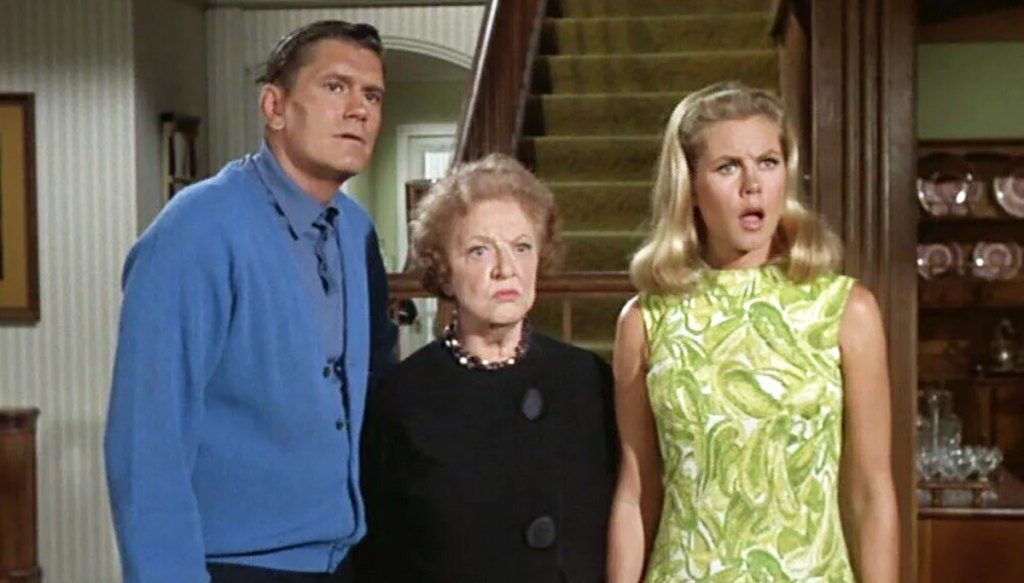
Marion Lorne’s path to Bewitched was anything but typical. As Geoffrey Mark explains, her life took a dramatic turn long before television made her a household name. “Marion’s life is terribly interesting because she gave up her career in America for love, moved to London, appeared in England for many years doing things, supporting her husband, who was an actor.” After his death, she returned to the United States, and, as Mark puts it, “Providence brought her to Mr. Peepers.”
That series marked the beginning of a late-in-life reinvention. “Very early in television, all of a sudden, Marion Lorne had a new career playing a befuddled woman who is trying to take things terribly seriously and can’t, and stammers and stumbles.” The audience response shaped the performance itself. “Mr. Peepers was done in front of a live audience. And when the audience began to react to the stammering, she did more of it—and it was written into the script more.” The result was a defining persona: “For better or for worse, she was kind of stuck with that. That became her hook.”
That same character carried through to The Garry Moore Show, and then seamlessly into Bewitched. But what could have been a repetitive comic device became something deeper. “Clara was the heart of Bewitched,” Mark says flatly. “And Clara made Darren acceptable. Clara made Samantha acceptable.”

The reason was simple and profound. “How could Samantha be so nice when all of her relatives are jerks? Well, her favorite aunt isn’t a jerk.” And Darren’s humanity is revealed through his kindness to Clara. Mark points to her introductory episode as a perfect example. As Darren prepares to ask her to leave, she remains focused on polishing doorknobs, thanking him for listening. “She’s hearing what he’s saying, but the character is ignoring what he’s saying… ‘Thank you for listening to me, because so few people basically care what I have to say.’” The moment changes everything. “Darren changes his mind and doesn’t tell her to leave.”
He also notes a subtle but important piece of character continuity: “If one watches all the episodes very carefully, it is clear that Clara is Maurice’s sister, not Endora’s.” He adds that Maurice’s interactions with her are “always lovely… like a brother would be.”
Behind the scenes, Lorne was deeply cherished. “It broke William Asher’s heart and Liz’s heart that Marion got so ill,” Mark says. “They let her work as long as she possibly could.” Even technical challenges—her hearing aids causing feedback, her hair loss during treatment—were handled with care and respect. Mark closes simply: “I have never heard from anyone a bad word about Marion Lorne.”
Paul Lynde (Uncle Arthur)

Geoffrey Mark doesn’t hesitate when asked to sum up Paul Lynde. “Paul Lynde was a gifted tragedy,” he says, a phrase that captures both the brilliance and the instability that defined Lynde’s career. “Enormously talented, enormously insecure. A hard worker, a good friend when sober… a raving b**ch to be avoided when he was drunk. And the older he got, the more often he got drunk.”
Those contradictions shaped Lynde’s professional life as much as his unmistakable comic persona. He was deeply loved by those who understood him best. “Bill Asher and he were the best of friends,” Mark says, and “Liz loved him.” But Lynde’s behavior also cost him opportunities, including a failed sitcom pilot derailed by what Mark refers to as “bad behavior.”
It was Asher who quietly engineered Lynde’s way onto Bewitched despite network resistance. “Bill snuck him in in the first season as Samantha’s driving instructor,” Mark explains. The appearance went well enough that “ABC didn’t yell, even though they’d instructed Bill not to use him on the show originally.” That opening led directly to the creation of Uncle Arthur.

Although Lynde appeared far less often than memory suggests, his impact was outsized. “He was on the show 10 times,” Mark says, “and he made such an impression that people think he was on the show all the time.” A large part of that impression came from his chemistry with Dick York. “Not so much with Dick Sargent—but I don’t think Dick Sargent had good chemistry with anybody on that show.”
Lynde never lacked work. “Paul Lynde worked constantly on television, in the theater, in films,” Mark says. What he lacked was stability. “Had he not had alcoholism—let’s use that word—had his personal life not been so contentious, he would’ve been an even bigger star, because his talent called for it.” Uncle Arthur, in that sense, became both a triumph and a reminder: a showcase for Lynde’s comic genius, and a glimpse of what might have been if his demons hadn’t kept pace with his gifts.
Elizabeth Montgomery (Serena)

Serena, the wild and mischievous paternal cousin of Samantha Stephens, was born not out of story necessity, but out of a practical concern: creative restlessness. As Geoffrey Mark puts it, “What does one do when the star of a show is getting bored playing the same character? One allows her to play something else.” The character was initially conceived as a one-time diversion for Montgomery, not a recurring presence.
In her first appearance, Serena was far removed from the version audiences would later come to know. Mark describes the original conception as “a beautiful, dark-haired sophisticate of the mid-1960s,” someone who would have been comfortable “going to a Broadway show, eating at a chic and trendy restaurant, shopping at Bergdorf Goodman’s for a fur.” Crucially, “we don’t even hear about the lookalike business yet,” he notes, emphasizing that Serena was not initially defined in opposition to Samantha. “Serena originally is not a kook. She’s a very intelligent sophisticate.”
The plot device that introduced her leaned into misdirection rather than comedy excess. “It was a good plot allowing Darren to think that his brand-new baby girl had grown into a woman by Endora and was paying a visit.” At that point, Serena functioned as a clever narrative complication rather than a cartoon.
When the character returned, however, cultural context had shifted. “Sometimes it only takes a year to change a culture,” Mark observes. Between Serena’s first and second appearances, “the British explosion had happened, miniskirts had happened, war demonstrations had happened, hippies had happened. The producers decided to take Serena and change her, make her flighty, make her selfish… there’s a sophisticate who’s up on the newest things, and then there’s a kook who’s up on the most recent things—and they turned Serena into that because Samantha was down to earth.”

For Montgomery, it was an opportunity. “They gave Liz this chance to play this over-the-top character instead or on top of playing Samantha.” Mark believes it worked—at least initially. “I think it worked for a while, but Serena was badly written… they were repeating the same things, the same sentences, the same stuff over and over.”
The problem, he argues, was a lack of growth. “Had they grown Serena into something else, had they let her keep growing? It might’ve been funnier. But they let her get big and then they froze her. She became a go-to for writers because it was the easiest thing to write. There’s no character development. It’s just, ‘Oh, Serena does this.’ Just like with Endora, there are back-to-back episodes built around superficial magical gags. Nothing changes. You don’t know anymore about these characters at the end of the episode than you did before.”
Alice Ghostley (Esmeralda)

Geoffrey Mark is unequivocal about Alice Ghostley’s place in Bewitched. “Alice Ghostley was another huge talent,” he says. “Bewitched was brilliantly cast. While there’s an occasional guest star who’s not terribly memorable, the regular recurring characters were cast so beautifully.”
Esmeralda, the bumbling and insecure witch-maid who serves the Stephens family, was introduced to fill a narrative need that had previously been served by Aunt Clara. “Rightly or wrongly,” Mark explains, the producers believed that “the Aunt Clara character gave the show wonderful plots of witchcraft gone wrong and what Darren and Samantha have to do to deal with that.” Esmeralda was designed to occupy similar territory, but timing proved crucial. “Unfortunately for the show, Esmeralda appears after Dick York left the show. Had Dick been there, I think the writing and direction would’ve allowed Darren to like Esmeralda.”
That distinction mattered. Esmeralda, Mark says, “was trying to live a mortal life, kind of, sort of. She was actually working. She wanted purpose to her life. Much like I Love Lucy needed Mrs. Trumbull, they needed a way to get the kids out of the way if they weren’t in the plot. Oh—Esmeralda’s taking care of them.”
Instead, Esmeralda became another source of irritation for Darren, largely because of the shift in performance style after York’s departure. “Every time Dick Sargent walks into a room, he’s annoyed at someone or something,” Mark says.
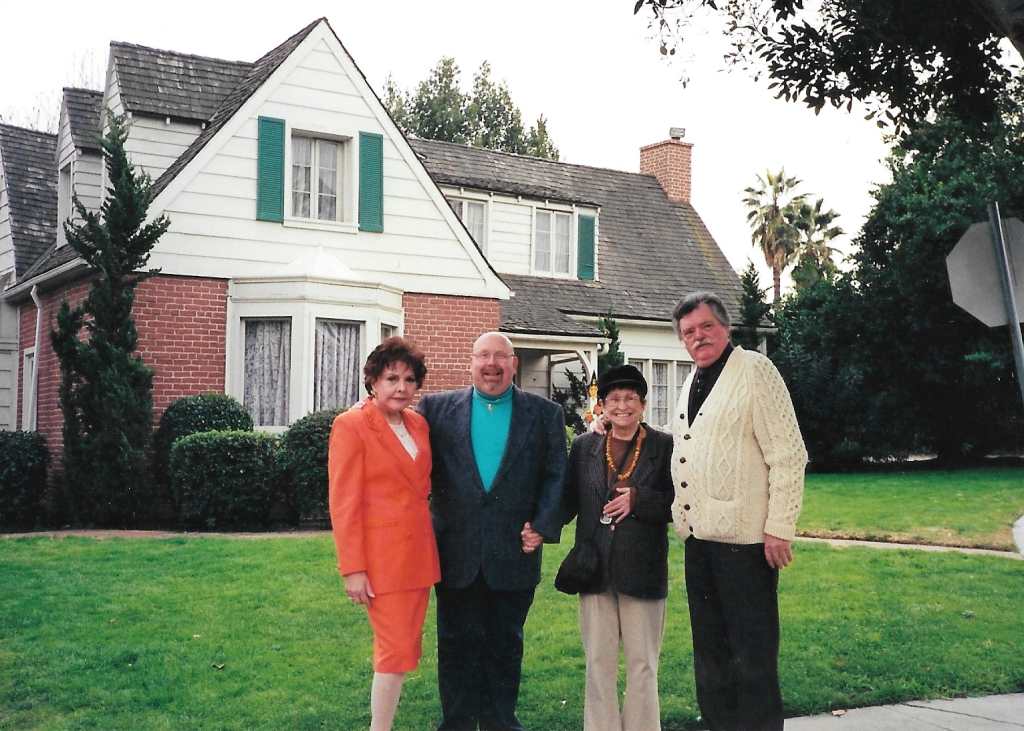
Ghostley, however, was no stranger to the show. “Alice had appeared early on as a maid they hired who is terrible. They figure out that she shouldn’t be a maid. She should be an accountant.” Darren even helps the character land a job at McMann and Tate. “That’s how Alice became Esmeralda a few years later. She’d already played a maid on the show for them—but a mortal one.”
Ghostley loved being part of the series, though she shared a common frustration. “Like a lot of the actors on the show, she didn’t like doing the same thing over and over and over again. The writers too often had her going, ‘Oh, dear,’ which she took from Zazu Pitts. But they needed her.”
Off camera, Ghostley left an equally strong impression. “Alice was a very dear woman,” Mark says warmly. “She was married and their marriage was a happy one.” He speaks from firsthand experience: “I was a guest in their home and dined with them.”
Erin Murphy (Tabitha Stephens)

Geoffrey Mark’s assessment of Erin Murphy begins with admiration that has only deepened over time. “Erin is a classic beauty,” he says, emphasizing that it’s not a nostalgic observation. “Still. She’s a grandmother, but—classic beauty.” Mark adds that she remains closely connected to the world of classic television, noting that she is currently dating Moosie Drier, best known from Laugh-In and The Bob Newhart Show.
“Boy did Bewitched luck out casting Erin Murphy,” he says. Because of child labor laws, the role of Tabitha required twins, and Erin shared the part with her sister, Diane. “They’re not exactly identical. They’re more fraternal, but as little kids, they looked enough alike that they could be substituted in and out.”
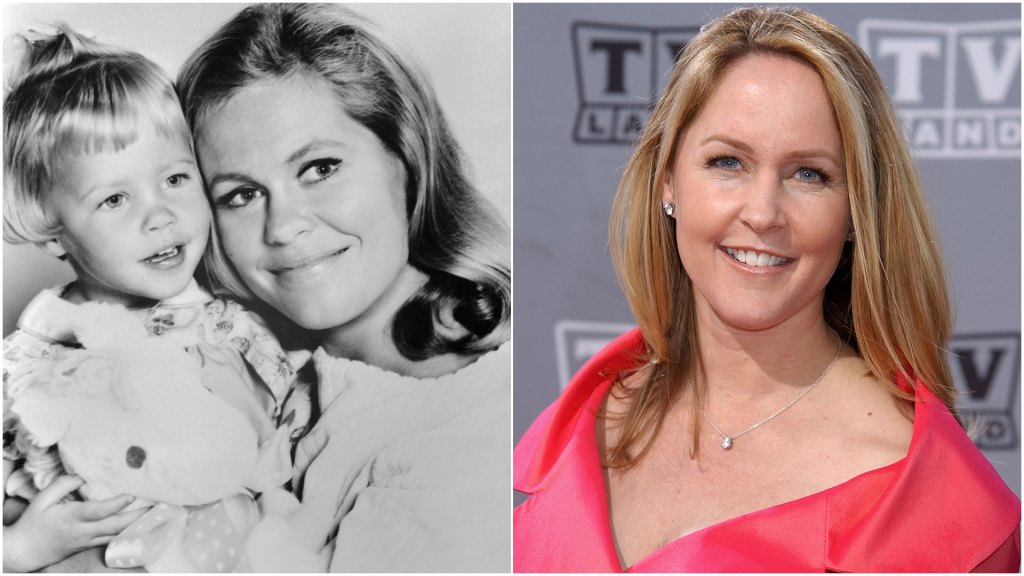
It quickly became clear which child was better suited for filming. “It turned out that Erin was the one with the personality for a camera,” Mark says. “So after a while, it was only Erin—except in long shots, or if something happened, or she was sick.” He makes a point of noting that whenever Tabitha speaks onscreen, “that’s only Erin.”
What made the casting especially remarkable was how the role evolved. “To luck out, to hire someone who can barely speak or say a word, and then as they get older, find out that they’re actually pretty and talented and can deliver punchlines,” Mark says, is almost unheard of. He singles out a late-series episode in which Tabitha befriends an African American girl and the two decide they want to be sisters. The script, he notes, was credited to a school class—“written,” he says pointedly, with quotation marks—before being adapted for television.
Mark sees a strong physical and emotional continuity between Murphy and her TV mother. “To this day, Erin looks like Liz, and is still absolutely beautiful and a wonderful representative of the show. A lovely, lovely woman.”
Bernard Fox (Dr. Bombay)
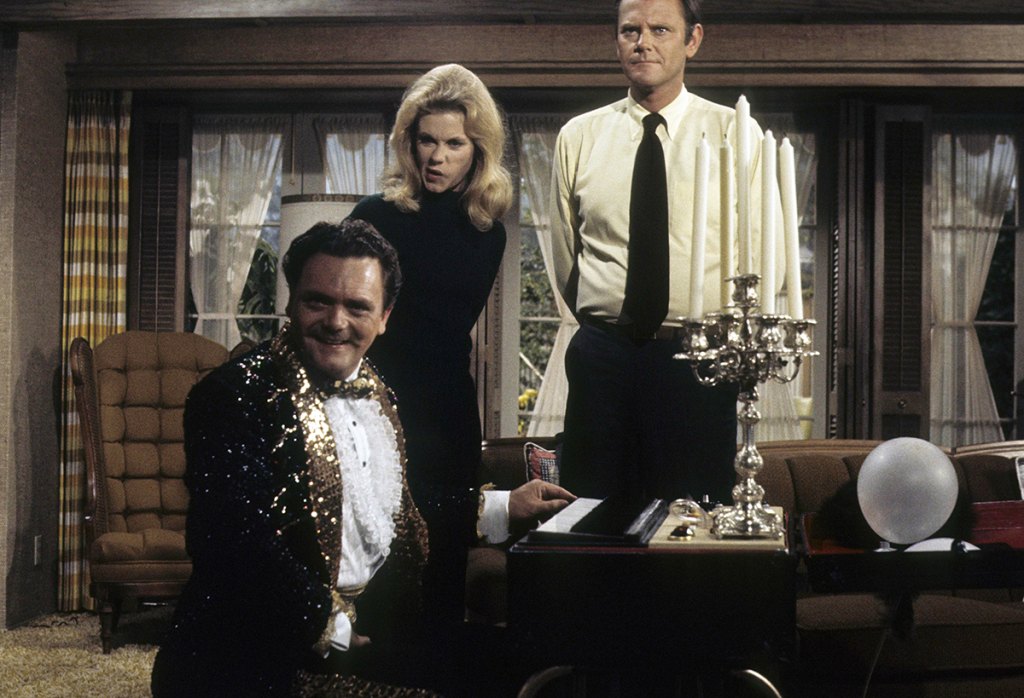
Geoffrey Mark places Bernard Fox squarely in the category of under-appreciated comic specialists. “Another brilliant comedy actor who came from England,” he says, noting that Fox ultimately “made his mark in this country more on television than in film or on stage.” During his Bewitched years, Fox was simultaneously appearing on The Andy Griffith Show, playing a very different role as Malcolm Merriweather.
That versatility was central to Fox’s appeal. “He could be very warm in his characterizations like he was on Andy Griffith,” Mark explains, “or he could play difficult very well also.” Dr. Bombay fell firmly into the latter category. The character’s brisk bedside manner and barely concealed irritation contrasted sharply with Fox’s more genial roles elsewhere, making his appearances instantly recognizable.

Dr. Bombay also existed in a strange gray area within Bewitched’s internal logic. “The Dr. Bombay character in some ways goes against the rules of Bewitched,” Mark observes. “For instance, he has a last name. But the show itself was inconsistent about his status. There are episodes where Endora says, ‘We’ll go to a different doctor,’ and there are other episodes where they say he’s the only doctor for witches. And of course, the joke—he’s a witch doctor.”
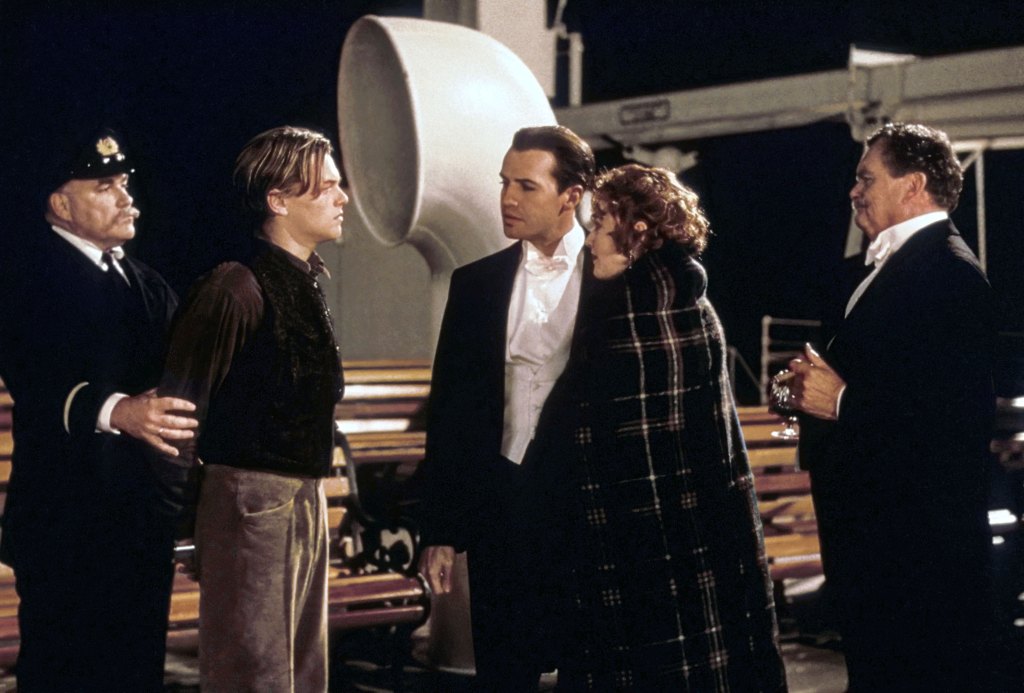
When Fox wasn’t leaning into the character’s exaggerated irritation, he cut a very different figure. “When he wasn’t playing so over the top, he was actually a very handsome man, quite well built earlier in his life.” Fox’s career stretched decades beyond Bewitched, culminating in a brief but memorable appearance in Titanic. Mark recalls seeing him onscreen and being caught completely off guard. “The first time I saw Titanic and he came up on the screen… at the top of my very loud lungs, I yelled, ‘Calling Dr. Bombay, calling Dr. Bombay, emergency, come right away.’”
The reaction was immediate. “They had to stop the film because the audience laughed so hard and for so long,” Mark says, adding that the screening paused until the laughter subsided.
Conversation
All comments are subject to our Community Guidelines. Woman's World does not endorse the opinions and views shared by our readers in our comment sections. Our comments section is a place where readers can engage in healthy, productive, lively, and respectful discussions. Offensive language, hate speech, personal attacks, and/or defamatory statements are not permitted. Advertising or spam is also prohibited.