The Four Marriages of ‘Bewitched’ Star Elizabeth Montgomery: Love Was So Much Easier on TV (EXCLUSIVE)
Inside the actress' four marriages and the relationship that finally brought her lasting happiness

When you strip away the spells, potions and mischievous relatives from Bewitched, what remains is a straightforward love story — a couple determined to make their marriage work no matter how many obstacles get tossed in their way. Elizabeth Montgomery’s Samantha and Dick York’s Darrin became one of television’s most enduring pairings for precisely that reason. The warmth between them on-screen wasn’t something Elizabeth took for granted in her own life, and she spent years searching for that same kind of steadiness off-camera, enduring three marriages that didn’t last before she finally found the relationship she’d been hoping for.
Much of her difficulty with men can be traced back, as is so often the case, to childhood. Elizabeth grew up in the shadow of her father, actor-producer Robert Montgomery, whose approval she could never quite secure. Born on April 15, 1933, she was the daughter of two performers — her mother, Elizabeth Daniel Bryan, had been on Broadway — so it was almost inevitable that she would step into the family business. But whatever professional path she chose, the dynamic with her father was rarely smooth. Their relationship set the tone for the emotional challenges she would carry into adulthood and into her early marriages.
Geoffrey Mark (pop culture historian and author): “Elizabeth had a very complicated relationship with her father, which colored her relationships with men most of her life. Part of it was being the child of a big celebrity, part of it was getting her first acting experience with daddy on his show, Robert Montgomery Presents, and part of it was seeing that daddy was not a very good husband to mommy. Elizabeth resented her father. She, as a married woman, irrespective of which marriage we’re talking about, did not like having her father visit, did not like exposing her children to her father. She was looking for a man who wouldn’t be the cold, withdrawn person that Robert had been with her. Bill Asher said, ‘I don’t myself quite understand why Liz was so against her father, but it really bothered her, having him around.’”
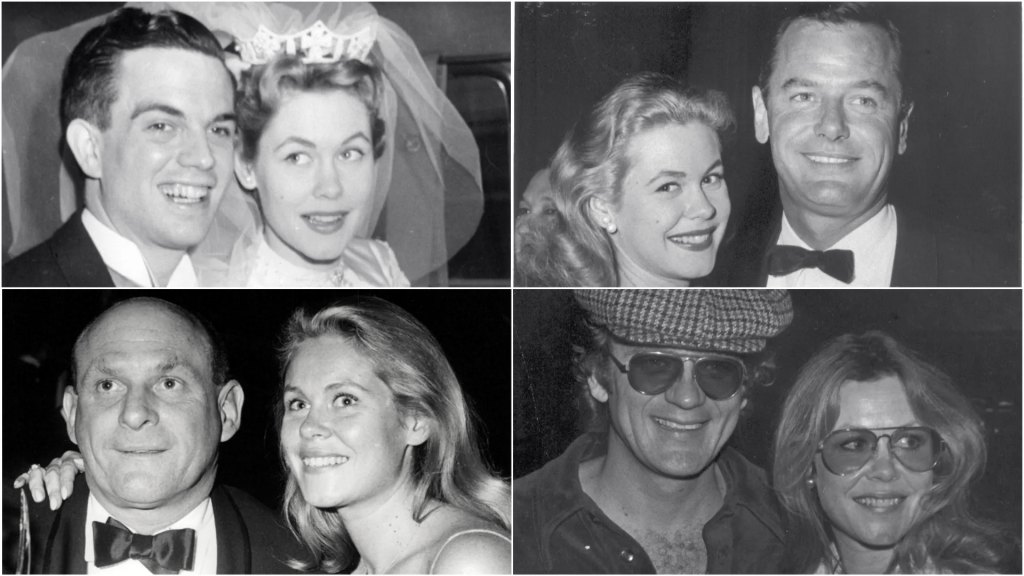
Robert Foxworth (husband #4): “They didn’t get along very well. [In The Legend of Lizzie Borden], when he saw the glee in her eye as she took an ax to her father, he caught something there and said, ‘Well, you finally got me.’” (via Closer)
Elizabeth Montgomery: “My father hasn’t always encouraged my acting. For years, I announced to him that I was going to be an actress and that I would eventually do pictures. I’m not sure he was in favor of a screen career for me, but then I don’t believe I can develop in just one medium. He always just told me to go ahead if acting was what I wanted.” (Elmira Advertiser, 1955)
Herbie J Pilato (author, Twitch Upon a Star: The Bewitched Life and Career of Elizabeth Montgomery and Bewitched Forever): “Ultimately, I think her father was jealous that Elizabeth became a bigger star on TV or otherwise than he ever was. Elizabeth was one of the biggest TV stars of the sixties. That’s all there is to it. Bewitched put ABC on the map. So it started out being this resentful father-daughter relationship because he didn’t want her to be an actress. Then a further wedge grew between them when he divorced her mother, who she loved dearly.”
“It was my sense that Robert Montgomery never got over the death of his first daughter and somehow seemed to resent Elizabeth from the beginning, almost for being born. It was a very strange relationship, but she still loved him and she still respected his work, but their relationship was complicated.”
Marriage #1: Elizabeth Montgomery & Frederick Gallatin Cammann

As complicated as things were with her father, the pattern seemed to echo in her adult relationships. Elizabeth’s first marriage — to New York City socialite Frederick Gallatin Cammann — was a whirlwind. The two wed in March 1954, when she was only 20, and the union appeared to come out of nowhere, even to friends who thought they knew her well. Just as quickly as it began, it was over in less than a year, setting the stage for the turbulent romantic life that followed.
Herbie J Pilato: “Robert was thrilled, because Frederick was the same age as Elizabeth, but, as it turned out, Fred wanted a wife and Elizabeth wanted to be a star. They divorced a year later.”
Star-Gazette (1954): “Love robbed Bob Montgomery’s daughter, Betty, of a top movie role in Daddy Long Legs. Betty, who has scored a hit in TV in her father’s show, was here in Hollywood to make the test. When producer Sam Engel came on the test stage, no Betty. He was handed a note instead, saying she was so lonely for her bridegroom that she had taken the plane the evening before in a burst of nostalgia.”
But the first sign of trouble may have surfaced just a month later, when Frederick discovered his status had shifted with the release of the new edition of the Social Register. For people in his world, this wasn’t some casual directory — it was a meticulously curated listing of America’s “acceptable” high-society families, a kind of who’s-who of old money and established lineage. Inclusion meant you belonged; exclusion meant you didn’t. Finding his standing altered in that book would have been more than a minor embarrassment — it signaled a loss of the social footing that defined much of his identity.

Oakland Tribune (1954): “Some of society’s ranking favorites were voted out and a number of newcomers were added. John Jacob Astor’s name is missing for the first time since his childhood, apparently because of his marital troubles … Elizabeth Montgomery did the same thing to Frederick Gallatin Cammann as her father did in connection with Mrs. Grant Harkness, former wife of William Hale Harkness. Mrs. Harkness was taken out of the register in 1952 after marrying Montgomery. Cammann finds himself on the outside looking in after his March 27 marriage to the actor’s daughter.”
New York Daily News (1955): “Actress Elizabeth Montgomery was back at work today after winning a Nevada divorce from New York TV producer Frederic Gallatin Cammann. Miss Montgomery charged cruelty in her divorce action yesterday at Las Vegas. The couple were married in March 1954 when Cammann was working on the Robert Montgomery Presents TV show.”
Frederick Gallatin Cammann: “She thought her career demanded that she head back to Hollywood and I didn’t see how I could fit in out there.”
Marriage #2: Elizabeth Montgomery & Gig Young

It didn’t take long for Elizabeth to marry again, this time to actor Gig Young — a talented but troubled performer who would later earn an Academy Award for Best Supporting Actor for They Shoot Horses, Don’t They? in 1969. If her father had been pleased with Frederick, he was equally displeased with this match. Robert Montgomery made no secret of his irritation, viewing the relationship as a step in the wrong direction and voicing his concerns long before the marriage began to show its cracks.
Herbie J Pilato: “She cared about he father, but she definitely zinged him a couple of times. If she knew something bothered him, she would do it. The thing is, Gig Young was an older actor, pretty much Robert’s age. Robert Montgomery wigs out and she loved it. She also became friends with Bette Davis, who Robert did not get along with, and she loved his reaction. Aside from this, she was such a beautiful person who did so much for the disabled, was so down to earth and unaffected by her position. She brought all that to Bewitched, and that’s why everybody just fell in love with her.”
Elizabeth and Gig married in 1956, but by the time they divorced in 1963, the relationship had worn thin. Accounts from those around them paint a picture of a marriage that was difficult almost from the start. Gig was wrestling with worsening alcoholism and deepening emotional struggles, and those issues inevitably seeped into the marriage. What began with promise gradually became a situation Elizabeth could no longer navigate, leading her to step away for her own well-being.

Geoffrey Mark (pop culture historian, author of The Lucy Book): “Gig was extraordinarily handsome, yet extraordinarily immature for someone his age. “I’m not sure if he was diagnosed as being bipolar, but what I’ve heard about his behavior sure sounds like it. Which meant that Elizabeth was riding an emotional roller coaster being married to him. Up and down, up and down. She didn’t want that. She lived that as a child. And sometimes, even though we don’t want to, we repeat previous family relationships. Many of us end up with people who remind us of our own parents.”
Tragedy followed Gig years after their divorce. In 1978, he married his fourth wife, Kim Schmidt, and just three weeks later — on October 19 — he shot her and then himself. Investigators never determined a clear motive, leaving the circumstances shrouded in uncertainty.
Marriage #3: Elizabeth Montgomery & William Asher

By the time Elizabeth appeared in 1963’s Johnny Cool, her life had already moved in a new direction. On that film, she worked with director William Asher, a seasoned producer-director twelve years older than she was. A spark formed during the production, and the professional partnership soon deepened into something far more personal.
Geoffrey Mark: “Bill Asher had a very complicated personal life at the time he met Liz. He was separated from his first wife, who was the mother of his children from that marriage. He was directing Liz in Johnny Cool and was having an affair with three women at the same time.”
“So Bill, to take the pressure off a little bit, went East after Johnny Cool. He’d already begun to have feelings for Liz, and she for him, during the filming of the movie. He went East to help create and direct The Patty Duke Show. There, he had a two-bedroom suite in a hotel. Literally, there were days when he had one woman in one bedroom and somebody else in the other bedroom, and neither lady knew the other one was there. It was almost like a French farce. In walks Liz to all of this and she tells Bill that she’s pregnant. Then, on top of all of that, the assassination of President Kennedy takes place. Bill was extraordinarily close to the president. Peter Lawford was his best friend and Bill had a meltdown. So much so that he was asked to leave The Patty Duke Show.”
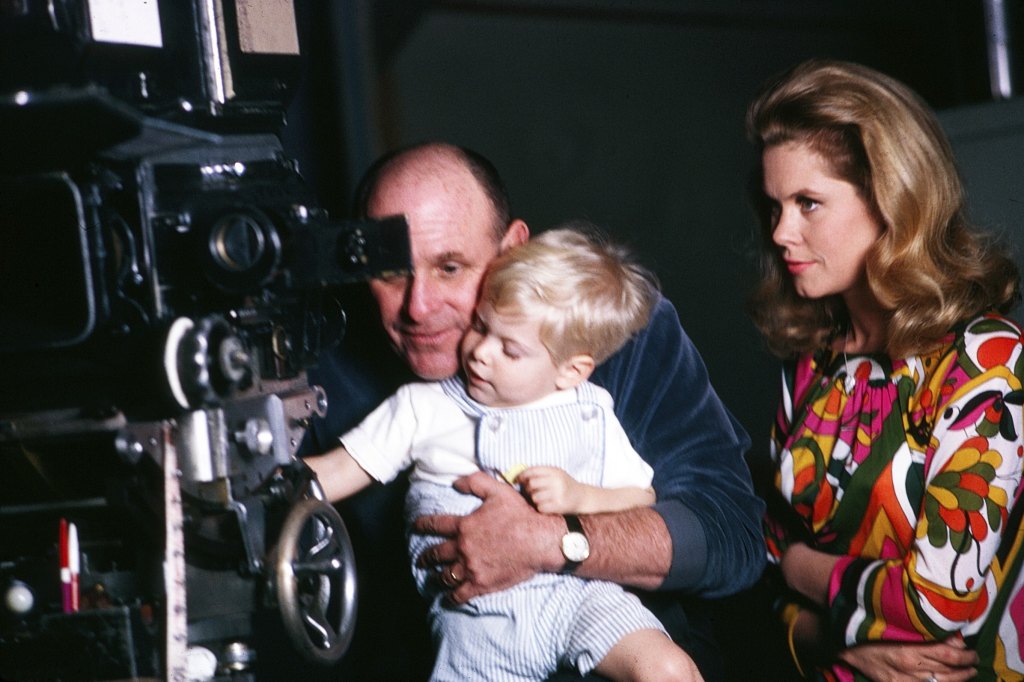
“His name was removed from the show, even though he was co-creator, and he and Elizabeth went back to Los Angeles. To his credit, Bill gave up the other ladies. And I assure you that all of this is true, because I talked to the ladies and they all confirmed, ‘Yeah, this is what was going on.’ And while he was getting his wind back, he jumped into work again with the Beach Blanket movies with Frankie Avalon and Annette Funicello, which he directed, co-produced and in some cases co-wrote. And then they got the script for Bewitched.”
“Tammy Grimes had been the original person they wanted for the part. A lot of the original concept, as created by Sol Saks, was very different from what we know as Bewitched, and Bill is the one who came up with the change of point of view, naming the characters differently and sharpening their relationships. They made a pilot, Liz had her baby and the series was given the green light. And the marriage was very successful for a while. Bill, who had always been a wanderer, felt, despite what anyone will tell you otherwise, Liz was the love of his life and he gave up being a wild man. They worked very hard together, they had a beautiful home, they had a beautiful beach house at Malibu. And Liz got pregnant again and again. According to Bill, they had a great sex life.”

When Bewitched wrapped in 1972 — in no small part because Elizabeth was ready to leave the series behind — her marriage to William Asher was also coming undone. The reasons for the split depend on who’s telling the story; accounts differ, and those close to the couple have offered a range of explanations. What’s clear is that by the time the show ended, the foundation of their relationship had begun to erode, and neither seemed able to pull it back together.
Geoffrey Mark: “With the success of Bewitched and the films he was directing and producing, Bill became enormously busy and sometimes one cannot see what’s right in front of one’s eyes. Liz was becoming unhappy. As much as she appreciated the great success of Bewitched, she saw herself as a multi-talented actor who could do all kinds of things. She felt stifled by the program, so she was creatively unhappy.”

“Bill didn’t notice and because he was so busy, their marriage was beginning to suffer. The other thing is, both Liz and Bill enjoyed having a drink, but Bill was becoming an alcoholic. That was causing more stress in the marriage, as well as the fact that because he didn’t need to direct every single episode, he would take time off and do other things. She could not. So by the time Dick York was taken off the show and Dick Sargent took his place, things were not as good as they had been on the set or between them. Bewitched could have gone on longer, but Liz did not want to and she had begun having an affair with one of her directors.”
Herbie J Pilato: “Bill told me it was his fault; he had had an affair,” he says, noting that her going with that director, Richard Michaels, was nonetheless extremely painful to him. “Bill Asher was pissed when that happened. His protégé has an affair with his wife? That was tough. So she ends the show and then fills out her contract with ABC with the Mrs. Sundance and Legend of Lizzie Borden TV movies.”

Geoffrey Mark: “Bill expressed regret that he should have sensed Liz’s unhappiness, which was driven home to him when he came home one day to find that her clothing and jewelry were gone. Bill and the children didn’t really see Liz for a year. Now I’m not saying she didn’t speak to her children in that year or there weren’t visits, but she was not a full-time mother. She was not in the house and other than her accountant, nobody really knew where she was. After that year she wanted to come back to the marriage, but Bill’s heart was broken and he felt he couldn’t trust her anymore. The damage was done. Bill felt, ‘All these years you’ve been complaining about your father, and then this is how you behave as a mother?’ Bear in mind, this is his point of view, not the kids’ necessarily. He felt he just couldn’t trust her enough to take her back, and in later years regretted that decision.”
Marriage #4: Elizabeth Montgomery & Robert Foxworth

The marriage officially ended in October 1974, though Elizabeth never felt compelled to discuss the breakup publicly. After three divorces, she had more or less decided that marriage itself was no longer something she wanted, even if she still believed in the possibility of love. That shift in perspective arrived around the same time she made the 1973 TV movie Mrs. Sundance — the project that introduced her to actor Robert Foxworth, who would become the most enduring relationship of her life.
Robert Foxworth: “She walked into the rehearsal hall and it was just immediate.” (via Closer Weekly)
Herbie J Pilato: “She was intrigued by his name, because it matches her father’s name, Robert. This is the first guy who’s younger than her and she loves that he’s never seen an episode of Bewitched. She falls in love with Robert Foxworth, but she doesn’t marry him. He’s always asking her, ‘Will you marry me? Will you marry me?’ Twenty years later, she says, ‘OK, let’s get married.’ And he’s, like, ‘What?’” They were married in 1993. In those years with Robert, she seemed to have found the inner peace that eluded her for most of her life.
Robert Foxworth: “She was a real homebody. She was a wonderful cook. She liked to work in the garden and the kids were a huge part of her life.” (via Closer Weekly).
Geoffrey Mark: “Helping to maintain a tight family unit was Bill Asher’s third wife, actress Joyce Bulifant, to whom he was married in 1976 until 1993. What Joyce did to include Liz in their lives is that on every Christmas, Thanksgiving, birthday and anniversary she would have Bill’s first wife and whoever she was seeing, and Liz and Robert and all the children over at once so that none of the children would feel that their parents were choosing partners over them; that the brothers and sisters could all be together and that the children’s happiness came first. That their parents could all be friends and behave well as a lesson for them in their lives. So Bill and Liz were not enemies and saw one another socially and were a part of each other’s lives with their children.”


With Robert, Elizabeth finally found the kind of love and stability that had eluded her for so many years. Their relationship grounded her, and professionally, she entered a period where she was able to take on an impressive range of television movies, each one giving her the opportunity to show just how much depth she possessed as an actress. It was work that let her move far beyond the confines of Bewitched, revealing a versatility that had never been fully tapped during her sitcom years. Sadly, her life and career were cut short when she died of colon cancer on May 18, 1995, at only 62.
Robert Foxworth: It was quick, about seven weeks from diagnosis to her death. She didn’t want people crying over her. When I think of her, I realize she would be so happy with her children today. To see them and her grandchildren would have made her proud.”
Family Statement Following Her Death: “The image of Elizabeth Montgomery is the image of the medium of television itself. She was a friend who has been in our living rooms thousands of times and has impacted our lives in many ways. As an actress, she brought us joy with Bewitched and ground-breaking legislation with her performance in A Case of Rape. As an activist, she has been a longtime supporter of gay and lesbian civil rights, HIV-AIDS causes and animal-rights organizations. She was, most of all, a person who loved life and her work, and shared both with us generously.”
Conversation
All comments are subject to our Community Guidelines. Woman's World does not endorse the opinions and views shared by our readers in our comment sections. Our comments section is a place where readers can engage in healthy, productive, lively, and respectful discussions. Offensive language, hate speech, personal attacks, and/or defamatory statements are not permitted. Advertising or spam is also prohibited.