Inside the Lost ‘Man With No Name’ Paperback Novels That Followed Clint Eastwood’s ‘Dollars’ Trilogy
Think you know Sergio Leone's iconic Westerns? This exclusive look at the forgotten books that completely changed the anti-hero will have you rethinking what you know

Key Takeaways
- Clint Eastwood’s 'Man with No Name' continued in paperback novels after the 'Dollars' trilogy.
- The books tried to turn Leone’s mysterious drifter into a recurring Western hero.
- Douglas Winter argues the character’s mystery is exactly what made him endure.
Most fans know Clint Eastwood‘s “the Man with No Name” from Sergio Leone’s movie trilogy consisting of A Fistful of Dollars, For a Few Dollars More and The Good, the Bad and the Ugly. But the truth is, far fewer realize that after the films became an international phenomenon, publishers attempted to continue the adventures in a series of long-forgotten paperback novels.
At the same time, according to author and literary and pop culture historian Douglas E. Winter, those books reveal something important about the character: the more writers tried to expand the world of the Man with No Name (also known as the Stranger), the clearer it became why the character had connected with audiences in the first place.
“First, this was a new kind of Western hero in that he wasn’t really a hero, he was an anti-hero,” Winter explains. “The closest thing possibly to him would’ve been Marlon Brando in One-Eyed Jacks. But the Eastwood character was this consummate anti-hero in the sense that, as Eastwood said, ‘We made a different kind of Western. The good guy fired first.'”
“They call him Man With No Name, but in reality, he has no past, and he really, in a certain sense, has no future,” adds Winter. “He just arrives and deals with situations that have their own sense of darkness and evil to them; he works his way through those things and survives. He’s not really a good guy; he’s a mystery and an enigma. Authority means nothing. He’s a character unlike anything audiences had seen before. He’s the same in each movie and there’s no character arc as there might be in traditional dramatic films. Instead, there’s just this existence in a violent world that’s filled with chaos and he’s making his own way through it. He wasn’t perfect: he lies, he cheats, he shoots first. He’s several things that we’ve been taught to identify with someone who’s not the good guy. But at the same time, he’s not the bad guy. There are worse people.”
Why Clint Eastwood wasn’t Sergio Leone’s first choice
Given the reputation of the films and Eastwood’s emergence from them, it may be surprising to know that he wasn’t Leone’s first choice. At the time, Eastwood was still best known for playing Rowdy Yates on the Western television series Rawhide, a role that had made him recognizable, but hardly a movie star.
“I think what Leone saw in Eastwood was what we’ve seen from Eastwood in so many movies since, this kind of iconic look, this stoicism,” Winter muses. “He looked the part and the part had to be someone who was somewhat bereft of emotion, who was walking through this West that Leone imagined with a certain amount of strength of character, but who was his own person.”
The result was one of the most unusual success stories in movie history. “These films made Clint Eastwood into an international superstar without him starring in one American motion picture prior to them. He’d appeared in a few, but he had never been the lead, so this is a very rare thing, particularly for an American.”
The timing made Eastwood’s rise even stranger. A Fistful of Dollars was heavily inspired by director Akira Kurosawa’s 1961 samurai film Yojimbo—though some would say “inspired” was too lax a word. “Fistful was filmed in 1964 and released in Europe in 1964,” Winter explains, “but because of the copyright infringement allegations with Yojimbo, it was held up and was not released in the United States until 1967. By that point in time, all three films were done.”
When United Artists finally released the trilogy in America, the response was immediate. “The films were huge,” says Winter. “And then they just sort of entered film history. They were the archetypal Italian westerns.”
Yet even as the trilogy was turning Eastwood into a star, he was already looking ahead. “The combination of reaching the end of this trilogy that Leone had created, and of having played that same character three times, and his own desire to make things big in the United States led Eastwood to really focus on roles here,” Winter says. “And his time with Leone was done.”
That doesn’t mean he left the Stranger behind, particularly when one considers that 1971’s Dirty Harry, starring Eastwood as Detective Harry Callahan, often felt like the Man with No Name transported into modern-day San Francisco. “It really helped make that second character, because so much of it was similar. The audiences immediately transported the character he built in the Westerns into this character and he certainly didn’t do anything to try to dispute that.”
The lost ‘Man with No Name’ paperback novels
The popularity of the Dollars films naturally led publishers to wonder whether the Man with No Name could succeed beyond the movie screen. In the late 1960s, that wasn’t an unusual idea. “At that time, paperback novelizations and movie tie-ins were a major enterprise,” explains Winter. “United Artists quite rightly commissioned novelizations of the films and then what you could call supposedly original novelizations that weren’t based on the films themselves, but were based on the character. The notion of continuing on with the character was completely in line with what the publishing industry was doing at the time when it was coming to publishing conventional Westerns.”
The original run consisted of the three film novelizations followed by five original adventures. The film tie-ins were Frank Chandler’s A Fistful of Dollars (1965) and Joe Millard’s For a Few Dollars More (1965) and The Good, the Bad and the Ugly (1967). A look at the original novels follows.
‘A Dollar to Die For’ by Brian Fox (1967)
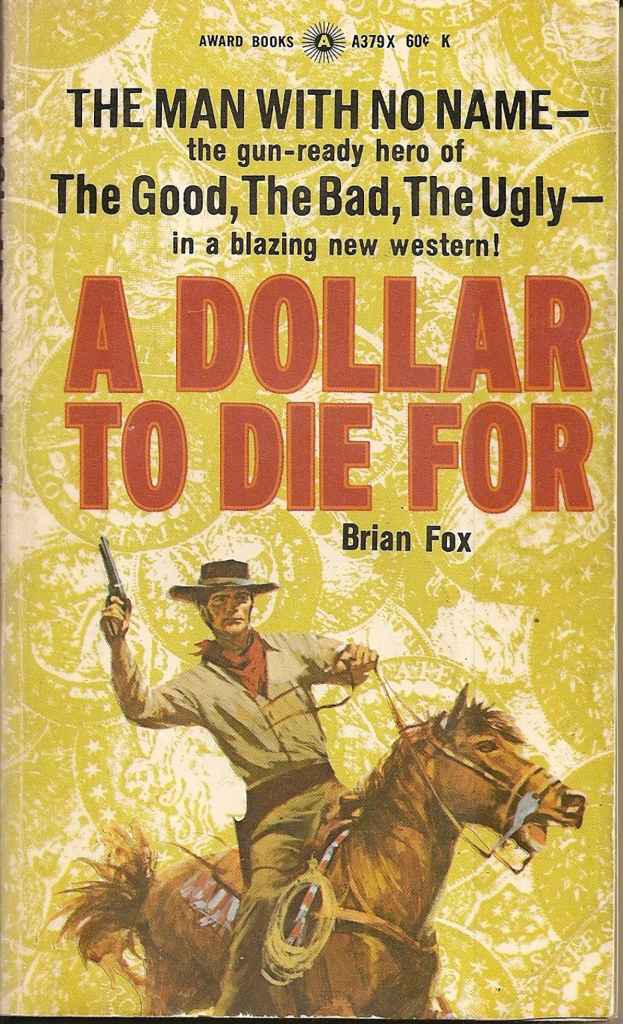
The Man with No Name’s mission to deliver outlaw Pinky Roebuck for a reward leads him into a dangerous hunt for hidden gold involving Mexican soldiers, Apache warriors and the unpredictable bandit Tuco Ramírez. After a series of shifting alliances and double-crosses, the Stranger succeeds in collecting his bounties before once again disappearing down the trail.
‘A Coffin Full of Dollars’ by Joe Millard (1971)
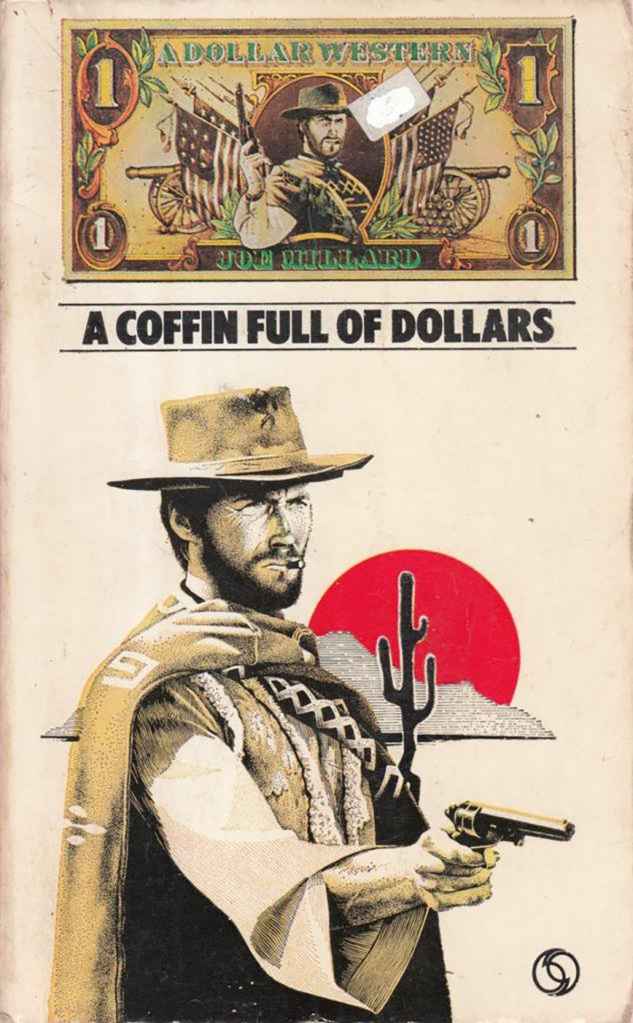
The character joins a traveling circus after rescuing its performers from a gang of outlaws. His journey soon pits him against rival bounty hunters, ruthless bandits and thieves pursuing a fortune hidden in a coffin. Amid double-crosses, shootouts and a race for stolen money, the Stranger finds himself caught in one of the most unusual adventures of his wandering career.
‘The Devil’s Dollar Sign’ by Joe Millard (1972)
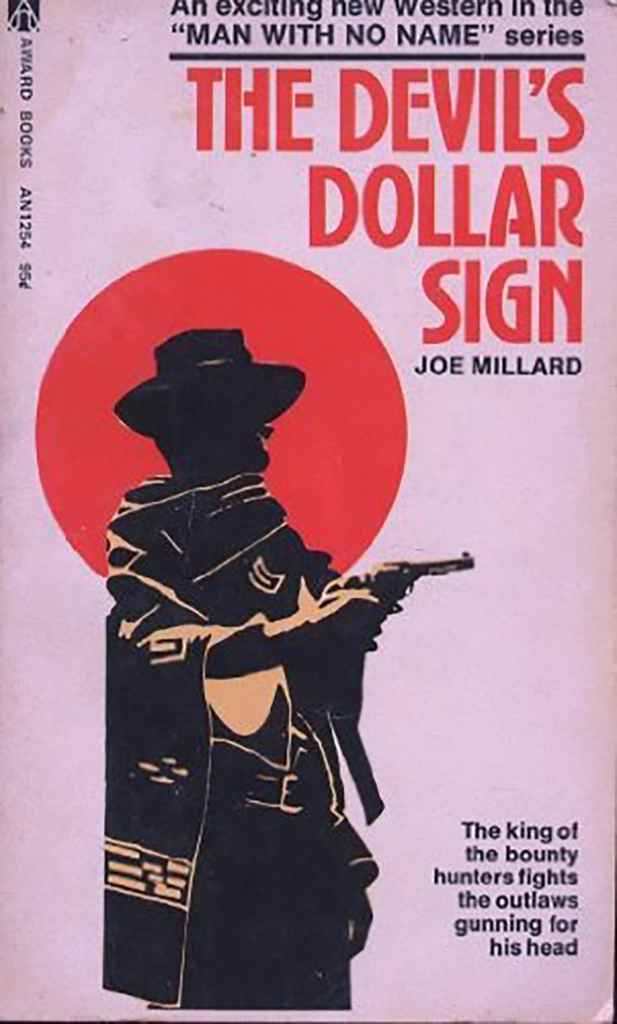
The Man with No Name joins a frantic race to locate a legendary treasure hidden in Dollar Sign Canyon. Battling hostile Apaches, crooked officials, murderous outlaws and a fanatical preacher, the Stranger must rely on his wits and his gun to survive a deadly quest for gold in one of the West’s most unforgiving landscapes.
‘Blood For a Dirty Dollar’ by Joe Millard (1973)
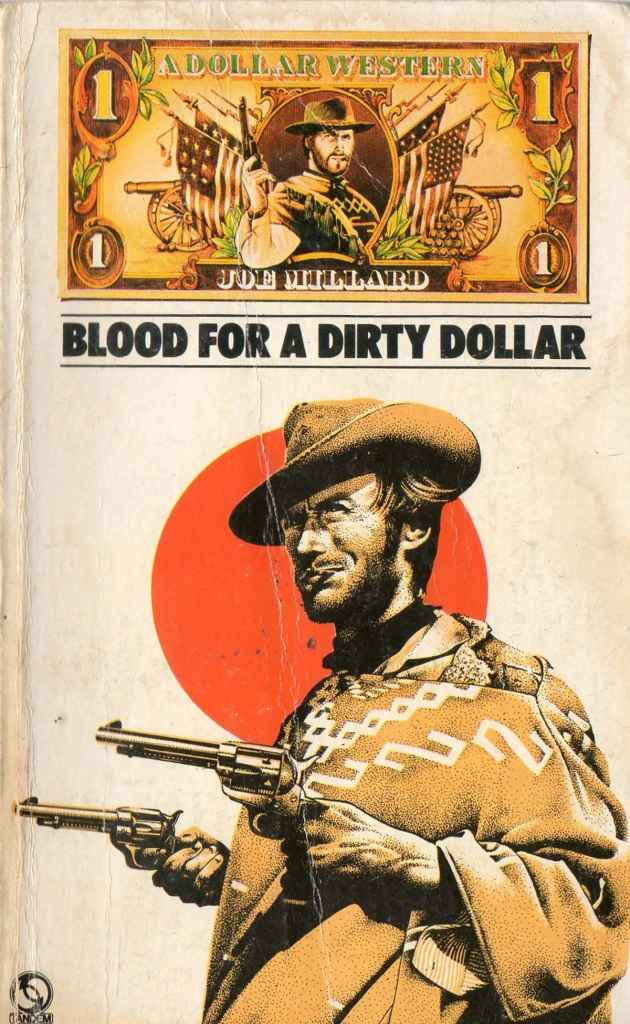
The anti-hero is caught in a violent struggle involving murder, betrayal and revenge. As he tracks dangerous criminals across the frontier, the Stranger becomes entangled in a web of shifting loyalties where nearly everyone has a price and justice can be as elusive as the outlaws he’s pursuing. Faced with ruthless enemies and competing bounty hunters, he must decide who can be trusted—and who deserves a bullet.
‘The Million-Dollar Bloodhunt’ by Joe Millard (1973)
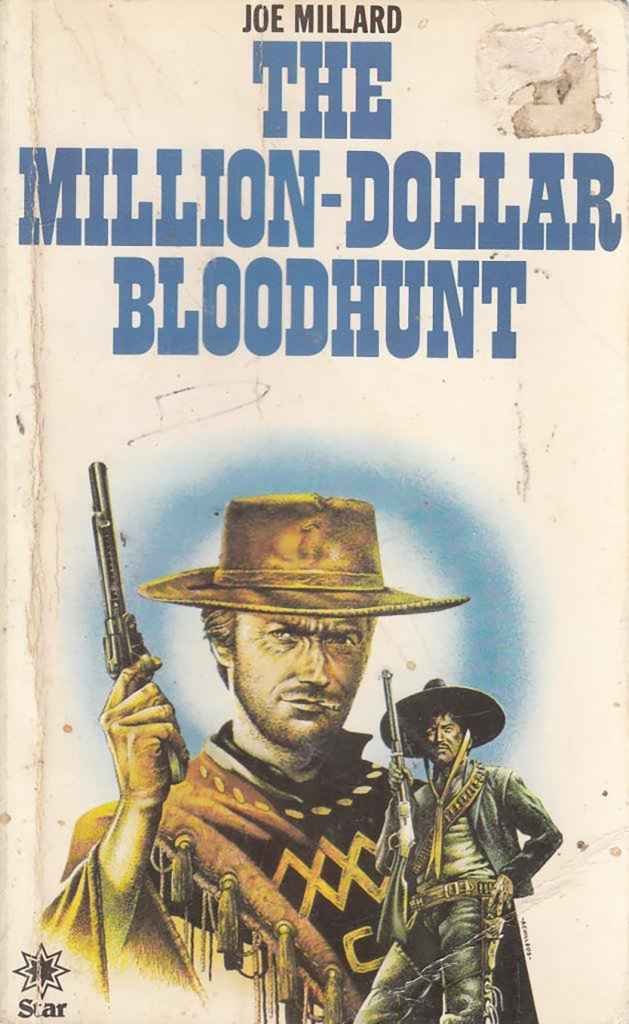
In his final adventure, the Man with No Name teams with an unlikely group of treasure hunters as they pursue the escaped killer Pachuco across the desert. While the Stranger is motivated by the enormous bounty on the outlaw’s head, his companions are more interested in a hidden cache of stolen gold reportedly worth a million dollars. As the chase intensifies, greed, betrayal and shifting alliances prove just as dangerous as the ruthless fugitive they’re tracking.
Why the book sequels failed to match the movies
The problem with the book series, Winter argues, was that the Man with No Name wasn’t like most Western heroes. “The issue for anyone novelizing the Leone films is that they are based significantly on visual and audio, where the narrative is oftentimes less important to the film-going experience than the vision and the sound. Leone was a very stylized filmmaker. He was intent on showing certain things; he’d move to these extreme closeups. He’d move to these extremely wide shots. The staging of where people were standing in any given scene was very important to him. It was also very important to the impact that his films would have.”
“His integration with music and his relationship with composer Ennio Morricone was very important because the music played such a significant role in the films. None of that can really be conveyed in black and white on a printed page. And then there was the Stranger himself. He has no past and wisely, Millard didn’t try to delve into things like internal dialogue or motivation or explanation. That’s because the mystery surrounding the character was one of his greatest strengths. He’s a man of very few words. When he does speak, it’s very brief and to the point. So to a certain extent, you’re hamstrung from the beginning. A good, thoughtful writer who was attuned to what Leone was trying to do and was doing could use the written word to convey something similar. Joe Millard was a talented writer and he certainly brought his talents to those books. As books, they’re fine entertainment.”


The larger problem, in Winter’s view, was that the novels gradually moved away from what made the films unique. “He wrote the books as if they were conventional Westerns. In other words, he didn’t try to take the Italian style, the Italian influence, the Italian perspective on the American western and bring it to the books.”
By the end of the series, the mysterious drifter who had wandered into Leone’s dusty frontier had become something much more familiar. “Everyone knows who he is. He’s this feared gunman throughout the West who’s known for his costume, just like a superhero,” Winter says. “But he’s also just a good guy.”
For him, that transformation gets to the heart of the challenge. “An anti-hero can only right so many wrongs before they’re no longer anti, and they’re simply a hero.”
Conversation
All comments are subject to our Community Guidelines. Woman's World does not endorse the opinions and views shared by our readers in our comment sections. Our comments section is a place where readers can engage in healthy, productive, lively, and respectful discussions. Offensive language, hate speech, personal attacks, and/or defamatory statements are not permitted. Advertising or spam is also prohibited.