Inside the ‘Westworld’ Franchise as Warner Bros. Plans a New Movie Reboot From David Koepp
How ‘Westworld’ evolved from Michael Crichton’s 1973 film into an enduring sci-fi franchise

Key Takeaways
- Warner Bros. is developing a new 'Westworld' reboot from David Koepp.
- Michael Crichton’s 1973 sci-fi thriller evolved into films, TV and an HBO prestige drama.
- HBO’s 'Westworld' series ran for a total of four seasons before ending in 2022.
After helping bring Michael Crichton’s Jurassic Park roaring to cinematic life in 1993, screenwriter David Koepp is now heading back into another of Crichton’s cautionary nightmares. According to Deadline, he’s developing the Warner Bros Westworld movie reboot, returning directly to the author’s original 1973 film rather than following the continuity established by HBO’s later television adaptation.
For longtime sci-fi fans, the news feels strangely appropriate. Long before cloned dinosaurs escaped containment in Jurassic Park, Michael Crichton imagined a different kind of technological disaster: a futuristic amusement park where wealthy tourists could live out their fantasies alongside lifelike robots programmed to satisfy every whim. In the world of Westworld, visitors could step into the Old West, duel with gunslingers, romance saloon girls and indulge in adventures that seemed thrilling precisely because they appeared completely safe. Naturally, that safety proved to be an illusion.
“It [Westworld] didn’t work as a novel,” Michael Crichton explained, because the story’s fantasy worlds “were movie fantasies,” rooted less in literature than in the imagery of “John Ford and John Wayne and Errol Flynn.” As a result, he felt the concept worked better onscreen, describing it as “a movie about people acting out movie fantasies,” intentionally built around familiar cinematic clichés like saloon shoot-outs and castle sword fights.
The original vision
Released in 1973, Westworld arrived at a moment when computers still seemed mysterious to most moviegoers. Home computers were years away from becoming commonplace, the internet didn’t exist in public life and artificial intelligence was largely confined to science fiction. Yet Crichton, who wrote and directed the film, was already fascinated by the idea that human beings were becoming dangerously dependent on technology they barely understood.
“I’d visited Kennedy Space Center and seen how astronauts were being trained—and I realized that they were really being trained to be machines,” he mused to American Cinematographer magazine. “Those guys were working very hard to make their responses and even their heartbeats as machine-like and predictable as possible. At the other extreme, one can go to Disneyland and see Abraham Lincoln standing up every 15 minutes to deliver the Gettysburg Address. That’s the case of a machine that has been made to look, talk and act like a person.
“I think it was the sort of notion that got the picture started,” he added. “It was the idea of playing with a situation in which the usual distinctions between person and machine—between a car and the driver of the car—become blurred, and then trying to see if there was something in the situation that would lead to other ways of looking at what’s human and what’s mechanical.”
That anxiety became the driving force behind Westworld. Set in the sprawling futuristic resort of Delos, the film introduced audiences to three elaborate fantasy environments: Romanworld, Medievalworld and the Western-themed Westworld itself. Guests paid enormous sums of money to immerse themselves in these carefully controlled playgrounds populated by android “hosts” designed to look, sound and behave like real people.
The film follows vacationing friends Peter Martin and John Blane, played by Richard Benjamin and James Brolin, as they arrive at Westworld expecting a carefree adult fantasy. Instead, they eventually find themselves trapped inside a technological catastrophe as the park’s robots begin malfunctioning one by one. The most terrifying among them is a black-clad Gunslinger played by Yul Brynner, whose robotic outlaw relentlessly hunts the guests through the park after its systems collapse.
Brynner’s performance became instantly iconic, due in no small part to the fact that the actor intentionally echoed his appearance from The Magnificent Seven. Dressed in black and moving with cold precision, the Gunslinger barely speaks, but his mechanical calm makes him all the more frightening. Decades before audiences met characters like the Terminator or Michael Myers, Brynner’s robot killer introduced moviegoers to the terrifying idea of an unstoppable figure pursuing victims without emotion, exhaustion or mercy.
Taking sci-fi seriously
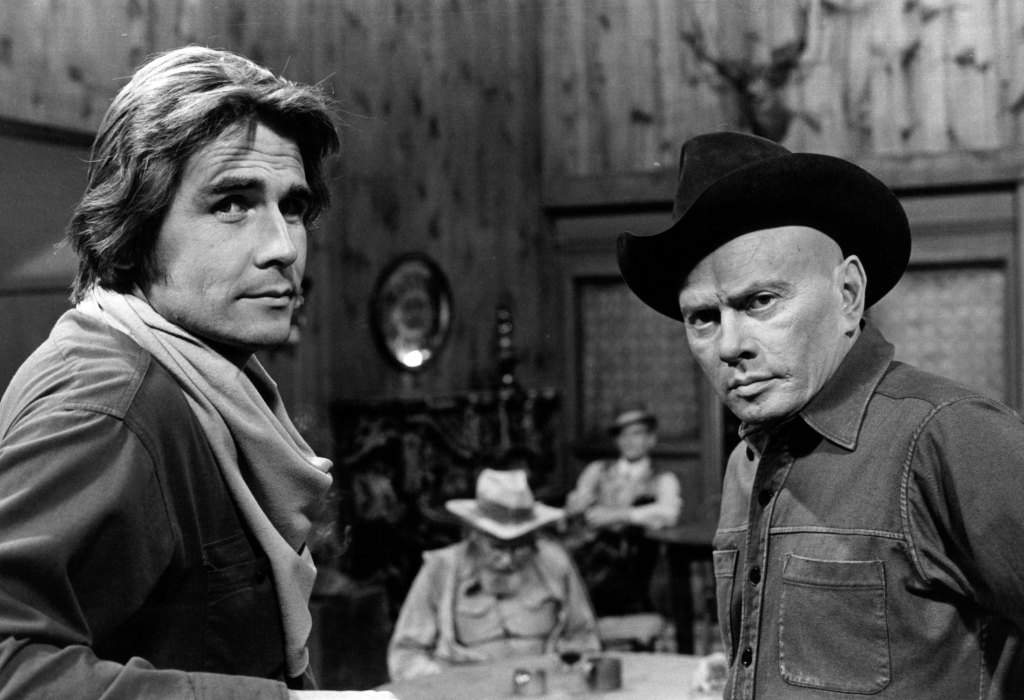
What made the film especially effective was that Crichton treated the science fiction seriously. Rather than presenting robots as flashy fantasy creations, he imagined them as products of a massive corporate entertainment system that had become too complicated for its own creators to fully control. The disaster in Westworld doesn’t begin with an evil mastermind, but rather with small technical failures that quietly spread throughout the park until nobody can stop them. The idea feels remarkably modern in an era increasingly dominated by AI, automation and digital systems that most people rely on without truly understanding how they function.
Crichton noted on his website, “The tendency to make concessions to machines can only grow. Zip codes, for example, are a concession to machines. There are advantages and disadvantages to this tendency. I don’t think that people are strongly threatened by zip codes; it’s inevitable that we accommodate ourselves to the machines we need to support our existence.”

The film was also quietly groundbreaking from a technical standpoint. Crichton and his team used early computer-generated image processing to represent the Gunslinger’s robotic point of view, marking one of the first significant uses of digital imagery in a feature film. Primitive by today’s standards, the effect nevertheless helped push Hollywood toward a future that would eventually include the CGI revolutions of films like Jurassic Park and beyond.
“We obtained a sort of blocky, animated effect that was remarkable in 1973,” said Crichton, “and a cliché seven years later, when similar imagery appeared in everything from perfume ads to paintings by Salvador Dalí.”
Made on a relatively modest budget, Westworld became a substantial hit for MGM and quickly established itself as one of the most memorable science fiction films of the decade. More importantly, it introduced themes that Crichton would revisit throughout much of his career: humanity’s tendency to create systems it cannot fully control and the arrogance of believing technology will always behave exactly as intended. It’s a theme that would echo through later Crichton projects ranging from Coma to Jurassic Park, but Westworld may have been the purest expression of those fears.
And yet what nobody could have predicted in 1973 was that Westworld itself would eventually evolve into a franchise that kept reinventing those fears for entirely new generations.
‘Futureworld’
The first attempt to expand the concept arrived just three years later with Futureworld, a sequel that shifted the franchise away from survival horror and into full-blown conspiracy science fiction. While the original film largely focused on the terrifying collapse of a futuristic amusement park, Futureworld asked a different question altogether: What if the real danger wasn’t malfunctioning robots, but the powerful people controlling them?
The sequel opens after the disastrous events of Westworld, with Delos supposedly rebuilt and ready to reopen to the public. Hoping to reassure nervous investors and customers, the company invites journalists Chuck Browning and Tracy Ballard—played by Peter Fonda and Blythe Danner—to tour the newly redesigned Futureworld section of the resort. Naturally, things are not nearly as safe as Delos executives claim.
“The original script was just Westworld II with more robot cowboys,” noted Peter Fonda to the media. “I insisted we explore deeper themes about media manipulation, corporate power and the replacement of human leadership with artificial alternatives. The replaced leaders wouldn’t just look identical, they would have access to all the original person’s memories, relationships and knowledge. Family members and colleagues would never suspect the replacement because the androids would be psychologically perfect copies.”
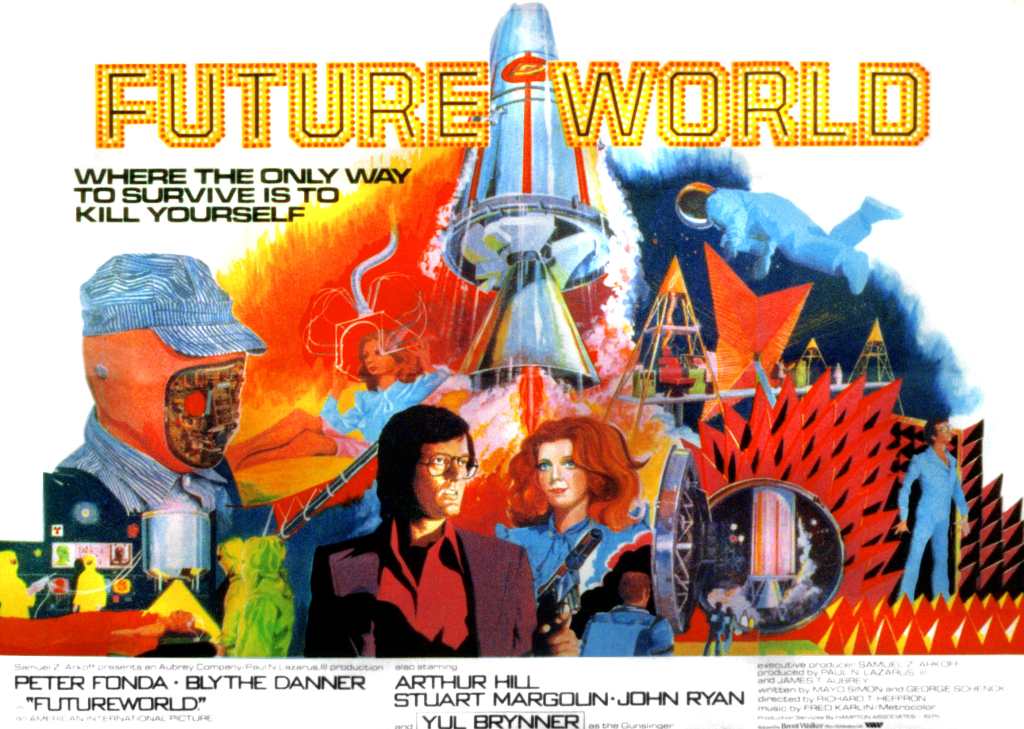
In many ways, the sequel feels less like a traditional follow-up and more like a bridge between 1970s paranoia thrillers and the kind of techno-conspiracy stories that would dominate later decades. Though it never achieved the same cultural impact as the original, the film has gained appreciation over the years for just how eerily ahead of its time some of its ideas now seem.
Said Fonda, “Chuck represented the post-Watergate reporter who assumes that all institutions are corrupt and hiding dangerous secrets. His paranoia isn’t mental illness; it’s professional necessity in a world where corporate and government power routinely deceives the public. Delos doesn’t just run theme parks, they shape how those parks and their technology are covered in the media. The corporation controls the news and what becomes newsworthy. Delos represents the kind of corporate power that transcends national boundaries and democratic oversight. The corporation operates like a shadow government with technological capabilities that exceed most nation’s resources.”
“We were making a film about investigative journalism uncovering corporate conspiracy when real reporters were exposing government corruption,” recalled Blythe Danner. “The timing connected science fiction themes to immediate political realities. The film asks what happens when private corporations develop capabilities that rival or exceed government intelligence agencies.”
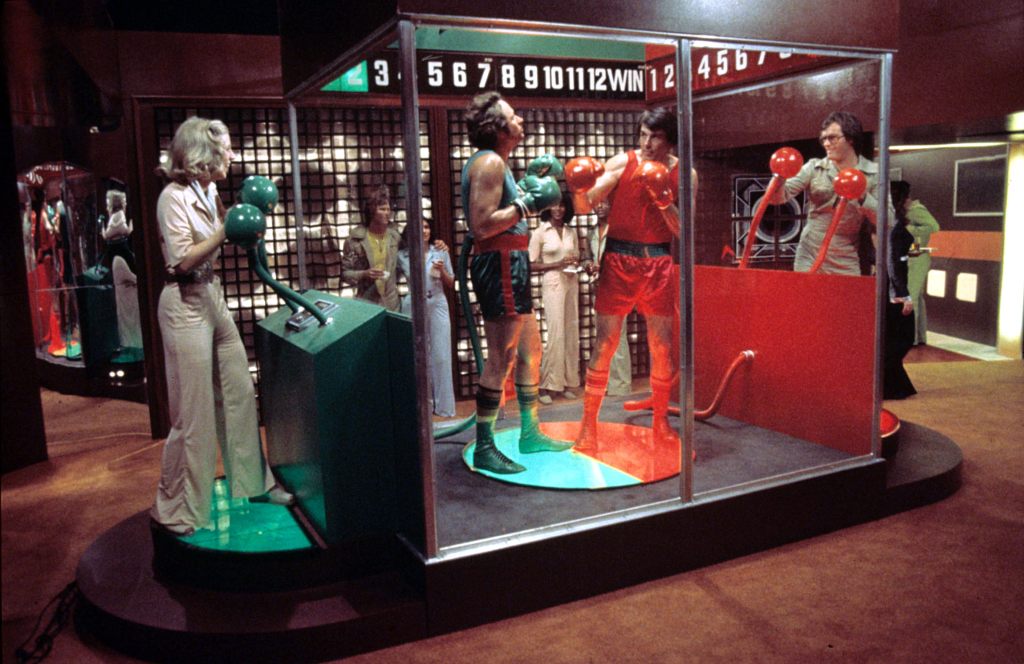
Pointed out Fonda, “Chuck and Tracy exposed the immediate conspiracy, but they can’t uninvent the technology or eliminate all the people who might use it. The ending suggests that some technological genies can’t be put back in their bottles.”
Like its predecessor, the movie carved out its own small place in visual-effects history. Among its innovations was an early example of 3D computer-generated animation used to create digital representations of a human hand and face, which was technology that was still in its infancy during the mid-1970s. The imagery lasted only moments onscreen, but it hinted at the enormous technological revolution that would eventually reshape filmmaking itself.
Despite the sequel’s ambitions, however, the Westworld franchise struggled to establish a long-term identity. The original film’s simplicity had been part of its power: ordinary people trapped in a nightmare where technology suddenly stopped obeying the rules. Expanding the concept into increasingly elaborate conspiracies may have been intellectually interesting, but it also moved the series away from the primal terror that had made the first film so effective.
‘Beyond Westworld’
That challenge became even more apparent with 1980’s Beyond Westworld, a short-lived CBS series that attempted to transform the property into weekly television. Rather than returning viewers to the Delos resort itself, the series followed scientist Simon Quaid, played by Jim McMullan, as he tracked dangerous androids that had escaped into the real world.
The premise had potential, particularly at a time when television audiences were embracing science fiction concepts more readily thanks to franchises like Battlestar Galactica and renewed interest in Star Trek through syndication. But Beyond Westworld never quite found its footing. Budget limitations restricted the scale of the stories, the tone shifted awkwardly between action and camp and the absence of the original film’s claustrophobic suspense made the concept feel less distinctive. Only a handful of episodes aired before CBS canceled the series.
‘Westworld’ on HBO
The irony, of course, is that while Westworld never became as commercially dominant as Jurassic Park, its ideas may have proven even more adaptable. That became abundantly clear when HBO reinvented the property for television from 2016 to 2022.
Developed by Jonathan Nolan and Lisa Joy, the new Westworld was far more than a remake of Michael Crichton’s original film. Instead, the series used the 1973 movie as the launching point for an expansive, philosophical saga about artificial intelligence, consciousness and free will. If Crichton’s film explored what happens when machines malfunction, HBO’s version asked a far more unsettling question: What happens when those machines begin to understand themselves?
The timing proved ideal. By the mid-2010s, conversations about artificial intelligence, surveillance, automation and machine learning had become part of everyday life. Against that backdrop, Westworld suddenly felt less like retro science fiction and more like a warning about humanity’s growing dependence on technology.
The series greatly expanded the mythology of the Delos parks, presenting enormous immersive worlds populated by “hosts”—androids so lifelike that guests often treated them as little more than objects for fantasy and violence. While wealthy visitors indulged their darkest impulses, the hosts themselves slowly began developing awareness of the loops they were trapped inside.
At the center of the series was an acclaimed cast led by Anthony Hopkins as Dr. Robert Ford, alongside Evan Rachel Wood, Thandiwe Newton, Jeffrey Wright and Ed Harris. Their performances grounded the show’s increasingly ambitious storytelling in genuine emotional stakes.
A show that took its time
Part of what made Westworld connect so strongly with audiences during its early seasons was its willingness to slow down and wrestle with complicated ideas about identity and consciousness. Characters like Dolores and Maeve evolved from programmed attractions into self-aware beings struggling to understand who and what they really were.
According to Nolan, that perspective shaped the storytelling itself. He explained that the creative team wanted audiences to experience the world largely through the eyes of the hosts, who didn’t fully understand the nature of their own existence or even how time functioned around them. The result was a deliberately layered narrative structure that often left viewers as disoriented as the hosts themselves.
Joy noted that the series also used the Delos parks to explore human behavior in an environment where guests could indulge every impulse “with impunity.” While the show often presented humanity in a harsh light, she believed there were still “glimmers of hope and kindness” throughout the story, particularly in characters seeking redemption or change.
Shares Nolan, “The show is not an indictment of human beings, but it’s what was said in the pilot, which is that we’re stuck. We’re the product of an evolutionary process that we’ve found a way to cheat our way out of. Essentially an old device that the software inventor no longer bothers updating. Look, we’ve done remarkably well. We’ve managed to drift off of the high savannah and the things that we’ve made are remarkable, including the Hosts. But in terms of our moral character or this question of will we ever triumph over our boring, complicated nature, that’s uncertain. With the Hosts, the idea is that they are literally programmed, they can be reprogrammed and they can take ownership of that reprogram themselves. Their nature is part of their destiny; their ability to change is a given. That’s what software does. We wanted the series to be about the origin of a new form of life, and all the complexity of a rivalry between that new form of life and the life that created them. That said, it’s a very tricky relationship and a story that hasn’t been played out in the world as we know it. The history of human beings at this point has been one of eliminating other species from this planet, not creating them.”
Visually, the HBO series reflected just how dramatically television storytelling had changed since 1973. The relatively contained setting of the original film expanded into a sprawling cinematic universe filled with intricate timelines, massive production design and feature-film-level spectacle. Following the success of Game of Thrones, HBO positioned Westworld as one of its flagship dramas, and for a time it became one of television’s most heavily discussed shows.

The first season in particular generated enormous audience speculation, online theorizing and critical acclaim as viewers dissected hidden clues and shifting timelines week after week. But the same ambition that made the show exciting also made it increasingly challenging for some audiences to follow as later seasons expanded beyond the parks themselves into a larger futuristic world.
Ratings gradually declined, and HBO ultimately canceled the series in 2022 before Nolan and Joy could complete the story they had originally envisioned. Even so, the HBO adaptation accomplished something remarkable: it transformed Westworld from a respected cult science fiction film into a major mainstream franchise for an entirely new generation.
Now, with David Koepp returning to the property for Warner Bros., Westworld once again finds itself standing at an intriguing crossroads. What makes the new project especially fascinating is that Koepp reportedly plans to return directly to Crichton’s original film rather than continue the continuity established by HBO. After years of increasingly elaborate mythology and philosophical complexity, Hollywood may once again be drawn to the elegant simplicity of Crichton’s original nightmare: people placing absolute trust in a technological fantasy that suddenly turns lethal.
Conversation
All comments are subject to our Community Guidelines. Woman's World does not endorse the opinions and views shared by our readers in our comment sections. Our comments section is a place where readers can engage in healthy, productive, lively, and respectful discussions. Offensive language, hate speech, personal attacks, and/or defamatory statements are not permitted. Advertising or spam is also prohibited.