Exercise Is Key to Longevity and Health—Can a 20-Minute Strength and Balance Workout Help?
A look at the latest fitness trend for women over 50, complete with AI-enabled machines, brain games and balance sessions

Key Takeaways
- The Exercise Coach offers strength, cardio and balance training in about 20 minutes.
- Strength and balance exercises can help older adults preserve mobility and independence.
- At-home options include sit-to-stands, heel-to-toe walking and tai chi videos.
You’ve heard it a million times: Exercise is the key to longevity, or along, healthy life. It’s been shown to lift energy levels, keep bones strong, ward off dementia, boost mood, speed weight loss, help us live longer…the list of benefits goes on and on. But for many people, it’s just one more to-do to add to an already busy day. And while exercise is well-known to boost levels of feel-good endorphins, some people just don’t enjoy it.
But what if you could get the body and brain benefits of a strenuous workout in as little as 20 minutes, two or three days a week? That’s the idea behind The Exercise Coach, a fitness franchise with more than 225 locations across the country. When I visited a nearby location in Paramus, New Jersey, I tested out their Strength Plus program. My workout, which I completed in about 20 minutes—included strength training moves plus exercises to improve flexibility, a little bit of cardio, and—my favorite part!—balance and cognitive-focused training.
Here’s what I learned.
Why balance + strength training are key for longevity
“Age-related muscle loss can make climbing stairs, rising from a chair, carrying groceries and recovering from a misstep more difficult. Resistance exercise can improve strength and physical function, while also supporting bone health,” says Edmundo Rodriguez-Frias, MD, a Medical Contributor at Retreat of Broward, located in Fort Lauderdale, Florida. “As a geriatrician, I view strength training as a key part of preserving mobility and independence as women age.”
He explains, “Strong legs and hips help stabilize the body and recover from changes in position, while balance exercises train postural control and coordination. Both matter because more than one in four adults age 65 and older falls each year, according to the Centers for Disease Control and Prevention.”
What the workout looks like
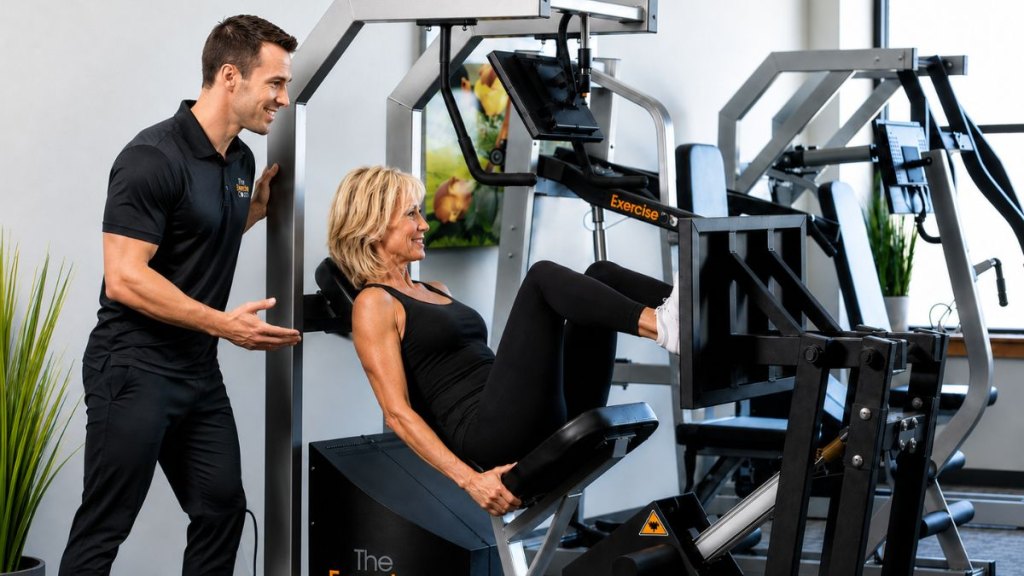
The brand new center I visited had several pieces of equipment like you’d find at any gym, including a leg press machine, a seated row and a chest press. Unlike a typical gym, it wasn’t loud or busy. And instead of selecting your own weights as you would normally do (and guessing at just how heavy you can lift), the company’s Exerbotics AI-based machines adapt to your body and your ability.
Testing it out, with a trainer by my side, I slid into the machine, adjusted it for my height, and did one rep of an exercise. That created a baseline, which showed up as a green line across the attached video screen. Then, as I repeated the move (aiming for 8 reps of each exercise), I saw a yellow line showing my current effort. It was a bit like a game, challenging me to stay close to or above (but not below) the green line, and I definitely pushed myself harder than I might have on a typical machine.
Each time you return for a workout, you plug your PIN in and it pulls up your info, showiong you what you did last time and challenging you to do more. The more often you go, the more data you see, charting your progress.
“People get that real-time feedback, and they get total certainty about how hard they should be lifting and the system basically provides them effort guidance that keeps them lifting at a level that is safe, that is ideal for the production of results, and really very motivating,” explains The Exercise Coach CEO and co-founder Brian Cygan.
I also worked in a bit of cardio, doing brief high-intensity stints on an exercise bike and testing out their 360 machine—a device that consisted of two tall poles attached to a base. Standing on the platform, I moved the poles back and forth and side to side for a few minutes—moves that boosted my heart rate and put my core to work.
Balance practice
We hear all the time about how important balance is to longevity and health. Indeed, Yuval Pinto, MD, a family physician at Johns Hopkins Hospital specializing in weight management and the prevention and treatment of obesity-related chronic medical conditions, says, “Balance is very important in the process of aging because falls are the leading cause of injury, fracture and injury-related death in older adults. One fall can trigger a cascade of fracture, hospitalization, fear of falling, inactivity and lost independence.” The good news, he promises, “Balance is trainable, and programs that combine balance work with lower-body strengthening cut fall rates and risks of injuries.”
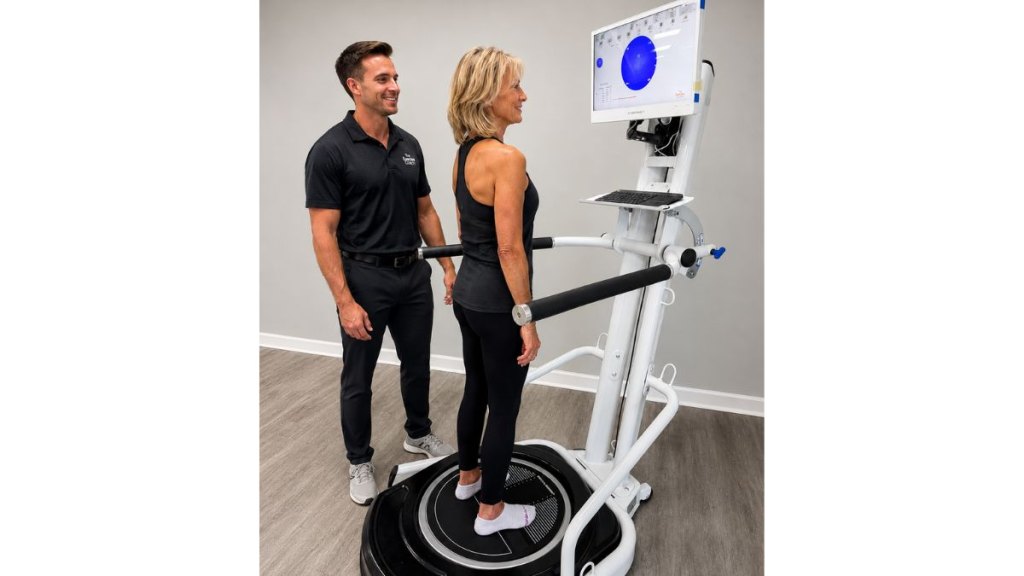
The Exercise Coach’s unique balance training aims to help restore balance in a fun, challenging way. To do it, I stepped on a machine that looked like a heavy-duty vibration plate (above). I stood in the center of the platform, which is attached to a video screen. I had to activate my core to stay steady (a target on the screen showed how stable I was). Then I repeated the test with my eyes closed—a much more challenging task! Next, I played some brain games on the computer screen while trying to stay steady on the platform—a fun challenge that worked my body and mind in a totally new way.
Does it work?
“Strength training is very important after the age of 50,” says Dr. Pinto. “This is because the hormone estrogen falls sharply around menopause, and that speeds up loss of both muscle and bone. Women lose roughly 1 percent of lean mass per year after 50, and bone loss can reach 2 to 3 percent per year in the first 5 to 7 years after the final period. Strength training is the only lifestyle intervention that directly counters both losses. In short, strength training benefits bone health, muscle preservation, sarcopenia prevention and metabolic health.”
Is a 20-minute workout long enough to get results? Cygan says it is. “The average type of progress that we’ve seen for someone in their first year ranges from about 40 to 70 percent strength increase for upper and lower bodies, and that was based on a study of more than 5,000 clients who had an average age of 60.”
For women who don’t enjoy exercise or those who have joint pain or can’t (or don’t want to) withstand longer workouts, The Exercise Coach workouts may be ideal. Cygan describes a typical client as a 62-year-old woman with arthritis in her knees who can’t simply hop on a treadmill. “We offer a method that is actually very joint friendly and optimal at the same time for conditioning her muscles, which is what matters most to metabolic health and longevity.” Dr. Rodriguez-Frias notes, “Technology that adjusts resistance or tracks progress may be useful, but individualized progression, proper technique and consistency matter more than the equipment itself.”

What does it cost?
The price is comparable to that of many other workouts, whether that’s studio classes like Pilates and yoga or personal training sessions: The one-on-one training sessions cost about $35 to $45 per session, depending on location, and semi-private sessions are also available. Most people train 2 to 4 times a week, says Cygan.
How to get the balance, strength and longevity perks at home

It’s easy to find strength training workouts online or on YouTube and you can pick up dumbbells and resistance bands at sporting goods stores (though many people have luck searching on Facebook Marketplace or hitting garage sales).
As far as balance, there are many ways to work on balance at home without access to a gym, says Dr. Pinto, who recommends doing sit-to-stands from a chair and walking heel to toe along a hallway. He also suggests finding free tai chi videos on YouTube or free or discounted fall-prevention classes through your local YMCA (after consulting with a doctor). You can also consider balance-training devices like a Gibbon SlackBoard or a BOSU balance trainer or try at-home exercises like this one.
Ready for more? Subscribe to our YouTube channel for video podcasts, health tips and uplifting stories designed for women 40, 50, 60 and beyond.
Conversation
All comments are subject to our Community Guidelines. Woman's World does not endorse the opinions and views shared by our readers in our comment sections. Our comments section is a place where readers can engage in healthy, productive, lively, and respectful discussions. Offensive language, hate speech, personal attacks, and/or defamatory statements are not permitted. Advertising or spam is also prohibited.