Why Building Emotional Vocabulary at Home is the Catalyst to Transform How Kids Show Up At School

Joy, as an emotion, is largely associated with childhood, yet Greg Bro, founder of Brute Optimism and the Every Shape Emotional Literacy Series, believes it is severely scarce in the spaces children are meant to thrive. When classrooms carry pressure and homes carry stress, children, he notes, are often left navigating both without the vocabulary to process what they feel. In that critical space, Bro’s series emerges as a resourceful asset where children could find the language for their emotions.
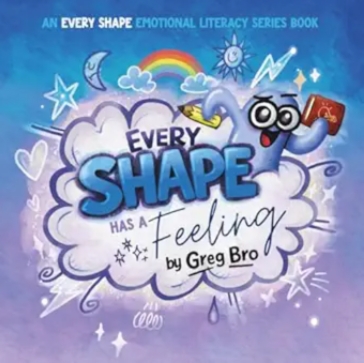
Through his newly launched book, Every Shape Has a Feeling, and a growing series of school visits, Bro is building a framework where emotional fluency starts early and travels with a child, from the kitchen table to the classroom, and increasingly, beyond, to more spaces where emotional fluency is essential. His approach is playful and deeply intentional. “Big feelings made simple,” as he puts it, becomes less of a tagline and more of a working model for how children, and the adults around them, can navigate complexity without shutting down.
Research supports the premise that he champions. Studies show that children who are exposed to negative events experience problems that cascade into academic performance, causing physical and emotional distress, which can be exacerbated by language and communication limitations. Conversely, research indicates that social and emotional learning programs can lead to decreased conduct problems and emotional distress. Still, Bro insists that statistics tell only part of the story. In practice, Bro has witnessed that children who can name feelings of belonging or discomfort often begin to externalize those feelings instead of internalizing them.
Bro observes that such language often begins at home. Parents who engage with these ideas, driven by reading, doodling and discussing emotions, help in designing continuity. Bro explains, “A child who learns to express frustration in the living room may carry that understanding into school, where it shapes how they interact with peers and teachers.”
Under that continuity, Bro believes children may be able to navigate social and academic environments with improved emotional precision and respond to challenges without shutting down.
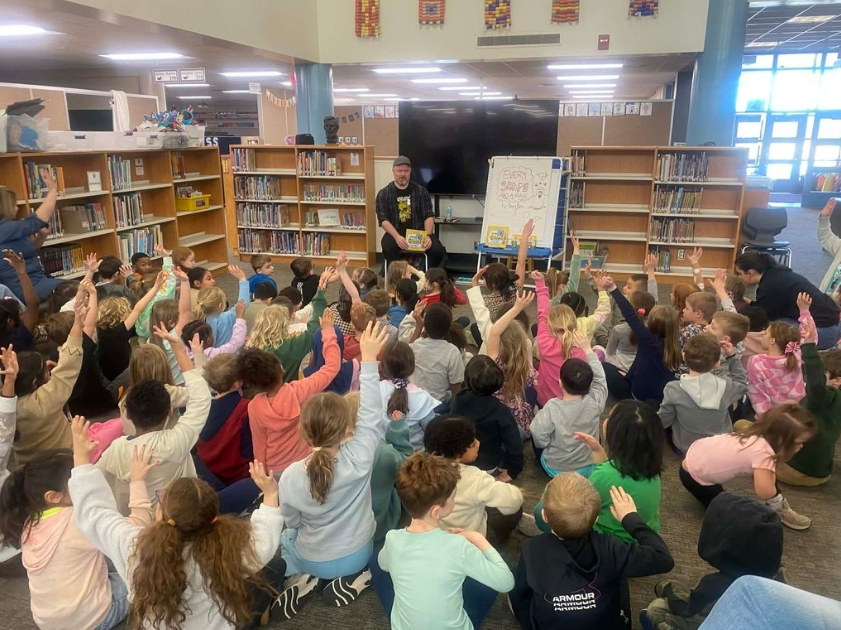
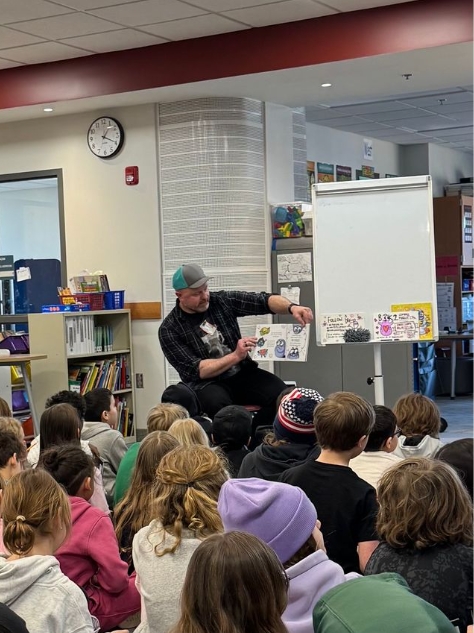
Bro’s school visits function as a live launchpad for these ideas. Drawing from his background in UX design, he approaches classrooms with a human-centered mindset, observing, iterating and refining in real time. “I’m able to get a sense of where there’s a need and how I can serve that need,” he explains. According to Bro, the feedback loop is immediate as kids respond and teachers observe, causing the material to evolve.
What stands out in these sessions is not just the message, but the method. He fosters an imagination hub, where a scribble may become a unicorn and a mistake can take form into a story of its own. “It’s like a magic trick for them,” he states. His “doodle rescue” exercise reframes errors as raw material for creativity, while “doodle mash” invites children to merge unlikely ideas into something entirely new. “There’s a gravitational pull of excitement. They start scooting up, pulling on your pant leg, shouting ideas,” he adds.
According to Bro, laughter lowers barriers, making it easier to engage with topics that might otherwise feel heavy or inaccessible. In his sessions, fun and silliness become a gateway to self-awareness.
Bro’s upcoming hospital visits, scheduled throughout major Minneapolis children’s networks, signal a broader application within spaces beyond the classroom. According to him, these environments, often defined by uncertainty and stress, can become productive ground for tools that help children process fear and regain a sense of agency. As he aims to integrate his sessions across multiple hospital locations, he aims to introduce a scalable model that maintains emotional resonance even at a distance.
Regardless, Bro is clear about what cannot be replicated. “Nothing beats being in a room with them,” he says. “The immediacy of connection, the shared laughter, the spontaneous ideas. Those anchor the experience in a way that technology can only approximate.”
Parents, too, play a critical role in sustaining this momentum. Raising children, Bro notes, sharpens self-awareness in adults. “You really think about who they see when they look at you,” he reflects. That awareness, Bro notes, may lead to more intentional communication, reinforcing the emotional frameworks children are learning. The exchange can become reciprocal, where children learn from adults, and adults recalibrate through their children.
Beneath the playfulness lies a serious concern. Bro highlights the emotional weight people carry, with stress, anxiety and the ambient pressure of a rapidly changing world. Without release, he insists that pressure accumulates. “There has to be a way to let a little air out of the balloon,” he says.
His work offers one such release. It invites children to explore, question and express without fear of getting it wrong. It encourages parents to re-engage with creativity, not as a luxury, but as a necessity, through co-creative parenting. The shapes in his books are simple, but the systems they disrupt are not. Bringing fun back into everyday spaces may sound lighthearted, even trivial. In practice, it is anything but. It is about causing a paradigm shift in teaching and parenting systems and how people show up for one another in between.
And in that shift, something essential begins to return: the freedom to feel, to create and to belong. That’s where Brute Optimism finds its purpose.


