How the 1994 ‘Stargate’ Movie Led to ‘Stargate SG-1’—And Changed Sci-Fi TV Forever (Exclusive)
The untold story of how a hit movie became 'SG-1'—and launched a sci-fi legacy that still continues

Key Takeaways
- The 1994 'Stargate' film introduced a concept that reshaped sci-fi TV.
- Plans for a movie trilogy collapsed, opening the door for 'Stargate SG-1' instead.
- 'SG-1' turned the Stargate into a storytelling engine for weekly adventures—and spinoffs.
In Hollywood, success doesn’t always look the way anyone expects. Case in point: the Stargate movie. Released in 1994, the film arrived at a time when sequels, remakes and adaptations dominated the landscape. Yet here was something original—an ambitious blend of sci-fi and ancient mythology from Roland Emmerich and Dean Devlin that struck a chord with audiences even if critics weren’t entirely convinced.
What no one could have predicted at the time was that Stargate wouldn’t just continue—it would evolve. Not on the big screen as originally intended, but on television, where Stargate SG-1 would take the core idea and transform it into something far bigger, spinning off the series Stargate Atlantis and Stargate Universe in the process, as well as the new series coming from Amazon. That journey—from feature film to franchise—begins here.
ROLAND EMMERICH (co-writer/director, Stargate): “When I was in film school, there was a wave of theories about aliens visiting Earth thousands of years ago and being responsible for the pyramids and such. It wasn’t so much that I believed in the theories, but I always thought the idea could be the basis for a fantastic adventure movie.”
DEAN DEVLIN (co-writer/producer, Stargate): “Roland told me about a concept he had for a film set inside the Great Pyramids of Egypt. I told him about an idea I had for a kind of desert epic in outer space. We decided to combine the two and Stargate was born.”
Here’s how MGM describes the plot of the original film: “Set against the wondrous backdrop of the Great Pyramids of Giza, Stargate tells the story of two very different men who join forces to unravel the mystery of a curious artifact which could reveal the origin of civilization. A tough-minded military man, Colonel Jack O’Neil (Kurt Russell) heads a top-secret team investigating a mysterious artifact unearthed at Giza. Daniel Jackson (James Spader) is a brilliant Egyptologist whose scientific curiosity clashes with O’Neil’s secret agenda. But it is Jackson who identifies the object as a Stargate—a portal to another world. O’Neil leads Jackson and a reconnaissance team through the Stargate, which transports them millions of light-years from Earth, where they are stranded on a strange and alien planet. When the enigmatic ruler of this extraordinary world discovers that the doorway to Earth can be reopened, he devises a deadly plot. Racing against time, O’Neil and Jackson must overcome Ra if they are to save Earth and find a way back home.”
The clash between the military and scientific communities’ ambitions for the Stargate is brought to life through the film’s two main characters: Special Forces Colonel Jack O’Neil and brilliant young Egyptologist Daniel Jackson. For O’Neil, the Stargate represents the fulfillment of a personal as well as professional mission; for Jackson, it is the culmination of a life’s work.
The ‘Stargate’ movie that started it all
JOEL MICHAEL (producer, Stargate): “The Stargate is the object of conflict, because it has the capability of satisfying two very different objectives. O’Neill has his own clandestine plan, while Jackson understands that he has discovered something quite magnificent … and wonderful.”
DEAN DEVLIN: “They each have their own agenda of what they want to accomplish when they go through the Stargate, and they’re at opposite ends of the spectrum. One of the things this film is about is the two sides learning to respect one another and ultimately working together towards a single goal.”
KURT RUSSELL (actor, “Jack O’Neil”): “O’Neil is drawn to this mission because he has, in his own estimation, nothing left to live for. That makes him mysterious … and certainly dangerous.”
JAMES SPADER (actor, “Daniel Jackson”): “Daniel is something of an island, an outsider. He’s become frustrated by the world around him and then, all of a sudden, this door opens up that is … perfect.”
KURT RUSSELL: “[What drew me to it was] Roland has a clear vision and the producers were equally enthusiastic about it. It made me feel as if they could achieve what they were setting out to do. They cared a lot and it was infectious.”
JAMES SPADER: “The script was unlike anything I had ever done or even considered doing. Then I met Roland and found him to be tremendously excited about this. He and the producers made it seem like it was going to be a fascinating journey, and I wanted to go on it. So I did. And I’m glad I did.”
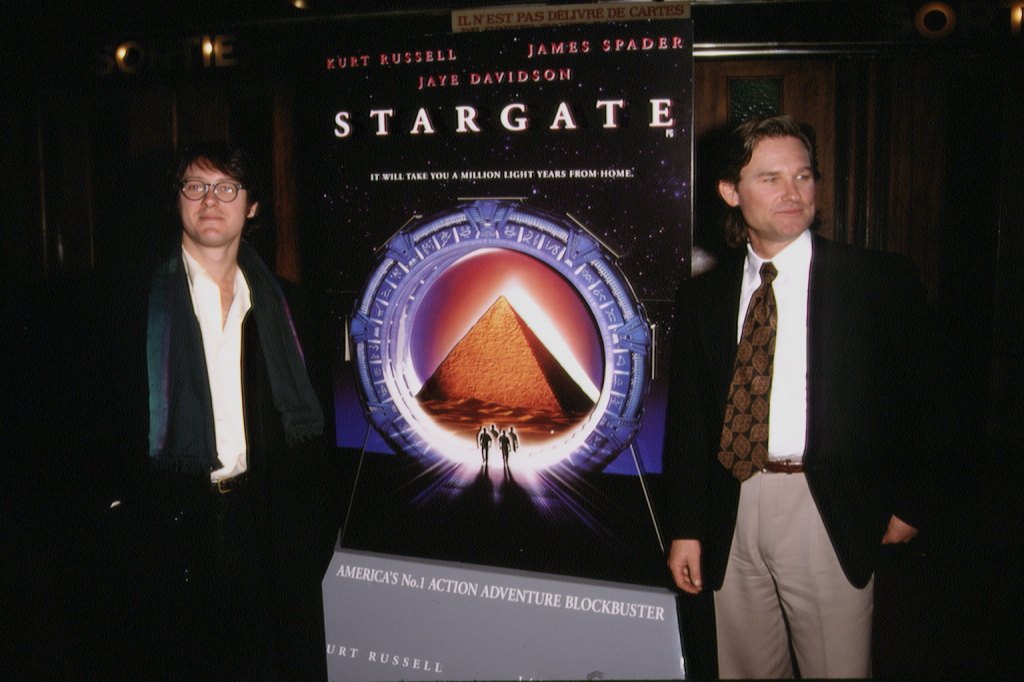
DEAN DEVILIN: “Kurt’s ideas for his character were right on the money, and James can identify a line that’s not right and knows just how to change it to make it work.”
ROLAND EMMERICH: “They are both extremely talented actors, but their styles and approach to their work couldn’t be more different. James examines his role from an intellectual point of view, while Kurt is more emotional, going straight to the heart of the character. Ironically, their parts were similar in that way, so the relationship between them worked perfectly.”
KURT RUSSELL: “Stargate is a great journey, but in the end, it is a very human story. That is to say, simply, that you can travel to the other end of the universe, but whatever life form you encounter, you are still going to have to deal with your own humanity.”
JAMES SPADER: “My character spent his life studying entire civilizations spanning centuries. The breadth of one lifetime is meaningless to him. I think what he discovers in the course of the story is the value of that one life and that every culture is made up of millions of single lifetimes.”
Journey through the Stargate
Stargate transports audiences to the city of Nagada on the planet Abydos, millions of light-years from Earth. However, its culture is steeped in an ancient and earthbound civilization. It was this notion that would, in many ways, eventually serve as a launching point for what would become the Stargate: SG-1 television series—though that show’s co-creators and executive producers, Brad Wright and Jonathan Glassner, extrapolated from the film’s set-up.
DEAN DEVLIN: “One of the leaps we asked the audience to accept is that the Egyptian culture didn’t evolve, but was actually a legacy—an imitation of something that had been there before. We needed to juxtapose a very primitive society with what could have been the inspiration for ancient Egyptian art and culture. To do that, our creative team had to design a world that would have the style of ancient Egypt, yet seem high-tech.”
BRAD WRIGHT (co-creator/ executive producer, Stargate: SG-1): “There was this race of beings that look just like us, that have been around for over a million years. And they were quite a dominant, quite wonderful race of people who explored the Milky Way and went on to explore other galaxies. And we called them the Ancients or the Gate Builders. They had a series of these devices called Stargates that they use to travel from civilization to civilization. What a Stargate does is open a stable wormhole. It’s like a conduit from one planet to another. It’s a shimmering pool of water that you walk into and it demolecularizes you and you appear on the other side and you’re intact. And then it shuts off. When we first discovered the Stargate, it was in the feature film Stargate. The Earth Stargate was dug up from the sands of Egypt near Cairo. So in the show, we were going to try and use it again. The intrepid Air Force Special Forces step through the Stargate for the first time and encounter what we call on the television series, the Goa’uld. This is a race of beings that have taken human populations to their worlds, acted as their gods and enslaved the population. Over the course of Stargate SG-1, which was our first television series, we came up against the Goa’uld and we helped free the oppressed and made alliances. These teams, which we call SG teams, the leading of which is SG-1, explored and eventually freed the Milky Way of these bad guys called Goa’uld.”
The movie version of Stargate was greeted by middling reviews upon its release, but financial success in the form of a nearly $200 million global gross—not bad considering its $55 million budget. With a profit margin like that, Devlin and Emmerich were understandably confident that they would be able to continue the story in their hoped-for big-screen trilogy. But that wasn’t in the cards, much to their disappointment.
Thoughts on the ‘Stargate’ movie
By all reports, MGM wasn’t considering any sort of future for Stargate on the big screen, the studio’s focus being pretty strongly on television at that time, particularly dipping into their library for IPs that could be newly exploited. And the primary reason that Stargate even entered the corporate zeitgeist was concern that writer/producers Wright and Jonathan Glassner would remain with the highly successful The Outer Limits, on which they served as executive producers. Both men had separately come to John Symes, the president of MGM at the time, with the notion of turning Stargate into a weekly series.
PETER DELUISE (writer/director/creative consultant, Stargate: SG-1): “What happened was Stargate came out and Jonathan and Brad, independently of each other, recognized that it was the perfect setup for a series. There’s this expression in writing called ‘The Door in,’ which means, what is the door into this story and how do we get there? It’s not just the inciting incident, although it can be that. And the Stargate itself was, in fact, a doorway to another world where you didn’t have to spend excruciating amounts of money on the spaceship ride over to them. So they both recognized that it was the perfect device for a series and they each approached MGM with the idea of making a show based on the movie.”
BRAD WRIGHT: “I remember walking out of the movie thinking, ‘That wasn’t great, but that Stargate is one of the best storytelling devices I’ve seen since the Enterprise on Star Trek.’ I mean, it’s a story-making machine. And the other thing is that I think one of the reasons Stargate was successful was that it featured people from the here and now, and the only reason we had access to space was due to this magical device that allows you to do it.”
ROBERT C. COOPER (co-executive producer, Stargate: SG-1): “I liked the movie, although I don’t know that I immediately said, ‘Oh, there’s a television series I would want to work on for 17 seasons.’ As it turned out, back in the day, when you were doing a more episodic show, Stargate proved itself to be a brilliant engine. Today, I really look for a great character to get me started that I can follow through the show. The movie had that, too. At the end of the day, Jack O’Neill is a guy who is a little bit Lethal Weapon; his son had died and he was willing to throw everything out the window. And Daniel Jackson’s a passionate, headstrong archaeology nerd. Those were great characters. But at the core, it also had a great engine; it had a device, like the starship Enterprise, which could take you anywhere you wanted to go this week and get you into trouble.”
JONATHAN GLASSNER (co-creator/ executive producer, Stargate: SG-1): “What fascinated me about the movie was really quite simple. It was in a day when television was still very episodic and not very serialized. Each episode had to stand alone, and this giant gate that could take you to another planet lent itself really well to being episodic. It was a great way to do a new story with new characters every week on new adventures every week while keeping ongoing arcs for the continuing characters. That’s what struck me when I saw the film. It was just the perfect venue to do a show.”
ROBERT C. COOPER: “I just recently watched an interview with Dean Devlin, which I thought was great. He looked back on it and explained some of the challenges they had, what their hopes and dreams were for it and how it maybe fell short. Basically, I agree with his point of view on it, but thought that it was a brilliant idea. Maybe not 100% realized to its full potential. It was interesting to hear him come full circle. Originally, he was quite bitter and angry at the show, and maybe a little critical of it. Frankly, in the early seasons, it was probably deserved, but he has developed, at least, an understanding and respect for what we did after that.”
ANDY MIKITA (director, Stargate: SG-1): “I was a big fan of the original Stargate movie. The whole concept was just so cool. The fact that it was present day, was part of the US Air Force, had the Egyptian mythologies and how everything was tied in with future, present, past, was just so intriguing. That was one of the big draws for me initially and I love that about SG-1.”
BRAD WRIGHT: “When I saw the movie, I objected to this one thing only, which was that the first two obstacles that they ran into became the entire story. Obstacle one: How do we get home? Obstacle two: How do they figure out what they’re saying? So the language and the way to get home became their two biggest obstacles. The other thing I did like was the sarcophagus, because it was a get-out-of-jail-free card, which we ended up basically doing over and over again ourselves. The sarcophagus is a device the Goa’uld use to quickly heal injuries and can even bring people who have recently died back to life. I also liked Kurt Russell’s character, though he was a little humorless for me, but I thought James Spader was interesting and the scope was wonderful and huge. It was sci-fi and I love sci-fi.”
The ‘Stargate’ movie becomes ‘Stargate SG-1’

PETER DELUISE: “Dean Devlin had other things in mind for Stargate. They thought that they were going to shoot a trilogy of that story. To hear them talk about it, that’s what their plan was. But MGM thought there would be more money in television, I guess. I mean, why would you try to make less money? And MGM said, ‘A series sounded like a good idea; let’s do that.’”
DAVID READ (host YouTube channel, Dial the Gate): “MGM recognized that a lot of these sci-fi stories—especially when you have a device like a ‘ring’ that will take you anywhere in the galaxy—would serve itself better as an hour-long TV series to really get into those existential social issues like Star Trek did and other series attempted to do. Even Dean Devlin admitted to me on Dial the Gate that you can’t do 350 plus hours of product if something isn’t really working.”
DEAN DEVLIN: “The original plan was to do three movies, and so there were going to be three major addresses for the Stargate. And that’s why we needed the nine [chevrons]. Parts two and three would have also used seven-chevron addresses, but with a different chevron lighting on the Stargate to travel to a different planet. We had big plans for it, but we never got to explore it. There are two different places on Earth that are famous for pyramids. One was an Egyptian, and our second was going to be a Mayan culture. And then the third was going to tie in almost every mystery that we’ve ever had on Earth! Whether it was Bigfoot or the Yeti—we were going to tie everything together into a larger mythology. And it was going to be so much fun. It was going to be so wild. But we never got to go there. We never got to explore it.”
ROBERT C. COOPER: “Dean Devlin recounted in this interview I read, which I had not really heard before, that MGM basically said to him, ‘We want to make a TV show,’ and he was, like, ‘Okay, great. Let’s do that,’ and they said, ‘No, we don’t want you to do it.’ If that had been me, I would have been bitter, too.
JONATHAN GLASSNER: “When Brad and I were gearing up to do Stargate, Dean Devlin and Roland Emmerich were saying some bad things about it to the press. Cut to 20 or 25 years later, I get a call from my agent, who said, ‘Dean Devlin wants to meet you,’ and I’m, like, ‘Why?’ ‘He read your script’—it was another script; a script that he and I are still trying to sell, by the way—‘and he loved it and wants to talk to you about it.’ And I said, ‘He’s going to punk me,’ because there was such bad stuff said about us. So I went in and actually he had read a different script than the one we’re working on together now, and he said, ‘Do you have any other ideas?’ And so I pitched him this idea and the whole time I’m thinking, ‘He’s making me do this as an exercise, just to screw with me.’ But after I finished the pitch, he said, ‘I love this. Let’s take it out.’ While we’ve been trying to do this, he ended up asking me to run The Outpost, and I worked with him on that for four years. And we have had a Stargate conversation. He has not watched the show. He did watch the pilot and when he saw the nudity, it pissed him off and he turned it off. But we really hit it off, which is kind of ironic.”
DEAN DEVLIN: “It was a very painful thing for a long time, because you’re watching someone else raise your children. It was very hard. But many years later, it was obvious to me that, even though I had not been watching the show, that they must have been doing something right, because you don’t get to live that long, you don’t get to have that many fans and you don’t get that kind of passion unless you’ve done a really good show.”

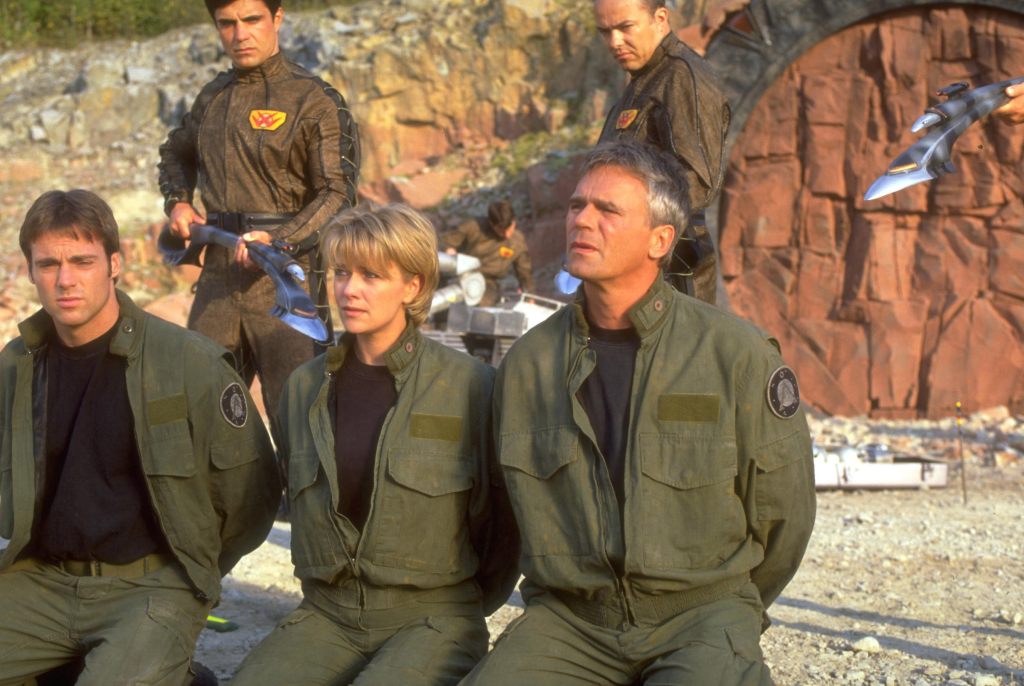
DARREN SUMNER (webmaster, Gateworld.net): “The two-hour premiere episode of SG-1, ‘Children of the Gods,’ certainly means to pick up where the movie had left off. It is one year later, Daniel Jackson is alive and well and living on Abydos, and the Stargate is in mothballs at the bottom of a military installation deep inside Cheyenne Mountain (not Creek Mountain, as in the movie—but that’s a detail for us nitpickers). When the gate activates and an alien who looks a lot like Ra steps through, O’Neill is reactivated once again to finish the mission he’d thought was a success. There are a few changes—some subtle (Sha’uri becomes the easier-to-pronounce Sha’re) and some not so subtle (Ra’s species is not extinct but thriving, and they don’t look like Roswell Greys). But the move to a weekly format worked and it just made sense. The Stargate has 39 symbols on it, with millions of possible combinations, so it’s only logical that one gate can go to many different places.”
DAVID READ: “The biggest change from movie to TV was probably the villain. If you look at the Stargate novels by Bill McKay, which Dean Devlin considers canon to his universe, they were really going to go in a different direction with the villains. It was Brad and Jonathan’s genius idea to make them parasitical and to invent the Jaffa; the Jaffa were not a thing in the feature film. There’s a line in ‘Children of the Gods’ that there were no creatures like this on Abydos, which is their nod to say that this is a completely original species. Part of that was that Ra came from a dying race, but in the television series, that’s not the case. The Goa’uld are everywhere. Fans have tried to reverse engineer that idea to explain it, but there are things that are just not compatible.”

“For production reasons, every other Stargate out there doesn’t have its own symbols; the symbols are standardized throughout the Stargate network to make it compliant, budget-wise, with the TV series. They can’t come up with a set of 40 new symbols for the dial home device in every episode; certain things had to be adapted to make the show work. At the same time, why not make the chevrons glow instead of being solid black? There were little things that Brad and Jonathan took advantage of that increased the quality of a series that would eventually turn into 10 seasons, with seven more seasons of spinoffs.”
As the dust settled on the original Stargate, what remained was a concept far more powerful than any single story: a gateway—both literal and creative—that could lead anywhere. While Roland Emmerich and Dean Devlin had envisioned one path forward, it would be Brad Wright and Jonathan Glassner who ultimately stepped through a different door, redefining what Stargate could be. The creation of Stargate SG-1—its challenges, its reinventions, and its eventual success—is a story all its own… and one that will be explored in the near future.
Ready for more nostalgia? Subscribe to our YouTube channel for video podcasts, health tips and uplifting stories designed for women 40, 50, 60 and beyond.
Conversation
All comments are subject to our Community Guidelines. Woman's World does not endorse the opinions and views shared by our readers in our comment sections. Our comments section is a place where readers can engage in healthy, productive, lively, and respectful discussions. Offensive language, hate speech, personal attacks, and/or defamatory statements are not permitted. Advertising or spam is also prohibited.