The Lost ‘Star Trek IV’ Sequel That Fans Were Never Supposed to See: Beyond ‘The Voyage Home’
How the unpublished 'Music of the Spheres' became the most fascinating 'Star Trek' lost adventure

Key Takeaways
- A lost 'Star Trek IV: The Voyage Home' sequel explored the whale Probe's origins.
- Margaret Bonanno's original novel 'Music of the Spheres' was transformed into 'Probe.'
- The original manuscript survived and became a legendary lost 'Trek' story.
When 1986’s Star Trek IV: The Voyage Home ended, it felt like the franchise had tied up just about everything. The humpback whales were safe in the 23rd century. Earth had been saved, Admiral James T. Kirk got his command back, Dr. Gillian Taylor left 20th-century San Francisco behind to start over in the future and as the newly christened Enterprise-A headed off on its shakedown cruise, the whole thing played like a perfect curtain call for one of Star Trek’s most crowd-pleasing films.
But there was one enormous loose thread—so big it’s almost funny how calmly the movie walks away from it—and that would be that the alien Probe that nearly destroyed Earth simply… left. No explanation. No origin story. No “here’s who built it.” It just turned around and headed back into deep space, and the film trusted audiences to live with the mystery. And honestly, that’s part of why it works. In great sci-fi, the thing you don’t explain can stay lodged in your brain for decades.
Late author Margaret Wander Bonanno was one of the people who couldn’t let it go, because once you start pulling at that thread, the questions multiply fast. What happened after the Probe departed? What became of the whales it had been searching for? What did Gillian Taylor’s life look like after she abandoned everything she knew? And, most of all—what was the larger story behind the visitor that crossed the galaxy and nearly wiped out a planet just to find humpbacks?

Those questions became the foundation of her Star Trek IV sequel, Music of the Spheres, a novel commissioned as a follow-up to The Voyage Home. And here’s where the story becomes very “lost Trek”: most fans never had a real shot at reading Bonanno’s book the way she wrote it. After extensive editorial revisions—and a rewrite by another, uncredited writer—her manuscript was transformed into the 1988 novel Probe, while Music of the Spheres quietly slipped into legend.
Nearly 40 years later, it’s still one of the most fascinating “what if?” chapters in Trek history—not because it’s merely unpublished, but because it’s a complete, finished adventure that took a different road than the one the official timeline chose.
Not ‘the next mission’
One reason Music of the Spheres still intrigues fans is that Bonanno didn’t approach it like a standard tie-in assignment. A lot of Trek novels function like extended episodes: drop the crew into a crisis, resolve it, restore the status quo, roll credits. But Bonanno’s instinct seems to have been the opposite. Instead of racing ahead to “the next adventure,” she looked backward—right at the mystery the film deliberately left unanswered—and started tugging on it.
The manuscript opens immediately after the movie, with the galaxy still absorbing what just happened. Starfleet wants to move on (understandably), but Spock can’t. The crisis may be over, but to him, the central question hasn’t been answered. And that’s a very Spock way to build a sequel: where others see a solved problem, he sees an incomplete explanation.
The Gillian Taylor problem
The other big strength is the one the franchise itself mostly dodged: Gillian Taylor (portrayed by actress Catherine Hicks in the film). Looking back, it’s kind of astonishing how quickly Star Trek moves on from her. Gillian makes one of the most dramatic choices in the series—leaving her century behind and stepping into a future she barely understands—and then the films largely treat that as “happily ever after.”
Bonanno clearly thought there was more story there, so rather than treating Gillian like a temporary guest star, Music of the Spheres keeps her tied to George and Gracie, and to the future of Earth’s humpback whale population. As a result, she becomes a part of the aftermath.
And Bonanno was very clear about what she wanted to do: “I wanted to write about what happened to the Probe after it left Earth in STIV, trace it back to its planet of origin, and describe who had created it,” she recalled in an online essay.. “My editor, Dave Stern, suggested the Probe angle after I had been pitching Romulan stories to him for several years.”
That quote is basically the DNA of the whole project: the Probe mystery plus a Romulan story Bonanno had already been eager to tell.
Why Romulans?
Bonanno didn’t treat the Probe as a one-off monster-of-the-week. She saw it as a doorway into a larger political and diplomatic story—one that could ripple outward through the Trek universe. As she put it: “I wanted to write about Romulans. They had been neglected in the novels, and I thought there was a lot of room to develop them. I decided to combine the Probe story with a Romulan story involving the Neutral Zone and the beginnings of diplomatic relations between the Federation and the Romulan Empire.”
That’s a bigger swing than “Kirk and crew solve another crisis.” It’s also the kind of swing that feels oddly prophetic. Years before The Undiscovered Country made diplomacy and fragile peace the point of a Star Trek movie, Bonanno was already thinking in those terms—what would it actually look like if a decades-long cold conflict began to thaw? And that broader scope helps explain why the manuscript makes room for elements beyond a straight Probe investigation—like Kevin Riley from the original series and a political storyline unfolding inside the Romulan Empire. More than just writing a sequel to The Voyage Home, Bonanno was using the film as a launchpad.
The title isn’t just poetic
Bonanno also made the title do real work. It wasn’t a random poetic phrase—it was her way of telling readers what kind of story she thought she was writing: “Thematically, the book had a lot to do with music, and I also wanted the title to refer to Pythagoras’ theory that the universe had its own music,” she wrote.
That’s significant because it points to what Music of the Spheres seems most interested in: communication and understanding. The Probe isn’t a conventional villain seeking territory or attempting conquest, but instead is trying to reach a species it believe is gone. It isn’t trying to conquer Earth. It’s trying to reach a species it believes is gone. Bonanno takes that idea and pushes it outward—toward the ways intelligence recognizes intelligence, and the misunderstandings that happen when two civilizations don’t even share a baseline. In that sense, the manuscript feels less like a “Part Two” and more like a continuation of the film’s real question: “What is it saying and what does it do when it hears an answer?”
How a sequel became a ‘lost Trek’ legend
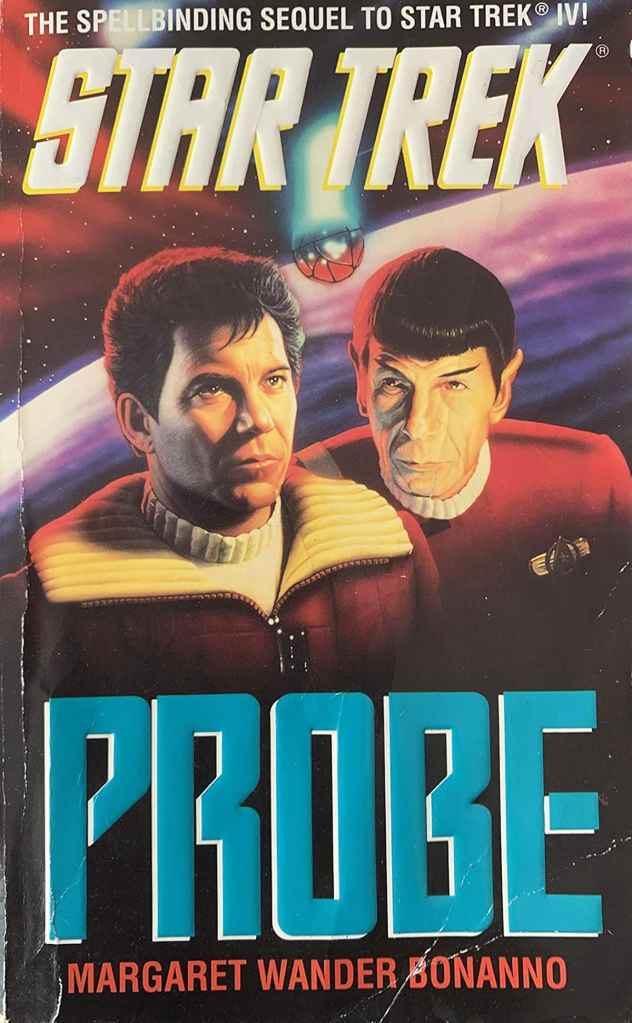
Of course, the reason Music of the Spheres has the reputation it does isn’t only the story it tells. It’s what happened to it. Bonanno delivered one version and the publishing process produced another. Extensive revisions were requested and by the time the book reached shelves in 1988, it appeared under a different title: Probe. Not a completely different story built from scratch—readers have long noted the overlap—but not, in Bonanno’s view, the book she set out to write.

That’s the moment where this stops being “a Trek novel” and becomes “lost Trek history,” because it raises the kind of question Trek fans can’t resist: what if Bonanno’s original version had reached readers intact? What if fans had gotten her direct continuation of The Voyage Home—the one built to chase the Probe to its point of origin, while also expanding the Romulans—rather than the heavily revised version?

And unlike a lot of lost Trek, this isn’t purely hypothetical. Music of the Spheres survived. Copies circulated, fans compared it to Probe and Debates started. Decades later, those conversations still haven’t stopped—because the Probe itself hasn’t stopped haunting the franchise.
Whether readers ultimately prefer Music of the Spheres or the published Probe is a matter of taste. What isn’t really debatable is the manuscript’s place in Trek lore. It’s a completed adventure that somehow slipped out of the official timeline—and for fans who have spent decades wondering what became of the whale Probe, it remains the closest thing to the sequel that almost was.
Conversation
All comments are subject to our Community Guidelines. Woman's World does not endorse the opinions and views shared by our readers in our comment sections. Our comments section is a place where readers can engage in healthy, productive, lively, and respectful discussions. Offensive language, hate speech, personal attacks, and/or defamatory statements are not permitted. Advertising or spam is also prohibited.